Hunters Palette
| Hunters Palette | |
|---|---|
 Hunters Palette with pieces connected | |
| Material | Schist |
| Size | c. 66 cm x 26 cm |
| Created | 31st century BC (circa) |
| Discovered | Abydos.[1][2] |
| Present location | British Museum, Louvre |
| Identification | British Museum, EA 20790, EA 20792, Louvre E 11254 |
The Hunters Palette or Lion Hunt Palette is a c. 3100 BCE cosmetic palette from the Naqada III period of late prehistoric Egypt. The palette is broken: part is held by the British Museum and part is in the collection of the Louvre. It was initially registered as discovered in the El-Amarna region, probably the result of confusion with other objects, and Budge later stated it came from Abydos.[3][4]
Content
The Hunters Palette shows a complex iconography of lion hunting as well as the hunt of other animals such as birds, desert hares, and gazelle types; one gazelle is being contained by a rope. The weapons used in the twenty-man hunt are the bow and arrow, mace, throwing sticks, flint knives, and spears. Two iconographic conjoined bull-forefronts adorn the upper right alongside a hieroglyphic-like symbol similar to the "shrine" hieroglyph, sḥ.
|

Details
 Louvre fragment showing various weapons
 Hunters Palette, details, especially a lion's body with arrows.
 Hunters detail
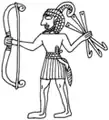 Drawing of a hunter.
 Hunter with bow
 Hunter's with staff
 Drawing of a hunter.
See also

References
- ↑ "cosmetic-palette; cast British Museum". www.britishmuseum.org.
By Nile and Tigris: a narrative of journeys in Egypt and Mesopotamia on behalf of the British museum between the years 1886 and 1913 I (London, 1920), p.338
- ↑ Budge, E. A. Wallis (Ernest Alfred Wallis) (1920). By Nile and Tigris : a narrative of Journeys in Egypt and Mesopotamia on behalf of the British Museum between the years 1886 and 1913. London : Murray. p. 338.
{{cite book}}: CS1 maint: publisher location (link) - ↑ "cosmetic-palette; cast British Museum". www.britishmuseum.org.
By Nile and Tigris: a narrative of journeys in Egypt and Mesopotamia on behalf of the British museum between the years 1886 and 1913 I (London, 1920), p.338
- ↑ Budge, E. A. Wallis (Ernest Alfred Wallis) (1920). By Nile and Tigris : a narrative of Journeys in Egypt and Mesopotamia on behalf of the British Museum between the years 1886 and 1913. London : Murray. p. 338.
{{cite book}}: CS1 maint: publisher location (link)
External links
- British Museum page on the Palette
- Photo of Hunters Palette
- Predynastic palette corpus
- the Louvre fragment

| |||||||||||||||||
| |||||||||||||||||
| |||||||||||||||||