François Tomb
| François Tomb | |
|---|---|
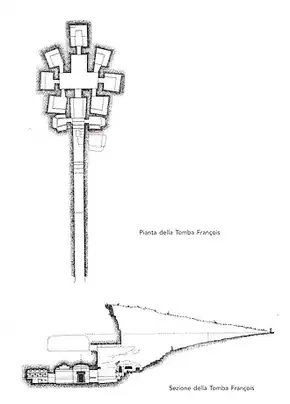 Ground plan of the François Tomb | |
  Location within Lazio | |
| Type | tomb |
| Cultures | Etruscan |
| Location | Vulci, Lazio, Italy |
| Region | Province of Viterbo |
| History | |
| Built | late fourth century BC |
| Site notes | |
| Excavation dates | 1857 |
| Archaeologists | Alessandro François and Adolphe Noël des Vergers |
| Condition | ruined |
| Public access | no |
42°25′2.8″N 11°38′20.6″E / 42.417444°N 11.639056°E
The François Tomb is an important painted Etruscan tomb from the Ponte Rotto Necropolis in the Etruscan city of Vulci, Lazio, in central Italy. It was discovered in 1857 by Alessandro François[1] and Adolphe Noël des Vergers. It dates to the last quarter of the fourth century BC. The tomb seems to belong to the Etruscan family of the Saties (or Seties) and one of its chief occupants is Vel Saties, who appears with his dwarf, Arnza.[2]
Its outstanding frescoes are significant both iconographically and also in terms of their comments on Etruscan history and identity.

Frescos
The tomb contains a fresco depicting Caelius Vibenna (whom the Romans believed the Caelian Hill was named after) and Mastarna (a legendary figure whom the Emperor Claudius identified with Servius Tullius).[3] The paintings also include a representation of Marce Camitlas (Latin equivalent "Marcus Camillus") about to draw his sword against a crouching Cneve Tarchunies Rumach (that is, "Gnaeus Tarquinius of Rome", though ancient histories of Rome do not include any reference to a Tarquinius with the praenomen Gnaeus).[4]
The frescos were removed by Prince Torlonia soon after their discovery and were kept in the Torlonia Museum (Rome). From 1946 they were stored at the private Villa Albani in Rome as part of the Torlonia collection until being acquired by the Italian state in 2026 and moved to the Museo Nazionale Etrusco di Villa Giulia.[5]
Other finds
Some pottery vessels from the tomb are now in the British Museum.[6]

See also
References
- ↑ "Dictionary of Art Historians". Archived from the original on 2018-03-23. Retrieved 2018-03-23.
- ↑ Jane DeRose Evans (1992). The Art of Persuasion: Political Propaganda from Aeneas to Brutus. University of Michigan Press. pp. 14–. ISBN 0-472-10282-6.
- ↑ Anna Maria Sgubini Moretti (2004). Eroi etruschi e miti greci: gli affreschi della Tomba François tornano a Vulci. Cooperativa archeologia.
- ↑ Ross Holloway, R. "Cneve Tarchunies Rumach". Classica Sao Paolo 7/8 1994/1995. Retrieved 25 Aug 2019.
- ↑ "TOMBA FRANÇOIS". Museo Nazionale Etrusco di Villa Giulia. Retrieved 23 July 2026.
- ↑ British Museum Collection
Sources

- Bloom, Marcia G. 1974. The François tomb at Vulci, an Etrusco-Hellenistic monument. Thesis/dissertation, University of Pennsylvania.
- Holliday, Peter James. 1993. Narrative and event in ancient art. Cambridge University Press.
Further reading
- http://www.instoria.it/home/FrancoisII.htm
- http://www.mysteriousetruscans.com/francois.html
- Bridgeman Art Library v. Corel Corp.
- F. Messerschmidt, A. von Gerkan, Nekropolen von Vulci, Berlin, 1930;
- M.Cristofani, research on paintings of François Vulci grave. The decorative friezes, in Diala, 1, 1967, pp. 189–219
- S. Steingräber, Catalogue raisonné of Etruscan painting, Milan, 1984, pp. 380–387;
- Peter J. Holliday, Narrative structures in the François tomb, in Narrative and event in ancient art, Cambridge, 1988, pp. 175–197;
- F. Coarelli, Revixit Ars. Art and Ideology in Rome. By Hellenistic models to the republican tradition, Rome, 1996, pp. 138–178;
- S. Steingräber, Etruscan frescoes, from the geometric to the Hellenistic period, San Giovanni Lupatoto, 2006, pp. 68 et seq;