History of modern Mongolia

| Part of a series on the |
| History of Mongolia |
|---|
 |
The modern democratic era of Mongolia began after the Democratic Revolution of 1990, which occurred in the wake of the 1989 Revolutions and the collapse of the Soviet Union. The peaceful demonstrations led to the resignation of the entire politburo in March 1990, subsequently paving the way to democratization.
Up until then, the country's sole legal party was the Mongolian People's Revolutionary Party (MPRP), ruling since 1921. After the 1990 revolution, Mongolia underwent a massive political transition from a socialist one-party state to a multi-party parliamentary democracy.[1] The first free and fair elections were held in July 1990.[2] The democratically elected People's Great Khural established a small lower house, the State Little Khural, and elected a president, a prime minister and a vice president. A new constitution was drafted in 1991, ratified by Mongolia's first president, Punsalmaagiin Ochirbat, on 13 January 1992, and put into force on 12 February 1992.[3] The ratification of Mongolia's fourth constitution officially ended the 68-year-old Mongolian People's Republic. The MPRP, now distanced from communism, retained its parliamentary majority in 1992. It wouldn't be until 1996 when the party transferred power to the Mongolian opposition. Since then, the Mongolian People's Party (renamed MPRP) and the Democratic Party emerged as the dominant two parties, with alternating political power.
With the end to Soviet aid in 1991, Mongolia, in its early transitional years from a planned economy to a market economy, faced a severe economic shock with a sharp decline in production, hyperinflation, high unemployment, and exacterbated poverty due to weakened social services. The implementation of privatization, market liberalization, and market-oriented reforms began gradual economic recovery in 1994. Mining in Mongolia would be the primary source of income, following a series of foreign investment in the 2000s and 2010s. Consequently, economic overdependence, environmental impacts and resource nationalism from mining became a prevalent issue alongside endemic corruption, inequality, and poverty.
Since the 1990s, Mongolia pursued a neutral foreign policy, dubbed the Third neighbor policy, at the global stage. The country has been a prominent contributor to the United Nations peacekeeping efforts, with more than 23,000 personnel deployed between 2002 and 2025.[4]
Prelude
The Mongolian People's Republic, since its establishment in 1924, has been a socialist satellite state of the Soviet Union throughout much of its existence. The two states maintained close political and economic ties in the aftermath of the Sino-Soviet split. With Soviet support, the country experienced rapid industrialisation, collectivisation, and modernization along with social reforms at the cost of political, cultural, and religious freedom.
Inspired by Mikhail Gorbachev's reforms in the Soviet Union, the leadership under Jambyn Batmönkh implemented market reforms but failed to appeal to those who, in late 1989, wanted broader political and societal changes.[5] Concepts of glasnost, freedom of speech, and economic liberties inspired the initial discussions that would lead to the revolution.[6][7]
Beginning in December 1988, the ruling party's mouthpiece, Ünen (lit."Truth"), began publishing a new column called "Workers' Letters," which criticized the Politburo and party leaders for the first time.[8] Also in December, a youth underground organization called "New Generation" (Шинэ үе) was established by young dissidents: Erdeniin Bat-Üül, Sosorbaramyn Tsogtsaikhan, and Sukhbaataryn Amarsanaa.[8][9]
The first public demonstrations took place on 6 December 1989 in Erdenet, the second-largest city of the MPR.[8] During the demonstration, protestors submitted demands to local party structures for the withdrawal of Soviet troops from Erdenet, the full nationalization of Erdenet Mining Corporation (jointly owned by the governments of the MPR and the USSR), and the resignation of the Politburo of the MPRP's Central Committee.[10]

The next day, on 7 December, similar demonstrations by teachers and students took place in Ard Ayush square at Khovd, the provincial capital of Khovd Province. The demonstrators handed over demands for the resignation of the Politburo and the government to the local governing body, which were to be delivered to Ulaanbaatar, the capital.[10]
1990 Democratic revolution
On the morning of 10 December 1989, the first open pro-democracy demonstration took place in front of the Youth Cultural Center in Ulaanbaatar.[11] There, Elbegdorj announced the creation of the Mongolian Democratic Union (MDU).[12] At the demonstration, the MDU founders publicly petitioned the government for a real implementation of Perestroika, allowing a multi-party system, and the total implementation of the Universal Declaration of Human Rights in all party and government affairs.[13]
In subsequent months, the activists led by 13 democracy leaders including Tsakhiagiin Elbegdorj, Sanjaasürengiin Zorig, Erdeniin Bat-Üül, Bat-Erdeniin Batbayar and others continued to organize demonstrations, rallies, protests and hunger strikes, as well as teachers' and workers' strikes.[14] The activists had growing support from Mongolians, both in the capital and the countryside, and the union's activities led to other calls for democracy all over the country.[15][16][17]
On 2 January 1990, the MDU began distributing leaflets calling for a democratic revolution.[13] When the government did not comply with these and later, more aggressive demands, demonstrations occurred. On January 14, 1990, some 1000 protesters met on the square in front of the Lenin Museum, which has been renamed as Freedom Square since then, in Ulaanbaatar. A demonstration on Sükhbaatar Square on 21 January (in weather of -30 C) followed. Protestors carried banners alluding to Genghis Khan, rehabilitating a figure which Soviet schooling neglected to praise.[18] They celebrated Daramyn Tömör-Ochir, a statesman who was purged from the MPRP in 1962 as part of the MPRP's efforts to suppress the commemoration of the 800th anniversary of Genghis Khan's birth. Demonstrators carried a modified Flag of Mongolia, which lacked a star symbolizing socialism; this flag would become the new flag after the revolution.[19]

After numerous demonstrations of many thousands of people in the capital city as well as provincial centers, on 4 March 1990, the MDU and three other reform organizations held a joint outdoor mass meeting, inviting the government to attend. The government sent no representative to what became a demonstration of over 100,000 people demanding democratic change.[13] Ten members of the organizations began a hunger strike on 7 March, the next day,[13] the Mongolian People's Revolutionary Party (MPRP)'s Politburo – the authority of the government eventually gave way to the pressure and entered negotiations with the leaders of the democratic movement.[20] Jambyn Batmönkh, chairman of the Politburo of MPRP's Central Committee, decided to dissolve the Politburo and resigned on 9 March 1990.[21][22] This paved the way for the first multi-party elections in Mongolia.[14]
Behind the scenes, however, the MPRP had seriously considered cracking down on the protesters, writing a decree that was left to be signed by the party leader Jambyn Batmönkh. Batmönkh opposed it, maintaining a strict policy of never using force (Mongolian: Хүч хэрэглэж хэрхэвч болохгүй). People those were present there later recalled that Batmönkh said "I will never sign this. We few Mongols have not yet come to the point that we will make each other's noses bleed," smacked the table, and left the room."[23]
Elbegdorj announced the news of the Politburo resignation to the hunger strikers and to people who'd gathered on Sükhbaatar Square at 10 PM on that day after the negotiations between leaders of MPRP and Mongolian Democratic Union.[24] Then the hunger strike stopped.
In April, the conflict worsened, with the government restricting the freedom of assembly and the democracy leaders submitting an ultimatum demanding equal participation of all political groups. The MPRP refused to accede to the demands.[13] However, in May, under pressure and after negotiations with members of the opposition movement, the People's Great Khural approved the Law on Political Parties.[10] Six political parties were registered by the Supreme Court of the MPR.
1990–1992: Democratic transition
1990 parliamentary elections
Following the collapse of the communist regime, Mongolia's first free, multi-party legislative elections were held on 29 July 1990.[13][25] Six political parties ran for 430 seats in the People's Great Khural (upper house) and 50 seats in the new State Little Khural (lower house). With opposition parties unable to nominate enough candidates, the ruling Mongolian People's Revolutionary Party (MPRP) won 357 seats and an 83% majority in the Great Khural. Members for the State Little Khural were to be elected from the upper house via proportional representation of the party vote. One seat equaled 5% of the party vote. The People's Great Khural first met on 3 September and elected the president (MPRP), vice president (MSDP), prime minister (MPRP), and 50 members to the Little Khural. The vice president was also chairman of the Little Khural. The MPRP, which won 61% of the votes, received 31 of the 50 seats in the lower house.[26]
| Party | Acronym | People's Great Khural | State Little Khural |
|---|---|---|---|
| Mongolian People's Revolutionary Party | MPRP МАХН |
357 | 31 |
| Mongolian Democratic Party | MDP МоАН |
16 | 13 |
| Mongolian Revolutionary Youth League | MRYL МХЗЭ |
9 | – |
| Mongolian National Progress Party | MNPP МҮДН |
6 | 3 |
| Mongolian Social Democratic Party | MSDP МСДН |
4 | 3 |
| Independents | – | 38 | – |
| Total | 430 | 50 | |
| Source: Nohlen et el., GEC | |||
The new MPRP government under Dashiin Byambasüren formed a unity government with the opposition parties and implemented constitutional and economic reforms.[26] Two high-ranking ministers of the Byambasüren cabinet were non-MPRP ministers; these being First Deputy Prime Minister Davaadorjiin Ganbold (MNPP chairman) and Deputy Prime Minister Dambiin Dorligjav (deputy MDP chairman).
1992 Constitution of Mongolia

In November 1991, the People's Great Khural began discussion on a new constitution, which entered into force on 12 February 1992. In addition to establishing Mongolia as an independent, sovereign republic and guaranteeing a number of rights and freedoms, the new constitution restructured the legislative branch of government, creating a unicameral legislature, the State Great Khural.
 Modified flag of the MPR and the official flag of Mongolia from 1992 to 2011
 State emblem of Mongolia, adopted in 1992
 State seal of Mongolia, adopted in 1992
 National symbols and founding documents at the National Museum of Mongolia
Economy
In the early and mid-1990s, with the collapse of the Soviet Union, which had until 1990 provided significant economic aid to Mongolia's state budget, the country faced severe economic problems dating back to the 1980s. Foreign trade collapsed, economic and technical aid from the former socialist countries ended, and the domestic economy struggled with privatization. Inflation rose, stores' shelves were depleted, and ration cards for food were issued for a period of time. A thriving black market had arisen in Ulaanbaatar by 1988 to meet the needs of the populace.[13]
1990s after transition

In the same year the constitution was ratified, the 1992 elections for the newly established unicameral State Great Khural were held on June 30. The MPRP won another round of parliamentary elections, winning 70 out of 76 seats in the State Great Khural.[1] The main opposition alliance, the Democratic Alliance between the MDP, MNPP, and Mongolian United Party,[27] won four seats, while the MSDP and an independent won a single seat.[28] Puntsagiin Jasrai, an economist, was subsequently elected the next prime minister of an all-MPRP cabinet.[29] The new constitution also provided that the President of Mongolia would be elected by popular vote rather than by the legislature as before. Incumbent Punsalmaagiin Ochirbat became Mongolia's first universally elected president, winning the 1993 presidential election with two-thirds of the vote. Originally an MPRP member, Ochirbat ran as the MNDP-MSDP joint opposition candidate after the MPRP had nominated an orthodox party member, Lodongiin Tüdev, as their candidate.[30] The MPRP was electorally defeated for the first time in its history.
Democratic administration

(1996–1998)

(1998)

(1998–1999)

(1999–2000)
In the 1996 parliamentary elections, the Democratic Union Coalition (DUC) won 50 of the 76 seats in the State Great Khural, co-led by Tsakhiagiin Elbegdorj as the chairman of the Mongolian National Democratic Party.[31] The MPRP lost its parliamentary majority and was out of power for the first time since 1921.[32] Despite their electoral success, the DUC leaders fought amongst themselves for the offices of Prime Minister and the President of Mongolia. Subsequently, MPRP candidate Natsagiin Bagabandi was overwhelmingly elected as president in the 1997 presidential election, defeating incumbent DUC candidate Ochirbat. Democratic PM Mendsaikhany Enkhsaikhan, elected in 1996, was replaced by party chairman Elbegdorj in early 1998.[33] In addition to the political discord, harsh winters, the 1997 Asian financial crisis, and the 1998 Russian financial crisis adversely affected Mongolia's largely agricultural economy.[34] Elbegdorj soon lost a motion of no confidence on 25 July 1998, but his successor's nominations were blocked multiple times by President Bagabandi, the MPRP parliamentary minority, and a single MTUP legislator.

On 2 October 1998, during the ongoing cabinet crisis, a key leader of the 1990 revolution and infrastructure minister Sanjaasürengiin Zorig was assassinated at his home. A national mourning was declared following his death. Many people speculate that the murder was politically motivated, as Zorig was a likely pick to become the next prime minister.[31] The case of Zorig's murder remains unsolved to this day. His death would lead to the breakaway of Zorig's allies from the DUC and the establishment of the Civil Will Party by his sister, Sanjaasürengiin Oyun, in March 2000. The DUC's infighting and disagreements led to four Democratic PMs and one acting PM holding office over four years.[33]
2000s
In the next 2000 parliamentary election, the DUC witnessed a major electoral wipeout, securing only a single seat. In contrast, the MPRP won a supermajority of 72 seats.[35] The MPRP-controlled parliament nominated and appointed party chairman Nambaryn Enkhbayar as prime minister. Following their election defeat, the five former member parties of the DUC merged to form the Democratic Party (DP) in December 2000.[36] Despite a much formidable opposition, president Bagabandi was re-elected with 59% of the vote in the 2001 presidential election. With the presidency, premiership, and parliament secured, the MPRP would oversee a politically stable administration. Primary opposition parties to the MPRP, such as the DP, the Motherland Party, and the Civil Will Party, began reorganizing and formed the Motherland Democratic Coalition (MDC) in July 2003.
Coalition government

The 2004 parliamentary election resulted in a hung parliament between the MPRP and the MDC, with the MPRP as the plurality. There were concerns of electoral fraud in the 2004 election, but they were largely ignored.[37] Without parliamentary majority, the MPRP was forced to join a coalition government led by MDC chairman Tsakhiagiin Elbegdorj.[38] Much like the previous Democratic coalition, the MDC would oversee frequent political scandals, crises, and infighting. The MDC was dissolved in December 2004 due to party disagreements over the upcoming 2005 presidential election. Furthermore, economic slowdown and party disputes during Elbegdorj's tenure led to the formation of three splinter parties – the New National Party, the People's Party, and the reformed Mongolian Social Democratic Party.[39][33]
Five parties with parliamentary representation were eligible to nominate a candidate in the 2005 presidential election. All five except the Civil Will Party nominated their candidates for the race, leading to Mongolia's first-ever four-way presidential election. Former prime minister Nambaryn Enkhbayar would come out on top in the 2005 presidential election, with 54% of the vote.[40] Later in 2005, the DP lost 5 of its seats to the MPRP, leading to the now-majority MPRP leaving the coalition in January 2006. A new coalition government led by the MPRP was established the same month.[41] A government reshuffle took place at the end of 2007, when the MPRP decided to replace its prime minister, Miyeegombyn Enkhbold, with Sanjiin Bayar.[42]
Political upheaval


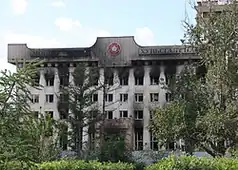
In the June 2008 parliamentary elections, preliminary results showed the MPRP with a majority. Allegations of electoral fraud surrounding the election were declared by the chairman of the DP and former prime minister Elbegdorj on 1 July 2008. Elbegdorj, Bazarsadyn Jargalsaikhan (Republican Party leader), Jalbasurengiin Batzandan, and Otgonjargalyn Magnai (Civic Movement Party leaders) called on the people to contest the results.
The initial peaceful demonstrations, amplified by opposition leaders, soon turned into a riot. The riot resulted in Mongolia's first state of emergency, lasting four days. The military was brought into the city to quell the riot. Five people were killed by the police, over 300 people were injured, the headquarters of the ruling MPRP was set on fire, and many nearby shops and galleries were looted by rioters. Locally, the event came to be known as the Black Day. Then-leaders of the MPRP, prime minister Sanjiin Bayar and president Nambaryn Enkhbayar, faced intense backlash from the public due to allegations of human rights abuse, economic mismanagement, and electoral fraud. The opening of the newly-elected State Great Khural in July was boycotted by the opposition for a month.
First Olympic gold medal

Meanwhile also in August 2008, the 2008 Summer Olympics were held in Beijing. In the 2008 Olympics, the 29-athlete Olympic team of Mongolia competed in seven events. Naidangiin Tüvshinbayar won Mongolia's first ever Olympic gold medal in judo on 14 August 2008. The following night, massive celebrations occurred in Ulaanbaatar. On Sükhbaatar Square, Mongolia's president, prime minister, and members of parliament celebrated the occasion with thousands of people in front of the Government Palace. Soon, Enkhbatyn Badar-Uugan won a gold medal in boxing on 24 August 2008 and became the second Mongolian to win an Olympic gold. The 2008 Summer Olympics have been Mongolia's most successful games ever.

After a month-long boycott, the State Great Khural was finally convened on 28 August 2008. Incumbent prime minister Bayar was re-elected (65-1) led a coalition government between the MPRP and the DP on 11 September 2008. During the second cabinet of Bayar, the long-stalled Oyu Tolgoi project, one of Mongolia's most financially undertaking mining project, was put into motion. The Mongolian government signed a major investment agreement with Ivanhoe Mines and Rio Tinto to mine Oyu Tolgoi on 6 October 2009. However, this 2009 agreement faced intense public backlash over several issues, primarily corruption and undermining of Mongolia's interests. Bayar soon resigned on 28 October 2009 due to declining health. He was succeeded by Sükhbaataryn Batbold (MPRP) as prime minister in 2009 and later as party chairman in 2010.
In the 2009 presidential election, Democratic candidate Tsakhiagiin Elbegdorj defeated incumbent president Nambaryn Enkhbayar.[43][44]
2010s
Despite being heavily hit by the 2008 financial crisis and the 2008-2009 winters, Mongolia's economy saw immense growth starting from 2010, thanks to a boom in the country's growing mining sector.[45] The country saw a rapid double-digit GDP growth, and was considered one of the fastest-growing economies in the world.[46] Due to its immense mineral resources, Mongolia was nicknamed "Mine-golia" and the next Asian tiger.[47] IMF forecast of Mongolia's economic growth in 2011 was at 17.5%.[48]
In November 2010, the MPRP would restore its original 1921 name, the Mongolian People's Party (MPP), and ideologically shifted from democratic socialism to social democracy.[49] This change provoked Enkhbayar's faction within the party to split and form the splinter Mongolian People's Revolutionary Party.[50][51]
Democratic electoral comeback
In January 2012, the DP made a decision to leave the coalition government before the upcoming June elections. In the 2012 parliamentary elections, the DP won 31 out of 76 seats, becoming the largest party in parliament, whilst the MPP came second and the new Justice Coalition (JC) between the MPRP and MNDP came third. It was the first incident of a parallel voting method being used.[52] A coalition government was formed by the DP with the MPP, the Justice Coalition, and the Civil Will–Green Party.[53] In the 2012 local elections, the MPP was defeated for the first time in the country's history.[54]

In the 2013 presidential election, incumbent president Elbegdorj was re-elected in a three-way race.[55] The DP held the office of the presidency, the prime minister, and the majority of parliament from 2012 to 2016. Starting from 2014, however, Mongolia's economic growth started to stagnate as foreign debt and inflation rose and copper and coal prices plummeted.[56][57] In late 2014, sitting PM and DP chairman Norovyn Altankhuyag was ousted by majority MPs amid the economic stagnation and corruption allegations. DP legislator Chimediin Saikhanbileg was appointed the next prime minister and DP speaker Zandaakhüügiin Enkhbold assumed the party chairmanship. The cabinet of Saikhanbileg, composed of the DP, the MPP, and the JC, focused primarily on economic stabilization and the mining sector.

During his tenure, Saikhanbileg oversaw and signed a 2015 investment agreement with Rio Tinto which further progressed Oyu Tolgoi's stalled underground expansion. The deal, which brought US$5.4 billion to Oyu Tolgoi, came under scrutiny for concerns of debt accumulation and corruption in the years leading up to 2019. A cabinet reshuffle in 2015 ousted the MPP from the cabinet amid political instability. In one of his last decisions, Saikhanbileg approved the purchase of Russian shares of Erdenet Mining Corporation before the June 2016 election; which was met with intense political backlash. Russian state-owned Rostec held 49% of Erdenet copper, Mongolia's largest state revenue provider, since 2008.
Foreign investment recovered starting from 2015 but by 2016, the economic forecast of Mongolia's growth by the IMF was just at 0.4%. The economic free fall and growing DP unpopularity promptly led to a landslide MPP victory in the 2016 parliamentary election.[48]
Supermajority of the MPP
Compared to the MPP's supermajority of 65 seats, the DP's majority was reduced to only nine seats. MPP chairman Miyeegombyn Enkhbold was elected the parliamentary speaker, and Jargaltulgyn Erdenebat was appointed the prime minister.
The 2017 presidential election was the first time no candidates met the required 50% majority vote. The MPRP's nominee Sainkhüügiin Ganbaatar effectively split the MPP vote to Battulga's favour, coming in third with only a thousand-vote difference with MPP candidate Enkhbold. The first-ever presidential runoff was held in July between the MPP nominee Miyeegombyn Enkhbold and DP nominee Khaltmaagiin Battulga. Despite the high number of protest votes called by Ganbaatar, Battulga's populist and nationalist campaign, similar to that of Donald Trump's 2016 campaign, led to him winning 50.6% of the popular vote, beating Enkhbold by only 9.4%.[58][59] The share of blank votes in a presidential election reached its historic highest at 8%. Infighting between the Enkhbold-led camp of 32 legislators and the Ukhnaagiin Khürelsükh-led camp of 33 legislators occurred in the subsequent months following the MPP's electoral defeat.

In September 2017, prime minister Erdenebat and his cabinet were ousted (42–31) from office after a parliamentary motion. He was succeeded by deputy prime minister Khürelsükh in October 2017.
2018-2019 protests and crisis
In late December 2018, a series of mass demonstrations occurred in Ulaanbaatar. The protest came after the unravelling of a landmark 2018 SME loan scandal, in which 14 parliamentarians, 2 cabinet ministers, 1 deputy minister and several high officials were involved, amidst a stagnating economy and quality of life. The main phase of the anti-government protests occurred between 27 December 2018 and 10 January 2019.[60] The protestors called for the resignation of speaker Miyeegombyn Enkhbold, who was in an unresolved 2016 corruption case and believed to be heading a cabalistic duopoly between the MPP and DP.[61]
The mass protests coincited with a major factional infighting within the governing MPP and subsequent political gridlock since November 2018.[62] A series of political manuevers led to a failed motion of no confidence in November, a proposed dissolution of parliament, and dismissal of MPP caucus leader Damdiny Khayankhyarvaa and MPP mayor of Ulaanbaatar Sunduin Batbold in December. In the aftermath of the protests, Enkhbold was dismissed by the State Great Khural on 29 January 2019,[61] forcing him to retire from politics. He was succeeded by Gombojavyn Zandanshatar on 1 February 2019.[63]
2019 constitutional crisis and amendments

Anti-corruption initiatives by the government intensified in the following months. A legislation allowing president Battulga to dismiss corrupt judges based on the suggestions of the National Security Council, a non-constitutional body chaired by the president, was passed by parliament in March 2019. Several justices, prosecutors and anti-corruption chiefs were dismissed by the president in March and June.[64] Subsequently, the country was plunged into a constitutional crisis.[65]
Later in November, the debate came to end with amendments to the Constitution of Mongolia, which empowered the prime minister and judicial independence with reduced presidential oversight powers. The presidential term, originally a single renewable four-year term, was limited to a non-renewable term of six years. Incumbent president Battulga was consequently barred from a second term.
2020s
COVID-19 pandemic

On 27 January 2020, the Government of Mongolia closed its border with China and all schools following the WHO reports on coronavirus. Multiple holidays, including Tsagaan Sar and Naadam, were cancelled by the government. The COVID-19 pandemic was confirmed to have reached the country when its first case was identified in a French man who traveled from Moscow to Dornogovi on 10 March 2020. From March to November, much of Mongolia's confirmed COVID-19 cases were imported. The country's first case of community transmission was announced on 11 November. Multiple lockdowns were issued by the government in the following months.
During the pandemic, the MPP won yet another landslide victory in the 2020 parliamentary election. However, before the 2020 election, the ruling party had redrawn the electoral map in a way beneficial to MPP.[66] In January 2021, MPP chairman and prime minister Ukhnaagiin Khürelsükh, in office since 2017, resigned after COVID-19 protests over the treatment of a coronavirus patient.[67] His shock resignation led many analysts to believe that he was bidding for the presidency.[68] Luvsannamsrain Oyun-Erdene (MPP) became the new prime minister on 27 January 2021. Born in 1980, he represented a younger generation of politicians who had studied abroad.[69] The MPRP strategically merged into the MPP during the 100th anniversary of the MPP in April 2021,[70] officially ending its decade-long existence and allowing a new third-party to enter the political scene. The centrist National Labour Party (NLP), with one seat in the State Great Khural, became the primary third-party voice in politics.
In the 2021 presidential election, former PM and MPP candidate Khürelsükh became the country's sixth democratically elected president with a landslide victory. In an electoral upset, the DP nominee and chairman, Sodnomzunduin Erdene, came last out of the three candidates, with 6% of the vote. Dangaasürengiin Enkhbat, running from the Right Person Electorate Coalition, received 21% of the vote which came mostly from Mongolian expats and youth.[71]
On 20 June 2021, Mongolia overtook China in terms of the total COVID-19 cases, becoming the third most affected country in East Asia. Three days later, on 23 June, the amount of COVID-19 cases in the country crossed the 100,000 mark. On 26 August, the number of COVID-19 cases in Mongolia crossed the 200,000 mark. On 13 January 2022, COVID-19 cases in Mongolia crossed the 400,000 mark.
Post-COVID Mongolia
In December 2022, mass protests began in Ulaanbaatar after reports of a corruption scandal involving coal theft emerged. According to unofficial data, about 6.5 million tons of coal were allegedly stolen from Mongolia and exported to China. Protestors called for accountability, punishment of corrupt officials, and broader legal anti-corruption reform. A failed storming of the Government Palace on the second day of protests led to the injury of 13 policemen and internal troops in a stampede. The government met with the protestors and promised to investigate the affair. A parliamentary working group was formed and held a public hearing on 21 December 2022. Several officers and businessmen related to the theft were arrested and a special regime for Mongolia's state-owned Erdenes Tavantolgoy mining company was introduced.

In 2022 and 2023, a series of constitutional amendments were made to the Mongolian constitution by the State Great Khural. On 31 May 2023, the parliament voted to expand the State Great Khural from 76 to 126 seats.[72] Later in December, political parties reached a consensus to redraw Mongolia's electoral districts; the amount of constituencies decreased from 29 to 13.[73]
In the 2024 parliamentary election, the MPP won 68 of the 126 seats and 35% of the proportional party vote, gaining only 6 seats. In contrast, the amount of seats won by the opposition DP and the HUN Party (former NLP) increased by 31 and 7. The National Coalition and the Civil Will–Green Party also gained parliamentary representation with 4 seats respectively. Incumbent Oyun-Erdene was re-appointed as prime minister by the expanded parliament and subsequently formed a coalition government, led by the MPP, with the DP and the HUN.
2025 youth-led protests

On 14 May 2025, anti-government demonstrations began in Ulaanbaatar, following reports of extravagant spending by the son of prime minister Oyun-Erdene. The protests, primarily led by young Mongolians, centered on broader concerns about government corruption, inequality, and the influence of political elites and their families. Oyun-Erdene denied wrongdoing and stated he would resign if any financial irregularities were found. The protests continued for over two weeks, prompting a realignment within the governing coalition and an eventual vote of no confidence.
On 3 June, Oyun-Erdene resigned as prime minister after losing a vote of confidence in the State Great Khural, receiving support from only 44 members of parliament, 20 short of the 64 required. Prior to his resignation, Oyun-Erdene provoked powerful business and mining interests for his efforts in establishing a sovereign wealth fund, similar to that of Norway.[74] Analysts described the events as reflecting deeper political divisions, including internal tensions within the ruling MPP. Since 2024, the MPP had an emerging factional divide between conservative members born in the 1970s and reformist members born in the 1980s.
2025 political crisis

(2021–2025)

(2025–2026)

(since 2026)
Former parliamentary speaker, Gombojavyn Zandanshatar, was nominated as the next prime minister by President Khürelsükh on 10 June. He was subsequently appointed by the State Great Khural on 13 June.[75] However, a successor to Oyun-Erdene as the next MPP chairperson would not be named until the party's September conference. According to the party charter, the party chairman is designated to assume the role of prime minister when possible. Then-speaker Dashzegviin Amarbayasgalan, with the support of several allied MPP officials and MPs, came to increasingly challenge Zandanshatar's tenure in the months leading up to the part congress in September.
Tensions between the two camps in support of Zandanshatar and Amarbayasgalan reached its height during the MPP Congress on 27-28 September. Amarbayasgalan, a long-term ally of Oyun-Erdene, and PM Zandanshatar, a long-term ally of Khürelsükh, both ran for the chairmanship elections. Both sides contested the election results,[76] ultimately leading to a leadership battle and political crisis that lasted 1 month and 15 days. The crisis came to an end on November 11, when Nyam-Osoryn Uchral, the First Deputy Prime Minister of Mongolia, was overwhelmingly voted in as the next party chairman.[77] He was officially registered by the Supreme Court as the successor to Oyun-Erdene on November 15 and subsequently sworn in to the month-long vacant speaker's office on November 20.[78] The election of MPP leader Uchral to the speaker's office later led to a parliamentary boycott by the DP starting in March 2026. During the second week of parliamentary gridlock, prime minister Zandanshatar resigned on 27 March 2026 and was succeeded by Uchral three days later.[79]
See also
References
- 1 2 Batbayar, Tsedendambyn (1993). "Mongolia in 1992: Back to One-Party Rule". Asian Survey. 33 (1): 61–66. doi:10.2307/2645287. ISSN 0004-4687. JSTOR 2645287.
- ↑ "Анхны ардчилсан сонгууль бол бахархах сайхан түүх, ардчиллын баталгаа мөн". General Election Commission of Mongolia. 2015-07-08. Retrieved 2025-09-22.
- ↑ iKon.mn, А. Төгөлдөр (2025-01-13). "1992 оноос хойш дөрвөн удаа Үндсэн хуульд өөрчлөлт оруулжээ". ikon.mn (in Mongolian). Retrieved 2025-08-01.
- ↑ Batchimeg (2025-09-24). "Khurelsukh Ukhnaa: Mongolia Will Steadfastly Support the United Nations' Efforts to Safeguard International Peace and Security - President of Mongolia". President of Mongolia. Archived from the original on 2025-11-13. Retrieved 2026-07-30.
- ↑ Kaplonski, Christopher (2004). Truth, History, and Politics in Mongolia: The Memory of Heroes. Psychology Press. pp. 51, 56, 60, 64–65, 67, 80–82. ISBN 1134396732.
- ↑ "Interview with Akim Gotov (in Mongolian)". The Oral History of Twentieth Century Mongolia, University of Cambridge. Archived from the original on 21 October 2014. Retrieved 8 July 2013.
- ↑ "Transcript of interview with Khaidav Sangijav" (PDF). Civic Voices. p. 6. Archived from the original (PDF) on 16 January 2014. Retrieved 8 July 2013.
- 1 2 3 Baabar. "Монголын ардчилсан хувьсгалын хроник". www.baabar.mn (in Mongolian). Retrieved 2026-05-06.
- ↑ Б.Энхмандах (2011-12-16). "Ардчиллын анхны 13 –ын нэг С.Амарсанаа номоо гаргалаа" [S.Amarsanaa, one of the first 13 Democratic leaders, publishes his book]. gogo.mn (in Mongolian). Retrieved 2026-05-06.
- 1 2 3 Б.Дөлгөөн (2015-07-29). "Монголд ардчилал эхэлсэн түүх" [History of the beginning of democracy in Mongolia]. ikon.mn (in Mongolian). Retrieved 2026-05-06.
- ↑ G., Dari (5 December 2011). "Democracy Days to be inaugurated". news.mn (in Mongolian). Archived from the original on 10 January 2012. Retrieved 8 July 2013.
- ↑ "Tsakhia Elbegdorj". Community of Democracies Mongolia. Archived from the original on 10 June 2013. Retrieved 8 July 2013.
- 1 2 3 4 5 6 7 S. and S., Amarsanaa & Mainbayar (2009). Concise historical album of the Mongolian Democratic Union. pp. 3–5, 10, 33–35, 44, 47, 51–56, 58, 66.
- 1 2 Ahmed and Norton, Nizam U. and Philip (1999). Parliaments in Asia. London: Frank Cass & Co.Ltd. p. 143. ISBN 0-7146-4951-1. Retrieved 8 July 2013.
- ↑ Baabar (16 November 2009). "Democratic Revolution and Its Terrible Explanations". baabar.mn (in Mongolian). Archived from the original on 27 December 2012. Retrieved 25 June 2013.
- ↑ "Democracy's Hero: Tsakhiagiin Elbegdorj". Washington: The International Republican Institute. 21 July 2011. Archived from the original on 28 April 2012. Retrieved 8 August 2012.
- ↑ "Mongolia Celebrates 20th Anniversary of Democratic Revolution". The International Republican Institute. 11 December 2009. Archived from the original on 19 December 2010. Retrieved 8 August 2012.
- ↑ Fineman, Mark (1990-01-24). "Mongolia Reform Group Marches to Rock Anthem". Los Angeles Times. Retrieved 2012-12-26.
Mongolia-watchers in Beijing said that... the democracy movement is rooted more in nationalism than in dissent.... 'Watching it unfold, you get the feeling this is more a pro-nationalist and pro-Mongolian movement than it is anti-party or anti-government,' said a diplomat who left Ulan Bator on Monday.
- ↑ Kaplonski, Christopher (2004). Truth, History, and Politics in Mongolia: The Memory of Heroes. Psychology Press. pp. 51, 56, 60, 64–65, 67, 80–82. ISBN 1134396732.
- ↑ Wilhelm, Kathy (12 March 1990). "Mongolian Politburo resigns en masse". The Free Lance Star. Fredericksburg, VA. p. 4. Retrieved 8 July 2013.
- ↑ "Entire Mongolian Politburo resigns". Lawrence Journal-World. Lawrence, KS. 12 March 1990. pp. 8A. Retrieved 8 July 2013.
- ↑ Ch., Munkhbayar (13 March 2013). "What was the Mongolian democratic revolution?". dorgio.mn (in Mongolian). Archived from the original on 6 May 2020. Retrieved 8 July 2013.
- ↑ B. and R., Enkhtuul and Oyun. "Batmönkh's widow A. Daariimaa:If my husband was working as a professor, he would have been alive today". Zuunii Medee (Century News). Retrieved 3 July 2013.
- ↑ Tsakhia, Elbegdorj (1999). Mongolian Democratic Union; New Period Youth Organization; Mongolia's Young Leaders Foundation (eds.). The Footstep of Truth is White book "Speech of Ulaan Od newspaper's correspondent Elbegdorj at Young Artists' Second National Congress". Ulaanbaatar: Hiimori. p. 15. ISBN 99929-74-01-X.
- ↑ Holley, David (24 July 1990). "Briefing Paper : For the First Time, Mongolians Have Political Choices". Los Angeles Times. Los Angeles, CA. Retrieved 8 August 2013.
- 1 2 Holley, David (1990-08-01). "Opposition Parties Win Place in Mongolia Cabinet". Los Angeles Times. Retrieved 2026-04-02.
- ↑ Ц.Ганхуяг (2021-01-13). "С.Зориг тэргүүтэй Нэгдсэн намынхан". sonin.mn (in Mongolian). Retrieved 2026-04-19.
- ↑ "The first State Great Hural election /1992-1996/". Parliament.mn - Монгол Улсын Их Хурал (in Mongolian). Archived from the original on 2025-11-13. Retrieved 2026-03-22.
- ↑ "MONGOLIA : parliamentary elections Ulsyn Ikh Khural, 1992". archive.ipu.org. 1992. Retrieved 2026-03-22.
- ↑ А, Намуун (2021-06-09). "ТҮҮХ: Үе, үеийн Ерөнхийлөгчийн сонгуульд өрсөлдөж байсан эрхмүүд". Ikon.mn (in Mongolian). Retrieved 2025-09-22.
- 1 2 "Ардчилагдсан нь (II)". baabar.mn (in Mongolian). Retrieved 2025-09-22.
- ↑ Lawrence, Susan V. (14 June 2011). "Mongolia: Issues for Congress" (PDF). Congressional Research Service. Retrieved 25 June 2013.
- 1 2 3 gogo.mn (2008-05-23). "Тарж, талцдаг эвслүүдийн түүх давтагдах уу". gogo.mn (in Mongolian). Retrieved 2025-09-01.
- ↑ Pradeep K. Mitra, "The Impact of Global Financial Crisis and Policy Responses: The Caucasus, Central Asia and Mongolia." Global Journal of Emerging Market Economies 2.2 (2010): 189–230.
- ↑ "Гурав дахь удаагийн сонгуулиар байгуулагдсан Монгол Улсын Их Хурал /2000-2004 он/". parliament.mn (in Mongolian). Монгол Улсын Их Хурал. 2024-07-02. Retrieved 2025-09-02.
- ↑ "Намын тухай". democraticparty.mn (in Mongolian). Democratic Party. Retrieved 2025-09-01.
- ↑ gogo.mn (2008-05-02). "УИХ-ын 2004 оны сонгуулийн зарим булхай сая илрэв". gogo.mn (in Mongolian). Retrieved 2025-09-22.
- ↑ "Mongolia's Rival Parties Reach Power-Sharing Agreement - 2004-08-13". ཝི་ཨོ་ཨེ།. 2004-08-13. Retrieved 2025-08-26.
- ↑ Wang Wei-fang: The Dissolution of Mongolia's Right-Wing Alliance following the 2004 Mongolian Parliamentary Election and its Impact Archived 2011-05-25 at the Wayback Machine Mongolian and Tibetan Affairs Commission
- ↑ "Ex-communists win Mongolia race". BBC Online. 23 May 2005. Retrieved 1 March 2009.
- ↑ "Diplomatic Bluebook 2006: Chapter 2. Japan's Regional Diplomacy" (PDF). www.mofa.go.jp. Ministry of Foreign Affairs of Japan. April 2006. p. 47. Archived from the original (PDF) on 2025-02-11. Retrieved 2025-08-26.
- ↑ "Mongolia (07/07)". U.S. Department of State. Retrieved 2025-08-26.
- ↑ "Mongolia Profile". BBC News. BBC. 3 November 2011. Retrieved 31 July 2012.
- ↑ Enkhbayar, Shagdar; Roland-Holst, David; Sugiyarto, Guntur (September 2010). "Mongolia's investment priorities from a national development perspective" (PDF). berkeley.edu. p. 9. Retrieved 25 June 2013.
- ↑ "Mongolia's Economic Boom". thediplomat.com. Retrieved 2025-09-22.
- ↑ "Mongolia Quarterly Economic Update - August 2011". World Bank. Retrieved 2025-09-22.
- ↑ Нэргүй, Г. (2012-05-22). "Mineral-Rich Mongolia Rapidly Becoming 'Mine-golia' - News.MN". News.MN - The source of news. Retrieved 2025-09-22.
- 1 2 "MPP returns to power in Mongolia – DW – 06/30/2016". dw.com. Retrieved 2025-09-22.
- ↑ Mongolia's oldest party restores its original name, Business Mongolia, Ulaanbaatar, 5 November 2010. Retrieved: 12 May 2011.
- ↑ "Former MPRP is reborn and former President named chairman". Business-Mongolia.com. 2 February 2011. Archived from the original on 4 October 2013. Retrieved 30 June 2013.
- ↑ "Түүхэн товчоон". nam.mn (in Mongolian). Mongolian People's Party. Retrieved 2025-08-27.
- ↑ "Mongolia's State Great Hural (the Parliament)". parliament.mn (in Mongolian). Retrieved 6 August 2013.
- ↑ Нэргүй, Г. (2012-08-21). "The coalition government officially completed - News.MN". News.MN. Retrieved 2025-09-22.
- ↑ G., Dashrentsen (1 July 2013). "A party that is defeated in five elections in row is dissolved". baabar.mn (in Mongolian). Archived from the original on 19 July 2013. Retrieved 6 August 2013.
- ↑ "Incumbent Mongolian president wins 2nd term on pro-Western, anti-graft platform". The Washington Post. Washington. 27 June 2013. Retrieved 29 June 2013.
{{cite news}}: CS1 maint: deprecated archival service (link) - ↑ "Mongolia Economic Update - December, 2014". World Bank. Retrieved 2025-09-22.
- ↑ Schmitz, Rob (2016-12-05). "Once Booming, Mongolia's Economy Veers From Riches To Rags". NPR. Retrieved 2025-09-22.
- ↑ "Mongolia's new president is Mongolia first and China last | East Asia Forum". 2017-08-11. Retrieved 2025-09-22.
- ↑ "Mongolia Just Chose a New President. What Now?".
- ↑ "Thousands protest corruption in Ulaanbaatar". Al Jazeera. 27 December 2018.
- 1 2 Bittner, Peter (2019-02-02). "Mongolia's March Against Corruption". thediplomat.com. Retrieved 2026-07-28.
- ↑ "2018 оны 18 ОНЦЛОХ үйл явдал". ikon.mn (in Mongolian). 2018-12-31. Retrieved 2026-07-28.
- ↑ "Mongolian parliament elects new speaker". www.xinhuanet.com. 2019-02-01. Retrieved 2026-07-29.
- ↑ "Mongolia: Freedom in the World 2020 Country Report". Freedom House. Retrieved 2026-07-29.
- ↑ "Anti-corruption protests force removal of Mongolian politician". Civicus. 3 May 2019.
- ↑ "Analysis | Here's how an unpopular ruling party swept Mongolia's June elections". The Washington Post. 2020-07-07. Archived from the original on 2021-01-18.
- ↑ Lkhaajav, Bolor. "Mongolia's Prime Minister Offers Shock Resignation Amid Protests". thediplomat.com. Retrieved 2025-09-05.
- ↑ "What to expect from a Khurelsukh-Battulga showdown". Mongolia Weekly. 2021-02-01. Retrieved 2025-09-05.
- ↑ "With New PM, a New Generation Taking Charge in Mongolia".
- ↑ "МАН, МАХН нэгдэн нийлэх гэрээнд гарын үсэг зурлаа" [MPP and MPRP sign agreement to merge]. MONTSAME News Agency (in Mongolian). 29 April 2021. Archived from the original on 29 April 2021. Retrieved 5 October 2021.
- ↑ "Ex-Mongolian prime minister Khurelsukh wins presidential election in landslide". Reuters. 10 June 2021.
- ↑ Odonkhuu, Munkhsaikhan. "Will Recent Constitutional Amendments Promote Political Pluralism in Mongolia?". constitutionnet.org. Archived from the original on 2 March 2024. Retrieved 30 June 2024.
- ↑ B., Bilguun (21 December 2023). "The number of parliamentary constituencies and mandates for the 2024 regular election has been approved". ikon. Archived from the original on 9 April 2024.
- ↑ Wintour, Patrick (27 May 2025). "Mongolia PM expected to call vote of confidence in the face of protests". The Guardian. ISSN 0261-3077. Retrieved 28 May 2025.
- ↑ "Монгол Улсын 34 дэх Ерөнхий сайдаар Г.Занданшатарыг томиллоо". Parliament.mn - Монгол Улсын Их Хурал (in Mongolian). 2025-06-13. Retrieved 2026-01-06.
- ↑ Chuluunbaatar, Sumiya (2025-09-30). "Mongolia's 2025 Political Earthquake". The Diplomat. Retrieved 2026-01-06.
- ↑ Chuluunbaatar, Sumiya (2025-11-28). "Mongolia's MPP Taps Uchral Nyam-Osor as Chair". The Diplomat. Retrieved 2026-03-31.
- ↑ Adiya, Amar (2025-11-26). "Mongolia Elevates Millennial Speaker Uchral as Ruling Party Pushes Pro-Business Reform". Mongolia Weekly. Retrieved 2026-01-08.
- ↑ Associated Press (2026-04-01). "Mongolia names ex-hip-hop artist as new prime minister". The Manila Times. Retrieved 2026-03-31.