Heat (1972 film)
| Heat | |
|---|---|
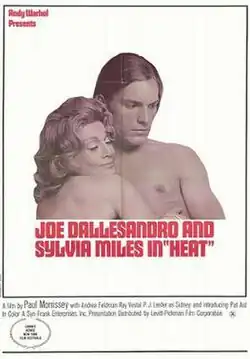 Theatrical release poster | |
| Directed by | Paul Morrissey |
| Written by | Paul Morrissey |
| Produced by | Andy Warhol |
| Starring | Joe Dallessandro Sylvia Miles Andrea Feldman |
| Cinematography | Paul Morrissey |
| Edited by | Jed Johnson[1] Lana Jokel[1] |
| Music by | John Cale |
| Distributed by | Levitt-Pickman |
Release dates |
|
Running time | 102 minutes |
| Country | United States |
| Language | English |
| Budget | $15,000[2]–$100,000[3] |
| Box office | $2,000,000[2] |
Heat is a 1972 American comedy drama film directed by Paul Morrissey, produced by Andy Warhol, and scored by John Cale. Conceived as a parody of Sunset Boulevard (1950), the film stars Warhol superstars Joe Dallesandro, Sylvia Miles, and Andrea Feldman. It is the final installment in the "Paul Morrissey Trilogy" produced by Warhol, following Flesh (1968) and Trash (1970).
Plot
Joey Davis is an unemployed former child star who supports himself as a hustler in Los Angeles. Joey uses sex to get his landlady to reduce his rent, then seduces Sally Todd, a former Hollywood starlet.
Sally tries to help Joey revive his career but her status as a mediocre ex-actress proves to be quite useless. Sally's psychotic daughter, Jessica, further complicates the relationship between Sally and the cynical, emotionally numb Joey.
Cast
- Joe Dallesandro as Joey Davis
- Sylvia Miles as Sally Todd
- Andrea Feldman as Jessica
- Pat Ast as Lydia, the motel owner
- Ray Vestal as Ray, the producer
- Lester Persky as Sidney
- Eric Emerson as Eric
- Gary Kaznocha as Gary
- Harold Stevenson as Harold (credited as Harold Childe)
- John Hallowell as gossip columnist
- Pat Parlemon as girl by the pool
- Bonnie Walder as Bonnie
Production
Heat was based on an idea by writer John Hallowell.[4][5] Produced for less than $100,000 and developed without a formal written plot, the film was shot over two weeks in a Hollywood mansion in 1971.[3][6] The love scenes were filmed several months later during Labor Day weekend at Warhol's house in East Hampton, New York.[7]
Release
In May 1972, Heat was screened at the Cannes Film Festival.[8] The following August, it was shown at the 33rd Venice International Film Festival, becoming the first Warhol production permitted to screen in Italy.[9]
The film premiered at the New York Film Festival on October 5, 1972, before opening the next day at New York's Festival Theatre.[10] It later expanded to the Waverly Theatre in Greenwich Village and the Rialto Theatre in Times Square on October 11.[11] The film grossed $28,000 in its first week of release at the Festival Theatre.[11]
On October 16, 1972, a special screening and reception was held at the Directors Guild of America on Sunset Boulevard in Hollywood.[12] Among those in attendance were Joni Mitchell, Jack Nicholson, Ross Hunter, and George Cukor.[13]
The film was screened at the San Francisco International Film Festival on October 19, 1972, and shown the following day at the Palace of Fine Arts before opening at San Francisco's Music Hall Theatre on October 21.[14][15][16]
Reception
The film was well-received by film critics. Rex Reed of the New York Daily News said, "Heat is the most important film to ever emerge from the tropic underground movement, providing freshness and excitement in a dreary Cannes Film Festival to which the establishment has brought large doses of irrelevance and tedium."[17] Derek Malcolm of The Guardian called it "one of the very best things" at the Venice Film Festival.[18] "It succeeds in being both funny and sad, and effortlessly truthful too," he said.[18]
The New York Film Festival screening was standing-room only and was received by a generally enthusiastic crowd however three people walked out, with one lady claiming "It's the most disgusting thing I have ever seen" and referring to the films of the era "Make them, make them, just don't show them to anybody."[10][19] At a panel discussion following the New York Film Festival screening, Otto Preminger called it "depressingly entertaining".[19]
After previously ignoring most Warhol films, the New York Daily News reviewed the film, with Kathleen Carroll awarding it three stars.[20] The advert for the film was censored in the Daily News with a t-shirt painted on Dallesandro and a bra strap on Miles.[20]
Andrea Feldman, who had a much larger role than in previous Warhol films, committed suicide shortly before the film was released.[21] Her performance garnered positive reviews, with Judith Crist, writing in New York magazine, "The most striking performance, in large part non-performance, comes from the late Andrea Feldman, as the flat-voiced, freaked-out daughter, a mass of psychotic confusion, infantile and heart-breaking."[22]
In a review for the Los Angeles Times, Kevin Thomas described Heat as a "captivating but too drawnout parody of Sunset Boulevard crossed with Where Love Has Gone." He added, that the film "rings true at its core; it's around the edges that indulges in self-defeating spoofery and sexploitation."[5]
Peter Schjeldahl of The New York Times wrote that Heat is "by far the slickest and most coherent specimen of Warholian cinema to date; it is also, for me, the least interesting. If it lacks the harshness and distraction of previous Warhol Factory productions, it also lacks their sense of serendipity and thorny life. Without being boring, it's a bore."[23]
Jerry Stein of The Cincinnati Post described the film as "an unexpectedly cold, harsh comedy in its lack of compassion."[1]
See also
References
- 1 2 3 Stein, Jerry (August 24, 1973). "Cinema: The Failures Gather in Hollywood". The Cincinnati Post. p. 16.
- 1 2 Eichelbaum, Stanley (June 7, 1974). "'Frankenstein' in 3-D--bigger than 'Trash'". The San Francisco Examiner. p. 28. Retrieved August 26, 2024.
- 1 2 Eichelbaum, Stanley (October 24, 1972). "A Star is Born in Warhol Factory". San Francisco Examiner. p. 24.
- ↑ "Heat movie review & film summary (1972)". Roger Ebert. Retrieved November 4, 2024.
- 1 2 Thomas, Kevin (October 20, 1972). "'Heat' Lean on Warhol Ambience". Los Angeles Times. pp. Part lV Page 17.
- ↑ Gardner, Paul (November 14, 1972). "Morrissey Gives the Director's View". The New York Times.
- ↑ Reed, Rex (October 1, 1972). "The Fall and Rise of Sylvia". The Baltimore Sun. pp. D23. Retrieved May 7, 2026.
- ↑ Reed, Rex (May 19, 1972). "Warhol's 'Heat' Happy Festival Surprise". Daily News. p. 62. Retrieved May 7, 2026.
- ↑ Quinn Curtiss, Thomas (September 4, 1974). "Venice Festival Honors Chaplin". The New York Times. Archived from the original on July 17, 2020. Retrieved November 4, 2024.
- 1 2 "Don't Go Into Film Fest If You Can't Stand 'Heat'". Variety. October 11, 1972. p. 3.
- 1 2 "'Heat'-ed Up At The B.O." Variety. October 11, 1972. p. 7.
- ↑ Van Ness, Chris (October 20–29, 1972). "Warhol in Wonderland" (PDF). Los Angeles Free Press. 9 (42): 1, 9.
- ↑ Lee Browning, Norma (October 19, 1972). "Hollywood Today". Chicago Tribune. pp. 14 - Section 1A. Retrieved April 10, 2025.
- ↑ Eichelbaum, Stanley (October 20, 1972). "Caustic, Campy Satire". The San Francisco Examiner. p. 34. Retrieved May 7, 2026.
- ↑ Wasserman, John L. (October 21, 1972). "Unplanned Comedy In Warhol's 'Heat'". San Francisco Chronicle. p. 40. Retrieved May 7, 2026.
- ↑ "GREAT MOMENTS | San Francisco Film Festival". history.sffs.org. Retrieved November 4, 2024.
- ↑ Reed, Rex (May 19, 1972). "Warhol's 'Heat' Happy Festival Surprise". New York Daily News. p. 21. Retrieved September 21, 2025.
- 1 2 Malcolm, Derek (September 6, 1972). "Eastern Promise". The Guardian. p. 10. Retrieved September 21, 2025.
- 1 2 Verrill, Addison (October 11, 1972). "Morrisey's Ad-Libbed 'Heat' Whams N.Y. Fest; Could Have B.O. Wattage Too". Variety. p. 7.
- 1 2 "Daily News Decides To Recognise Warhol". Variety. October 11, 1972. p. 7.
- ↑ Killen, Andreas (December 10, 2008). 1973 Nervous Breakdown: Watergate, Warhol, and the Birth of Post-Sixties America. Bloomsbury Publishing USA. p. 147. ISBN 978-1-59691-999-0.
- ↑ Crist, Judith (October 9, 1972). "Some For The Cachet, Others For The Cash". New York Magazine. 5 (41).
- ↑ Schjeldahl, Peter (November 26, 1972). "What's So Hot About 'Heat'?". The New York Times.
External links

- 1972 films
- 1972 comedy-drama films
- 1972 LGBTQ-related films
- 1970s parody films
- 1972 black comedy films
- American LGBTQ-related films
- American comedy-drama films
- Films directed by Paul Morrissey
- Films about male prostitution in the United States
- Films scored by John Cale
- LGBTQ-related black comedy films
- 1970s LGBTQ-related comedy films
- LGBTQ-related comedy-drama films
- 1972 English-language films
- 1972 American films
- Films about landlords
- Films set in Los Angeles
- Films about actors
- English-language black comedy films
- Films produced by Andy Warhol