Hawthorn Railway Bridge
Hawthorn Railway Bridge | |
|---|---|
 | |
| Coordinates | 37°49′32.4″S 145°01′03″E / 37.825667°S 145.01750°E |
| Carries | Burnley Group: |
| Crosses | Yarra River |
| Locale | Melbourne, Victoria, Australia |
| Begins | Burnley (west) |
| Ends | Hawthorn (east) |
| Named for | Hawthorn |
Preceded by | Hawthorn Bridge |
Followed by | Wallen Road Bridge (also called Swan Street Bridge)[a] |
| Characteristics | |
| Design | Truss bridge |
| Material | Steel |
Pier construction | Bluestone |
| Total length | 100 m (330 ft) |
| Width | 17 m (56 ft) |
| Longest span | 40 m (130 ft) |
Rail characteristics | |
| No. of tracks |
|
| History | |
| Designer | Francis Bell |
| Constructed by | George Cornwell and Co |
| Opened | 13 April 1861 |
| Rebuilt |
|
| Location | |
Interactive map of Hawthorn Railway Bridge | |
| References | |
| [1] | |
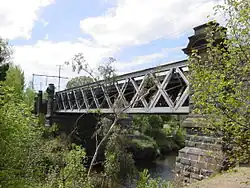
The Hawthorn Railway Bridge is a steel truss bridge that crosses the Yarra River 5 kilometres (3.1 mi) east of Melbourne, in Victoria, Australia. The bridge carries the Burnley Group between Burnley and Hawthorn stations on the Alamein, Belgrave and Lilydale lines. Completed in 1861 by the Melbourne and Suburban Railway Company, it is the oldest extant railway bridge over the Yarra River.
The Main Yarra Trail passes underneath the western abutment of the bridge.[1]
Description
Completed in 1861, Hawthorn Railway Bridge was designed by Francis Bell.[2] The opening had been delayed due to delays in completion of the bridge with the original iron trusses having been lost at sea.[3] With a span of approximately 60 metres (200 ft), it was one of the last major items of permanent way to be built on the fledgling railway. The contractors were George Cornwell and Co.[3][b]
Cornwell had previously been involved as contractor in many other major construction works including the Melbourne and Suburban Railway as a whole, as well as Melbourne Grammar School, the Model School, Coppin's Haymarket Theatre, and the Sunbury railway goods shed. Subsequently, he was a contractor on Parliament House, Albert Park Station, Jack's Magazine[5] and the Wallaby Creek water supply.[3]
It is likely that Alexander Kennedy Smith, who had designed the Cremorne Railway Bridge for the Melbourne and Suburban Railway Co, was also involved in the design of the Hawthorn Bridge, but was perhaps out of his depth. He ordered trusses which were inadequate for the job, and had to shorten them, suggesting he did not understand the design.
The opening of the bridge on 13 April 1861 allowed the Melbourne and Suburban Railway Company to extend its line from Pic Nic railway station (east of Burnley) to Hawthorn.[6] The earliest views of the bridge show it to consist of a deck lattice girder with five intersects. The main span over the river was flanked by segmental bluestone arch spans on either side, detailed in an Italianate style.[1] The construction of the railway bridge and line to Hawthorn advanced the rapid growth of the suburb.[7]
The bridge was duplicated in 1882 by the Railways Construction Branch, and minor works to the bearings and girder ends were made in 1887–8 to lower the levels of its girders by 6 in (150 mm). A new double-track bridge using large double Warren trusses was built on its north side in 1912. One of the previous wrought iron lattice trusses was left in place.[3]
The bridge was extended westwards in 1938–39 when a new span was added to cross the Yarra Boulevard, which was constructed by sustenance workers during the Depression as a scenic drive.[8] In 1971, the original piers were strengthened and a metal girder span added to accommodate a third track.[3]
See also
Notes
- ↑ Not to be confused with the Swan Street Bridge.
- ↑ Not Goldsack & Co as recorded in Leo Harrigan's Victorian Railways to '62, account of the history of railways in Victoria.[4]
References
- 1 2 3 "Hawthorn Railway Bridge, Yarra River (local government list), Heritage Overlay HO297". Victorian Heritage Database. Heritage Victoria. Retrieved 31 May 2026.
- ↑ "To the Editor of the Herald". The Sydney Morning Herald. 16 December 1868. p. 6. Retrieved 16 September 2011 – via Trove. National Library of Australia.
- 1 2 3 4 5 Vines, Gary. "National Trust Study of Victoria's Masonry, Metal and Concrete Rail Bridges and Masonry Road Bridges" (abstract). National Trust of Australia (Victoria). pp. 57–60. Retrieved 30 May 2014 – via academia.edu.
- ↑ Harrigan, Leo J. (1962). Victorian Railways to '62. Melbourne: Victorian Railways Public Relations and Betterment Board. p. 54.
- ↑ "Jack's Magazine, Victorian Heritage Register (VHR) Number H1154, Heritage Overlay HO45". Victorian Heritage Database. Heritage Victoria.
- ↑ Allom Lovell & Associates (n.d.). "Hawthorn Railway Bridge". Yarra Heritage Review: Building Citations (Report). pp. 433–434. Retrieved 31 May 2026 – via Heritage Council of Victoria.
- ↑ "Hawthorn's History by Train". Hawthorn Historical Society. 6 January 2022. Retrieved 6 June 2026.
- ↑ 1930s. Workers constructing the Boulevard (Susso Drive) (photo). Retrieved 22 February 2013 – via Picture Victoria.
External links
- Hawthorn Railway Bridge, Melbourne (postcard: printed, b&w; 8.8 x 13.8 cm. approx.). Pictures Collection. 30 July 1911. Retrieved 31 May 2026 – via State Library of Victoria.
- Daniel, Mark James (25 April 1901). Flood. From Hawthorn Railway Bridge Looking North (negative: glass; 8.5 x 11.0 cm. (quarter plate)). Pictures Collection. Retrieved 31 May 2026 – via State Library of Victoria.
- "Victorian railways: Making tracks". ScienceWorks: Museums Victoria. n.d. Retrieved 31 May 2026.

- 1861 establishments in Australia
- Bridges completed in 1861
- Bridges in Melbourne
- Bridges over the Yarra River
- Buildings and structures in the City of Boroondara
- Buildings and structures in the City of Yarra
- Italianate architecture in Melbourne
- Railway bridges in Victoria (state)
- Transport in the City of Boroondara
- Transport in the City of Yarra