Government of the Cook Islands
| Cook Islands Government | |
|---|---|
 | |
| Overview | |
| Established | 1965 |
| Country | Cook Islands |
| Leader | Prime Minister of the Cook Islands (Mark Brown) |
| Appointed by | King's Representative (Tom Marsters) on the advice of the prime minister |
| Main organ | Cabinet of the Cook Islands |
| Responsible to | Cook Islands Legislative Assembly |
|
|---|
The Cook Islands is a self-governing parliamentary democracy in free association with New Zealand.[1][2] It is part of the Realm of New Zealand,[3] which comprises New Zealand, the Cook Islands, Niue, Tokelau, and the Ross Dependency.[4] The Cook Islands consists of 15 islands in Polynesia, with Rarotonga the largest and most populous island and the seat of government.
The Cook Islands has a unique governance framework shaped by its history, culture, and political evolution. The country has navigated a transition from traditional leadership to colonial administration and, ultimately, to self-governance. Central to this transformation is the Cook Islands Constitution Act 1964,[5] which formalised self-rule while preserving traditional governance practices.
Cultural values, including communal decision-making and the advisory role of the House of Ariki, remain integral to public administration. Additionally, the Pa Enua Governance Division exemplifies localised governance tailored to the needs of island communities.[6]
Governance history
The governance history of the Cook Islands reflects a dynamic interplay of tradition and external influences. Historically, decision-making was guided by ariki (chiefs), who governed through consensus and communal practices. This system was deeply rooted in Polynesian culture and continues to influence governance today through the House of Ariki, established under the Part 1 S8 – 11B of the Constitution.[7]
The arrival of missionaries in the 19th century brought significant cultural and administrative changes, introducing Christian principles that reshaped governance. Traditional laws were aligned with Christian teachings, such as the implementation of "Blue Laws" to regulate societal behaviour. These "Blue Laws" were introduced by the Reverend John Williams. He adapted a version of the Raʻiātea Code of Laws to regulate the conduct of the peoples of Rarotonga.[8]
In 1888, the Cook Islands became a British protectorate, leading to external administrative control. This transitioned to New Zealand's jurisdiction in 1901, following annexation. Governance was formalised with the establishment of the Resident Commissioner in 1891 and the Legislative Council in 1946, which marked the beginning of Cook Islands' legislative autonomy.
Self-governance was achieved in 1965 under the Cook Islands Constitution Act 1964 (Parliamentary Counsel Office, 1964). This Act defined the country's administrative and political structures while maintaining free association with New Zealand for defence and foreign affairs. Since independence, constitutional amendments have incorporated traditional leadership and adapted to evolving governance needs. The establishment of the Pa Enua Governance Division further decentralised administration, fostering localised service delivery.[6]
The head of state of the Cook Islands is King Charles the III.[2] The King's Representative is Sir Tom Marsters. The King's Representative fulfills the role of a Governor-General and is responsible for appointing the Prime Minister and the Cabinet, in addition to chairing the Executive Council. Prior to 1982 this role was undertaken by the High Commissioner of New Zealand, however these powers were repatriated.[4]
Cultural context
The Cook Islands' governance system integrates traditional leadership and cultural values with modern administrative frameworks. The House of Ariki, comprising traditional leaders, advises on matters related to welfare and culture. This ensures that policymaking respects indigenous traditions, blending them with contemporary governance practices.[2]
The Pa Enua Governance Division plays a critical role in bridging traditional and contemporary governance. This division coordinates local administration, involving elected officials, traditional leaders, and community representatives to ensure inclusive decision-making.[6]
Communal decision-making remains a cornerstone of Cook Islands culture, influencing governance at all levels. These practices promote collaboration and inclusivity, ensuring that public sector management reflects community priorities. However, balancing these traditions with the efficiency demands of bureaucratic systems presents an ongoing challenge.[9]
Central government
The governance framework is anchored in parliamentary sovereignty, with a unicameral legislature comprising 24 members. The Executive Council is the supreme decision-making body of Government and comprises the King's Representative (as Chair) and all Cabinet Ministers which includes the Prime Minister.[2] The Prime Minister and Cabinet are responsible for policy implementation, while the legislature provides oversight.
Current composition
As of 8 February 2024, the Cook Islands Cabinet consists of:[10]
Cabinet ministers
| Incumbent | Portfolios and responsibilities | Since |
|---|---|---|
| Mark Brown (Cook Islands Party) |
|
1 June 2020 |
| Albert Nicholas (Cook Islands Party) |
|
16 February 2024 |
| Rose Toki-Brown (Independent) |
|
2 June 2021 |
| Vaine Mokoroa (Cook Islands Party) |
|
2 June 2021 |
| George Angene (Cook Islands Party) |
|
10 July 2018 |
| Tingika Elikana (Cook Islands Party) |
|
31 January 2024 |
Local government
Island government

Local government in the Cook Islands comprises Island governments under the Pa Enua framework. These island governments enhance localised governance by fostering community engagement in decision-making and tailored service delivery.[6] An island government is a council established under the 2012-13 Island Government Act.[11] The objects of this Act are:
- To foster good governance by all island governments.
- To promote accountability of island governments to their island communities.
- To encourage community participation in the governance of each island through transparency and consultation.
- To encourage island governments and the island community to progressively assume responsibilities as and when they are able to do so.
- To enable island governments and their island communities to decide on how best to promote the social, economic, cultural and environmental well-being of the respective islands.
The Act establishes an island government on each island.[11]
There are island councils on all of the inhabited outer islands (Outer Islands Local Government Act 1987 with amendments up to 2004, and Palmerston Island Local Government Act 1993) except Nassau, which is governed by Pukapuka (Suwarrow, with only one caretaker living on the island, also governed by Pukapuka, is not counted with the inhabited islands in this context).
The members of each island government comprise elected members consisting of a mayor and councillors, appointed members consisting of traditional leaders or representative, religious representative and members of parliament. The later 3 are ex-officio members of the island government. The island governments are, in effect, a form of local government.
The island government may also be known as Kavamani Enua or any other term prescribed by regulations made under the Island Government Act.[6]
 |
 |
Aitutaki (including uninhabited Manuae) |
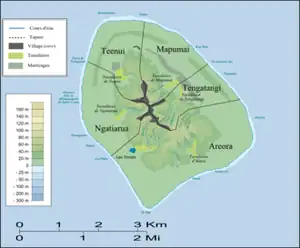 |
 |
Atiu (including uninhabited Takutea) |
 |
 |
Mangaia |
 |
 |
Manihiki |
 |
 |
Mauke |
 |
 |
Mitiaro |
 |
 |
Palmerston |
 |
 |
Penrhyn |
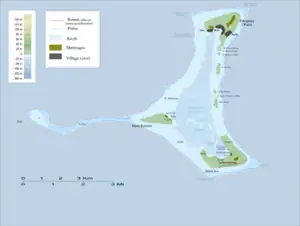 |
 |
Pukapuka (including Nassau and Suwarrow) |
 |
 |
Rakahanga |
Vaka councils


Three vaka councils headed by mayors were established on Rarotonga by the Rarotonga Local Government Act 1997,[12] then abolished in February 2008, despite much controversy.[13][14]
| Vaka | Districts |
|---|---|
| Puaikura | Arorangi |
| Takitumu | Matavera, Ngatangiia, Takitumu |
| Te-Au-O-Tonga | Equivalent to Avarua, the country's capital |
Village committees
On the lowest level, there are village committees. Nassau, which is governed by Pukapuka, has an island committee (Nassau Island Committee), which advises the Pukapuka Island Council on matters concerning its own island.
Challenges
The Cook Islands face persistent governance challenges, including political patronage, which undermines public sector neutrality. External funding dependencies further exacerbate vulnerabilities, limiting the country's ability to achieve full economic independence. Decentralisation[15] efforts through the Pa Enua Governance Division have been successful in some areas but have also faced capacity constraints,[16] leading to the re-centralisation of certain functions[17]
Implications for public sector management
The Cook Islands' governance framework demonstrates the importance of integrating traditional leadership and cultural practices into modern administrative systems. The Pa Enua Governance Division serves as a model for localised governance, addressing the unique challenges of geographic dispersion and resource limitations. While external dependencies and political patronage remain significant obstacles, the Cook Islands offer valuable lessons for other Small Island Developing States (SIDS) seeking to balance tradition and modernity in governance.
Public sector reform and capacity building in small island developing states
The public sector in SIDS, including thee Cook Islands, was initially considered to be bloated and inefficient by the World Bank. However, more recent literature acknowledges that small states invest considerable financial and human resources relative to their GDP in order to deliver public services to small populations. Moreover, the public sector is the main employer in many SIDS and compensates for low capacity within the private sector.[17]
New public management reforms, which focused on rightsizing the public sector, were introduced in the 1990s. There is little evidence on the success of these reforms, although Hassall[18] suggests that they were generally resisted. Hence, the public sector remains relatively large in many SIDS.
The public sector in SIDS is not independent and is compromised by political interference, patronage politics and ethnic affiliations. These tendencies coupled with other socio-cultural characteristics are not suitable for establishing the Weberian model of the public service which emphasises individual merit and neutrality.[19]
Devolution had limited success in the Cook Islands. Consequently, many public sector functions were recentralised.[15]
References
- ↑ "Cook Islands". New Zealand Ministry of Foreign Affairs and Trade. Retrieved 2025-02-06.
- 1 2 3 4 "Parliament Handbook". Parliament of the Cook Islands. Retrieved 2025-02-06.
- ↑ Quentin-Baxter, Alison. "The Cook Islands, Niue and Tokelau as parts of the Realm of New Zealand" (PDF). Te Marae Akarau Vānanga O Te Kuki Airani Parliament of The Cook Islands. Retrieved 6 February 2025.
- 1 2 Townend, Andrew (2003-08-01). "The Strange Death of the Realm of New Zealand: The Implications of a New Zealand Republic for the Cook Islands and Niue". Victoria University of Wellington Law Review. 34 (3): 571–608. doi:10.26686/vuwlr.v34i3.5768. ISSN 1179-3082.
- ↑ "Cook Islands Constitution Act 1964 No 69 (as at 04 August 1965)". New Zealand Legislation. Retrieved 2025-02-06.
- 1 2 3 4 5 "Pa Enua Goverance". Office of the Prime Minister Cook Islands. Retrieved 2025-02-06.
- ↑ "Constitution". Parliament of the Cook Islands. Retrieved 2025-02-06.
- ↑ Vainerere, Tangata (January 2022). "Ipukarea Timeline: A Treasury of Momentous Events in Cook Islands History 400 CE to 2023". Te Marae Akarau Vānanga o te Kuki Airani Parliament of the Cook Islands. Retrieved 8 December 2024.
- ↑ Campbell, I.C. (1989). A History of the Pacific Islands (PDF) (1 ed.). University of Canterbury Press. ISBN 0-520-06900-5.
- ↑ "Cabinet Services". www.pmoffice.gov.ck. Office of the Prime Minister Cook Islands. Retrieved 18 May 2025.
- 1 2 "Cook Islands Parliament Acts". Parliament of the Cook Islands. Retrieved 2025-02-06.
- ↑ Larmour, Peter and Barcham, Manuhuia. Cook Islands 2004, Transparency International Country Study Report.
- ↑ "Rarotonga Local Government (Repeal) Bill To Be Tabled, Cook Islands Government". Cook-islands.gov.ck. Archived from the original on 17 October 2013. Retrieved 17 October 2013.
- ↑ Minister asked to answer queries over abolition of Vaka Councils. The Cook Islands Herald, No. 393 (9 February 2008)
- 1 2 Glassie, Nandi T. (2018-10-02). "Public sector management and reform: Cook Islands experience". Asia Pacific Journal of Public Administration. 40 (4): 212–218. doi:10.1080/23276665.2018.1543083. ISSN 2327-6665.
- ↑ "Public Sector Reform and Capacity Building in Small Island Developing States - GSDRC". 2019-08-22. Retrieved 2025-02-06.
- 1 2 "Public Sector Reform and Capacity Building in Small Island Developing States". k4d.ids.ac.uk. Retrieved 2025-02-06.
- ↑ Hassall, Graham (2018-10-02). "Special Issue on public sector enhancement in Pacific Island states". Asia Pacific Journal of Public Administration. 40 (4): 207–211. doi:10.1080/23276665.2018.1553276. ISSN 2327-6665.
- ↑ Everest-Phillips, Max; Henry, Samuel (2018-09-13). "Public Administration in Small and Very Small States: How Does Smallness Affect Governance?". International Journal of Civil Service Reform and Practice. 3 (2). doi:10.56289/ijcsrp.110.
| ||||||||||||||||||||||||||||||||||||||||||||||||||||||||||||||||||||||||||||||||||||||||||||||||||||||||||||||||||||


