Franz Schieß
Franz Schieß | |
|---|---|
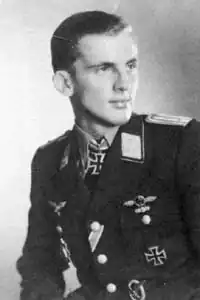 Schieß as an Oberleutnant | |
| Nickname | "Nawratil" |
| Born | 21 February 1921 St. Pölten, Austria |
| Died | 2 September 1943 (aged 22)[1] Gulf of Naples, off Ischia, Fascist Italy |
Cause of death | Killed in action |
| Allegiance |  Nazi Germany |
Branch | Army Luftwaffe |
Service years | Army (1938–40) Luftwaffe (1940–43) |
Rank | Hauptmann (captain) |
| Unit | JG 53 |
| Commands | 8./JG 53 |
Conflicts | World War II |
| Awards | Knight's Cross of the Iron Cross |
Franz Schieß (21 February 1921 – 2 September 1943) was a Luftwaffe fighter ace. He claimed 67 victories in 657 missions, (14 on the Eastern Front, and 53 against the Western Allies) whilst flying the Messerschmitt Bf 109.
Schieß initially served in the Heer (German Army) during the Invasion of Poland. He then transferred to the Luftwaffe, was trained as a fighter pilot, and was posted to Jagdgeschwader 53 (JG 53—53rd Fighter Wing). He claimed his first aerial victories on 22 June 1941, the first day of Operation Barbarossa, the German invasion of the Soviet Union. JG 53 was transferred to the Mediterranean Theatre in late 1941. In early 1943, Schieß was appointed Staffelkapitän (squadron leader) of 8. Staffel (8th squadron) of JG 53. He was shot down and killed in action over the Gulf of Naples, off Ischia, on 2 September 1943.
Early life and career
Schieß, also known as Franz Schiehs, was born on 25 February 1921 in Wörth, part of Sankt Pölten, in Lower Austria.[2] During the Invasion of Poland, which marked the beginning of World War II in Europe, he served in the Heer (German Army) before transferring to the Luftwaffe in 1940. Following pilot and fighter pilot training,[Note 1] Schieß was posted to the Geschwaderstab (headquarters unit) of Jagdgeschwader 53 (JG 53—53rd Fighter Wing) in March 1941.[4]
When Schieß joined JG 53 in March 1941, the Geschwaderstab was based at Köln-Butzweilerhof Airfield for a period of rest and replenishment and was commanded by Geschwaderkommodore (wing commander) Major Günther Freiherr von Maltzahn. Following training on the then new Messerschmitt Bf 109 F-2 aircraft, the Geschwaderstab transferred to the English Channel where they were based at Saint-Omer-Wizernes on 15 March.[5] Serving with the Geschwaderstab for nearly two years, Schieß established a close friendship with Maltzahn. Later, the members of his Staffel (squadron) called him "Nawratil", after his radio call sign name.[6]
Fighter pilot career
Schieß engaged in aerial combat for the first time on 24 March 1941. Flying a combat air patrol from Dungeness to Dover, he engaged in combat with two Royal Air Force (RAF) Supermarine Spitfire fighters. In a head-on attack, neither side scored any hits.[7] JG 53 was withdrawn from the Channel Front on 8 June 1941 and ordered to Mannheim-Sandhofen Airfield in preparation of Operation Barbarossa, the German invasion of the Soviet Union.[8] The Geschwaderstab then moved to Krzewica, located approximately 70 kilometers (43 miles) west of Brest, on 14 June. Here, JG 53 was subordinated to Luftflotte 2 (Air Fleet 2) and was deployed on the right flank of Army Group Centre.[9] On 22 June, the opening day of Operation Barbarossa, Schieß claimed his first aerial victories, destroying an Polikarpov I-153 biplane fighter and an Ilyushin DB-3 bomber.[10]
On 9 July as the Battle of Białystok–Minsk came to and end, the Geschwaderstab reached an airfield named Tyranovka, located approximately 15 kilometers (9.3 miles) north of Myropil. Here they fought in the Battle of Uman.[11] On 21 July, the Geschwaderstab reached Bila Tserkva. Three days later, Schieß claimed his eleventh aerial victory.[12] On 6 August, they were then withdrawn from the Eastern Front, returning to Germany for further deployment on the Western Front.[13] For his achievements on the Eastern Front, Schieß had been awarded both classes of the Iron Cross (Eisernes Kreuz),[4] which included the presentation of the Iron Cross 1st Class (Eisernes Kreuz erster Klasse) on 24 July.[12]
Malta and North Africa
The ground personnel of JG 53 began their relocation to Sicily in late November 1941. Equipped with the Messerschmitt Bf 109 F-4/Z, the Geschwaderstab followed on 13 December via Mannheim-Sandhofen, Munich-Riem, Naples, finally arriving at Comiso Airfield on 15 December.[14] In December 1942, Schieß succeeded Oberleutnant Wilfried Pufahl as Geschwaderadjutant, the assisting officer helping the Geschwaderkommodore.[15] Operating from Sicily, Schieß flew combat missions during the Siege of Malta, claiming eleven aerial victories.[16]
Schieß claimed his first aerial victory in this theater on 25 January 1942. That day, RAF fighters escorted supply shipping and destroyers from Force K. As the ships passed the Delimara peninsula, located on the edge of the Marsaxlokk Bay, they came under attack by four Junkers Ju 88 bombers escorted by five Bf 109s from the Geschwaderstab. In this encounter, Luftwaffe pilots claimed eight aerial victories, including one by Schieß. The RAF squadrons lost three of five Hawker Hurricane fighters from No. 185 Squadron, No. 126 Squadron lost two aircraft, No. 249 Squadron sustained one loss, and No. 242 Squadron suffered three losses.[17] On 24 February, Schieß shot down Pilot Officer Don Tedford flying Hurricane BG771 from No. 249 Squadron. Tedford, who was wounded in the encounter, made a forced landing at RAF Luqa.[18]
In August 1942, the Geschwaderstab was reequipped with the Bf 109 G-2 trop.[19] On 8 November, Allied forced launched Operation Torch, the invasion of French North Africa. The next day, large elements of JG 53, including the Geschwaderstab, transferred to Tunis-El Aouina Airfield to provide aerial protection for the harbors at Tunis and Bizerte.[20] Schieß claimed his first aerial victory over North Africa on 17 November. His opponent may have been a Spitfire from No. 111 Squadron piloted by Sergeant Nigel Basil Steevenson who was shot down and killed near Bône, now Annaba.[21]
Schieß was awarded the German Cross in Gold (Deutsches Kreuz in Gold) on 23 January 1943.[4] On 29 January, 22 Boeing B-17 Flying Fortress heavy bombers of the 17th and 310th Bombardment Group attacked Bizerte. Defending against this attack, Schieß claimed a B-17 bomber and an escorting Lockheed P-38 Lightning fighter, probably belonging to the 82nd Fighter Group piloted by Lieutenant George W. Scott, shot down.[22]
Squadron leader
On 16 February 1943, the now Oberleutnant Schieß was appointed Staffelkapitän (squadron leader) of 8. Staffel of JG 53. He succeeded Oberleutnant Jürgen Harder who had been transferred. The Staffel was subordinated to III. Gruppe of JG 53 under command of Major Franz Götz.[23] He went on to claim 29 aerial victories as leader of 8. Staffel of JG 53.[1] Schieß was regarded as one of the most enthusiastic and aggressive pilots in the Mediterranean theatre, and often flew the escort missions for the Junkers Ju 52 transport aircraft as they tried to evacuate personnel out of Africa. On 18 April he shot down a Spitfire (for his 43rd victory), but nevertheless 24 heavy-laden transports were shot down and a further 35 damaged, in what became known as the "Palm Sunday Massacre".[24]

Even when his unit was evacuated back to Sicily after the fall of Tunis in April 1943, he still flew over to Tunisia each day doing combat missions before returning to Sicily each night, writing home of "wonderful aerial combats".[25] The aerial operations for Operation Corkscrew, the Allied invasion of the Italian island of Pantelleria, began on 18 May. Escorted by P-38 fighters from the USAAF 14th Fighter Group, bombers attacked Porto di Pantelleria, Margana airfield and Trapani. Defending against this attack, Schieß claimed a P-38 shot down northwest of Trapani.[26] On 21 May, shortly before 11:00, III. Gruppe was scrambled to intercept a large USAAF bomber formation heading for Pantelleria. The Gruppe intercepted the bombers and their fighter escort at 11:30. In this encounter, Schieß claimed the destruction of a P-38, his 50th aerial victory, and damaging a second P-38.[27] Schieß was awarded the Knight's Cross of the Iron Cross (Ritterkreuz des Eisernen Kreuzes) on 21 June.[28] Four days later, he claimed a B-17 bomber shot down 30 kilometers (19 miles) south of Stromboli.[29]
When on 18 August, Götz was promoted to Major and sent on home leave, Harder was temporarily tasked with leading III. Gruppe on the ground while Schieß led in the air. The next day, he led the Gruppe in an attack on a large formation of USAAF B-17 bombers flying over Montecorvino Rovella. In this encounter, III. Gruppe pilots claimed six B-17 bombers shot down, including one by Schieß.[30] Schieß shot down 12 enemy aircraft in 11 days, of which seven were P-38 twin-engine fighters. Together with Harder of III. Gruppe of JG 53, Schieß was promoted to the rank of Hauptmann (captain) on 1 September 1943.[31]
Death
The next day, on 2 September 1943, Schieß led a scramble against a USAAF North American B-25 Mitchell bomber formation attacking rail marshalling yards at Cancello, Naples. His unit engaged the fighter escort of P-38 Lightnings. Unable to break through the fighter screen to attack the bombers, he followed the force back over the Gulf of Salerno.[32] His final battle took place over the island of Ischia; at around 13:45, the pilots heard Franz Schieß radio: "At them again, everyone get ready!" At the time, the formation was 30 to 40 kilometers (19 to 25 miles) southwest of Ischia when Hauptmann Schieß's wingman was forced away by two Lightnings and lost sight of his Staffelkapitän.[25][31] Ten of the P-38s were shot down, but Schieß's Bf 109 G-6 "Black 1 + I" (Werknummer 160 022—factory number) crashed into the Mediterranean 30 to 50 kilometers (19 to 31 miles) south-southwest of Ischia in the Gulf of Salerno.[33] Though not witnessed, he was probably shot down by a P-38.[34]
On September 27 Günther von Maltzahn wrote to Schieß's parents expressing the close friendship they shared:[35]
I ask that you and your husband accept my and my Geschwader's most sincere and heartfelt sympathy on the unspeakably hard stroke of fate which befell your son Franz.
I can sympathize with how hard it must be to come to terms with thoughts that you will never see your son Franz again in this life. One could not have wished for a better officer. Not only did there exist a comradeship and a mutual trust between Kommodore and adjutant that was tested in far more than 100 air battles, but in him I lost my best friend, on whom I could depend no matter what the situation.
Command of 8. Staffel remained vacant for almost two weeks until Hauptmann Karl Leonhard was transferred on 15 September.[23] With 17 aerial victories claimed over the P-38, Schieß was the most successful Luftwaffe fighter pilot combating the P-38.[36]
Summary of career
Aerial victory claims
According to US historian David T. Zabecki, Schieß was credited with 67 aerial victories.[37] Spick also lists Schieß with 67 aerial victories claimed in 540 combat missions and a mission-to-claim ratio of 8.06. This figure includes 13 aerial victories in North Africa, a further 40 aerial victories in the Mediterranean theater and 14 more on the Eastern Front.[38] Obermaier however states that Schieß flew 657 combat missions, including 29 on the English Channel, 84 on the Eastern Front and 376 over Malta.[2] Mathews and Foreman, authors of Luftwaffe Aces — Biographies and Victory Claims, researched the German Federal Archives and found documentation for 68 aerial victory claims, plus one further unconfirmed claim. This number includes 14 claims on the Eastern Front and 54 over the Western Allies, including three four-engined bombers.[39]
| Chronicle of aerial victories | |||||||||
|---|---|---|---|---|---|---|---|---|---|
|
This and the – (dash) indicates unconfirmed aerial victory claims for which Schieß did not receive credit.
This and the ? (question mark) indicates information discrepancies listed by Prien, Stemmer, Rodeike, Bock, Mathews and Foreman. | |||||||||
| Claim | Date | Time | Type | Location | Claim | Date | Time | Type | Location |
| – Stab of Jagdgeschwader 53 –[40] Operation Barbarossa — 22 June – 6 August 1941 | |||||||||
| 1 | 22 June 1941 | 07:25 | I-153 | northwest of Kobryn[41] | 8 | 14 July 1941 | 11:00 | SB-3[42] | |
| 2 | 22 June 1941 | 16:35 | DB-3 | Biała Podlaska[41] | 9 | 20 July 1941 | 17:52 | I-15[42] | vicinity of Uman |
| 3 | 24 June 1941 | 10:00 | SB-2 | northwest of Kobryn[41] | 10 | 23 July 1941 | 06:33 | I-16[42] | vicinity of Uman |
| 4 | 24 June 1941 | 10:10 | SB-2 | vicinity of Kobryn[41] | 11 | 24 July 1941 | 11:45 | I-16[42] | vicinity of Uman |
| 5 | 29 June 1941 | 19:55 | SB-3[41] | vicinity of Bobruysk | 12 | 25 July 1941 | 18:14 | I-15 | northeast of Bila Tserkva[43] |
| 6 | 6 July 1941 | 14:05 | DB-3 | east of Polonne[41] | 13 | 26 July 1941 | 11:00 | V-11 (Il-2)[43] | |
| 7 | 7 July 1941 | 06:15 | SB-3 | east of Polonne[41] | 14 | 29 July 1941 | 17:02 | SB-3[43] | |
| – Stab of Jagdgeschwader 53 –[39] Mediterranean Theater — 15 December 1941 – 31 December 1942 | |||||||||
| 15 | 25 January 1942 | 10:49 | Hurricane | south of Malta[44] south of La Valletta |
24 | 17 October 1942 | 13:41?[Note 2] | Spitfire | 5 km (3.1 mi) north of La Valletta[46] |
| 16 | 24 February 1942 | 16:00 | Hurricane[44] | vicinity of Malta | 25 | 17 November 1942 | 13:37 | Spitfire | Bône harbour[46] |
| 17 | 15 June 1942 | 15:15 | Beaufighter | west of Linosa[46] | 26 | 25 November 1942 | 12:00 | Spitfire | 10 km (6.2 mi) north-northwest of Majaz al Bab[46] |
| 18 | 7 July 1942 | 10:47 | Spitfire[46] | vicinity of Malta | 27 | 3 December 1942 | 11:41 | P-38 | La Garaet Achkil[46] |
| 19 | 9 July 1942 | 12:20 | Spitfire[46] | vicinity of Malta | 28 | 4 December 1942 | 16:04 | Boston | 6 km (3.7 mi) south of Jefna[46] |
| 20 | 14 July 1942 | 10:32 | Spitfire | 5 km (3.1 mi) east-southeast of La Valetta[46] 5 km (3.1 mi) east-northeast of Zonqor Point Malta |
29 | 5 December 1942 | 15:40 | P-38 | 5 km (3.1 mi) west of Djebel Abiod[46] |
| 21 | 18 July 1942 | 14:33 | Spitfire | 5 km (3.1 mi) north of La Valetta[46] | — |
5 December 1942 | 15:42 | P-38 | west of Djebel Abiod[46] |
| 22 | 26 August 1942 | 13:17 | Spitfire | 12 km (7.5 mi) south of La Valetta[46] | 30 | 6 December 1942 | 15:58 | Dragonfly | 18 km (11 mi) south of Djebel Abiod[46] |
| 23 | 11 October 1942 | 14:35 | Spitfire[46] | vicinity of Malta | 31 | 18 December 1942 | 11:08 | Spitfire | 20 km (12 mi) west of Jefna[46] |
| – Stab of Jagdgeschwader 53 –[45] Mediterranean Theater — 1 January – 15 February 1943 | |||||||||
| 32 | 2 January 1943 | 09:07 | Spitfire | 20 km (12 mi) east of Bône[47] | 35 | 17 January 1943 | 14:00 | P-38 | 28 km (17 mi) northeast of Béja[47] |
| 33 | 4 January 1943 | 12:23 | P-40 | 20 km (12 mi) southwest of Sbeitla[47] southwest of Pichon |
36 | 29 January 1943 | 11:10 | B-17 | 15 km (9.3 mi) northeast of Béja[47] |
| 34 | 16 January 1943 | 13:48 | Hurricane | 15 km (9.3 mi) west-southwest of Tebourba[47] 18 km (11 mi) southeast of Mateur |
37 | 29 January 1943 | 11:30 | P-38 | 12 km (7.5 mi) northeast of Bou Arada[47] 12 km (7.5 mi) southwest of Mateur |
| – 8. Staffel of Jagdgeschwader 53 –[45] Mediterranean Theater — 16 February – 2 September 1943 | |||||||||
| 38 | 26 February 1943 | 17:02 | Spitfire | 40 km (25 mi) north of La Valetta[48] | 54 | 11 June 1943 | 15:37 | Spitfire | 20 km (12 mi) northwest of Pantelleria[49] |
| 39 | 25 March 1943 | 09:44 | Spitfire | 5 km (3.1 mi) northwest of La Valetta[48] | 55 | 25 June 1943 | 12:13 | B-17 | 30 km (19 mi) south of Stromboli[49] |
| 40 | 5 April 1943 | 19:00 | Spitfire | southwest of Béja[48] | 56 | 19 August 1943 | 12:20 | B-17 | 40 km (25 mi) southeast of Benevento[49] |
| 41 | 11 April 1943 | 09:59 | Spitfire | 3 km (1.9 mi) north of Mateur[48] 7 km (4.3 mi) south of Tunis |
57 | 20 August 1943 | 12:43 | P-38 | 12 km (7.5 mi) north of Grazzanise[50] |
| 42 | 17 April 1943 | 19:14 | Spitfire | 18 km (11 mi) north of Medjez el Bab[48] vicinity of Cap Vito |
58 | 21 August 1943 | 13:04 | B-26 | 12 km (7.5 mi) west of Capua[50] |
| 43 | 18 April 1943 | 18:07 | Spitfire | 24 km (15 mi) southwest of Mateur[48] | 59 | 22 August 1943 | 12:17 | B-26 | 50 km (31 mi) southwest of Capri[50] |
| 44 | 29 April 1943 | 16:02 | P-38 | 3 km (1.9 mi) north of Cape Farina[48] | 60 | 23 August 1943 | 11:30 | Catalina | south of Capri[50] |
| 45 | 8 May 1943 | 18:45 | P-40 | 8 km (5.0 mi) southeast of Cape Bon[48] | ?[Note 3] | 26 August 1943 | 12:52 | B-26 | |
| 46 | 8 May 1943 | 19:00 | P-40 | 10 km (6.2 mi) northeast of Zembra[48] 18 km (11 mi) east of Kelebia |
61 | 26 August 1943 | 12:52?[Note 4] | P-38 | 8 km (5.0 mi) south of Gaeta[50] 2 km (1.2 mi) west of Grazzanise |
| ?[Note 3] | 11 May 1943 | 12:25 | P-40 | 10 km (6.2 mi) southwest of Marsala | 62 | 27 August 1943 | 12:39?[Note 5] | B-25 | 15 km (9.3 mi) northeast of Capua[50] 10 km (6.2 mi) north of Benevento |
| 47 | 18 May 1943 | 14:15 | P-38 | northwest of Trapani[52] | 63 | 27 August 1943 | 12:51?[Note 6] | P-38 | 10 km (6.2 mi) west of Benevento[50] 40 km (25 mi) south of Capri |
| 49 | 19 May 1943 | 13:47 | P-38 | 36 km (22 mi) west of Marettimo[52] | 64 | 28 August 1943 | 15:43 | P-38 | 2 km (1.2 mi) east of Altamura[50] east of Castel Volturno |
| 50 | 21 May 1943 | 11:24 | P-38 | 40 km (25 mi) north of Pantelleria[52] | 65 | 28 August 1943 | 15:51?[Note 7] | P-38 | east of Castel Volturno[50] 2 km (1.2 mi) east of Albaccora |
| 51 | 25 May 1943 | 11:03?[Note 8] | P-38 | 30 km (19 mi) northwest of Trapani[49] | 66 | 30 August 1943 | 12:06 | P-38 | southwest of Castel Volturno[50] |
| 52 | 6 June 1943 | 06:42 | Boston | 20 km (12 mi) northwest of Pantelleria[49] | 67 | 30 August 1943 | 12:15 | P-38 | southwest of Castel Volturno[50] |
| 53 | 10 June 1943 | 15:50 | P-40 | 1 km (0.62 mi) west of Pantelleria[49] | |||||
Awards
- Iron Cross (1939) 2nd and 1st Class[4]
- Honor Goblet of the Luftwaffe on 7 September 1942 as Leutnant and pilot[53]
- German Cross in Gold on 23 January 1943 as Leutnant in Stab/Jagdgeschwader 53[54]
- Knight's Cross of the Iron Cross on 21 June 1943 as Oberleutnant and Staffelkapitän of the 8./Jagdgeschwader 53[55][56]
Notes
- ↑ Flight training in the Luftwaffe progressed through the levels A1, A2 and B1, B2, referred to as A/B flight training. A training included theoretical and practical training in aerobatics, navigation, long-distance flights and dead-stick landings. The B courses included high-altitude flights, instrument flights, night landings and training to handle the aircraft in difficult situations.[3]
- ↑ According to Mathews and Foreman claimed at 13:41.[45]
- 1 2 This claim is not listed by Prien, Stemmer, Rodeike and Bock.[51]
- ↑ According to Mathews and Foreman, claimed at 13:37.[45]
- ↑ According to Mathews and Foreman, claimed at 12:51.[45]
- ↑ According to Mathews and Foreman, claimed at 13:11.[45]
- ↑ According to Mathews and Foreman, claimed at 15:21.[45]
- ↑ According to Mathews and Foreman, claimed at 11:05.[45]
References
Citations
- 1 2 Scutts 1998, p. 94.
- 1 2 Obermaier 1989, p. 195.
- ↑ Bergström, Antipov & Sundin 2003, p. 17.
- 1 2 3 4 Dixon 2023, p. 27.
- ↑ Prien et al. 2002, pp. 179–181.
- ↑ Prien 1998, p. 678.
- ↑ Prien 1997, pp. 216, 218.
- ↑ Prien et al. 2002, p. 180.
- ↑ Prien et al. 2003, p. 88.
- ↑ Weal 2001, p. 18.
- ↑ Prien et al. 2003, pp. 89–90.
- 1 2 Prien 1997, p. 284.
- ↑ Prien et al. 2003, pp. 90–91.
- ↑ Prien et al. 2004, p. 18.
- ↑ Prien et al. 2004, p. 34.
- ↑ Weal 2007, pp. 81–83.
- ↑ Shores, Cull & Malizia 1991, pp. 57–59.
- ↑ Shores, Cull & Malizia 1991, pp. 95–96.
- ↑ Prien et al. 2004, p. 29.
- ↑ Prien et al. 2004, p. 31.
- ↑ Shores & Massimello 2016, pp. 122–125.
- ↑ Shores & Massimello 2016, pp. 285–286.
- 1 2 Prien et al. 2011, p. 260.
- ↑ Weal 2007, p. 91.
- 1 2 Sundin & Bergström 1997, p. 44.
- ↑ Shores et al. 2018, p. 36.
- ↑ Prien 1998, p. 605.
- ↑ Prien 1998, pp. 619–620.
- ↑ Shores et al. 2018, p. 112.
- ↑ Prien 1998, p. 672.
- 1 2 Prien 1998, p. 677.
- ↑ Weal 2007, p. 99.
- ↑ Prien 1998, p. 729.
- ↑ Scutts 1998, p. 61.
- ↑ Prien 1998, pp. 678, 679.
- ↑ Young 2023, p. 43.
- ↑ Zabecki 2014, p. 1617.
- ↑ Spick 1996, p. 239.
- 1 2 Mathews & Foreman 2015, pp. 1120–1121.
- ↑ Mathews & Foreman 2015, p. 1120.
- 1 2 3 4 5 6 7 Prien et al. 2003, p. 93.
- 1 2 3 4 Prien et al. 2003, p. 94.
- 1 2 3 Prien et al. 2003, p. 95.
- 1 2 Prien et al. 2004, p. 41.
- 1 2 3 4 5 6 7 8 Mathews & Foreman 2015, p. 1121.
- 1 2 3 4 5 6 7 8 9 10 11 12 13 14 15 16 Prien et al. 2004, p. 42.
- 1 2 3 4 5 6 Prien et al. 2010, p. 393.
- 1 2 3 4 5 6 7 8 9 Prien et al. 2011, p. 267.
- 1 2 3 4 5 6 Prien et al. 2011, p. 269.
- 1 2 3 4 5 6 7 8 9 10 11 Prien et al. 2011, p. 270.
- ↑ Prien et al. 2011, pp. 268, 270.
- 1 2 3 Prien et al. 2011, p. 268.
- ↑ Patzwall 2008, p. 179.
- ↑ Patzwall & Scherzer 2001, p. 405.
- ↑ Fellgiebel 2000, p. 377.
- ↑ Scherzer 2007, p. 661.
Bibliography
- Bergström, Christer [in Swedish]; Antipov, Vlad; Sundin, Claes (2003). Graf & Grislawski – A Pair of Aces. Hamilton MT: Eagle Editions. ISBN 978-0-9721060-4-7.
- Dixon, Jeremy (2023). Day Fighter Aces of the Luftwaffe: Knight's Cross Holders 1943–1945. Barnsley: Pen and Sword Books. ISBN 978-1-39903-073-1.
- Fellgiebel, Walther-Peer [in German] (2000) [1986]. Die Träger des Ritterkreuzes des Eisernen Kreuzes 1939–1945 — Die Inhaber der höchsten Auszeichnung des Zweiten Weltkrieges aller Wehrmachtteile [The Bearers of the Knight's Cross of the Iron Cross 1939–1945 — The Owners of the Highest Award of the Second World War of all Wehrmacht Branches] (in German). Friedberg, Germany: Podzun-Pallas. ISBN 978-3-7909-0284-6.
- Mathews, Andrew Johannes; Foreman, John (2015). Luftwaffe Aces — Biographies and Victory Claims — Volume 4 S–Z. Walton on Thames: Red Kite. ISBN 978-1-906592-21-9.
- Obermaier, Ernst (1989). Die Ritterkreuzträger der Luftwaffe Jagdflieger 1939 – 1945 [The Knight's Cross Bearers of the Luftwaffe Fighter Force 1939 – 1945] (in German). Mainz, Germany: Verlag Dieter Hoffmann. ISBN 978-3-87341-065-7.
- Patzwall, Klaus D.; Scherzer, Veit (2001). Das Deutsche Kreuz 1941 – 1945 Geschichte und Inhaber Band II [The German Cross 1941 – 1945 History and Recipients Volume 2] (in German). Norderstedt, Germany: Verlag Klaus D. Patzwall. ISBN 978-3-931533-45-8.
- Patzwall, Klaus D. (2008). Der Ehrenpokal für besondere Leistung im Luftkrieg [The Honor Goblet for Outstanding Achievement in the Air War] (in German). Norderstedt, Germany: Verlag Klaus D. Patzwall. ISBN 978-3-931533-08-3.
- Prien, Jochen (1997). Jagdgeschwader 53 A History of the "Pik As" Geschwader March 1937 – May 1942. Atglen, Pennsylvania: Schiffer Publishing. ISBN 978-0-7643-0175-9.
- Prien, Jochen (1998). Jagdgeschwader 53 A History of the "Pik As" Geschwader May 1942 – January 1944. Atglen, Pennsylvania: Schiffer Publishing. ISBN 978-0-7643-0292-3.
- Prien, Jochen; Stemmer, Gerhard; Rodeike, Peter; Bock, Winfried (2002). Die Jagdfliegerverbände der Deutschen Luftwaffe 1934 bis 1945—Teil 4/II—Einsatz am Kanal und über England—26.6.1940 bis 21.6.1941 [The Fighter Units of the German Air Force 1934 to 1945—Part 4/II—Action at the Channel and over England—26 June 1940 to 21 June 1941] (in German). Eutin, Germany: Struve-Druck. ISBN 978-3-923457-64-9.
- Prien, Jochen; Stemmer, Gerhard; Rodeike, Peter; Bock, Winfried (2003). Die Jagdfliegerverbände der Deutschen Luftwaffe 1934 bis 1945—Teil 6/II—Unternehmen "BARBAROSSA"—Einsatz im Osten—22.6. bis 5.12.1941 [The Fighter Units of the German Air Force 1934 to 1945—Part 6/II—Operation "BARBAROSSA"—Action in the East—22 June to 5 December 1941] (in German). Eutin, Germany: Struve-Druck. ISBN 978-3-923457-70-0.
- Prien, Jochen; Stemmer, Gerhard; Rodeike, Peter; Bock, Winfried (2004). Die Jagdfliegerverbände der Deutschen Luftwaffe 1934 bis 1945—Teil 8/II—Einsatz im Mittelmeerraum—November 1941 bis Dezember 1942 [The Fighter Units of the German Air Force 1934 to 1945—Part 8/II—Action in the Mediterranean Theater—November 1941 to December 1942] (in German). Eutin, Germany: Struve-Druck. ISBN 978-3-923457-74-8.
- Prien, Jochen; Stemmer, Gerhard; Rodeike, Peter; Bock, Winfried (2010). Die Jagdfliegerverbände der Deutschen Luftwaffe 1934 bis 1945—Teil 11/I—Einsatz im Mittelmeerraum—1.1. bis 31.12.1943 [The Fighter Units of the German Air Force 1934 to 1945—Part 11/I—Action in the Mediterranean Theater—1 January to 31 December 1943] (in German). Eutin, Germany: Struve-Druck. ISBN 978-3-923457-95-3.
- Prien, Jochen; Stemmer, Gerhard; Rodeike, Peter; Bock, Winfried (2011). Die Jagdfliegerverbände der Deutschen Luftwaffe 1934 bis 1945—Teil 11/II—Einsatz im Mittelmeerraum—1.1 bis 31.12.1943 [The Fighter Units of the German Air Force 1934 to 1945—Part 11/II—Action in the Mediterranean Theater—1 January to 31 December 1943] (in German). Eutin, Germany: Struve-Druck. ISBN 978-3-942943-00-0.
- Scherzer, Veit (2007). Die Ritterkreuzträger 1939–1945 Die Inhaber des Ritterkreuzes des Eisernen Kreuzes 1939 von Heer, Luftwaffe, Kriegsmarine, Waffen-SS, Volkssturm sowie mit Deutschland verbündeter Streitkräfte nach den Unterlagen des Bundesarchives [The Knight's Cross Bearers 1939–1945 The Holders of the Knight's Cross of the Iron Cross 1939 by Army, Air Force, Navy, Waffen-SS, Volkssturm and Allied Forces with Germany According to the Documents of the Federal Archives] (in German). Jena, Germany: Scherzers Militaer-Verlag. ISBN 978-3-938845-17-2.
- Scutts, Jerry (1998) [1994]. Bf 109 Aces of North Africa and the Mediterranean. Aircraft of the Aces. Vol. 2 (2nd ed.). London, UK: Osprey Publishing. ISBN 978-1-85532-448-0.
- Shores, Christopher F.; Cull, Brian; Malizia, Nicola (1991). Malta: The Spitfire Year 1942. London, UK: Grub Street. ISBN 978-0-948817-16-8.
- Shores, Christopher; Massimello, Giovanni (2016). A History of the Mediterranean Air War, 1940–1945, Volume Three: Tunisia and the End in Africa, November 1942 – May 1943. London, UK: Grub Street Publishing. ISBN 978-1-910690-67-3.
- Shores, Christopher; Massimello, Giovanni; Guest, Russell; Olynyk, Frank; Bock, Winfried; Thomas, Andy (2018). A History of the Mediterranean Air War, 1940–1945, Volume Four: Sicily and Italy to the Fall of Rome, 14 May 1943 – 5 June 1944. London: Grub Street. ISBN 978-1-911621-10-2.
- Spick, Mike (1996). Luftwaffe Fighter Aces. New York: Ivy Books. ISBN 978-0-8041-1696-1.
- Sundin, Claes; Bergström, Christer [in Swedish] (1997). Luftwaffe Fighter Aircraft in Profile. Atglen, PA: Schiffer Military History. ISBN 978-0-7643-0291-6.
- Weal, John (2001). Bf 109 Aces of the Russian Front. Aircraft of the Aces. Vol. 37. Oxford, UK: Osprey Publishing. ISBN 978-1-84176-084-1.
- Weal, John (2007). Jagdgeschwader 53 "Pik-As". Aviation Elite Units. Vol. 25. Oxford: Osprey Publishing. ISBN 978-1-84603-204-2.
- Young, Edward M. (2023). P-38 Lightning Vs Bf 109: North Africa, Sicily and Italy 1942–43. Duel. Vol. 131. Bloomsbury Publishing. ISBN 978-1-4728-5952-5.
- Zabecki, David T., ed. (2014). Germany at War: 400 Years of Military History. Santa Barbara, California: ABC-Clio. ISBN 978-1-59884-981-3.
Further reading
- Smith, J.Richard & Pegg, Martin (2003). Jagdwaffe Vol 3, Sec3: War over the Desert June 1940 – June 1942 Hersham, Surrey: Ian Allan Publishing ISBN 1-903223-22-9
- Roba, Jean-Louis & Pegg, Martin (2003). Jagdwaffe Vol 4, Sec2: The Mediterranean 1942 – 1943 Hersham, Surrey: Ian Allan Publishing ISBN 1-903223-35-0 including colour profile of aircraft (p. 167)
Knight's Cross of the Iron Cross recipients of Jagdgeschwader 53 | ||
|---|---|---|
|  | |
- 1921 births
- 1943 deaths
- Aviators killed by being shot down
- Luftwaffe pilots
- German World War II flying aces
- Austrian aviators
- Luftwaffe personnel killed in World War II
- Missing in action of World War II
- Recipients of the Gold German Cross
- Recipients of the Knight's Cross of the Iron Cross
- People from Sankt Pölten