First presidency of Carlos Andrés Pérez
 | |
| First Presidency of Carlos Andrés Pérez March 11, 1974 – March 11, 1979 | |
| Cabinet | See list |
|---|---|
| Party | Acción Democrática |
| Election | |
| Seat | Miraflores Palace |
 Presidential Standard | |
| Library website | |
The first presidency of Carlos Andrés Pérez or the First Andrés Pérez Presidency or the First Andrés Pérez Administration was Carlos Andrés Pérez's first tenure as the President of Venezuela, which lasted from 11 March 1974 to 11 March 1979. His first Presidency coincided with the oil boom of 1974, which saw Venezuela's economy prosper. Carlos Andrés Pérez launched a program of rapid modernization. His first presidency also saw the nationalization of the oil industry. He would later regain the presidency following his Victory in the 1988 Elections in Venezuela. His Second presidency would start on February 2 1989.
Background
| Venezuelan Presidential election 1973 | |||||||||||||||||||||
| Results | |||||||||||||||||||||
| |||||||||||||||||||||
In 1973, Carlos Andrés Pérez was nominated to run for the presidency for AD. Youthful and energetic, Perez ran a vibrant and triumphalist campaign, one of the first to use the services of American advertising gurus and political consultants in the country's history. During the run up to elections, he visited nearly all the villages and cities of Venezuela by foot and walked more than 5800 kilometers.[1] He was elected in December of that year, receiving 48.7% of the vote against the 36.7% of his main rival. Turnout in these elections reached an unprecedented 97% of all eligible voters, a level which has not been achieved since.
Many people were skeptical that Venezuelans would choose such a controversial figure as Pérez, but when the results were in they showed he had won a clear a victory, but, what was even more important, AD had an absolute majority in Congress: the pardo masses were still adecos to the core (1973). Pérez's appeal was not only to the poor but also to the elite and the middle class, for, it was widely reported in political circles and the media, that his political advisor Diego Arria created his public persona as a well-tailored man and in general refurbished his "image".
Cabinet
| Ministries [2] | ||
|---|---|---|
| OFFICE | NAME | TERM |
| President | Carlos Andrés Pérez | 1974–1979 |
| Home Affairs | Luis Piñerúa Ordaz | 1974–1975 |
| Octavio Lepage | 1975–1978 | |
| Manuel Mantilla | 1978–1979 | |
| Foreign Relations | Efraín Schacht Aristeguieta | 1974–1975 |
| Ramón Escovar Salom | 1975–1977 | |
| Simón Alberto Consalvi | 1977–1979 | |
| Finance | Héctor Hurtado | 1974–1977 |
| Luis José Silva Luongo | 1977–1979 | |
| Defense | Homero Leal Torres | 1974–1976 |
| Francisco Álvarez Torres | 1976–1977 | |
| Fernando Paredes Bello | 1977–1979 | |
| Development | Carmelo Lauría Lesseur | 1974 |
| Constantino Quero Morales | 1974–1975 | |
| José Ignacio Casal | 1975–1976 | |
| Luis Álavarez Domínguez | 1976–1979 | |
| Education | Luis Manuel Peñalver | 1974–1977 |
| Carlos Rafael Silva | 1977–1979 | |
| Gerardo Cedeño Fermín | 1979 | |
| Justice | Otto Marín Gómez | 1974–1975 |
| Armando Sánchez Bueno | 1975–1976 | |
| Juan Martín Echeverría | 1976–1979 | |
| Mines and Hydrocarbons | Valentín Hernández Acosta | 1974–1979 |
| Environment | Arnoldo José Gabaldón | 1977–1979 |
| Agriculture | Froilán Álvarez Yépez | 1974 |
| Luis José Oropeza | 1974–1975 | |
| Carmelo Contreras Barboza | 1975 | |
| Gustavo Pinto Cohén | 1975–1979 | |
| Labor | Antonio Leidenz | 1974–1976 |
| José Manzo González | 1976–1979 | |
| Health and Social Assistance | Blas Bruni Celli | 1974–1975 |
| Antonio Parra León | 1975–1979 | |
| Communications | Armando Sánchez Bueno | 1974–1975 |
| Leopoldo Sucre Figarella | 1975–1976 | |
| Jesús Vivas Casanova | 1976–1977 | |
| Transport and communications | Jesús Vivas Casanova | 1977–1979 |
| José Ignacio Álvarez Maldonado | 1979 | |
| Urban Development | Robert Padilla Fernández | 1977–1979 |
| Information and Tourism | Diego Arria | 1977–1978 |
| Celestino Armas | 1978–1979 | |
| Youth | Pedro París Montesinos | 1977 |
| Alfredo Baldó Casanova | 1977–1979 | |
| Secretary of Presidency | Ramón Escovar Salom | 1974–1979 |
| Efraín Schacht Aristeguieta | 1975–1976 | |
| José Luis Salcedo Bastardo | 1976–1979 | |
| Office of Coordination and Planification | Gumersindo Rodríguez | 1974–1977 |
| Lorenzo Azpúrua Marturet | 1977–1979 | |
Domestic policy
Legislative policy
Congress gave Pérez a mandate to rule by decree for 100 days – and then for a further 100 days. He also had a fiscal fortune in his hands such as no Venezuelan president ever had. And Pérez didn’t lose time to start spending it. He commissioned a report on government, which was prepared and carried out by Arnoldo Gabaldón. It contained a blueprint for further large scale bureaucratic expansion. Gabaldón himself was named to a super-ministry, which combined public works and communications.[3] Since it was impossible to hire every Venezuelan, Pérez decreed that all public places should have bathroom attendants and that every elevator the country over should have an operator, although Venezuela had only had one or two hand-operated elevators before the Pérez Jiménez building euphoria. Contracts were handed out with abandon, and Venezuelans applauded with gusto. Pérez proclaimed that the oil wealth would not be squandered and founded a huge fund for "productive investments". This fund was exhausted very quickly. Congress had surrendered its power of fiscal oversight, one of the historical bases of democracy.
Economics
Nationalization of iron and oil
One of the most radical aspects of Pérez's program for government was the notion that petroleum oil was a tool for under-developed nations like Venezuela to attain first world status and usher a fairer, more equitable international order. International events, including the Yom Kippur War of 1973, contributed to the implementation of this vision.
In 1975, the iron industry was nationalized and, the following year, the oil industry was nationalized, creating the company Petróleos de Venezuela, S.A. (PDVSA). International events, including the Yom Kippur War of 1973, contributed to the implementation of Pérez's vision, as the drastic increase in oil prices that led to an economic boom for the country just as Pérez began his term in office.[4]
His policies, including the nationalization of the iron and petroleum industries, investment in large state-owned industrial projects for the production of aluminium and hydroelectric energy, infrastructure improvements, and the funding of social welfare and scholarship programs, were extremely ambitious and involved massive government spending, to the tune of almost $53 billion. His measures to protect the environment and foster sustainable development earned him the Earth Care award in 1975, the first time a Latin American leader had received this recognition.[5]
Yet Pérez's credentials as a nationalist leader were not soiled. In fact, for many they were enhanced because in 1975 he nationalized the iron industry, and in 1976 he jumped further and nationalized the oil industry. Since by that time Venezuela was equipped to manage it, not much harm was done by that in itself, but with all the new collaterals that the government could offer, Pérez, after having gone through the "surplus" for investments, started taking out international loans and not small ones but sizable ones. Pérez "statized" the Venezuelan economy to such a degree that the load of paperwork to open a business was so heavy that a service branch was created called "permisología" (approximately, the "science of permits"), to which businessmen had to recur as a matter of course if they wanted to get the necessary bureaucratic approval. Permisologia was not meant to deter foreigners, and it was more burdensome on Venezuelan small entrepreneurs than on any other economic sector. Leftists were in a dazzled quandary because, on one hand, they disliked Pérez, but, on the other, they couldn’t complain about the state's interference because that was part of their own social and economic agenda. Labor unions, which in Venezuela were corrupt and pervasive and AD-managed, stood solidly behind Pérez.
Oil boom

Most people in Venezuela with a minimum of money and initiative could go to Miami and bring back a suitcase full of products that were sold to customers, generally friends or neighbors. Even servants' quarters were part of this informal import economy network. In Miami, Venezuelans became known as the "gimme two" people (due to a popular Venezuelan expression, "Ta' barato, dame dos").[6] The government of Carlos Andrés Pérez had an average poverty rate of 13%,[7] and this era is remembered as "Saudi Venezuela".[8] During this period, significant amounts of capital left Venezuela, especially in the later years.[9]
Economic indicators
The GDP per capita of the economy grew by an average of 0.27% annually. Meanwhile, the average unemployment rate was 5.88%, while average annual inflation reached 8.2%. In addition, the poverty index increased by 5 points compared to the previous democratic period and remained at an average of 14.08 points, although by the end of the period the poverty index had fallen to 11.67.[7]
Education policy
During the government of Carlos Andrés Pérez, the Biblioteca Ayacucho and the Gran Mariscal de Ayacucho Program were created. At the same time, the National System of Youth and Children's Orchestras and Choirs of Venezuela was created under the initiative and leadership of the Venezuelan musician José Antonio Abreu.[10]
Environment
Pérez introduced legislation to protect the environment, whereas Caldera had tried to build a road into the vast southern area of Venezuela known as Amazonas, which his government wanted to settle and exploit.[11] Since soils there are barren, all that could have been achieved would have been the destruction of forested areas where only Amerindian tribes and missionaries, both Catholic and Baptist, lived. By the time that Pérez was through with Venezuela, it was palpable that its society was more unequal than it ever had been: The pardos had been done in again, and as to economic diversification, there was essentially none. Even import-substitution in the automobile industry went down the drain when Pérez started importing Dodge Darts and selling them at subsidized prices.
Security
Kidnapping of William Niehous
William Niehous was an American businessman kidnapped by far-left guerrillas. His kidnapping was the longest in Venezuelan history, lasting 3 years and 4 months. The government of Carlos Andrés Pérez mobilized quickly for his rescue. There were some controversies in the case; RCTV was shut down for 3 days due to the disclosure of exclusive information about the kidnapping.[12] The founder of the Socialist League, Jorge Antonio Rodríguez, was detained by agents of the DISIP, on suspicion of involvement in the kidnapping; Jorge Antonio Rodríguez was tortured and died on July 25 of that year from a heart attack.[13] Deputy Salom Mesa was also accused of being involved in the kidnapping, and his parliamentary immunity was lifted; he was imprisoned for two years in the San Carlos Barracks.[14]
Human Rights
During Pérez's first government, the non-governmental organization Committee for the Defense of Human Rights (CDDH) denounced cases of forced disappearance, as well as the claims of relatives searching for the bodies of the victims.[15] The CDDH also denounced harassment, persecution, and arrests carried out against labor and student leaders and activists linked to certain leftist groups.[15]
In 1975, following the escape of a group of prisoners from the San Carlos barracks, approximately 200 people were arrested for alleged involvement in the escape. Some were later released after it was proven that they had not participated in the incident.[15] The CDDH denounced the mistreatment suffered by the detainees and the prohibition on receiving family visits.[15]
That same year, the murder of nine young people in a boarding house occurred, a case that became known as the Valencia massacre.[15] In response to the increase in cases of arbitrary detentions and extrajudicial executions committed by the Judicial Police Technical Corps (PTJ), the CDDH requested the repeal of the Vagrancy and Misconduct Law and the elimination of a crime-fighting plan known as the "Christmas Plan."[15]
In 1976, guerrilla fighter and leader of the Red Flag Party, Tito González Heredia, died from wounds sustained in an alleged confrontation with Directorate of Intelligence and Prevention Services (DISIP) officials.[15] While being treated at a hospital, a bullet was removed from his head, leading to speculation of a possible execution.[15] González Heredia's death, combined with previous complaints of human rights violations, led the CDDH to file a complaint with the public prosecutor's office against the directors of DISIP and the PTJ, although the complaint did not succeed.[15]

After the death of Jorge Rodríguez, leader of the Socialist League, due to torture suffered following his detention, the Congressional Commission on Human Rights and Constitutional Guarantees urged that the former director of DISIP be interrogated, and President Carlos Andrés Pérez defined the murder as "unclassifiable and unjustifiable." In 1978, those responsible for his death were arrested.[15]
On August 27, 1975, the director of the Chilean National Intelligence Directorate (DINA), Manuel Contreras, held a meeting with Cuban official Rafael Rivas Vázquez, director of the Venezuelan intelligence agency DISIP. According to an investigation by journalist John Dinges, the meeting sought to secure Venezuela's collaboration with Operation Condor, a cooperation program among South American dictatorships to capture and disappear political dissidents.[16][17]
Some of these dissidents were refugees in Venezuela, and there was interest in capturing them, but the agreement was not reached due to the opposition of President Pérez.[16][17]
The Pérez government granted asylum to several political dissidents persecuted by dictatorial regimes.[18] In 1976, following the establishment of a dictatorial regime in Argentina, various activists and organizations expressed solidarity with the persecuted. That year, with the participation of Venezuelan deputy Orestes Di Giacomo and several activists, the Venezuelan Committee for Solidarity with the Argentine People (CVSPA) was created, tasked with denouncing human rights violations and providing support to refugees.[18]
Foreign policy

In the international arena, Pérez supported democratic and progressive causes in Latin America and the world. He opposed the Somoza and Pinochet dictatorships and played a crucial role in the finalizing of the agreement for the transfer of the Panama Canal from American to Panamanian control. In 1975, with Mexican President Luis Echeverría, he found SELA, the Latin American Economic System, created to foster economic cooperation and scientific exchange between the nations of Latin America. He also supported the democratization process in Spain, as he brought Felipe González, who was living in exile, back to Spain in a private flight and thus strengthened the Spanish Socialist Workers' Party.
The foreign relations of the first Pérez's government were characterized by a shift toward a non-aligned position in the context of the Cold War, while maintaining alignment with the West.[19]
Continuing with the foreign policy that Venezuela had maintained since 1958, during that time the country opened its doors to numerous exiles from the dictatorships of the Southern Cone, while also lending money to other Latin American countries.[19]
On the other hand, the Mariscal José Antonio Sucre scholarship program brought students from Venezuela to study in other countries. According to historian Tomás Straka, Carlos Andrés Pérez has been widely described as having intentions of becoming leader of the so-called Third World.[20] In 1976 Pérez became the vice president of the Socialist International.[21]
Americas
Argentina
On 11 May 1977 Argentine dictator Jorge Rafael Videla traveled to Venezuela, where he was received by Carlos Andrés Pérez. Videla gave a conference to the Venezuelan press where he denied that there was "discontent within the Armed Forces" and acknowledged "an excess of repression in the security forces".[22]
Cuba
The government of Carlos Andrés Pérez reestablished relations with Cuba, broken since 1961 as a result of the Betancourt doctrine.[19]
Chile

Diego Arria was sent to Chile in 1974 to negotiate with the dictatorship of Augusto Pinochet the release of former foreign minister of Salvador Allende, Orlando Letelier, a mission that was successful.[19] After this, Letelier was hired by Arria as an adviser in the Caracas governorship for six months,[23] as was former Minister of Health Arturo Jirón.[23] After the assassination of Orlando Letelier in Washington, D.C. in 1976, Arria went to the United States to personally seek his body, taking it to Caracas, where he was given a state funeral, in which President Pérez participated together with his cabinet.[23]
Nicaragua
Sergio Ramírez, former vice president of Nicaragua, declared that Carlos Andrés Pérez financed the Sandinista guerrillas with more than 100,000 dollars monthly so that they would overthrow dictator Anastasio Somoza.[24]
Panama
Carlos Andrés Pérez allied himself with Omar Torrijos Herrera, negotiating in favor of Panama in the transition of the canal into Panamanian hands.[19]
United States

In 1978 Pérez signed a boundary treaty with the United States that established the maritime boundaries of Aves Island with respect to Puerto Rico and the Virgin Islands.[25]
Uruguay
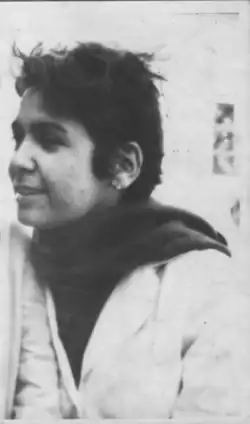
In 1976 Uruguayan teacher and political activist Elena Quinteros, part of the Party for the Victory of the People, was forced by the state forces of the dictatorship of Aparicio Méndez to contact one of her fellow activists, for which she escaped and hid in the gardens of the Venezuelan embassy in Montevideo, where two embassy diplomats tried to help her. However, they were injured, while Elena was captured and subsequently disappeared.[26]
The government of Pérez protested the events, requesting guarantees for Quinteros' life and breaking relations with Uruguay on 6 July 1976. The Uruguayan dictatorship responded by giving the Venezuelan ambassador a period of 72 hours to abandon the country.[27] Relations between both countries were interrupted for nine years, until the arrival of democracy in Uruguay during 1985.[26]
Asia
China
On 28 June 1974 diplomatic relations were established with China.[28]
Palestine
The government of CAP protected Ilich Ramírez (known as Carlos the Jackal), member of the Popular Front for the Liberation of Palestine, from British Intelligence during his stay in London, according to diplomat Elías Casado, former consul of Venezuela in London.[29]
Europe
Spain
The government of Pérez supported the process of democratization in Spain, playing a role in the negotiations for the Spanish Socialist Workers' Party (PSOE) and the Communist Party of Spain to be legalized.[19]
United Kingdom

The government of CAP protected Ilich Ramírez (known as Carlos the Jackal), member of the Popular Front for the Liberation of Palestine, from British Intelligence during his stay in London, according to diplomat Elías Casado, former consul of Venezuela in London. These orders reached Casado through several calls from the director of the private secretariat of the presidency, Gladys Vázquez, and from Cecilia Matos, Pérez's lover, asking him to watch over Carlos.[29]
Soviet Union
The government of Pérez expanded relations with the Soviet Union (USSR), broken since the government of Rómulo Betancourt as a result of his eponymous doctrine and only recently resumed during the previous government of Rafael Caldera. Invited by the government of the USSR, Pérez visited Moscow on 24 November 1976, with the intention of dealing with issues such as the expansion of cooperation between both countries in the economic and industrial sectors, and with respect to the latter, discussing oil technology.[30] According to Reinaldo Figueredo Planchart, Foreign Minister Escovar Salom refused to travel with Pérez to the Soviet Union in 1976 by order of former president Rómulo Betancourt, for which Figueredo accompanied the president in his place.[31]
Yugoslavia
On 17 March 1976 Yugoslav president Josip Broz Tito visited Venezuela, meeting with President Carlos Andrés Pérez, and signing a joint communiqué supporting the Non-Aligned Movement, where Venezuela was an observer.[32]
International trips
1974
| Date | Place | Main purpose |
|---|---|---|
| December | Lima (  Peru) |
Commemoration of the Battle of Ayacucho.[33] |
1975
| Date | Place | Main purpose |
|---|---|---|
| 17–22 March | ( Mexico) |
Return visit corresponding to the official visit to Venezuela by President Luis Echeverría the previous year.[34][35] |
1976
| Date | Place | Main purpose |
|---|---|---|
| 24 November | Moscow (  Soviet Union) |
Invitation by the Soviet government. Discussion on expanding cooperation between the two countries in the economic and industrial sectors, as well as on petroleum technology.[36] |

1977
| Date | Place | Main purpose |
|---|---|---|
| April | ( Saudi Arabia) |
Official tour of the Middle East.[37] |
| April | ( United Arab Emirates) | |
| April | ( Iran) | |
| April | ( Iraq) | |
| 27 June– 2 July |
Williamsburg, New York, Philadelphia, Chicago (  United States) |
Official visit.[38] |
| 6–9 September | Washington, D.C. ( United States) |
Attendance at the signing of the Panama Canal Treaty.[38] |
1978
| Date | Place | Main purpose |
|---|---|---|
| 6–8 August | Bogotá
( |
Participation in a summit meeting with presidents Alfonso López Michelsen of Colombia; Daniel Oduber of Costa Rica; José López Portillo of Mexico; Omar Torrijos, head of government of Panama; and Jamaican prime minister Michael Manley, concerning negotiations regarding the Panama Canal.[39] |

Corruption
The Sierra Nevada affair was a corruption scandal in Venezuela that revolved around the purchase of the Sierra Nevada ship during the first government of Carlos Andrés Pérez.[40]
Legacy
Towards the end of his first term in office, Pérez's reputation was tarnished by accusations of excessive, and disorderly, government spending. His administration was often referred to as Saudi Venezuela for its grandiose and extravagant ambitions. In addition, there were allegations of corruption and trafficking of influence, often involving members of Pérez's intimate circle or financiers and businessmen who donated to his campaign. A well-publicized rift with his former mentor Rómulo Betancourt and disgruntled members of AD all pointed to the fading of Pérez's political standing. By the 1978 elections, there was a sense among many citizens that the influx of petrodollars after 1973 had not been properly managed. The country was importing 80% of all foodstuffs consumed. Agricultural production was stagnant. The national debt had skyrocketed. And whilst per capita income had increased and prosperity was evident in Caracas and other major cities, the country was also more expensive and a significant minority of Venezuelans were still mired in poverty. This malaise led to the defeat of AD at the polls by the opposition Social Christian Party. The newly elected president, Luis Herrera Campins, famously stated in his inaugural speech that he was "inheriting a mortgaged country."
Nonetheless, the memory of CAP's first term proved powerful enough and positive enough in his 1988 electoral campaign to earn him a second term, resulting in the Second Presidency of Carlos Andrés Pérez.
See also
References
- ↑ CAP 2 Intentos [CAP 2 Attempts] (Documentary) (in European Spanish). Retrieved 2022-12-23.
- ↑ Gaceta Oficial de Venezuela, period 1974-1979.
- ↑ Stewart, William S., Change and Bureaucracy. Public Administration in Venezuela, 1978
- ↑ "Historia de Venezuela en Imágenes" [History of Venezuela in Images]. web.archive.org (in Spanish). 2007-02-06. Archived from the original on 2007-02-06. Retrieved 2026-05-07.
- ↑ "Pérez, Carlos Andrés". Diccionario de Historia de Venezuela (in Spanish). Fundación Empresas Polar.
- ↑ "La Venezuela saudita: cómo era vivir en el país del "dame dos"" [Saudi Venezuela: what it was like living in the country of "gimme two"]. Runrunes (in Spanish). 2018-11-10. Retrieved 2022-07-06.
- 1 2 "El índice de miseria en Venezuela" [The misery index in Venezuela] (PDF) (in Spanish). Archived from the original (PDF) on 12 June 2018. Retrieved 7 May 2026.
- ↑ Viva, Frontera (2020-06-19). "Venezuela Saudita: los años de bonanza" [Saudi Venezuela: the years of prosperity]. Frontera Viva Periodico Digital (in Spanish). Retrieved 2022-07-06.
- ↑ "La Política Cambiaria en Venezuela" [Exchange rate policy in Venezuela] (PDF). web.archive.org (in Spanish). Archived from the original on 2018-04-05. Retrieved 2026-05-07.
{{cite web}}: CS1 maint: bot: original URL status unknown (link) - ↑ "El Sistema Nacional de Orquestas y Coros Juveniles e Infantiles de Venezuela" [The National System of Youth and Children's Orchestras and Choirs of Venezuela]. Venezuela Tuya (in Spanish). Retrieved 2022-07-08.
- ↑ "VenezuelaTuya".
- ↑ Posible, Por Una Venezuela (2019-05-27). "RCTV: las 12 Cosas que no sabías del canal" [RCTV: the 12 things you did not know about the channel]. Por Una Venezuela Posible (in Spanish). Retrieved 2022-07-08.
- ↑ Barbar, Ricardo (2020-05-17). "CAP, el hombre que se inventó a sí mismo [II]" [CAP, the man who invented himself [II]]. Prodavinci (in Spanish). Retrieved 2023-05-02.
- ↑ "Antonio Ecarri Bolívar || Vesania del régimen contra los presos políticos" [Antonio Ecarri Bolívar || Brutality of the regime against political prisoners]. web.archive.org (in Spanish). 2016-08-25. Archived from the original on 2016-08-25. Retrieved 2026-05-07.
- 1 2 3 4 5 6 7 8 9 10 Montes de Oca, Rodolfo (2022). Sospechosos habituales. Diez aproximaciones a los antecedentes históricos del movimiento por los derechos humanos en Venezuela (1936-1999) (PDF). Caracas: Edición del Programa Venezolano de Educación-Acción en Derechos Humanos (PROVEA). pp. 135–223. ISBN 978-980-6544-74-1.
- 1 2 Giordano, Verónica (2011). "Democracia y doctrina de seguridad nacional en Venezuela, 1969-1979. Un estudio en perspectiva latinoamericana" (PDF). Miradas Transcordilleranas: 209–222.
- 1 2 Salvo, Manuel Salazar (2021-04-23). "Contreras: Historia de un intocable. Los inicios de la "Operación Cóndor"". Interferencia (in Spanish). Retrieved 2024-04-13.
- 1 2 Montes de Oca 2022, pp. 295-363.
- 1 2 3 4 5 6 Straka, Tomás (2020-05-17). "CAP, el hombre que se inventó a sí mismo [II]" [CAP, the man who invented himself [II]]. Prodavinci (in Spanish).
- ↑ Straka, Tomás (2020-05-24). "CAP, el hombre que se inventó a sí mismo [III]" [CAP, the man who invented himself [III]]. Prodavinci (in Spanish).
- ↑ "The Manifesto of Lima" (PDF). Socialist International. 1986.
- ↑ Tata Yofre, Juan Bautista (2019-08-25). "Los secretos de la reunión entre Jorge Rafael Videla y Jimmy Carter: las mentiras del general y un revelador documento confidencial" [The secrets of the meeting between Jorge Rafael Videla and Jimmy Carter: the general's lies and a revealing confidential document]. Infobae (in European Spanish).
- 1 2 3 Gómez, Uziel (2017-08-09). "El venezolano que sacó de Chile a Orlando Letelier cuestiona la pasividad de Bachelet para enfrentar el régimen de Maduro" [The Venezuelan who got Orlando Letelier out of Chile questions Bachelet's passivity in confronting the Maduro regime]. El Líbero (in Spanish).
- ↑ AP (2011-01-01). "Ex-official: Venezuela leader aided Sandinistas". Charleston Gazette-Mail.
- ↑ Leocenis García (4 October 2023). "Las visitas de los presidentes de Estados Unidos a Venezuela" [The visits of the presidents of the United States to Venezuela]. El Nacional.
- 1 2 "El día en que Venezuela rompió con la dictadura uruguaya" [The day Venezuela broke with the Uruguayan dictatorship]. El Observador.
- ↑ "Venezuela rompe sus relaciones con Uruguay" [Venezuela breaks relations with Uruguay]. El País. 7 July 1976.
- ↑ Fundación Empresas Polar. "Pérez, Carlos Andrés, gobiernos de" [Pérez, Carlos Andrés, governments of]. Dictionary of Venezuelan History. Retrieved 2022-01-08.
- 1 2 Vinogradoff, Ludmila (1994-08-28). "The Venezuelan government of Carlos Andrés Pérez protected the Jackal" [El Gobierno venezolano de Carlos Andrés Pérrez protegió a El Chacal]. El País. ISSN 1134-6582. Archived from the original on 17 August 2014.
- ↑ EFE (1976-11-25). "Visit of the Venezuelan president to the USSR" [Visita del presidente venezolano a la URSS]. El País (in Spanish). ISSN 1134-6582.
- ↑ "Reinaldo Figueredo Planchart: To rebuild Venezuela those guilty of the crisis must be punished" [Reinaldo Figueredo Planchart: Para reconstruir a Venezuela se debe castigar a los culpables de la crisis]. El Tiempo Latino (in Spanish). 2019-11-01.
- ↑ "1976 - Chronology of Venezuelan history" [1976 - Cronología de historia de Venezuela]. Fundación Empresas Polar. Retrieved 2025-03-14.
- ↑ Fundación Empresas Polar. "1974 - Cronología de historia de Venezuela" [1974 – Chronology of the history of Venezuela]. Diccionario de Historia de Venezuela (in Spanish). Retrieved 23 November 2024.
- ↑ "Declaración conjunta de los Presidentes de México y Venezuela" [Joint declaration of the Presidents of Mexico and Venezuela]. Nueva Sociedad (in Spanish). 18 May 1975. Retrieved 17 November 2024.
- ↑ "Presentación" [Presentation] (PDF). Banco Mext. Archived from the original (PDF) on 2015-04-16. Retrieved 2026-04-23.
- ↑ EFE (25 November 1976). "Visita del presidente venezolano a la URSS" [Visit of the Venezuelan president to the USSR]. El País (in Spanish). ISSN 1134-6582.
- ↑ Fundación Empresas Polar. "Pérez, Carlos Andrés, gobiernos de" [Pérez, Carlos Andrés, governments of]. Diccionario de Historia de Venezuela (in Spanish). Retrieved 9 November 2024.
- 1 2 "Visits By Foreign Leaders of Venezuela". Office of the Historian of the United States Department of State. Retrieved 10 November 2024.
- ↑ "Las vinculaciones con el exterior: Entrevistas del Presidente de México con Jefes de Estado y de Gobierno 1966-1984" [Foreign ties: Meetings of the President of Mexico with heads of state and government, 1966–1984]. Todo México. Compendio Enciclopédico 1985 [All Mexico: Encyclopedic Compendium 1985] (in Spanish). Galas Editores, Televisa SA, Enciclopedia de México, SA de CV y Banca Confia SNC. 1985. ISBN 968-7167-02-5.
- ↑ Juan Carlos Zapata (1993). Venenos del Poder. Alfadil Ediciones. pp. 71–72. ISBN 978-980-6273-78-8. Retrieved 17 July 2017.
President of Venezuela
(1974–1979) & (1989-1993) | |||||||
| First presidency |
|  | |||||
| Second presidency |
| ||||||
| Electoral history |
| ||||||
| Family |
| ||||||
| Image |
| ||||||
| Related | |||||||

| First Republic of Venezuela |  | |
|---|---|---|
| Second Republic of Venezuela | ||
| Third Republic of Venezuela | ||
| State of Venezuela | ||
| United States of Venezuela |
| |
| Republic of Venezuela | ||
| Bolivarian Republic of Venezuela | ||
Acting / interim / caretaker presidents shown in italics 1 Recognized by the National Assembly as "interim president" during the Venezuelan presidential crisis until 2023 | ||