Divergence between Anglicanism and Methodism
| Part of a series on |
| Methodism |
|---|
 |
 Christianity portal |
The divergence between Anglicanism and Methodism distinguishes the doctrine, as well as the practices of Anglicans and Methodists. This divergence occurred early on, during the lifetime of John Wesley, who is regarded as the founder of the Wesleyan Methodist tradition.[1] In the 1760s, Methodism and Evangelical Anglicanism took different trajectories, with differences becoming “distinctly apparent”.[2] Calling it "the grand depositum" of the Methodist faith, Wesley specifically taught that the propagation of the doctrine of entire sanctification was the reason that God raised up the Methodists in the world.[3][4]
Additionally, the Church of England was seen by Methodists as suffering from corruption and complacency.[5] Revivalistic worship, as well as certain doctrines distinguish Wesleyan Methodism from Anglican doctrine, particularly the teaching of the New Birth (first work of grace), as well as the teaching of the second work of grace—entire sanctification—the eradication of original sin from the heart of a believer, who is then made perfect in love.[6][7] In several ways, Methodism was influenced by Moravianism in "church organization, structure, worship and hymnody". Methodist worship, as well as the evangelism and missionary work of Methodist itinerant preachers John Wesley, George Whitefield and William Seward, included extemporaneous prayer and open-air preaching, which were disdained by Anglican clergy who resented and vehemently opposed the Evangelical Revival.[8][9]
Worship and evangelization
Early Methodists, in general, held a "distaste for the forms and trappings of Anglicanism".[10] Anglican theologian Jennifer Woodruff Tait writes that "For Methodists, Wesley's critique of Anglican legalism, corruption, and complacency (of which there was plenty in the 18th century) culminates in the establishment of Methodism".[5] This is reflected in the Historical Statement in The Book of Discipline of the Southern Congregational Methodist Church, which states:

God has always had a people — those who follow His teachings and are the salt of the earth. In the early years of the 18th century, the organized church had become ritualistic and filled with pomp and pageantry as the order of worship. The Anglican Church taught religion to be an intellectual and moral habit — without intervention of the Divine Being. In this setting, God's people were few in number. A practical religious movement based on the doctrine of a personal experience of salvation through faith was set in motion and shocked the formal churches of the 1700's. The name Methodist was one of the titles used to describe the participants in the new form of worship and because it continued to be an accurate description, Methodist was adopted as the official name.[11]
The Sunday Service of the Methodists, the first liturgical texts of Methodism, is a revision of the Anglican Book of Common Prayer by John Wesley, who supplanted the word "bishop" with "superintendent", "removed the service for private baptism", and "removed words which seem to presume the inevitability of regeneration in baptism".[10][12] Key to Methodist soteriology is the doctrine of the first work of grace—the New Birth—a personal conversion experience to faith in Jesus. Explicating Wesleyan Methodist theology, Dale M. Coulter states that "While prevenient grace [given in Holy Baptism] forms truth and goodness in human persons, it does not form Christ within them." He writes further that "In the new birth, the Spirit conceives Christ in the heart by reshaping the heart into the likeness of Christ."[13] This personal experience of the new birth is a common doctrine among Evangelical traditions, such as Methodists and Baptists—who like Methodists, branched off of Anglicanism.[14][15] Christian theologian Henry Bett deemed the changes reflected in The Sunday Service of the Methodists as theologically "very significant".[12]
Ryan Nicholas Danker wrote that the early Methodists ignored "numerous boundaries in their drive to preach the New Birth", including those boundaries of "hierarchy, law, sex, age, wealth, education, and religious vocation."[2] Methodists were accused by the Anglican mainstream of being "enthusiasts" and were seen as "disturbers of the world."[2][16] Gerald Goodwin described the Church of England as being "the one major church hostile to the Great Awakening" which it saw as the manifestation of "preposterous enthusiasm".[17] Street preaching was widely employed by Methodist preachers to call people to repentance, as well as to preach the New Birth and entire sanctification.[18][16] On April 2, 1739, John Wesley wrote in his journal that he "submitted himself to be more vile and proclaimed in the highways the glad tidings of salvation, speaking from a little eminence in a ground adjoining to the city, to about three thousand people."[18] Mobs, led by both Anglican clergy and laity, were violent towards the Methodists.[19] On 24 August 1748, John Wesley was "attacked by a mob in a British town called Roughlee while preaching."[20] William Seward, protégé of George Whitefield, was stoned to death by an angry mob in Caerleon, becoming the first Methodist martyr.[21][22]
Anglican bishop Edmund Gibson dismissed the Journal of Calvinistic Methodist preacher George Whitefield as "tainted with enthusiasm" and "in August 1739 Gibson wrote his Pastoral Letter, cautioning the people in his diocese—which included the American colonies—against Whitefield's 'enthusiasm'."[23]
No Anglican rector would allow Whitefield to preach in their churches in London, with the same being the case in the city of Bristol.[24] Being barred from preaching in Anglican churches led George Whitefield to preach in the fields, where large crowds gathered to hear him.[9]
The contentions aired by the Methodists against the established Anglican Church spared no one, including the clergy. While Wesley always maintained a reserved and diplomatic tone, others were not so reserved. Seward, for example, maintained that the “scarlet whore of Babylon” was not more corrupt in practice and principle than the Anglican clergy.[25]
Subsequently Evangelical Anglicans, who often held to Reformed theology, distanced themselves from Methodists:[5]
While sympathetic to the desire for "heart religion" that John preached, most Evangelicals desperately wanted to stay within the church, within which they were, in Ryan's words, an "embattled minority," They were gun-shy of associating with a movement criticized by Anglicanism's non-Evangelical members as politically seditious and religiously irresponsible. They viewed Methodism as dangerously close to the "conventicles" of an earlier era which had ultimately led to the overthrow of both state church and King; they distrusted John's use of lay preachers and the attempts of those lay preachers to administer Communion; and they resented Methodist preachers' disregard for parish boundaries by preaching to their flocks.[5]
To discourage Methodist itinerant preachers from open-air preaching various measures were sometimes resorted to. Aside from rowdy and threatening mobs, typically incited by various members of the Anglican clergy, a drummer-boy would sometimes be instructed to stand along side the preacher, and beat his drum loudly, drowning out the words of the sermon. Both Whitefield and Harris had to endure this sort of treatment. Itinerant preachers were at times also confronted and sharply reprimanded for drawing away people, and any contributions they would otherwise offer to the Anglican Church.[26][27]
Methodists, including leaders John Wesley and George Whitefield, employed extemporaneous prayer and Gibson labelled extemporaneous prayer "as a rejection of the 'Established Worship' outlined in the liturgy."[23] In the present-day, Methodist worship includes extemporaneous prayer as normative, though it is not common in Anglican services.[28][29] In general, Dissenters from the Church of England held that liturgical prayer was "performative, artificial, boring and repetitious, whereas free-form preayer was authetntic and bespoke the heart's true desire."[29] Methodism's first liturgical text The Sunday Service of the Methodists omitted "most of the holy days" that were present in the Anglican Book of Common Prayer as John Wesley saw them as "answering no valuable end."[30]

Methodism has incorporated particular distinctive worship practices, most of which are uncommon in Anglican praxis. The Oxford Handbook of Methodist Studies explicates this:[31]
In 1768, six Methodist students were expelled from the University of Oxford, leading to further deterioration between Anglicans and Methodists.[5] The Church of England came to refuse Holy Communion to known Methodists and in Great Britain, in the "1795 conference, the Methodist leaders decided to allow the administration of sacraments [in Methodist meetinghouses] if the majority of church officials consented."[32][33]
The Anglican worship that Methodists shunned was a text-based liturgy. Sunday morning included three services from the Book of Common Prayer: Morning Prayer, the Litany, and ante-communion (i.e. the early parts of the communion service). It culminated with a sermon (Hatchett 1976: 369–85; Spinks 2006: 492–533). The result was a lengthy period filled with the reading of Psalms, other biblical texts, prayers, and other prescribed acts of worship, and punctuated with the occasional singing of metrical Psalms. Evening Prayer rounded out Sunday. The dominant architectural feature, a multi-decked pulpit, reinforced the text-centredness. The lowest part was a desk for a clerk, who led the congregation in their responses and singing. Behind and above was the reading desk for the minister. Here he read the services and the appointed Scripture lessons, using his Bible, Prayer Book, and metrical Psalter. Above that desk was the pulpit from which the sermon was read. Anglican worship thus consisted of a dialogue between these leaders and the congregation, each constituency reciting their parts. Anglican worship had to contend with the levelling dynamic of group reading. Anyone familiar with worship that involves extended reading by congregations soon realizes the measured monotone that corporate reading can produce. Variety in pace and tone are lost as the congregation finds its common reading voice. Where worshippers were illiterate (universal literacy had yet to come), parishioners would have known the service by heart; but equally the memorization would have restricted innovation and encouraged a monotonous style. … But Methodists preferred worship that left them breathless, overwhelmed by a sense of God's presence that was explosive (not just solid), Scripture-experiencing (not just infused with Scripture texts), and emotional (not just rational). …The foundation was the preaching service involving prayer, songs, Scripture, and sermon (and sometimes an exhortation), concluded by a closing prayer and song. The service was very flexible, allowing adaptation for indoors or outdoors and could be either spontaneous or scheduled (the original meaning for a preacher’s ‘appointment’). There were no prescribed texts to read.[31]

Historically, Methodist churches have devoutly observed the Lord's Day (Sunday) with a morning service of worship, along with an evening service of worship (with the evening service being aimed at seekers and focusing on "singing, prayer, and preaching"); the holding of a midweek prayer meeting on Wednesday evenings has been customary.[35][36] 18th-century Methodist church services were characterized by the following pattern: "preliminaries (e.g., singing, prayers, testimonies), to a 'message,' followed by an invitation to commitment", the latter of which took the form altar call—a practice that a remains "a vital part" of worship.[37][38] A number of Methodist congregations devote a portion of their Sunday evening service and mid-week Wednesday evening prayer meeting to having congregants share their prayer requests, in addition to hearing personal testimonies about their faith and experiences in living the Christian life.[39][40] After listening to various members of the congregation share their salvation testimonies, voice their prayer requests, and share their praise reports, congregants may kneel for intercessory prayer.[41][36] Influenced by the practice of the Moravian Church—another part of the Evangelical Revival—Methodists adopted the observance of the lovefeast (with bread and water), which are typically held on a quarterly basis.[42] In certain Methodist connexions, such as the Missionary Methodist Church and the New Congregational Methodist Church, feetwashing is practiced at the time that the Lord's Supper is celebrated.[43][44] Foot-washing was once practiced in the Anglican Church but was entirely phased out by 1754. Modern Anglican/Episcopal provinces, however, have reintroduced foot washing for the liturgical observance of Maundy Thursday.[45]
Following the lead of the Moravian Brethren, John Wesley, adopted watch night services in 1740, sometimes calling them Covenant Renewal Services.[46] The services provided Methodist Christians with a godly alternative to the drunken revelry of New Year's Eve.[34] A Methodist watchnight service includes singing, spontaneous prayers and testimonials, as well as scripture readings and Holy Communion.[47][48] Methodist revival services and camp meetings have been characterized by groaning and shouting, as people sought the fullness of salvation that Methodists taught to be embodied by the experience of entire sanctification.[49][50] To outsiders, Wesleyans were labeled as "Shouting Methodists" due to their free expression during worship.[51] Revival services are often held for a week at least once a year in a number of Methodist churches.[52]
Summarizing the worship of Methodists, in contrast to that of Anglicans, academics James E. Kirby and William J. Abraham state:[31]
The difference between Anglican and Methodist worship went deeper than varying practices. The core character, what liturgical scholar James White has called the ‘central ethos’ (White 1989: 23) for each, was poles apart. Even though Methodism was a movement derived from Anglicanism, the character of its worship largely existed outside that root. Indeed, at many points, it was more similar to parallel heart-religion movements than it was to its Anglican origins. These parallel movements included Continental Pietists, some Baptists and Presbyterians, and even some Quakers. The defining principle for this alternative world was ‘experimental religion’ (to use the eighteenth-century phrase). The hallmark was an emphasis upon an inwardly perceived experiencing of God’s grace, especially as it dealt with salvation. This ethos defined the core character of Methodist worship and showed the points at which it differed from Anglicanism.[31]
Doctrines
The formularies of Anglicanism—including the Thirty-nine Articles of the Church of England, along with the The Books of Homilies—were drafted by Thomas Cramner, who held to Reformed (Calvinist) soteriology and sacramentology.[53][54] The Thirty-Nine Articles were approved by the Continental Reformed Churches, and the view of the Lord's Supper explicated in them, was viewed as reflecting the theology of John Calvin.[55] There was "emphatic official expression of the Church's Calvinist identity when James dispatched official delegates to attend the Reformed Synod of Dort in the Netherlands."[56] Benjamin Jenks (1646-1724) held that Reformed doctrine was the "express doctrine of the Church of Engand" and insisted that since the Reformation, the majority of English clergy held to Reformed soteriology.[57] Though early Anglicanism adhered to a "a broad Calvinist or Reformed consensus", contenders for Arminian doctrine in the Church of England emerged in the 17th century.[58] The Wesleyan-Arminian theology of Wesleyan Methodism differed from Classical Arminianism, however, by a "stronger Augustinian view on natural corruption; it lays greater stress of the subjective experience of conversion and regeneration; and adds a few additional doctrines, namely:"[59]
1. The doctrine of the universality of divine grace not only in its intention, but in its actual offer. (This was derived from the Quaker doctrine of universal light.)
2. The doctrine of the witness of the Spirit or the assurance of salvation (Rom. 8:15, 16).
3. The doctrine of perfectionism (also borrowed from the Quakers, and based on such passages as Matt. 5:48; Phil. 3:15; Heb. 6:1; 10:4; 1 John 3:6; 5:18).[59]
The Twenty-five Articles of Religion are the historic doctrinal statement of Wesleyan Methodism. John Wesley revised the Thirty-nine Articles of the Church of England, removing the Reformed (Calvinistic) parts among others, reflecting Wesleyan-Arminian theology.[60][61][62] In particular, the article on original sin was truncated, in view of the core Wesleyan Methodist doctrine of entire sanctification.[62] The Reformed theology of the real spiritual presence was retained by Methodists "and is well presented in the Holy Communion hymns of Charles Wesley."[63][64][65]
Though adhering to a variant of Reformed (Calvinist) theology, unlike the historic Reformed Churches the Calvinistic Methodists teach the Methodist doctrine of the New Birth—a personal experience of salvation; their worship, as with that of Wesleyan Methodists, includes extemporaneous prayer and preaching, thus diverging from Anglicanism.[66] Reformed Methodist leader George Whitefield experienced an evangelical converion in 1735 and his sermon The Nature and Necessity of our New Birth in Christ Jesus in Order to Salvation (1737) was widely read.[66]
Outward holiness
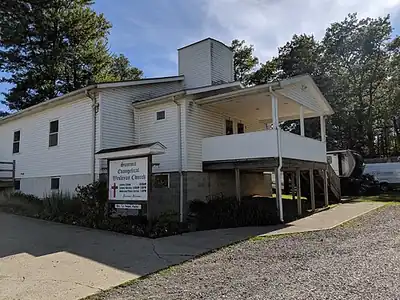
Early Methodism was criticized as being an evangelical "heart religion" that appealed to the labouring poor.[67] Certain aspects of Methodism "deterred many social elites" as the "honour code with still informed eltie values sat awkwardly against Methodism's call to repentance and its emphasis on human guilt."[67] Commensurate with the Methodist doctrine of outward holiness, early Methodists wore plain dress, with Methodist clergy condemning "high headdresses, ruffles, laces, gold, and 'costly apparel' in general".[68] John Wesley recommended that Methodists annually read his thoughts On Dress;[69] in that sermon, Wesley expressed his desire for Methodists: "Let me see, before I die, a Methodist congregation, full as plain dressed as a Quaker congregation."[70] The 1858 Discipline of the Wesleyan Methodist Connection thus stated that "we would ... enjoin on all who fear God plain dress."[71] Peter Cartwright, a Methodist revivalist, stated that in addition to wearing plain dress, the early Methodists distinguished themselves from other members of society by fasting once a week, abstaining from alcohol (teetotalism), and devoutly observing the Sabbath.[72]
Over time, many of these practices were relaxed in mainline Methodism, although practices such as teetotalism and fasting are still encouraged, in addition to the current prohibition of gambling.[73] Denominations of the conservative holiness movement, such as the Allegheny Wesleyan Methodist Connection and Evangelical Methodist Church Conference, continue to reflect the spirit of the historic Methodist practice of wearing plain dress, with members abstaining from the "wearing of apparel which does not modestly and properly clothe the person" and "refraining from the wearing of jewelry" and "superfluous ornaments (including the wedding ring)".[74][75] The Fellowship of Independent Methodist Churches, which continues to observe the ordinance of women's headcovering during prayer and worship, stipulates "renouncing all vain pomp and glory" and "adorning oneself with modest attire."[76]
Ecclesiology and polity

Methodist theologian David N. Field, with regard to Methodist ecclesiology, writes:[77]
While Wesley’s terminology varies, he understands the visible church as a community of people who have been transformed by the grace of God manifested in holiness of heart and life. It is the gathering of the scattered members of the invisible church in a particular location. This location can range from a relatively small community to a nation. Such a visible church is “a branch of the one, true, Church of Christ”. Holiness of heart and life and not institutional structures constitute the visibility of the church. Negatively, this means that institutional churches were mixed bodies made up of genuine believers, those who professed to believe and those who had “the form of godliness without the power.”[77]
Methodism was influenced by Moravianism in the areas of "church organization, structure, worship and hymnody."[78] Within the church:
John Wesley borrowed the idea of bands from the Moravians. A band, of five to ten people, was smaller than the more relaxed class meeting, and meant to be more intense. Men, women, the married and the single met in separate bands once a week, confessed their sins and prayed for one another.[78]
Methodism employs various models of ecclesiastical polity, depending on the Methodist denomination. Connexionalism is the term used to describe how a number of Methodist denominations are organized.
In the Evangelical Wesleyan Church, Free Methodist Church and Global Methodist Church, a modified form of episcopal polity is used, though unlike major branches of Evangelical-Lutheranism and Anglicanism, Methodist denominations have not shared in the historic episcopate.[79] In these Methodist denominations, the bishop "is an office within the presbyterate and not an order of ministry", in contrast to Anglicanism, which has a threefold ministry.[79] John Wesley held that the offices of bishop and presbyter constituted one order; Methodism thus has two orders of ministry—the presbyterate and diaconate.[80] Methodism's first liturgical text The Sunday Service of the Methodists substituted the word "priest" used in the Anglican Book of Common Prayer with "minister" or "elder", removing "any trace of sacerdotalism", with Wesley reflecting the views of evangelical Dissenters of his day.[81]
A number of Wesleyan Methodist denominations have congregational polity, including the Congregational Methodist Church, the First Congregational Methodist Church, the Southern Congregational Methodist Church, and the New Congregational Methodist Church.[82]
Other Wesleyan Methodist congregations are independent, though they typically associate with like-minded congregations and form groupings such as the Association of Independent Methodists and Fellowship of Independent Methodist Churches.
The Calvinistic Methodist Church, a Reformed Methodist denomination, has presbyterian polity.[83]
See also
- William Seward (preacher), Methodist martyr
References
- ↑ Danker, Ryan Nicholas (14 May 2016). Wesley and the Anglicans: Political Division in Early Evangelicalism. InterVarsity Press. pp. 15–16, 74–75. ISBN 978-0-8308-9964-7.
Polity and method would play a large role in Evangelical arguments with Wesley, especially for Samuel Walker and Thomas Adam, and to a certain extent William Grimshaw, one of Wesley's most ardent Evangelical supporters. These issues alone, however, do not explain the gradual shift that took place as Methodism and Evangelical Anglicanism diverged.
- 1 2 3 Danker, Ryan Nicholas (14 May 2016). Wesley and the Anglicans: Political Division in Early Evangelicalism. InterVarsity Press. pp. 17, 74. ISBN 978-0-8308-9964-7.
- ↑ George, 2017, p. 225
- ↑ Gibson, 2018
- 1 2 3 4 5 Tait, Jennifer Woodruff (24 January 2017). "Old evangelicals and "New Methodists"". Christian History Institute. Retrieved 1 August 2026.
- ↑ Tucker, 1918, p. 49
- ↑ Clarke, 2008, pp.13-26
- ↑ Goodwin, 1966, pp. 343-371
- 1 2 Kelley, 2018
- 1 2 Mahoney, James (23 January 2024). "Peculiar Prophets: American Methodism as Irregular, Disestablished Anglicanism". Firebrand Magazine. Retrieved 28 July 2026.
- ↑ The Book of Discipline of the Southern Congregational Methodist Church (Fourth ed.). Southern Congregational Methodist Church. 2014. p. iii.
- 1 2 Bett, Henry (18 August 2016). The Spirit of Methodism. Wipf and Stock Publishers. pp. 68–69. ISBN 978-1-5326-0507-9.
In Baptism the sign of the cross is omitted, and also the sentence 'that it hath pleased God to regenerate this infant with His Holy Spirit'.
- ↑ Coulter, Dale M. (2 September 2025). "Wesleyans, Grace, and the Ambiguities of Water Baptism". Firebrand Magazine. Retrieved 28 July 2026.
- ↑ Ingersoll, Julie (2009). Baptist and Methodist Faiths in America. Infobase Publishing. pp. 106–107. ISBN 978-1-4381-0250-4.
- ↑ Abraham, William J.; Kirby, James E. (24 September 2009). The Oxford Handbook of Methodist Studies. OUP Oxford. ISBN 978-0-19-160743-1.
The difference in Methodist preaching also included content. Consider the contrasts that Freeborn Garrettson, who grew up Anglican but later became a Methodist, highlighted in his reminiscing (Ruth 2005: 74–80). What he remembered hearing in his upbringing were 'moral sermons' read. In his later appraisal, this meant that there was no gospel preached. In particular, the new birth (i.e. regeneration) was not spoken of or heard. (Anglicans would have assumed that the entire congregation was already regenerate by virtue of being baptized as infants. Why speak about what one already presumes is true for the people?) In contrast, Methodist preachers sought to proclaim an experiential gospel powerfully or, in the words of Methodist bishop Francis Asbury, they were to 'feel for the power' (Wigger 1998: 77). If Methodists thought Anglicans preached 'moral sermons', in contrast they sought to proclaim a 'saving knowledge of Christ' and a 'spiritual and experimental [i.e. experiential] knowledge of repentance, faith, regeneration, and sanctification' (Asbury 1958: 2. 597).
- 1 2 Richey, Russell E. (2 March 2015). Methodism in the American Forest. Oxford University Press. p. 4. ISBN 978-0-19-935963-9.
Soon John Wesley and his nascent Methodist movement found such "natural" venues a necessary recourse. Angered over his untrained interlopers, their intrusion into the parishes, and their emotion-eliciting preaching, Anglican clergy increasingly barred Wesley and his preachers from their churches and made field preaching an evangelical necessity.
- ↑ Tirenin G. “All Say He is a Downright Methodist”: The Ministry and Evangelical Loyalism of the Rev. William Stringer. Church History. 2024;93(1):44-62. doi:10.1017/S0009640724000696. Page 45.
- 1 2 Wingeier-Rayo, Philip (22 July 2025). John Wesley and the Origins of Methodist Missions. Abingdon Press. ISBN 978-1-7910-3517-4.
In addition to the doctrine of salvation by faith, the formation of accountability groups, another important characteristic to the success of the Methodist revival was street preaching.
- ↑ "Wednesbury: Most unwelcoming to strangers - at least it was in 1743!". John Wesley’s New Room. Retrieved 29 July 2026.
- ↑ Gryboski, Michael (20 August 2023). "This week in Christian history: 'Martyr Synod,' John Wesley attacked, Puritan leader dies". Christian Post. Retrieved 29 July 2026.
- ↑ "Great Moments in Methodist Missions: William Seward". Christ Church Memphis. Retrieved 29 July 2026.
- ↑ Dallimore, Arnold (1970). George Whitefield : the life and times of the great evangelist of the eighteenth-century revival. London: Banner odf Truth Trust. p. 584. ISBN 978-0-8515-1300-3.
- 1 2 Lewis, Simon (2021). Anti-Methodism and Theological Controversy in Eighteenth-Century England: The Struggle for True Religion. Oxford University Press. p. 16. ISBN 978-0-19-285575-6.
- ↑ Potter, Charles Francis (1929). The Story of Religion as Told in the Lives of Its Leaders. Grossett and Dunlap. p. 486.
- ↑ Tucker, 1918, pp. 12-13
- ↑ Morgan, 1852, pp. 36, 49, 57
- ↑ Dallimore, 1980, p. 116
- ↑ Sigler, R. Matthew (4 July 2018). Methodist Worship: Mediating the Wesleyan Liturgical Heritage. Taylor & Francis. ISBN 978-0-429-95992-9.
Among the "distinctive features" of the Methodist worship tradition that White often highlighted was the "mixture of extemporaneous and fixed prayers" used in early Methodism.
- 1 2 Winner, Lauren F. (1 January 2010). A Cheerful and Comfortable Faith: Anglican Religious Practice in the Elite Households of Eighteenth-century Virginia. Yale University Press. p. 96. ISBN 978-0-300-12469-9.
- ↑ "Religion, Theology, and Biblical Literature". Methodist Magazine and Quarterly Review. G. Lane & P. B. Sandford: 155. 1875.
- 1 2 3 4 Abraham, William J.; Kirby, James E. (24 September 2009). The Oxford Handbook of Methodist Studies. OUP Oxford. ISBN 978-0-19-160743-1.
- ↑ Tucker, Robert Leonard (2 December 2008). The Separation of the Methodists from the Church of England. Wipf and Stock Publishers. p. 161. ISBN 978-1-60608-302-4.
The Methodists were too poor to own sittings in the Church, and when they crowded large churches to hear good sermons they were ordered out when it came time for the communion. The clergy did not want Methodists at their communion services.
- ↑ Cendana, Kat (7 May 2018). "Methodists Separate from Church of England 1795 – Amazing Bible Timeline with World History". Amazing Bible Timeline. Retrieved 1 August 2026.
- 1 2 Anna M. Lawrence (5 May 2011). One Family Under God: Love, Belonging, and Authority in Early Transatlantic Methodism. University of Pennsylvania Press. ISBN 978-0812204179.
- ↑ Tucker, Karen B. Westerfield (27 April 2011). American Methodist Worship. Oxford University Press. pp. 24–25. ISBN 978-0-19-045420-3.
- 1 2 "Prayer". Wilmore Free Methodist Church. 2024.
We gather each Wednesday at 7:00 p.m. for singing, joyful thanksgiving, sharing, and prayer. Anyone is welcome to come and share a burden for us to bear together or a blessing for us to celebrate together.
- ↑ Tucker, Karen B. Westerfield (2011). American Methodist Worship. Oxford University Press. p. 46. ISBN 978-0199774159.
- ↑ Coleman, Robert E. "The Origin of the Altar Call in American Methodism". Asbury Theological Seminary. Retrieved 22 May 2024.
- ↑ Catechism of the Pillar of Fire Church. Pillar of Fire Church. 1948. pp. 39–40.
- ↑ Abraham, William J.; Kirby, James E. (24 September 2009). The Oxford Handbook of Methodist Studies. OUP Oxford. ISBN 978-0-19-160743-1.
The focus on experience was likewise shown in the importance of testifying in Methodist worship. Whether on a spontaneous basis or in services largely devoted to testimonies (the love feast), Methodists were quick to testify of their experience of God's saving grace. Testifying was not limited to ministers since all Methodists were expected to be able to name what God had done for them. Whenever a Methodist acknowledged that Christ had died 'for me' and spoke of when she or he had felt the inward witness of the Spirit, it meant the gospel was neither remote nor theoretical.
- ↑ Adams, Michelle Medlock (7 January 2015). "God Don't Make No Junk!". Guideposts. Retrieved 15 March 2026.
When I was a little girl, growing up in the Bedford (IN) Free Methodist Church, I absolutely loved going to kids church. Our two leaders, Ivan Hunter and Donna Cummings, not only taught me important Bible stories, but that Jesus loved me unconditionally. Ivan would share his salvation testimony every chance he got, telling us that if Jesus could love him, then He could love anyone.
- ↑ Tovey, Phillip (24 February 2016). The Theory and Practice of Extended Communion. Routledge. pp. 40–49. ISBN 9781317014201.
- ↑ Melton, 1987, p. 275
- ↑ Missionary Methodist Church, p. 7
- ↑ Frykholm, 2020,The Christian Century, Essay
- ↑ "Watch Night services provide spiritual way to bring in New Year". The United Methodist Church. Retrieved 28 December 2011.
Methodism founder John Wesley originated Watch Night services in the mid-18th century, sometimes calling them Covenant Renewal services. The original services were spontaneous prayer services designed to deepen the spiritual life of Methodists.
- ↑ "Watch Night services provide spiritual way to bring in New Year". The United Methodist Church. Retrieved 28 December 2011.
The service is loosely constructed with singing, spontaneous prayers and testimonials, and readings, including the Covenant Renewal service from The United Methodist Book of Worship (pp. 288-294).
- ↑ "Watch Night of Freedom". Discipleship Ministries. 2007. Retrieved 1 January 2021.
The Watch Night service is today most often held on New Year's Eve, sometimes concluding at midnight, or on New Year's Day.
- ↑ Richey, Russell E. (2015). Methodism in the American Forest. Oxford University Press. p. 155. ISBN 978-0-19-935962-2.
Cookman described this one and three other camp meetings in a longish article for Methodism's Christian Advocate. "Two leading facts met my observation at all these meetings," he insisted. "First, the interest in the mind of the Church respecting the experience of personal holiness. Every where ministers and people were groaning for full redemption in the blood of the Lamb. I have seen hundreds at the same moment prostrated before God in the spirit of entire consecration, and concerned to appropriate Jesus as their full and perfect Saviour."
- ↑ Synan, Vinson (25 August 1997). The Holiness-Pentecostal Tradition: Charismatic Movements in the Twentieth Century. Wm. B. Eerdmans Publishing. p. 9. ISBN 978-0-8028-4103-2.
At times the emotions of the sanctified Methodists would exceed the limits of control. "Some would be seized with a trembling, and in a few moments drop on the floor as if they were dead; while others were embracing each other with streaming eyes, and all were lose in wonder, love and praise," wrote one observer. Another noted that some wept for grief while others shouted for joy "so that it was hard to distinguish one from the other." At times the congregations would "raise a great shout" that could be heard for miles around.
- ↑ Smith, Lillian C.; Beasley, Erin; Coleman, Justin; Caldwell-Gross, Jevon; Lightsey, Pamela R.; Johnson, F. Willis; Ross, Vance P.; Graves, Rodney Lorenzo; Butler, Tori C.; Rasmus, Rev Rudy (3 November 2020). I'm Black. I'm Christian. I'm Methodist. Abingdon Press. ISBN 978-1-7910-1710-1.
In the earliest days of Methodism, God's Spirit moved mightily. In John Wesley's lifetime, it was reported that when he preached, conviction of the Holy Spirit would manifest mightily and people would subsequently fall out, experience the shakes, and experience a holy laughter. Many people were reportedly "slain in the Spirit." In one instance, John Wesley recounts the following incident in his journal on Thursday, April 25, 1739, "Immediately one, and another, and another sunk to the earth: they dropped as if they were thunderstruck. One of them cried aloud." His journals also record him praying to expel demons. The openness to free expression in worship may have been an additional reason that free and enslaved Africans were attracted to the Methodists in America. That free expression continued into the next century. In the 1800s, Methodists were derided with the label "Shouting Methodists". Methodists were initially known for their enthusiasm. American evangelist, pastor, and teacher R.A. Torrey (1856-1928) wrote the following to describe an encounter he had with the Holy Spirit: "Sometime after this experience (I do not recall just how long after), while sitting in my room one day...suddenly...I found myself shouting (I was not brought up to shout and I'm not of a shouting temperament, but I shouted like the loudest shouting Methodist), Glory to God, glory to God, glory to God,' and I could not stop."
- ↑ "Rev. B.N. Miner Conducts Annual Winter Revival Series, Pastor of Free Methodist Church in Baltimore, Md". Houghton Star. 3 February 1944.
- ↑ González, Justo L. (1987). A History of Christian Thought: From the Protestant Reformation to the twentieth century. Abingdon Press. ISBN 978-0-687-17184-2.
It is clear that, in rejecting Roman Catholic doctrine on this point, Cranmer has also rejected Luther's views and adopted Calvin's position. The sacrament is not merely a symbol of what takes place in the heart, but neither is it the physical eating of the body of Christ. This must be so, because the body of Christ is in heaven and therefore our participation in it can only be spiritual. Only the believers are the true partakers of the body and blood of Christ, for the unbelievers eat and drink no more than bread and wine—and condemnation upon themselves, for the profanation of the Lord's Table. These views are reflected in the Thirty-nine articles, of which the twenty-eighth says that "the Body of the Christ is given, taken, and eaten, in the Supper, only after an heavently and spiritual manner. The next article says of the wicked that "in no wise are they partakers of Christ," although "to their condemnation [they] do eat and rink the sign or Sacrament of so great a thing." This marked Calvinistic influence would prove very significant for the history of Christianity in England during the seventeenth century…
- ↑ Samuel, Chimela Meehoma (28 April 2020). Treasures of the Anglican Witness: A Collection of Essays. Partridge Publishing. ISBN 978-1-5437-5784-2.
In addition to his emphasis on Bible reading and the introduction to the Book of Common Prayer, other media through which Cranmer sought to catechize the English people were the introduction of the First Book of Homilies and the 39 Articles of Religion. Together with the Book of Common Prayer and the Forty-Two Articles (which were later reduced to thirty-nine), the Book of Homilies stands as one of the essential texts of the Edwardian Reformation, and they all helped to define the shape of Anglicanism then, and in the subsequent centuries. More so, the Articles of Religion, whose primary shape and content were given by Archbishop Cranmer and Bishop Ridley in 1553 (and whose final official form was ratified by Convocation, the Queen, and Parliament in 1571), provided a more precise interpretation of Christian doctrine to the English people. According to John H. Rodgers, they "constitute the formal statements of the accepted, common teaching put forth by the Church of England as a result of the Reformation."
- ↑ Fisher, George P. (1891). "The Religious History of England". The Chautauquan. 12 (4). M. Bailey: 435.
The Anglican Church, which had now adopted the Protestant faith, did not differ from the Protestant churches on the Continent in ay important respect as regards matters of doctrine. The Articles of the Church of England were approved by Calvinists on the Continent. On the subject of the Eucharist, which was the principal point of doctrinal controversy among the Protestant churches, the opinions of Cranmer, after he ceased to be a Lutheran, were coincident with those of the Calvinists abroad.
- ↑ Milton, Anthony (26 January 2017). The Oxford History of Anglicanism, Volume I: Reformation and Identity c.1520-1662. Oxford University Press. ISBN 978-0-19-108461-4.
- ↑ Griesel, Jake; Counsell, Esther (16 April 2024). Reformed identity and conformity in England, 1559–1714. Manchester University Press. ISBN 978-1-5261-6796-5.
Jenks furthermore considered the Reformed doctrine of election and its concomitnts to be 'the express doctrine of the Church of England', and he insisted that the majority of English clergy since the Reformation upheld this view. As far as Jenks was concerned, therefore, Reformed soteriological orthodoxy was Church of England orthodoxy.
- ↑ Sedgwick, Peter H. (5 November 2018). The Origins of Anglican Moral Theology. BRILL. p. 37. ISBN 978-90-04-38492-7.
- 1 2 Schaff, Philip (1893). Theological Propaedeutic: A General Introduction to the Study of Theology, Exegetical, Historical, Systematic, and Practical, Including Encyclopaedia, Methodology, and Bibliography: a Manual for Students. Charles Scribner's Sons. p. 347.
- ↑ Melton, J. Gordon (1 January 2005). Encyclopedia of Protestantism. Infobase Publishing. p. 48. ISBN 9780816069835.
Among the items deleted by Wesley as unnecessary for Methodists were articles on Of Works Before Justification, which in Calvinism are largely discounted, but in Methodism lauded; Of Predestination and Election, which Wesley felt would be understood in a Calvinist manner that the Methodists rejected; and Of the Traditions of the Church, which Wesley felt to be no longer at issue.
- ↑ Phelan, Macum (1916). Handbook of All Denominations. Smith & Lamar. p. 113.
A discipline was adopted, contianing the General Rules and Articles of Religion, abridged by Wesley from the Thirty-Nine Articles, the new form being stripped of all distinctly Catholic and Calvinistic elements, and a liturgy, also prepared by Wesley.
- 1 2 Hastings, James; Selbie, John Alexander; Gray, Louis Herbert (1928). Encyclopaedia of Religion and Ethics. Scribner. p. 611.
For the guidance of his people he revised the Thirty-nine Articles, reducing their number by omission and abbreviation to 25 (so printed in the Wesleyan Methodist Service Book): the changes are in many instances significant. ... Article. ix., 'Of Original or Birth-Sin,' is also cut down materially: the Wesleyan teaching on Sanctification appeared to conflict with the assertion that 'this infection of nature doth remain, yes in them that are regenerated.' ... The general effect of the recasting is to emphasize the Protestant and Evangelical character of the formulary, to set aside the principle of State-establishment, and to eliminate Calvinism. ... The revised Articles of Religion were, however, from the first incorporated, with certain necessary local adaptations, in the constitution of the Methodist Episcopal Church of America (see Doctrine and Discipline, etc., of this Church, pp. 21-26).
- ↑ Douglas, J. D.; Toon, Peter (5 September 2023). The Concise Dictionary of the Christian Tradition: Doctrine, Liturgy, History. Zondervan. p. 318. ISBN 978-0-310-15734-2.
Receptionism: The teaching that while the bread and wine remain unchanged after consecration, the faithful communicant receives with them Christ's spiritual body and blood. This is the most widely held view in the Anglican and Methodist churches of the Real Presence of Christ and is well presented in the Holy Communion hymns of Charles Wesley (1707-1788).
- ↑ Mahoney, James (9 July 2024). "The Methodist's Duty: Wesley's "Constant Communion" and the 21st Century Methodist". Firebrand Magazine. Retrieved 4 April 2025.
Methodists say with Wesley that Holy Communion is a sacrament, and though we choose not to define our understanding along the lines of transubstantiation or consubstantiation (Methodist Articles of Religion, Art. XVIII), we do nonetheless believe in the Real Presence (that Jesus is present "after a spiritual manner," Art. XVIII) and that this sacrament is both medicine and food.
- ↑ Collins, Kenneth J. (2025). "Worship and the Sacraments (Part 2)". Biblical Training. Retrieved 4 April 2025.
Wesley says that there is a spiritual presence of Jesus in the Lord's Supper.
- 1 2 Jones, David Ceri; Schlenther, Boyd Stanley; White, Eryn Mant (15 April 2012). The Elect Methodists: Calvinistic Methodism in England and Wales, 1735-1811. University of Wales Press. pp. 5–7, 35–36, 42, 49–51, 58, 77–78. ISBN 978-0-7083-2502-5.
- 1 2 Lewis, Simon (2021). Anti-Methodism and Theological Controversy in Eighteenth-Century England: The Struggle for True Religion. Oxford University Press. pp. 20–21. ISBN 978-0-19-285575-6.
- ↑ Lyerly, Cynthia Lynn (1998). Methodism and the Southern Mind, 1770–1810. Oxford University Press. p. 39. ISBN 978-0195354249. Retrieved 19 June 2017.
- ↑ Journals of Wesley, Nehemiah Curnock, ed., London, England: Epworth Press 1938, p. 468.
- ↑ Wesley, John (1999). "The Wesley Center Online: Sermon 88 – On Dress". Wesley Center for Applied Theology. Retrieved 19 June 2017.
- ↑ The Discipline of the Wesleyan Methodist Connection, of America. Wesleyan Methodist Connection of America. 1858. p. 85.
- ↑ Cartwright, Peter (1857). Autobiography of Peter Cartwright: The Backwoods Preacher. Carlton & Porter. p. 74.
- ↑ Jones, Scott J. (2002). United Methodist Doctrine: The Extreme Center. Abingdon Press. p. 235. ISBN 978-0687034857.
- ↑ "I. The Church". Discipline of the Allegheny Wesleyan Methodist Connection. Allegheny Wesleyan Methodist Connection. pp. 19, 31–32.
Should we insist on plain and modest dress? Certainly. We should not on any account spend what the Lord has put into our hands as stewards, to be used for His glory, in expensive wearing apparel, when thousands are suffering for food and raiment, and millions are perishing for the Word of life. Let the dress of every member of every Allegheny Wesleyan Methodist Church be plain and modest. Let the strictest carefulness and economy be used in these respects.
- ↑ Evangelical Methodist Church Discipline. Evangelical Methodist Church Conference. 15 July 2017.
- ↑ "Brief Description". Fellowship of Independent Methodist Churches. 26 January 2022. Archived from the original on 26 January 2022. Retrieved 3 August 2022.
- 1 2 Field, David N. (27 August 2017). "Schism and Wesley's Understanding of the Church". MM. Retrieved 1 August 2026.
- 1 2 Clarke, M. V. (2008). Spirituality and Practicality: John Wesley's visit to America and Moravian Influences on Methodist Music and Worship. Lumen, 27, 13–26.
- 1 2 Platt, Jane; Wellings, Martin (30 December 2021). Anglican-Methodist Ecumenism: The Search for Church Unity, 1920-2020. Routledge. ISBN 978-1-000-52714-8.
Secondly, both the UMC and ECUSA are episcopally ordered, though UMC bishops do not exercise the same ministry as Episcopalian bishops; nor do they claim to belong to the historic episcopate.
- ↑ McClintock, John (1894). Cyclopædia of Biblical, theological, and ecclesiastical literature, Volume 6. Retrieved 10 June 2013.
Wesley had believed that bishops and presbyters constituted but one order, with the same right to ordain. He knew that for two centuries the succession of bishops in the Church of Alexandria was preserved through ordination by presbyters alone. "I firmly believe", he said, "I am a scriptural ἐπίσκοπος, as much as any man in England or in Europe; for the uninterrupted succession I know to be a fable which no man ever did or can prove;" but he also held that "Neither Christ nor his apostles prescribe any particular form of Church government." He was a true bishop of the flock which God had given to his care. He had hitherto refused "to exercise this right" of ordaining, because he would not come into needless conflict with the order of the English Church to which he belonged. But after the Revolution, his ordaining for American would violate no law of the Church; and when the necessity was clearly apparent, his hesitation ceased. "There does not appear," he said, "any other way of supplying them with ministers." Having formed his purpose, in February 1784, he invited Dr. Coke to his study in City Road, laid the case before him, and proposed to ordain and send him to America.
- ↑ Bett, Henry (18 August 2016). The Spirit of Methodism. Wipf and Stock Publishers. pp. 68–69. ISBN 978-1-5326-0507-9.
- ↑ Discipline of the New Congregational Methodist Church. New Congregational Methodist Church. 1970. p. 5.
- ↑ Griffiths, Edward (1905). The Presbyterian Church of Wales, Calvinist Methodists, historical hand-book, 1735-1905. p. 2.
Bibliography
- Clarke, M. V. (2008). Spirituality and Practicality: John Wesley's visit to America and Moravian Influences on Methodist Music and Worship. Lumen, 27, 13–26..
- Dallimore, Arnold A. (1980). George Whitefield: The Life and Times of the Great Evangelist of the Eighteenth-Century Revival. Vol. II. Edinburgh or Carlisle: Banner of Truth Trust. ISBN 978-0-85151-300-3.
- Davies, Rupert E.; George, A. Raymond; Rupp, Gordon (2017). A History of the Methodist Church in Great Britain, Volume Three. Wipf & Stock Publishers. p. 225. ISBN 978-1532630507.
- Gibson, James. "Wesleyan Heritage Series: Entire Sanctification". South Georgia Confessing Association. Archived from the original on 29 May 2018. Retrieved 30 May 2018.
- Frykholm, Amy (2020). "The strange, humbling ritual of foot washing". The Christian Century. Retrieved August 6, 2026.
- Goodwin, Gerald L. (1966). "The Anglican Reaction to the Great Awakening". Historical Magazine of the Protestant Episcopal Church. 35 (4). Historical Society of the Episcopal Church: 343–371. JSTOR 42973163.
- Kelley, Charles (15 May 2018). Fuel the Fire: Lessons from the History of Southern Baptist Evangelism. B&H Publishing Group. ISBN 978-1-5359-0824-5.
George Whitefield was the early lightning rod of the revival. His dramatic, sensational preaching of the gospel and call for repentance attracted some of the largest crowds ever to hear a sermon in England. He was an itinerant minister and insisted on going to the places where the gospel was not being preached. The boldness earned him the wrath of the official clergy, and he was forbidden to preach in many pulpits. Rejection by the churches led Whitefield to start preaching in the fields.
- Melton, J. Gordon (1987). The Encyclopedia of American Religions. Gale Research Company. p. 275. ISBN 978-0-8103-2133-5.
- Discipline of the Missionary Methodist Church. Missionary Methodist Church. 2004. p. 7.
- Morgan, Edward (1852). The life and times of Howel Harris, Esq., the first itinerant preacher in Wales. London: Holywell.
- Tucker, Robert Leonard (1918). The Separation of the Methodists from the Church of England. The Methodist Book Concern. p. 49.
Further reading
- Barr, Josiah Henry (1978). Early Methodists Under Persecution. Schmul Publishing.
- Danker, Ryan Nicholas (14 May 2016). Wesley and the Anglicans: Political Division in Early Evangelicalism. InterVarsity Press. ISBN 978-0-8308-9964-7.
- McLeod, Alexander W. (1899). The Methodist Ministry Defended, Or, A Reply to the Arguments in Favour of the Divine Institution, and the Uninterrupted Succession of Episcopacy: As Being Essential to a True Church and a Scriptural Ministry: as Stated in a Letter to the Author, by the Rev. Charles J. Shreve, Rector of Guysborough: in a Series of Letters, Addressed to that Reverend Gentleman. William Cunnabell.
- Isaac, Rhys (January 1973). "Religion and Authority: Problems of the Anglican Establishment in Virginia in the Era of the Great Awakening and the Parsons' Cause". The William and Mary Quarterly. 30 (1): 3–36. doi:10.2307/1923701. JSTOR 1923701.
- McIlwaine, Henry R. (1894). The struggle of Protestant dissenters for religious toleration in Virginia. Johns Hopkins Press.
- Robinson, Peter (2 August 2012). "The Reformed Face of Anglicanism". The Old High Churchman.
- Stevens, Abel (1859). The history of the religious movement of the eighteenth century called Methodism. Vol. I. New York: Carlton & Porter.
- —— (1859). The history of the religious movement of the eighteenth century called Methodism. Vol. II. New York: Carlton & Porter.
- —— (1859). The history of the religious movement of the eighteenth century called Methodism. Vol. III. New York: Carlton & Porter.
- Sweet, William Warren (1942). Religion In Colonial America. Charles Scribner's Sons.
- Tucker, Robert Leonard (1918). The Separation of the Methodists from the Church of England. The Methodist Book Concern.