Delta Andromedae
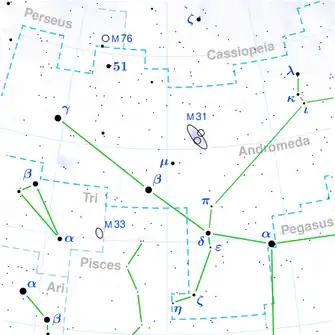  | |
| Observation data Epoch J2000.0 Equinox J2000.0 (ICRS) | |
|---|---|
| Constellation | Andromeda |
| Right ascension | 00h 39m 19.67518s[1] |
| Declination | +30° 51′ 39.6783″[1] |
| Apparent magnitude (V) | 3.28[2] |
| Characteristics | |
| δ And A | |
| Spectral type | K3 III(Aa)[3] K4 ± 2(Ab)[4] |
| U−B color index | +1.48[2] |
| B−V color index | +1.28[2] |
| R−I color index | +0.66[5] |
| δ And B | |
| Spectral type | M3 |
| U−B color index | 0.83[6] |
| B−V color index | 1.02[6] |
| Astrometry | |
| Radial velocity (Rv) | −9.88±0.15[7] km/s |
| Proper motion (μ) | RA: +114.45[1] mas/yr Dec.: −84.02[1] mas/yr |
| Parallax (π) | 30.91±0.15 mas[1] |
| Distance | 105.5 ± 0.5 ly (32.4 ± 0.2 pc) |
| Absolute magnitude (MV) | +0.8[8] |
| Orbit[9] | |
| Period (P) | 15,000 d |
| Eccentricity (e) | 0.34±0.14 |
| Periastron epoch (T) | 2415568 JD |
| Argument of periastron (ω) (primary) | 356.1±5.2° |
| Semi-amplitude (K1) (primary) | 4.0±2.7 km/s |
| Details[4] | |
| δ And Aa | |
| Mass | ~1.3[10] M☉ |
| Radius | 14.45±0.03[11] R☉ |
| Luminosity | 68±4 L☉ |
| Surface gravity (log g) | 2.0±0.3[3] cgs |
| Temperature | 4,315±9 K |
| Metallicity [Fe/H] | 0.04 dex |
| Rotational velocity (v sin i) | 6.5[7] km/s |
| Age | 3.2 Gyr |
| δ And Ab | |
| Mass | 0.6–0.8 M☉ |
| δ And B | |
| Mass | 0.529±0.021 M☉ |
| Radius | 0.532±0.017 R☉ |
| Luminosity | 0.04090 ± 0.00983 L☉ |
| Surface gravity (log g) | 4.70930 ± 0.0101 cgs |
| Temperature | 3,558±157 K |
| Other designations | |
| δ And, Delta Andromedae, Delta And, 31 Andromedae, 31 And, NSV 15142, BD+30 91, FK5 20, HD 3627, HIP 3092, HR 165, SAO 54058, PPM 65514, WDS 00393+3052A[12][13] | |
| Database references | |
| SIMBAD | data |
Delta Andromedae is a triple star[14] system in the northern constellation of Andromeda. Its identifier is a Bayer designation that is Latinized from δ Andromedae, and abbreviated Delta And or δ And, respectively. The system is visible to the naked eye as a point of light with a combined apparent visual magnitude of 3.28.[2] Based upon parallax measurements, it is located at a distance of approximately 105.5 light-years (32.3 parsecs) from the Sun.[1] The system is drifting closer with a radial velocity of −10 km/s.[7]
In Chinese, 奎宿 (Kuí Sù), meaning Legs (asterism), refers to an asterism consisting of δ Andromedae, η Andromedae, 65 Piscium, ζ Andromedae, ι Piscium, ε Andromedae, π Andromedae, ν Andromedae, μ Andromedae, β Andromedae, σ Piscium, τ Piscium, 91 Piscium, υ Piscium, φ Piscium, χ Piscium and ψ1 Piscium. Consequently, the Chinese name for δ Andromedae itself is 奎宿五 (Kuí Sù wǔ, English: the Fifth Star of Legs.)[15] Apart from its Bayer designation, it was also given the title Delta by Elijah H. Burritt in his star atlas.[16]
This is a long-period spectroscopic binary with an orbital period of approximately 15,000 days (41 years). The primary of the spectroscopic binary, component Aa, has a stellar classification of K3 III, indicating that it is an aging giant star.[3][9] It most likely evolved from a F-type main sequence star after consuming the hydrogen at its core.[17] The secondary, component Ab, is a relatively faint K-type dwarf, which has been imaged using a stellar coronagraph. The pair have a physical separation of 11.55±0.13 AU.[4]
The system has two companions, the closest of which is an orbiting red dwarf of class M3 with a separation of at least 940 astronomical units.[18][19]
An excess of infrared emission from δ Andromedae suggested that it may be surrounded by a shell of dust.[3][20] In 2003 it was determined that this is more likely a circumstellar debris disk.[17]
References
- 1 2 3 4 5 6 van Leeuwen, F. (November 2007), "Validation of the new Hipparcos reduction", Astronomy and Astrophysics, 474 (2): 653–664, arXiv:0708.1752, Bibcode:2007A&A...474..653V, doi:10.1051/0004-6361:20078357, S2CID 18759600.
- 1 2 3 4 Johnson, H. L.; et al. (1966). "UBVRIJKL photometry of the bright stars". Communications of the Lunar and Planetary Laboratory. 4 (99): 99. Bibcode:1966CoLPL...4...99J.
- 1 2 3 4 Judge, P. G.; Jordan, C.; Rowan-Robinson, M. (January 1, 1987), "Delta Andromedae (K3 III) - an IRAS source with an unusual ultraviolet spectrum", Monthly Notices of the Royal Astronomical Society, 224: 93–106, Bibcode:1987MNRAS.224...93J, doi:10.1093/mnras/224.1.93.
- 1 2 3 Bottom, M.; et al. (August 4, 2015), "Resolving the Delta Andromedae Spectroscopic Binary with Direct Imaging", The Astrophysical Journal, 809 (1): 11, arXiv:1506.07517, Bibcode:2015ApJ...809...11B, doi:10.1088/0004-637X/809/1/11, S2CID 32786144.
- ↑ Hoffleit, D.; Warren Jr., W. H., "HR 165, database entry", The Bright Star Catalogue (5th (Preliminary Version) ed.), CDS, archived from the original on 2020-10-02, retrieved 2008-08-28 ID V/50. Accessed on line August 28, 2008.
- 1 2 Blanco, Victor Manuel; Demers, S.; Douglass, G. G.; Fitzgerald, M. P. (1968). "Photoelectric catalogue : magnitudes and colors of stars in the U, B, V, and Uc, B, V systems". Publications of the United States Naval Observatory. Bibcode:1968PUSNO...21....B.
- 1 2 3 Massarotti, Alessandro; et al. (January 2008), "Rotational and Radial Velocities for a Sample of 761 HIPPARCOS Giants and the Role of Binarity", The Astronomical Journal, 135 (1): 209–231, Bibcode:2008AJ....135..209M, doi:10.1088/0004-6256/135/1/209.
- ↑ Ryon, Jenna; et al. (August 2009), "Comparing the Ca ii H and K Emission Lines in Red Giant Stars", Publications of the Astronomical Society of the Pacific, 121 (882): 842, arXiv:0907.3346, Bibcode:2009PASP..121..842R, doi:10.1086/605456, S2CID 17821279.
- 1 2 Bakos, Gustav A. (February 1976), "The spectroscopic orbit of δ Andromedae", Journal of the Royal Astronomical Society of Canada, 70: 23–26, Bibcode:1976JRASC..70...23B.
- ↑ Gontcharov, G.A.; Kiyaeva, O. V. (2002), "Photocentric orbits from a direct combination of ground-based astrometry with Hipparcos I. Comparison with known orbits", Astronomy and Astrophysics, 391, 647–657: 647, Bibcode:2002A&A...391..647G, doi:10.1051/0004-6361:20020896.
- ↑ Anugu, Narsireddy; Monnier, John D.; Mérand, Antoine; Flores, Becky; Gallenne, Alexandre; Gies, Douglas R.; Gutierrez, Mayra; Klement, Robert; Kraus, Stefan (2026-07-27), "Empirical H- and K-band Limb Darkening for 31 CHARA Stars: A Near-Infrared Benchmark for Stellar-Atmosphere Models", The Astronomical Journal, arXiv:2607.24956.
- ↑ "del And". SIMBAD. Centre de données astronomiques de Strasbourg. Retrieved August 28, 2008.
- ↑ "Entry 00393+3052", The Washington Double Star Catalog, United States Naval Observatory, archived from the original on 2008-04-12, retrieved 2008-08-28
- ↑ Eggleton, P. P.; Tokovinin, A. A. (September 2008), "A catalogue of multiplicity among bright stellar systems", Monthly Notices of the Royal Astronomical Society, 389 (2): 869–879, arXiv:0806.2878, Bibcode:2008MNRAS.389..869E, doi:10.1111/j.1365-2966.2008.13596.x, S2CID 14878976.
- ↑ (in Chinese) AEEA (Activities of Exhibition and Education in Astronomy) 天文教育資訊網 2006 年 5 月 19 日 Archived 2016-03-03 at the Wayback Machine
- ↑ Richard Hinckley Allen (1899) Star-names and Their Meanings, p. 38.
- 1 2 Decin, G.; et al. (November 2003), "Age Dependence of the Vega Phenomenon: Observations", The Astrophysical Journal, 598 (1): 636–644, arXiv:astro-ph/0308294, Bibcode:2003ApJ...598..636D, doi:10.1086/378800, S2CID 16751327
- ↑ Kaler, James B., "DELTA AND (Delta Andromedae)", Stars, University of Illinois, retrieved 2012-01-23
- ↑ Kervella, Pierre; Arenou, Frédéric; Thévenin, Frédéric (January 2022). "Stellar and substellar companions from Gaia EDR3. Proper-motion anomaly and resolved common proper-motion pairs". Astronomy and Astrophysics. 657: A7. arXiv:2109.10912. Bibcode:2022A&A...657A...7K. doi:10.1051/0004-6361/202142146. ISSN 0004-6361.
- ↑ Wirsich, J. (August 1998), "The Chromospheric Radiation on the Circumstellar Shell of δ Andromedae", The Astrophysical Journal, 502 (2): 909–917, Bibcode:1998ApJ...502..909W, doi:10.1086/305935, S2CID 120614789.
External links
- The Constellation Andromeda: The Chained Maiden Archived 2021-02-13 at the Wayback Machine, web page, European Southern Observatory outreach.
- Image Delta Andromedae
| Stars |
| ||||||||||||
|---|---|---|---|---|---|---|---|---|---|---|---|---|---|
| |||||||||||||
| Star clusters |
| ||||||||||||
| Nebulae |
| ||||||||||||
| Galaxies |
| ||||||||||||
| |||||||||||||
| |||||||||||||
