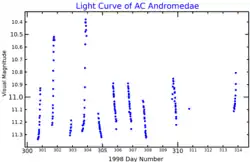
AC Andromedae (AC And) is a variable star in the constellation Andromeda. Its maximum apparent visual magnitude is 10.77, but can be seen fainter down to a magnitude of 11.9.
AC Andromedae was first reported to be a variable star by Paul Guthnick and Richard Prager in 1927. They noted that it varied in brightness rapidly, with no discernible period.[10][11]
The nature of AC Andromedae is still not determined. Its light curve shows clearly three radial pulsation modes, the fundamental one with a period of 0.71 days, and the first two overtones of 0.525 and 0.421 days, respectively. It also displays the Blazhko effect with a modulation period of 2.11 days.[12] It is unclear if it belongs to the class of RR Lyrae variables or to the one of Delta Scuti variables.[13][14] Another study points at AC And as an intermediate object between classical Cepheids and Delta Scuti variables.[4] The physical parameters of the star itself would be different depending on which class it belongs to.
By late 2018, the AC Andromedae was classified as rare "triple-mode" subtype of the dwarf cepheid (high-amplitude Delta Scuti variable).[15][16]
References
- ↑ Peña, J. H.; Peniche, R.; Hobart, M. A.; de la Cruz, C.; Gallegos, A. A. (2005). "Uvby-β Photometry of the RR Lyrae Star AC and". Revista Mexicana de Astronomía y Astrofísica. 41: 461. Bibcode:2005RMxAA..41..461P.
- 1 2 3 4 5 6 7 8 9 10 Vallenari, A.; et al. (Gaia collaboration) (2023). "Gaia Data Release 3. Summary of the content and survey properties". Astronomy and Astrophysics. 674: A1. arXiv:2208.00211. Bibcode:2023A&A...674A...1G. doi:10.1051/0004-6361/202243940. S2CID 244398875.
Gaia DR3 record for this source at VizieR.
- 1 2 AC And, database entry, Combined General Catalog of Variable Stars (GCVS4.2, 2004 Ed.), N. N. Samus, O. V. Durlevich, et al., CDS ID II/250 Accessed on line 2018-10-17.
- 1 2 3 Fernie, J. D. (November 1994). "AC Andromedae: the missing link between δ Scuti stars and classical Cepheids?". Monthly Notices of the Royal Astronomical Society. 271: L19–L20. Bibcode:1994MNRAS.271L..19F. doi:10.1093/mnras/271.1.L19.
- 1 2 3 Høg, E.; Fabricius, C.; Makarov, V. V.; Urban, S.; Corbin, T.; Wycoff, G.; Bastian, U.; Schwekendiek, P.; Wicenec, A. (2000). "The Tycho-2 catalogue of the 2.5 million brightest stars". Astronomy & Astrophysics. 355: L27–L30. Bibcode:2000A&A...355L..27H.
- 1 2 3 Cutri, Roc M.; Skrutskie, Michael F.; Van Dyk, Schuyler D.; Beichman, Charles A.; Carpenter, John M.; Chester, Thomas; Cambresy, Laurent; Evans, Tracey E.; Fowler, John W.; Gizis, John E.; Howard, Elizabeth V.; Huchra, John P.; Jarrett, Thomas H.; Kopan, Eugene L.; Kirkpatrick, J. Davy; Light, Robert M.; Marsh, Kenneth A.; McCallon, Howard L.; Schneider, Stephen E.; Stiening, Rae; Sykes, Matthew J.; Weinberg, Martin D.; Wheaton, William A.; Wheelock, Sherry L.; Zacarias, N. (2003). "VizieR Online Data Catalog: 2MASS All-Sky Catalog of Point Sources (Cutri+ 2003)". CDS/ADC Collection of Electronic Catalogues. 2246: II/246. Bibcode:2003yCat.2246....0C.
- ↑ Gontcharov, G. A. (November 2006). "Pulkovo Compilation of Radial Velocities for 35495 Hipparcos stars in a common system". Astronomy Letters. 32 (11): 759–771. arXiv:1606.08053. Bibcode:2006AstL...32..759G. doi:10.1134/S1063773706110065. S2CID 119231169.
- 1 2 Anders, F.; Khalatyan, A.; Chiappini, C.; Queiroz, A. B.; Santiago, B. X.; Jordi, C.; Girardi, L.; Brown, A. G. A.; Matijevic, G.; Monari, G.; Cantat-Gaudin, T. (2019-08-01). "Photo-astrometric distances, extinctions, and astrophysical parameters for Gaia DR2 stars brighter than G = 18". Astronomy and Astrophysics. 628: A94. arXiv:1904.11302. Bibcode:2019A&A...628A..94A. doi:10.1051/0004-6361/201935765. ISSN 0004-6361. S2CID 131780028.
- ↑ Stassun, Keivan G.; Oelkers, Ryan J.; Paegert, Martin; Torres, Guillermo; Pepper, Joshua; De Lee, Nathan; Collins, Kevin; Latham, David W.; Muirhead, Philip S.; Chittidi, Jay; Rojas-Ayala, Bárbara (2019-10-01). "The Revised TESS Input Catalog and Candidate Target List". The Astronomical Journal. 158 (4): 138. arXiv:1905.10694. Bibcode:2019AJ....158..138S. doi:10.3847/1538-3881/ab3467. hdl:1721.1/124721. ISSN 0004-6256. S2CID 166227927.
- ↑ Guthnick, P.; Prager, R. (November 1927). "Benennung von veränderlichen Sternen". Astronomische Nachrichten. 231 (10): 161–166. Bibcode:1927AN....231..161G. doi:10.1002/asna.19272311002.
- ↑ Münch, Guido (1951). "On the Spectrum of AC Andromedae". The Astrophysical Journal. 114: 546. Bibcode:1951ApJ...114..546M. doi:10.1086/145499.
- ↑ Jakate, S. M. (1978-09-01). "Photoelectric photometry of AC And". The Astrophysical Journal. 224: 603. doi:10.1086/156408. ISSN 0004-637X.
- ↑ Fitch, W. S.; Szeidl, B. (February 1976). "The three radial modes and evolutionary state of AC Andromedae". Astrophysical Journal. 203: 616–624. Bibcode:1976ApJ...203..616F. doi:10.1086/154120.
- ↑ Petersen, J. O. (May 1978). "An interpretation of the unique triple mode variable AC Andromedae as an RR Lyrae type star oscillating in the first three radial over-tones". Astronomy and Astrophysics. 65: 616–624. Bibcode:1978A&A....65..451P.
- ↑ Jurcsik, Johanna; Hajdu, Gergely; Catelan, Márcio (2018). "New Galactic multi-mode Cepheids from the ASAS-SN Survey". Acta Astronomica. 68 (4): 341. arXiv:1812.01575. Bibcode:2018AcA....68..341J. doi:10.32023/0001-5237/68.4.2. S2CID 119249971.
- ↑ Yang, Tao-Zhi; Sun, Xiao-Ya; Zuo, Zhao-Yu; Liu, Hai-Wen (2020). "KIC 10975348: A Double-mode or Triple-mode High-amplitude δ Scuti Star?". The Astronomical Journal. 161: 27. arXiv:2011.09091. doi:10.3847/1538-3881/abcb8b. S2CID 227013065.