Cyclic GMP-AMP synthase
| Cyclic GMP-AMP synthase | |||||||||
|---|---|---|---|---|---|---|---|---|---|
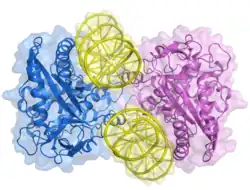 cGAS complexed with dsDNA (based on PDB 4O6A) | |||||||||
| Identifiers | |||||||||
| EC no. | 2.7.7.86 | ||||||||
| Databases | |||||||||
| BRENDA | enzyme data | ||||||||
| ExPASy | NiceZyme view | ||||||||
| KEGG | enzyme entry | ||||||||
| MetaCyc | metabolic pathway | ||||||||
| Rhea | reactions | ||||||||
| PDB structures | RCSB PDB PDBe PDBsum | ||||||||
| |||||||||


Cyclic GMP-AMP synthase (cGAS, cGAMP synthase), belonging to the nucleotidyltransferase family, is part of the cytosolic DNA sensor that activates a type-I interferon response (the cGAS-STING DNA sensing pathway). It binds to microbial DNA as well as self DNA that invades the cytoplasm, and catalyzes cGAMP synthesis.[1] In humans, this enzyme is encoded by the gene CGAS, while in some insects this activity has been found in the proteins encoded by genes cGLR1 or cGLR2.[2]
Function
The enzyme catalyses a chemical reaction that produces a specific isomer of cyclic guanosine monophosphate–adenosine monophosphate (cGAMP) from the components guanosine triphosphate (GTP) and adenosine triphosphate (ATP), with two units of pyrophosphate (PPi) as a byproduct:


The cyclic product has a bond between the 2'-OH of GMP and the 5'-phosphate of AMP and another between the 3'-OH of AMP and 5'-phosphate of GMP.[3] This cGAMP is a second messenger that binds to and activates the endoplasmic reticulum protein STING to trigger type-I IFNs production.[4][5][3] Mice lacking cGAS are more vulnerable to lethal infection by DNA viruses and RNA viruses.[6][7] In addition, cGAS has been shown to be an innate immune sensor of retroviruses including HIV.[8][9] The human gene encoding cGAS is MB21D1 on chromosome 6.
Human cGAS has been shown to produce less 2'3' cGAMP than mouse cGAS [1][10]. This difference can be explained by the structural differences between mcGAS and hcGAS. Human cGAS is activated in a strongly DNA length-dependent manner [11]. Indeed, human cGAS exhibits a higher affinity for DNA fragments of over 45 bp, whereas mouse cGAS is preferentially activated by shorter DNA sequences. Two amino acids, K187 and L195 in the N-terminus of hcGAS, have been shown to be responsible for human-specific control of 2'3' cGAMP synthesis [10]. The opposing responses of hcGAS and mcGAS to short DNA are completely reversed by the human-specific K187/L195 substitution [10].
References
- 1 2 Sun L, Wu J, Du F, Chen X, Chen ZJ (February 2013). "Cyclic GMP-AMP synthase is a cytosolic DNA sensor that activates the type I interferon pathway". Science. 339 (6121): 786–91. Bibcode:2013Sci...339..786S. doi:10.1126/science.1232458. PMC 3863629. PMID 23258413.
- ↑ "ENZYME entry: EC 2.7.7.86". expasy.org. SIB Swiss Institute of Bioinformatics. Retrieved 2026-08-04.
- 1 2 Zhang X, Shi H, Wu J, Zhang X, Sun L, Chen C, Chen ZJ (July 2013). "Cyclic GMP-AMP containing mixed phosphodiester linkages is an endogenous high-affinity ligand for STING". Molecular Cell. 51 (2): 226–35. doi:10.1016/j.molcel.2013.05.022. PMC 3808999. PMID 23747010.
- ↑ Wu J, Sun L, Chen X, Du F, Shi H, Chen C, Chen ZJ (February 2013). "Cyclic GMP-AMP is an endogenous second messenger in innate immune signaling by cytosolic DNA". Science. 339 (6121): 826–30. Bibcode:2013Sci...339..826W. doi:10.1126/science.1229963. PMC 3855410. PMID 23258412.
- ↑ Gao P, Ascano M, Wu Y, Barchet W, Gaffney BL, Zillinger T, et al. (May 2013). "Cyclic [G(2',5')pA(3',5')p] is the metazoan second messenger produced by DNA-activated cyclic GMP-AMP synthase". Cell. 153 (5): 1094–107. doi:10.1016/j.cell.2013.04.046. PMC 4382009. PMID 23647843.
- ↑ Li XD, Wu J, Gao D, Wang H, Sun L, Chen ZJ (September 2013). "Pivotal roles of cGAS-cGAMP signaling in antiviral defense and immune adjuvant effects". Science. 341 (6152): 1390–4. Bibcode:2013Sci...341.1390L. doi:10.1126/science.1244040. PMC 3863637. PMID 23989956.
- ↑ Yu P, Miao Z, Li Y, Bansal R, Peppelenbosch MP, Pan Q (January 2021). "cGAS-STING effectively restricts murine norovirus infection but antagonizes the antiviral action of N-terminus of RIG-I in mouse macrophages". Gut Microbes. 13 (1) 1959839. doi:10.1080/19490976.2021.1959839. PMC 8344765. PMID 34347572.
- ↑ Gao D, Wu J, Wu YT, Du F, Aroh C, Yan N, et al. (August 2013). "Cyclic GMP-AMP synthase is an innate immune sensor of HIV and other retroviruses". Science. 341 (6148): 903–6. Bibcode:2013Sci...341..903G. doi:10.1126/science.1240933. PMC 3860819. PMID 23929945.
- ↑ Lahaye X, Satoh T, Gentili M, Cerboni S, Conrad C, Hurbain I, et al. (December 2013). "The capsids of HIV-1 and HIV-2 determine immune detection of the viral cDNA by the innate sensor cGAS in dendritic cells". Immunity. 39 (6): 1132–42. doi:10.1016/j.immuni.2013.11.002. PMID 24269171.
- 1 2 3 Zhou, Wen; Whiteley, Aaron T.; de Oliveira Mann, Carina C.; Morehouse, Benjamin R.; Nowak, Radosław P.; Fischer, Eric S.; Gray, Nathanael S.; Mekalanos, John J.; Kranzusch, Philip J. (July 2018). "Structure of the Human cGAS–DNA Complex Reveals Enhanced Control of Immune Surveillance". Cell. 174 (2): 300–311.e11. doi:10.1016/j.cell.2018.06.026. PMC 6084792. PMID 30007416.
- ↑ Andreeva, Liudmila; Hiller, Björn; Kostrewa, Dirk; Lässig, Charlotte; de Oliveira Mann, Carina C.; Jan Drexler, David; Maiser, Andreas; Gaidt, Moritz; Leonhardt, Heinrich; Hornung, Veit; Hopfner, Karl-Peter (September 2017). "cGAS senses long and HMGB/TFAM-bound U-turn DNA by forming protein–DNA ladders". Nature. 549 (7672): 394–398. doi:10.1038/nature23890. ISSN 0028-0836.