Collections (The Young Rascals album)
| Collections | ||||
|---|---|---|---|---|
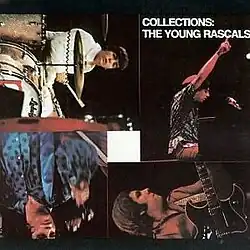 | ||||
| Studio album by | ||||
| Released | December 10, 1966[1] | |||
| Recorded | May 9 – November 11, 1966[2] | |||
| Studios | Atlantic and Talentmasters, New York[2] | |||
| Genres | Blue-eyed soul, garage rock | |||
| Length | 32:21 | |||
| Label | Atlantic | |||
| Producer | The Young Rascals | |||
| The Young Rascals chronology | ||||
| ||||
| Singles from Collections | ||||
| ||||
Collections is the second album by the rock band the Young Rascals. The album was released on December 10, 1966,[1] and rose to #15 on the Billboard Top LPs chart, and to #8 in Canada.[4]
History
Collections was the Rascals' first album to showcase their songwriting talent, with six of the album's songs written by band members. On its original release, the song "Turn On Your Love Light" was incorrectly titled "Love Lights," and credited to The Sonics' bandleader Gerald (Gerry) Roslie, who had written a song called "Love Lights" for that band. Upon its release as a single, "I've Been Lonely Too Long" was credited to Cavaliere/Brigati, rather than to Felix Cavaliere alone.
The album featured a Top 20 U.S. hit: "I've Been Lonely Too Long" reached #16 on the Billboard Hot 100.
Reception
| Review scores | |
|---|---|
| Source | Rating |
| Allmusic |   [5] |
In his review for Allmusic, music critic Bruce Eder wrote the "garage rock" sound of the band's first album was gone and called it a "wonderfully soulful body of music that picks up right where 'In the Midnight Hour' from the prior album left off. Most of this record is among the most danceable white rock music of its period..."[5] The band was awarded a Gold Album in the United States for Collections.[6]
Track listing
| No. | Title | Writer(s) | Lead vocals | Length |
|---|---|---|---|---|
| 1. | "What is the Reason" | Felix Cavaliere | 2:23 | |
| 2. | "Since I Fell for You" | Buddy Johnson | Eddie Brigati | 3:25 |
| 3. | "(I've Been) Lonely Too Long" | Cavaliere | Cavaliere | 2:57 |
| 4. | "No Love to Give" | Gene Cornish | Gene Cornish | 2:42 |
| 5. | "Mickey's Monkey / Turn On Your Love Light" |
| 4:41 | |
| Total length: | 16:08 | |||
| No. | Title | Writer(s) | Lead vocals | Length |
|---|---|---|---|---|
| 1. | "Come On Up" | Cavaliere | Cavaliere | 2:41 |
| 2. | "Too Many Fish in the Sea" | Cavaliere | 2:16 | |
| 3. | "More" | Brigati | 4:20 | |
| 4. | "Nineteen Fifty-Six" |
| Cornish | 2:28 |
| 5. | "Love Is a Beautiful Thing" |
|
| 2:30 |
| 6. | "Land of 1000 Dances" | Chris Kenner | Brigati | 1:58 |
| Total length: | 16:13 | |||
Personnel
Personnel according to the 1988 re-issue of Collections, unless otherwise noted.[7]
The Young Rascals
- Felix Cavaliere – organ, piano; lead vocals ("What is the Reason", "Lonely Too Long", "Come on Up", and "Too Many Fish in the Sea"), co-lead vocals ("Mickey's Monkey / Turn on Your Lovelights" and "Love is a Beautiful Thing"), production
- Eddie Brigati – percussion; lead vocals ("Since I Fell for You", "More", and "Land of 1000 Dances"), co-lead vocals ("Mickey's Monkey / Turn on Your Lovelights" and "Love is a Beautiful Thing"), production
- Gene Cornish – guitar, bass; lead vocals ("No Love to Give" and "Nineteen Fifty-Six"), production
- Dino Danelli – drums, percussion, production
Other personnel
- Tom Dowd – recording supervision, audio engineer (All tracks except "Land of 1000 Dances")
- Arif Mardin – recording supervision
- Phil Iehle – audio engineer (All tracks except "Land of 1000 Dances")
- Bruce Tergesen – audio engineer (All tracks except "Land of 1000 Dances")
- Bob Gallo – audio engineer ("Land of 1000 Dances")
- George Rodriguez – cover photography
- Loring Eutemey – cover design
Charts
|
|
Certifications
| Region | Certification | Certified units/sales |
|---|---|---|
| United States (RIAA)[14] | Gold | 500,000^ |
|
^ Shipments figures based on certification alone. | ||
References
Citations
- 1 2 Puterbaugh 1993, p. 7.
- 1 2 Palao & Unterberger 2024, p. 49.
- 1 2 Puterbaugh 1993, p. 6.
- ↑ "RPM Magazine - May 13, 1967 Page 5" (PDF).
- 1 2 Eder, Bruce. "Collections > Review". Allmusic. Retrieved September 19, 2011.
- ↑ "Gold & Platinum". Recording Industry Association of America.
- ↑ Anon. 1988, pp. 1–3.
- 1 2 Anon. (May 13, 1967). "Top LP's" (PDF). RPM. p. 5. Archived (PDF) from the original on February 20, 2025. Retrieved April 6, 2026 – via WorldRadioHistory.
- ↑ Anon. (June 3, 1967). "Top Selling R&B LP's" (PDF). Billboard. p. 37. Archived (PDF) from the original on December 20, 2024. Retrieved April 6, 2026 – via WorldRadioHistory.
- ↑ Anon. (April 22, 1967). "Top 100 Albums" (PDF). Cash Box. p. 55. Archived (PDF) from the original on November 30, 2025. Retrieved April 6, 2026 – via WorldRadioHistory.
- ↑ Anon. (April 29, 1967). "100 Top LP's" (PDF). Record World. p. 30. Archived (PDF) from the original on December 20, 2024. Retrieved April 6, 2026 – via WorldRadioHistory.
- 1 2 Anon. (December 30, 1967). "Top LP's – 1967" (PDF). Billboard. p. 42. Archived (PDF) from the original on October 25, 2025. Retrieved January 20, 2026 – via WorldRadioHistory.
- ↑ Anon. (December 23, 1967). "Best Albums of 1967" (PDF). Cash Box. p. 24. Archived (PDF) from the original on December 3, 2025. Retrieved January 20, 2026 – via WorldRadioHistory.
- ↑ "American album certifications – Rascals – Collections". Recording Industry Association of America.
Sources
- Anon. (1988). Collections (CD). United States: Warner Special Products. 9-27618-2.
- Palao, Alec; Unterberger, Richie (2024). It's Wonderful: The Complete Atlantic Studio Recordings (Box Set). United Kingdom: Now Sounds. QCRNOW7BX60.
- Puterbaugh, Parke (1993). The Very Best Of The Rascals (CD). United States: Rhino. R2 71277.