A Girl Like You (The Young Rascals song)
| "A Girl Like You" | ||||
|---|---|---|---|---|
 US single sleeve | ||||
| Single by the Young Rascals | ||||
| from the album Groovin' | ||||
| B-side | "It's Love" | |||
| Released | June 23, 1967 | |||
| Recorded | May 25, 1967 | |||
| Studio | Atlantic, New York City | |||
| Genre | ||||
| Length | 2:46 | |||
| Label | Atlantic | |||
| Songwriters | ||||
| Producer | The Young Rascals | |||
| The Young Rascals singles chronology | ||||
| ||||
| Audio | ||||
| "A Girl Like You" on YouTube | ||||
"A Girl Like You" is a song written by Eddie Brigati and Felix Cavaliere, and initially recorded by their band The Young Rascals. Lyrically, the song was inspired by Cavaliere's girlfriend Adrienne and explores the joys of falling in love from several perspectives. Musically, "A Girl Like You" is a blue-eyed soul song with elements of big band, R&B, and sunshine pop. The song features a big brass arrangement alongside harps and piccolos. The song was recorded on May 25, 1967, at Atlantic Studios in New York City with the Young Rascals producing and Arif Mardin providing the arrangements.
After performing on The Ed Sullivan Show, Atlantic Records released "A Girl Like You" as a single in the US on June 23, 1967, with "It's Love" on the B-side. The single continued the Rascals string of successes, managing to reach number 10 on the Billboard Hot 100 for two consecutive weeks. In Canada, "A Girl Like You" reached number one in September 1967. In the UK, "A Girl Like You" was released on August 4, 1967, and became the Young Rascals' second top-40 single in that country, reaching number 37 on the Record Retailer chart. The song was included as the opening track of the band's third studio album Groovin' in July 1967. Upon original release, the single received praise, with many critics and journalists focusing on Cavaliere's vocal performance and the backing brass arrangement.
Composition and recording
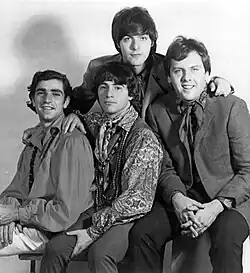
Similarly to the Young Rascals' two previous US top-twenty singles "I've Been Lonely Too Long" and "Groovin'", "A Girl Like You" was penned by group members Eddie Brigati and Felix Cavaliere.[1] As with those songs and "How Can I Be Sure" (1967), "A Girl Like You" was lyrically influenced by Cavaliere's girlfriend Adrienne, whom he believed was his "muse".[2] Guitarist Lenny Kaye opined the song lyrically revolved around the "joys of falling in love" from perspectives of both "halting uncertainty" to "ecstatic celebration".[3] Jim Newson of AllMusic believed the song to be part of the Young Rascals' "blue-eyed soul era",[4] whereas that site's Matthew Greenwald opined it featured a "big band-feel".[5] On the contrary, journalist Parke Puterbaugh felt "A Girl Like You" channeled the group's "former R&B-fury into positive vibes",[6] and Kaye describing it as "sunny pop".[3]
As described by Brigati for British music magazine Melody Maker in July 1967, "A Girl Like You" was completely different from "Groovin'",[7] instead featuring a "big rhythm thing with lots of brass" and "harp and piccolo riffs".[8] Sung by Cavaliere,[9] With a runtime of two minutes and forty-six seconds,[10] "A Girl Like You" opens with a "gentle, almost classical piano line" before moving into a swing arrangement for the bridge, culminating in the "big band"-sound of the chorus.[5] The song was recorded on May 25, 1967, at Atlantic Studios in New York City.[11][12] The recording was produced by the Young Rascals themselves, with Arif Mardin providing the big band arrangement.[13][14] According to musicologist Richie Unterberger, this was "indicative of the much wider assortment of instruments and arrangements" that the Young Rascals had started experimenting with in the studio.[8] According to Kaye, "A Girl Like You" represented the most "prominent use of horns" on a Young Rascals recording to date.[3]
Release and commercial performance
The Young Rascals first promoted "A Girl Like You" on the June 4, 1967, broadcast of The Ed Sullivan Show,[1] which was prior to the single's release.[15] In the US, "A Girl Like You" got its first issue as the A-side of the Young Rascals' seventh single through Atlantic Records on June 23, 1967.[15] The single's B-side was "It's Love", a jazz-influenced song written by Brigati and Cavaliere which featured Hubert Laws on flute.[16] Having been released only two months after the single release of "Groovin'", Alec Palao and Unterberger opined that "A Girl Like You" might have gotten a little "overlooked" in the previous single's tailwind.[17] In the UK, Atlantic released "A Girl Like You" as a single on August 4, 1967, with the band returning to touring the country to promote the single's British release in October 1967.[18]
In the US, "A Girl Like You" debuted on the Billboard Hot 100 at position 61 on July 15, 1967.[19] The single peaked at number 10 for two consecutive weeks in August 1967,[20] and dropped out on September 9, by which point it had spent nine weeks on the chart.[21] On the national charts published by Cash Box and Record World, "A Girl Like You" fared better, reaching number eight and five, respectively.[22][23] Kaye attributed the single's US chart success to "Groovin'", believing it to have "cracked the top-ten" on the "coattails" of "Groovin'".[3] Elsewhere, "A Girl Like You" reached number one for a week on the Canadian RPM Top 100 chart.[24] In Australia, the single reached number 31.[25] In the UK, "A Girl Like You" was the second of only two top-40 singles the Young Rascals' achieved,[26] reaching number 37 on the Record Retailer chart in late August 1967.[27]
"A Girl Like You" first saw album release on July 19, 1967, when it was included on the Young Rascals' third studio album Groovin'.[14] On the album, the song was sequenced as the opening track.[8] The song's stereo mix differs from the mono mix, which is shorter in length.[10] The inclusion of three US top-10 singles, including "A Girl Like You", helped fuel the album's chart success, reaching number five on the Billboard 200.[28] "A Girl Like You" has since been featured on most of the Young Rascals' compilation albums, including Time Peace: The Rascals' Greatest Hits on June 14, 1968 (which reached number one on the Billboard 200),[14] Anthology 1965–1972 (1992),[29] and The Very Best of The Rascals (1993)[30]
Reception and legacy
Upon original release, "A Girl Like You" received primarily positive reviews, with the Billboard staff reviewer describing it as a "well done rocking mover" with a potential for sales "to take the group right back up to the top of the Hot 100".[31] In Record World, the single was described as "at once sweet and powerful" and was certain to "keep up their [Young Rascals'] full head of steam".[32] The staff editors chose it as one of the "single picks of the weeks".[32] Amongst British reviewers, Penny Valentine of Disc and Music Echo found that the song had a "bigger production", though felt it wouldn't be as big of a hit because of the lack of "insinuation and appeal" compared to "Groovin'".[33] Nonetheless, she found the harp to be "nice" and "funnily fitting in", describing the single as a "good record but no instant hit."[33]
In a blind date for Melody Maker, Scottish singer Lulu believed Cavaliere had a nice voice on the single, though believed their prior Ed Sullivan Show appearances to have been "terrible".[34] She believed the song was "great to dance to", asking to keep a copy of the single.[34] For Derek Johnson of the New Musical Express, "A Girl Like You" was a "real corker of a single" thanks to the "irresistible driving beat and the spine-tingling r&b quality with which it's impregnated".[35] He praised the brass arrangement and harp performance as "sensational", believing it to "follows the same pattern" as "Groovin'" in many aspects, though believed "A Girl Like You" to "hit" him with "more impact".[35] Record Mirror's Peter Jones similarly believed "A Girl Like You" was superior to "Groovin'", praising the vocals as "high-flying" and as a "catchy approach to the song". He additionally commented on the arrangement, noting the "bashing brass scene".[36]
Retrospectively, Matthew Greenwald believed "A Girl Like You" represented "another quantum leap for the band who had been growing artistically by leaps and bounds over the past year", praising Dino Danelli's drum performance as "nothing short of spectacular", ending by stating it to be a "true masterpiece".[5]
Credits and personnel
Credits are adapted from the liner notes of the 1993 compilation album The Very Best of The Rascals, unless otherwise noted.[37]
The Young Rascals
|
Other personnel
|
Charts
Weekly charts
|
Year-end charts
|
References
Citations
- 1 2 Sexton, Paul (July 17, 2023). "'Ed Sullivan Show' Archive Shares Young Rascals' Summer Of Love Gem". uDiscoverMusic. Universal Music Group. Archived from the original on June 14, 2025. Retrieved April 12, 2026.
- ↑ Myers, Marc (April 4, 2013). "The Day They Grooved to 'Groovin''". The Wall Street Journal. Archived from the original on April 6, 2023. Retrieved April 12, 2026.
- 1 2 3 4 Kaye 1992, p. 37.
- ↑ Newson, Jim. "The Ultimate Rascals Review by Jim Newsom". AllMusic. Archived from the original on May 12, 2015. Retrieved April 12, 2026.
- 1 2 3 Greenwald, Matthew. "A Girl Like You Review by Matthew Greenwald". AllMusic. Archived from the original on October 16, 2022. Retrieved April 12, 2026.
- ↑ Puterbaugh 1993, p. 4.
- ↑ Ward, Carmen (July 8, 1967). "Rascals Use Big Band For Follow-Up" (PDF). Melody Maker. p. 9. Archived (PDF) from the original on December 21, 2024. Retrieved April 12, 2026 – via WorldRadioHistory.
- 1 2 3 Unterberger 2007, p. 3.
- ↑ Ruhlmann, William. "Felix Cavaliere Biography by William Ruhlmann". AllMusic. Archived from the original on September 21, 2023. Retrieved April 12, 2026.
- 1 2 3 4 Palao & Unterberger 2024, p. 50.
- ↑ Kaye 1992, p. 3.
- ↑ Palao & Unterberger 2024, pp. 46, 51.
- ↑ Kaye 1992, pp. 5–6.
- 1 2 3 Puterbaugh 1993, p. 7.
- 1 2 Puterbaugh 1993, p. 6.
- ↑ Palao & Unterberger 2024, p. 25, 50.
- ↑ Palao & Unterberger 2024, p. 25.
- ↑ "Rascals Disc" (PDF). Melody Maker. July 22, 1967. p. 2. Archived (PDF) from the original on February 20, 2026. Retrieved April 12, 2026 – via WorldRadioHistory.
- ↑ "Hot 100" (PDF). Billboard. July 15, 1967. p. 22. Archived (PDF) from the original on October 25, 2025. Retrieved April 12, 2026 – via WorldRadioHistory.
- 1 2 "Hot 100" (PDF). Billboard. August 19, 1967. p. 28. Archived (PDF) from the original on July 22, 2025. Retrieved April 12, 2026 – via WorldRadioHistory.
- ↑ "Hot 100" (PDF). Billboard. September 9, 1967. p. 22. Archived (PDF) from the original on February 18, 2026. Retrieved April 12, 2026 – via WorldRadioHistory.
- 1 2 "Cash Box Top 100" (PDF). Cash Box. August 12, 1967. p. 4. Archived (PDF) from the original on December 7, 2025. Retrieved April 12, 2026 – via WorldRadioHistory.
- 1 2 "100 Top Pops" (PDF). Record World. August 19, 1967. p. 23. Archived (PDF) from the original on November 8, 2025. Retrieved April 12, 2026 – via WorldRadioHistory.
- 1 2 "RPM 100" (PDF). RPM. September 2, 1967. p. 5. Archived (PDF) from the original on February 20, 2025. Retrieved April 12, 2026 – via WorldRadioHistory.
- 1 2 Kent 2005, p. 102.
- ↑ Lee, Iain (February 1, 2017). "Got To Be Free". Record Collector. Archived from the original on December 27, 2024. Retrieved April 12, 2026.
- 1 2 "Young Rascals". Official Charts. Archived from the original on February 27, 2026. Retrieved April 12, 2026.
- ↑ Unterberger 2007, p. 1.
- ↑ Kaye 1992, Back cover.
- ↑ Puterbaugh 1993, Back cover.
- ↑ "Spotlight Singles" (PDF). Billboard. July 8, 1967. p. 18. Archived (PDF) from the original on October 25, 2025. Retrieved April 12, 2026 – via WorldRadioHistory.
- 1 2 "Single Picks Of The Week" (PDF). Record World. July 8, 1967. p. 1. Archived (PDF) from the original on December 20, 2024. Retrieved April 12, 2024 – via WorldRadioHistory.
- 1 2 Valentine, Penny (August 5, 1967). "Good Young Rascals – but no instant hit" (PDF). Disc and Music Echo. p. 15. Archived (PDF) from the original on December 21, 2024. Retrieved April 12, 2026 – via WorldRadioHistory.
- 1 2 Kennedy-Cairns, Lulu (August 5, 1967). "Blind Date" (PDF). Melody Maker. p. 9. Archived (PDF) from the original on December 21, 2024. Retrieved April 12, 2026 – via WorldRadioHistory.
- 1 2 Johnson, Derek (August 5, 1967). "A Corker From Young Rascals" (PDF). NME. p. 4. Archived (PDF) from the original on February 11, 2026. Retrieved April 12, 2026 – via WorldRadioHistory.
- ↑ Jones, Peter (August 5, 1967). "Your Guide To This Week's New Singles" (PDF). Record Mirror. p. 9. Archived (PDF) from the original on February 15, 2026. Retrieved April 12, 2026 – via WorldRadioHistory.
- ↑ Puterbaugh 1993, pp. 6–7.
- ↑ Nimmervoll, Ed (August 30, 1967). "Go Set National Top 40". Go-Set. Archived from the original on September 2, 2025. Retrieved April 12, 2026.
- ↑ "The RPM 100 Top Singles of 1967" (PDF). RPM. January 6, 1968. p. 5. Archived (PDF) from the original on December 20, 2024. Retrieved January 11, 2026 – via WorldRadioHistory.
- ↑ "Top 100 Chart Hits of 1967" (PDF). Cash Box. December 23, 1967. p. 18. Archived (PDF) from the original on December 3, 2025. Retrieved January 11, 2026 – via WorldRadioHistory.
Sources
- Kaye, Lenny (1992). Anthology 1965–1972 (CD). United States: Rhino. R2 71031.
- Kent, David (2005). Australian Chart Book 1940–1969. Australia: Australian Chart Book. ISBN 0-646-44439-5. OCLC 62561852.
- Palao, Alec; Unterberger, Richie (2024). It's Wonderful: The Complete Atlantic Studio Recordings (Box set). United Kingdom: Now Sounds. QCRNOW7BX60.
- Puterbaugh, Parke (1993). The Very Best Of The Rascals (CD). United States: Rhino. R2 71277.
- Unterberger, Richie (2007). Groovin' (Box set). United States: Collectors' Choice Music. CCM-802.