Chlorocyphidae
| Chlorocyphidae | |
|---|---|
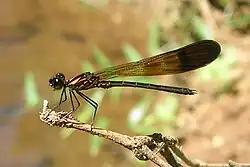 | |
| Rhinocypha bisignata | |
Scientific classification  | |
| Kingdom: | Animalia |
| Phylum: | Arthropoda |
| Clade: | Pancrustacea |
| Class: | Insecta |
| Order: | Odonata |
| Suborder: | Zygoptera |
| Superfamily: | Calopterygoidea |
| Family: | Chlorocyphidae Cowley, 1937[1] |
 | |
| Distribution of Chlorocyphidae | |
Chlorocyphidae is a family of damselflies in the superfamily Calopterygoidea, commonly known as jewels or heliodors.[2][3] Members of the family are typically small to medium-sized damselflies with brightly coloured bodies and often conspicuous wing markings. They inhabit forest streams and rivers throughout the Old World tropics, with their greatest diversity occurring in Southeast Asia.[4][5]
Many species are noted for their metallic colours and elaborate courtship displays, with males using brightly coloured wings and body markings in territorial and mating behaviour.[6] Chlorocyphidae is one of the most distinctive damselfly families and is consistently recovered as a monophyletic lineage in both morphological and molecular studies.[7][8][9][10]
Taxonomic history
Cowley (1937) recognised Chlorocyphidae as a distinct family of damselflies and noted that many contemporary authors used the alternative name Libellaginidae for the same group.[1] The family has long been regarded as a distinctive lineage of tropical stream-dwelling damselflies.
Morphological and molecular studies have consistently supported the monophyly of Chlorocyphidae.[7][8][9][10][11] Modern classifications recognise approximately twenty genera distributed throughout the Old World tropics.[3]
Although the family-group name Libellaginidae Yakobson & Bianchi, 1905 predates Chlorocyphidae under the principle of priority, the latter name has been used overwhelmingly in the scientific literature for much of the twentieth and twenty-first centuries.[10][12] Dijkstra et al. (2013) reported that Chlorocyphidae was preferred in almost 99% of published usage and recommended retaining it in the interests of nomenclatural stability.[10]
Genera
The following genera are currently placed in Chlorocyphidae:[3]
- Africocypha Pinhey, 1961
- Aristocypha Laidlaw, 1950
- Calocypha Fraser, 1928
- Chlorocypha Fraser, 1928
- Cyrano Needham & Gyger, 1939
- Disparocypha Ris, 1916
- Heliocypha Fraser, 1949
- Heterocypha Laidlaw, 1950 (monotypic)
- Indocypha Fraser, 1949
- Libellago Selys, 1840
- Melanocypha Fraser, 1949
- Pachycypha Lieftinck, 1950
- Paracypha Fraser, 1949
- Platycypha Fraser, 1949
- Rhinocypha Rambur, 1842
- Rhinoneura Laidlaw, 1915
- Sclerocypha Fraser, 1949
- Stenocypha Dijkstra, 2013
- Sundacypha Laidlaw, 1950
- Watuwila van Tol, 1998
Etymology
The family name Chlorocyphidae is derived from the type genus Chlorocypha, with the standard zoological suffix -idae used for animal families.
The genus name Chlorocypha was proposed by Fraser in 1928 as a replacement name during a discussion of the nomenclature of Micromerus and Libellago.[13] Fraser did not explain the derivation of the name. It is probably derived from the Greek χλωρός (chlōros, "green" or "greenish-yellow"), a reference that may allude to the metallic coloration common in many members of the family, and cypha, a name element used in several damselfly genera.
Gallery
 Libellago lineata, male


See also
References
- 1 2 Cowley, J. (1937). "The penis of the Chlorocyphidae (Odonata) as a group-character". Transactions of the Royal Entomological Society of London. 86 (1): 1–18. doi:10.1111/j.1365-2311.1937.tb00423.x.
- ↑ "Family CHLOROCYPHIDAE". Australian Faunal Directory. Australian Biological Resources Study. 2022. Retrieved 1 May 2026.
- 1 2 3 Paulson, D.; Schorr, M.; Abbott, J.; Bota-Sierra, C.; Deliry, C.; Dijkstra, K.-D.; Lozano, F. "World Odonata List". OdonataCentral. University of Alabama. Retrieved 1 May 2026.
- ↑ Hämäläinen, M., & Karube, H. (2001). Rhinocypha orea spec. nov., a new damselfly from Vietnam (Odonata: Chlorocyphidae). Zoologische Mededelingen, 75, 405-408.
- ↑ Mitra, Amit; Dem, Chimi; Gyeltshen, Karma; Dorji, Lungten; Puri, Nir Kumar; Tshering, Pema; Wangdi, Phurpa; Acharya, Promela; Namgyel, Rinzin; Dorji, Singye; Phuntsho, Sonam; Lhaden (2014). "Odonata survey in Central and Western Bhutan covering eight Dzongkhags (Districts): An annotated species list with nine new records" (PDF). Journal of Entomology and Zoology Studies. 2 (2): 11–15.
- ↑ Bybee, S. M.; Kalkman, V. J.; Erickson, R. J.; Frandsen, P. B.; Breinholt, J. W.; Suvorov, A.; Ware, J. L. (2021). "Phylogeny and classification of Odonata using targeted genomics". Molecular Phylogenetics and Evolution. 160: 1–15. Bibcode:2021MolPE.16007115B. doi:10.1016/j.ympev.2021.107115. hdl:11093/2768. PMID 33609713.
- 1 2 Rehn, A.C. (2003). "Phylogenetic analysis of higher-level relationships of Odonata". Systematic Entomology. 28 (2): 181–239. Bibcode:2003SysEn..28..181R. doi:10.1046/j.1365-3113.2003.00210.x.
- 1 2 Bybee, S.M.; Ogden, T.H.; Branham, M.A.; Whiting, M.F. (2008). "Molecules, morphology and fossils: a comprehensive approach to odonate phylogeny and the evolution of the odonate wing". Cladistics. 24 (4): 477–514. doi:10.1111/j.1096-0031.2007.00191.x. PMID 34879634.
- 1 2 Dumont, H.J.; Vierstraete, A.; Vanfleteren, J.R. (2010). "A molecular phylogeny of the Odonata (Insecta)". Systematic Entomology. 35 (1): 6–18. Bibcode:2010SysEn..35....6D. doi:10.1111/j.1365-3113.2009.00489.x.
- 1 2 3 4 Dijkstra, Klaas-Douwe B.; Bechly, Günter; Bybee, Seth M.; Dow, Rory A.; Dumont, Henri J.; Fleck, Günther; Garrison, Rosser W.; Hämäläinen, Matti; Kalkman, Vincent J.; Karube, Haruki; May, Michael L.; Orr, Albert G.; Paulson, Dennis R.; Rehn, Andrew C.; Theischinger, Günther; Trueman, John W.H.; Van Tol, Jan; von Ellenrieder, Natalia; Ware, Jessica (2013). "The classification and diversity of dragonflies and damselflies (Odonata). In: Zhang, Z.-Q. (Ed.) Animal Biodiversity: An Outline of Higher-level Classification and Survey of Taxonomic Richness (Addenda 2013)". Zootaxa. 3703 (1): 36–45. doi:10.11646/zootaxa.3703.1.9. hdl:10072/61365. ISSN 1175-5334.
- ↑ Dijkstra, Klaas-Douwe B.; Kalkman, Vincent J.; Dow, Rory A.; Stokvis, Frank R.; Van Tol, Jan (2014). "Redefining the damselfly families: A comprehensive molecular phylogeny of Zygoptera (Odonata)". Systematic Entomology. 39 (1): 68–96. doi:10.1111/syen.12035.
- ↑ Jacobson, G. G.; Bianchi, V. L. (1905). Orthoptera and Pseudoneuroptera of the Russian Empire and bordering countries [Прямокрылые и ложносетчатокрылые Российской империи и сопредельных стран] (in Russian). St. Petersburg: A.F. Devrien. pp. 952 [723]. ISBN 978-5-4460-2061-4.
{{cite book}}: ISBN / Date incompatibility (help) - ↑ Fraser, F.C. (1928). "Indian dragonflies. Part XXX". Journal of the Bombay Natural History Society. 32 (4): 683–691 [684].
External links
 Data related to Chlorocyphidae at Wikispecies
 Media related to Chlorocyphidae at Wikimedia Commons