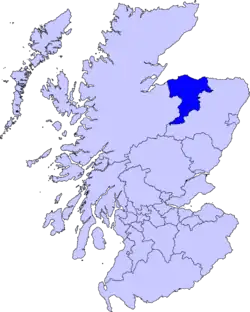
Chapeltown, Moray
| Chapeltown | |
|---|---|
 Chapeltown | |
  Chapeltown Location within Moray | |
| OS grid reference | NJ242210 |
| Council area | |
| Country | Scotland |
| Sovereign state | United Kingdom |
| Post town | BALLINDALLOCH |
| Postcode district | AB37 |
| Police | Scotland |
| Fire | Scottish |
| Ambulance | Scottish |
Chapeltown, also known as Chapeltown of Glenlivet, is a small hamlet in Moray, Scotland, in the Glenlivet area of the Cairngorms National Park.[1] The settlement lies in the Braes of Glenlivet, close to the Crombie Water, a tributary of the River Livet.[2] Chapeltown developed in the 19th century around a Roman Catholic church and school. It is also the location of Braeval distillery, a Speyside single malt whisky distillery established in 1973.[3]
History
The Braes of Glenlivet had a long association with Roman Catholicism, with the remoteness of the district provided shelter for Catholics during the period following the Scottish Reformation and the nearby Scalan seminary operated from 1716 until 1799, training around 100 Catholic priests and serving as an administrative centre for the Catholic Church in Scotland.[4] After Scalan closed in 1799, its former superior, Abbé MacPherson, sought to establish a permanent parish church for Catholics in the surrounding area.[2] In 1828, he was granted a piece of land at a place then known as Littletown of Eskemulloch, the site which developed into Chapeltown and established a church and school there.[2][4] A school and schoolhouse dating from 1832 survives as Mont Abbey. The Category C listed building originally accommodated the school on its ground floor and the schoolmaster's residence above.[5] A larger school building was constructed nearby in 1860; this single storey building, also Category C listed, later became disused.[6]
Economy
Braeval distillery stands beside Chapeltown and was constructed by Chivas Brothers, then part of Seagram, in 1973 under the name Braes of Glenlivet Distillery.[3][7] One of the earlier highly automated Scottish malt distilleries, it was initially equipped with three stills; two more were added in 1975 and a sixth in 1978.[3] The distillery was renamed Braeval in 1994 to avoid confusion with the neighbouring Glenlivet distillery. It was mothballed in the early 2000s before reopening in 2008 and is now operated by Chivas Brothers as part of Pernod Ricard.[3] It has a stated production capacity of around 4.2 million litres of spirit per year and six stills and is one of the highest situated whisky distilleries in Scotland.[3][8]
Community
Chapeltown's principal community facility is the Braes of Glenlivet Hall, also referred to as Chapeltown Hall, which is used for community meetings, performances and other local events.[9] The Glenlivet and Inveravon Community Association represents residents of the wider area and holds some of its regular public meetings at the hall, alternating with Glenlivet Public Hall.[10] The surrounding countryside also provides access to walking routes into the Ladder Hills and towards Scalan, forming part of the wider network of outdoor and heritage routes within Glenlivet and the Cairngorms National Park.[11]
Our Lady of Perpetual Succour Church
The first Catholic church at Chapeltown was established in 1828 and was probably designed by the priest Walter Lovi, who was also associated with the design of Catholic churches elsewhere in northern Scotland.[2] The present Church of Our Lady of Perpetual Succour was built in 1896–97 to designs by the Edinburgh architect John Kinross.[2] It is designed in a Scottish Romanesque style, with harled walls, pink granite dressings and a square gabled tower. Its interior retains extensive decorative stencilling, a timber barrel vaulted chancel ceiling and a carved reredos.[2] The church, adjoining Chapel House and burial ground form a Category A listed group. Chapel House dates largely from about 1830–40 and formerly served as the parish presbytery, while the burial ground contains a number of 19th century gravestones, many made from local slate.[2] The church remains in religious use and is served by the Roman Catholic Diocese of Aberdeen.[12]
References
- ↑ "Chapeltown from The Gazetteer for Scotland". Gazetteer for Scotland. Retrieved 2026-08-10.
- 1 2 3 4 5 6 7 "Braes of Glenlivet, Chapeltown, Roman Catholic Church of Our Lady of Perpetual Succour, Chapel House and Burial Ground". Historic Environment Scotland. Retrieved 10 August 2026.
- 1 2 3 4 5 "Braeval". ScotchWhisky.com. Retrieved 10 August 2026.
- 1 2 "Former Roman Catholic Seminary and Cottage to southwest, Scalan, Braes of Glenlivet". Historic Environment Scotland. Retrieved 10 August 2026.
- ↑ "Braes of Glenlivet, Chapeltown, Mont Abbey (Former School and Schoolhouse)". Historic Environment Scotland. Retrieved 10 August 2026.
- ↑ "Braes of Glenlivet, Chapeltown Former School". Historic Environment Scotland. Retrieved 10 August 2026.
- ↑ Lamond, John; Tucek, Robin (2007). The Malt Whisky File: The Essential Guide for the Malt Whisky Connoisseur. Canongate. p. 77. ISBN 978-1-84767-005-2. Retrieved 2026-08-10.
- ↑ DK (2016-11-01). World Whisky: A Nation-by-Nation Guide to the Best. Dorling Kindersley Limited. p. 56. ISBN 978-0-241-29911-1. Retrieved 2026-08-10.
- ↑ "Braes of Glenlivet Hall". North East Arts Touring. Retrieved 10 August 2026.
- ↑ "Community Associations". Tomintoul & Glenlivet Development Trust. Retrieved 10 August 2026.
- ↑ "Scalan Heritage Trail". Glenlivet Estate. Retrieved 10 August 2026.
- ↑ "Moray". Roman Catholic Diocese of Aberdeen. Retrieved 10 August 2026.