Cepheus OB3 Region
| Cepheus OB3 | |
|---|---|
| Observation data (J2000.0 epoch) | |
| Right ascension | 23h 04m 00s[1] |
| Declination | +63° 24′ 00″[1] |
| Distance | 2,360[2] (725[2]) |
| Apparent dimensions (V) | 5° |
| Physical characteristics | |
| connected to nebulosity Galactic coordinates: l = 111.3, b = +03.0[1] | |
| Other designations | III Cep |
| Associations | |
| Constellation | Cepheus |
The Cepheus OB3 region comprises a system of molecular clouds and H II regions associated with a large OB association, known as Cepheus OB3; the system takes its name from the northern constellation of Cepheus, in whose direction it is observed.
The association is located in the Orion Arm at a distance of approximately 725 parsecs (2,360 light-years) from the Solar System and is divided into two main subgroups based on the age of its member stars. The emission nebulae Sh2-160 and Sh2-155 are found in the region; within the latter, several infrared sources and molecular jets have been observed, indicating that a third generation of high- and low-mass stars is forming in the cloud.[2]
Observation
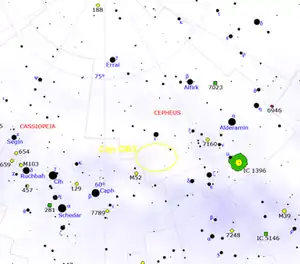
The region of the sky where the Cepheus OB3 association is observed lies in the southeastern part of the constellation Cepheus, along the northern Milky Way, near the border with Cassiopeia; its blue stars easily merge with the rich background star fields visible in this direction. The brightest components are of visual magnitude 7 and 8 and cannot be seen with the naked eye, but a pair of binoculars is sufficient to observe them, provided they can be distinguished among the numerous stars of similar brightness visible in this direction. The brightest one, HD 217312, is of magnitude 7.42.[3]
The declination of the association is strongly northern, favouring its observation from the Northern Hemisphere, where it is circumpolar down to low latitudes; from the Southern Hemisphere, the observation period is therefore very limited, and even the areas where it is visible are restricted to the tropical belt. The suitable months for observing it in the evening sky are between July and December.[a][3]
Characteristics and structure

Cepheus OB3 contains about forty young, bright stars,[4] among which three blue main-sequence stars, two blue main-sequence stars, and one blue giant of class B0III stand out. Among these, the brightest in terms of absolute magnitude are HD 217086, of class O7V and magnitude −4.9, and the aforementioned giant, of magnitude −4.8.[5] Photometric studies conducted in the 1990s refined this list of components, extending it to fainter stars.[3] It should be noted, however, that a 2005 study indicates that two of the O-class components listed as belonging to the association might be part of a more distant open cluster, designated ASCC 1125, with an age of 10 million years and located 1,500 parsecs from the Sun.[6]
In this association there is evidence of a division of its member stars into two subgroups, catalogued as Cepheus OB3a and Cepheus OB3b, with age serving as the distinguishing characteristic: Cepheus OB3a would in fact be the younger subgroup, with an age initially estimated at about 4 million years, while the second would have about 8 million years;[7] with the refinement of detection techniques, an age of 5.5 million years for the former and 7.5 million years for the latter was subsequently indicated.[3] The brightest stars of the Cepheus OB3b subgroup excite the gases of a nearby nebula, the ionized hydrogen region Sh2-155 (the famous Cave Nebula).[7] According to a study conducted using data from the Hipparcos satellite, it has been suggested that the runaway star Lambda Cephei may originate from this association, rather than from the adjacent Cepheus OB2.[8]
In the Cepheus OB3 association, over fifty X-ray sources are known, many of which were detected by ROSAT; it is suspected that most of them originate from T Tauri stars located in the regions surrounding the molecular cloud (but not inside it).[9] Also in X-rays, using the Chandra X-ray Observatory, two very rich open clusters were discovered in the 2000s, composed of 321 pre-main-sequence stars; one of these extends outside the molecular cloud and is part of the Cepheus OB3b association. These observations suggest that the X-ray luminosity function of this association differs from that obtained for other similar clusters, such as that in the Orion Nebula: indeed, in Cepheus OB3b there are more stars with masses below 0.3 M☉.[10]
Star formation phenomena

Through mapping in 12CO of the association's area, a molecular nebular complex extending 20×60 parsecs has been identified since the 1970s, within which several denser nebular areas can be distinguished, catalogued with progressive letters from Cepheus A to Cepheus F; in some of these, especially the first one, star formation would be very active, caused by the interaction of the cloud itself with the expanding H II region Sh2-155.[11] Cepheus OB3 can therefore be considered an example of sequential star formation.[12]
Cepheus A is one of the most studied nebular regions in the sky: it is an extremely active high-mass star-forming region, within which several thermal and non-thermal sources are known, some small H II regions, and strong infrared radiation emissions, all in an area of sky smaller than an arcminute.
The cloud Cepheus B is instead located in front of the nebula Sh2-155, whose ionization is due to the brightest components of the Cepheus OB3b subgroup; this nebula is the most active in the region and it is believed that the formation of the third generation of stars within Cepheus OB3 is taking place here. Studies in the radio continuum have shown that the compact ionized region located between Sh2-155 and the Cepheus B cloud is divided into four distinct regions; the most extensive of these, called the Ridge, is excited by the ionization front coming from very luminous young stellar objects. The other three parts, on the other hand, hide protostars still well wrapped in the cocoons in which they are forming.[13]
Associated with Sh2-155 might also be the dark nebula LDN 1211, which contains within it a bipolar jet structure originating from an infrared source and a small compact Herbig–Haro object, HH 363, plus three other infrared sources.[14] In total, around fifty infrared sources catalogued by IRAS[15] and 24 masers are known in the region around Sh2-155, of which six with OH emissions, fourteen with H2O emissions, and four with CH3OH emissions.[16]
Notes
- ↑ A declination of 63°N corresponds to an angular distance of 27° from the North Celestial Pole; this means that north of 27°N, the object is circumpolar, while south of 27°S, the object never rises.
References
- 1 2 3 "Simbad Query Result" [Simbad Query Result]. Retrieved 6 April 2013.
- 1 2 3 Kun, M.; Kiss, Z. T.; Balog, Z. (December 2008). Star Forming Regions in Cepheus [Star Forming Regions in Cepheus] (pdf). Vol. 4. Handbook of Star Forming Regions, Volume I: The Northern Sky ASP Monograph Publications, Bo Reipurth. p. 136. arXiv:0809.4761. ISBN 978-1-58381-670-7.
- 1 2 3 4 Jordi, C.; Trullols, E.; Galadi-Enriquez, D. (August 1996). "Cepheus OB3 association: faint members" [Cepheus OB3 association: faint members]. Astronomy and Astrophysics. 312: 499–507. Bibcode:1996A&A...312..499J. Retrieved 6 April 2013.
- ↑ Blaauw, A.; Hiltner, W. A.; Johnson, H. L. (July 1959). "Photoelectric Photometry of the Association III Cephei" [Photoelectric Photometry of the Association III Cephei]. Astrophysical Journal. 130 (69): 69. Bibcode:1959ApJ...130...69B. doi:10.1086/146697. Retrieved 12 March 2009.
- ↑ Humphreys, R. M. (December 1978). "Studies of luminous stars in nearby galaxies. I. Supergiants and O stars in the Milky Way" [Studies of luminous stars in nearby galaxies. I. Supergiants and O stars in the Milky Way]. Astrophysical Journal Supplement Series. 38: 309–350. Bibcode:1978ApJS...38..309H. doi:10.1086/190559. Retrieved 6 April 2013.
- ↑ Kharchenko, N. V.; Piskunov, A. E.; Röser, S.; Schilbach, E.; Scholz, R.-D. (September 2005). "109 new Galactic open clusters" [109 new Galactic open clusters]. Astronomy and Astrophysics. 440 (1): 403–408. arXiv:astro-ph/0505019. Bibcode:2005A&A...440..403K. doi:10.1051/0004-6361:20052740. Retrieved 6 April 2013.
- 1 2 Blaauw, Adriaan (1964). "The O Associations in the Solar Neighborhood" [The O Associations in the Solar Neighborhood]. Annual Review of Astronomy and Astrophysics. 2: 213–246. Bibcode:1964ARA&A...2..213B. doi:10.1146/annurev.aa.02.090164.001241. Retrieved 6 April 2013.
- ↑ Hoogerwerf, R.; de Bruijne, J. H. J.; de Zeeuw, P. T. (January 2001). "On the origin of the O and B-type stars with high velocities. II. Runaway stars and pulsars ejected from the nearby young stellar groups" [On the origin of the O and B-type stars with high velocities. II. Runaway stars and pulsars ejected from the nearby young stellar groups]. Astronomy and Astrophysics. 365 (2): 49–77. arXiv:astro-ph/0010057. Bibcode:2001A&A...365...49H. doi:10.1051/0004-6361:20000014. Retrieved 6 April 2013.
- ↑ Naylor, Tim; Fabian, A. C. (February 1999). "ROSAT observations of Cepheus OB3: the discovery of low-mass stars" [ROSAT observations of Cepheus OB3: the discovery of low-mass stars]. Monthly Notices of the Royal Astronomical Society. 302 (4): 714–722. Bibcode:1999MNRAS.302..714N. doi:10.1046/j.1365-8711.1999.02160.x.
- ↑ Getman, Konstantin V.; Feigelson, Eric D.; Townsley, Leisa; Broos, Patrick; Garmire, Gordon; Tsujimoto, Masahiro (April 2006). "Chandra Study of the Cepheus B Star-forming Region: Stellar Populations and the Initial Mass Function" [Chandra Study of the Cepheus B Star-forming Region: Stellar Populations and the Initial Mass Function]. The Astrophysical Journal Supplement Series. 163 (2): 306–334. arXiv:astro-ph/0601405. Bibcode:2006ApJS..163..306G. doi:10.1086/501453. Retrieved 6 April 2013.
- ↑ Sargent, A. I. (December 1977). "Molecular clouds and star formation. I - Observations of the Cepheus OB3 molecular cloud" [Molecular clouds and star formation. I - Observations of the Cepheus OB3 molecular cloud]. Astrophysical Journal. 218: 736–748. Bibcode:1977ApJ...218..736S. doi:10.1086/155729. Retrieved 6 April 2013.
- ↑ Elmegreen, B. G.; Lada, C. J. (June 1977). "Sequential formation of subgroups in OB associations" [Sequential formation of subgroups in OB associations]. Astrophysical Journal. 214: 725–741. Bibcode:1977ApJ...214..725E. doi:10.1086/155302. Retrieved 6 April 2013.
- ↑ Testi, L.; Olmi, L.; Hunt, L.; Tofani, G.; Felli, M.; Goldsmith, P. (November 1995). "Sequential star formation in the Cepheus molecular cloud: the S 155/Cepheus B interface" [Sequential star formation in the Cepheus molecular cloud: the S 155/Cepheus B interface]. Astronomy and Astrophysics. 303: 881. Bibcode:1995A&A...303..881T. Retrieved 6 April 2013.
- ↑ Alten, Victoria P.; Bally, John; Devine, David; Miller, Grant J. (January 1997). "Herbig-Haro objects discovered at Mount Laguna Observatory" [Herbig-Haro objects discovered at Mount Laguna Observatory]. Low Mass Star Formation - from Infall to Outflow, Poster Proceedings of IAU Symposium No. 182 on Herbig-Haro Objects and the Birth of Low Mass Stars. 182: 51. Bibcode:1997IAUS..182P..51A. Retrieved 6 April 2013.
- ↑ Helou, George; Walker, D. W. (1988). "Infrared astronomical satellite (IRAS) catalogs and atlases. Volume 7: The small scale structure catalog" [Infrared astronomical satellite (IRAS) catalogs and atlases. Volume 7: The small scale structure catalog]. Infrared Astronomical Satellite (IRAS) Catalogs and Atlases. 7: 1–265. Bibcode:1988iras....7.....H. Retrieved 6 April 2013.
- ↑ Avedisova, V. S. (March 2002). "A Catalog of Star-Forming Regions in the Galaxy" [A Catalog of Star-Forming Regions in the Galaxy]. Astronomy Reports. 46 (3): 193–205. Bibcode:2002ARep...46..193A. doi:10.1134/1.1463097. Retrieved 6 April 2013.
Bibliography
General texts
- Burnham, Robert Jr. (1978). Burnham's Celestial Handbook: Volume Two [Burnham's Celestial Handbook: Volume Two]. New York: Dover Publications, Inc. ISBN 978-0486235684.
- Arny, Thomas T. (2007). Explorations: An Introduction to Astronomy [Explorations: An Introduction to Astronomy] (3 updated ed.). Boston: McGraw-Hill. ISBN 978-0-07-321369-9.
- AA.VV (2002). L'Universo - Grande enciclopedia dell'astronomia [The Universe - Great Encyclopedia of Astronomy]. Novara: De Agostini.
- Gribbin, J. (2005). Enciclopedia di astronomia e cosmologia [Encyclopedia of Astronomy and Cosmology]. Milan: Garzanti. ISBN 88-11-50517-8.
- Owen, W.; et al. (2006). Atlante illustrato dell'Universo [Illustrated Atlas of the Universe]. Milan: Il Viaggiatore. ISBN 88-365-3679-4.
Specific texts
On stellar evolution
- Lada, C. J.; Kylafits, N. D. (1999). The Origin of Stars and Planetary Systems [The Origin of Stars and Planetary Systems]. Kluwer Academic Publishers. ISBN 0-7923-5909-7.
- De Blasi, A. (2002). Le stelle: nascita, evoluzione e morte [Stars: birth, evolution, and death]. Bologna: CLUEB. ISBN 88-491-1832-5.
- Abbondi, C. (2007). Universo in evoluzione dalla nascita alla morte delle stelle [Evolving Universe from the birth to the death of stars]. Sandit. ISBN 978-88-89150-32-0.
On the Cepheus OB3 association
- Kun, M.; Kiss, Z. T.; Balog, Z. (December 2008). Star Forming Regions in Cepheus [Star Forming Regions in Cepheus] (pdf). Vol. 4. Handbook of Star Forming Regions, Volume I: The Northern Sky ASP Monograph Publications, Bo Reipurth. p. 136. arXiv:0809.4761. ISBN 978-1-58381-670-7.
Sky charts
- Taki, Toshimi (2005). "Taki's 8.5 Magnitude Star Atlas" [Taki's 8.5 Magnitude Star Atlas]. Archived from the original on 5 November 2018. Retrieved 6 April 2013.
- Tirion, Wil; Rappaport, Barry; Lovi, George (1987). Uranometria 2000.0 - Volume I - The Northern Hemisphere to -6° [Uranometria 2000.0 - Volume I - The Northern Hemisphere to -6°]. Richmond, Virginia, USA: Willmann-Bell, inc. ISBN 0-943396-14-X.
- Tirion, Wil; Sinnott, Roger (1998). Sky Atlas 2000.0 [Sky Atlas 2000.0] (2 ed.). Cambridge, USA: Cambridge University Press. ISBN 0-933346-90-5.
- Tirion, Wil (2001). The Cambridge Star Atlas 2000.0 [The Cambridge Star Atlas 2000.0] (3 ed.). Cambridge, USA: Cambridge University Press. ISBN 0-521-80084-6.
External links
- "The HII region Sh 2-160 is located near or within the Cep OB3 association" [The HII region Sh 2-160 is located near or within the Cep OB3 association]. Retrieved 2 March 2025.
| Stars |
| ||||||||||||
|---|---|---|---|---|---|---|---|---|---|---|---|---|---|
| |||||||||||||
| Star clusters |
| ||||||||||||
| Nebulae |
| ||||||||||||
| Galaxies |
| ||||||||||||
| |||||||||||||
