Bergamo–Trescore–Sarnico Tramway
| Bergamo–Trescore–Sarnico tramway | |||
|---|---|---|---|
 Terminus on the lakefront of Sarnico | |||
| Overview | |||
| Termini |
| ||
| Service | |||
| Type | Tram | ||
| Operator | Società Tramvia a vapore Bergamo-Trescore-Sarnico (BTS) | ||
| History | |||
| Opened | 1901 (Bergamo–Trescore) 1902 (Trescore–Sarnico) | ||
| Closed | 1921 (Trescore–Sarnico) 1931 (Bergamo–Trescore) | ||
| Technical | |||
| Line length | 37 km (23 mi) | ||
| Track gauge | 1,445 mm | ||
| |||

The Bergamo–Trescore–Sarnico tramway, opened in two successive sections starting in 1901 and later integrated with the Trescore–Lovere Tramway, was part of an integrated network of connections linking the Italian provinces of Bergamo and Brescia via Lake Iseo.
Particularly active thanks to intensive passenger and freight traffic, the steam‑operated line was nevertheless closed on the section to Lovere in 1921, and ten years later on the remaining route, also due to a political climate unfavourable to investment in rail systems.[1][2][3]
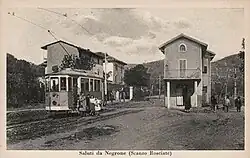
The first section as far as Negrone (Scanzorosciate), meanwhile electrified and integrated into the Bergamo tram network, survived until 1953.[4]
History

Among the entrepreneurial initiatives supported by the Banca Bergamasca di depositi e conti correnti were numerous public-service undertakings, such as the construction of a tramway that, passing through the spa town of Trescore Balneario, would allow Bergamo to reach the shores of Lake Iseo.[5] For the management of this initiative, the company Tramvia a vapore Bergamo-Trescore-Sarnico (BTS) was specifically founded, with its headquarters established at the Bergamo terminus, located in Via Paleocapa in the building known as Dolci-Terzi.[6]
After two years of construction work,[7] everything appeared ready for the inauguration of the line, which was 37 km long,[8] on which service commenced on 7 December 1901,[1] two months after the opening of the Lovere–Cividate Camuno Tramway, on the section Bergamo–Gorle–Trescore Balneario; actual service began on 20 December of the same year.[9][10]
Less than a year later, on 31 July 1902, the extension from Trescore to Sarnico was inaugurated.[8]
Ticket prices were set at two lire and twenty centesimi for first class and one lira and forty centesimi for second class for journeys from Bergamo to Sarnico; return trips cost three lire and thirty centesimi and two lire and ten centesimi, respectively.[8]
The service was structured with five daily pairs plus an additional odd-direction run, with departures from Bergamo at 5:10, 6:33, 9:20, 12:23, 16:00 and 20:13, and returns at 6:30, 9:12, 12:15, 16:45 and 20:10.[8]

A characteristic aspect of the service was its integration with other transport offerings in the area: the steamer schedules on Lake Iseo, for example, indicated rail and tram connections at the landing stages of Lovere (with the Camuna tramway), Iseo (with the tramway to Chiari and with the Brescia–Edolo and Iseo–Cremona railways), and Sarnico (with the tramway to Bergamo and the Palazzolo–Paratico railway).[11]
With the decline of traffic beginning, also as a consequence of the economic difficulties following the First World War, in the 1920s the first part of the route, up to Negrone (Scanzorosciate), was electrified and incorporated into the Bergamo tram network.[12]
The closure of the Trescore–Sarnico section occurred as early as 1921, while the remaining section from Negrone to Trescore, used by convoys heading to the Val Cavallina, remained in service until 1931.[3] The last vestige of what represented an important link between the city of Bergamo and its eastern province, the urban line to Negrone, was suppressed in 1953.[13]
Characteristics
Built with the usual tramway gauge of 1,445 mm,[14] the line ran for large stretches on its own right-of-way, especially in the second part of the route after Trescore Balneario; for this reason, the local daily L'Eco di Bergamo likened it to "an economical Swiss railway".[8]
Route
Leaving the terminus, adjacent to the city railway stations, trams bound for Sarnico reached Borgo Palazzo and, after passing under the valley railways, ran parallel to them until turning east shortly after passing the city's Nuovo Cimitero (New Cemetery). From here, the first section, electrified in the 1920s, wound its way serving first Gorle and then, after crossing the Serio, Scanzorosciate and the hamlet of Negrone, where the urban section ended on Via Piave, at the junction with Via Brenta.[12]
The steam trams then continued along the provincial road, towards Pitturello and Sant'Albano Alessandro, a locality served with a stop more central than the railway station on the Bergamo–Brescia railway, which was nevertheless a few hundred metres away.[15]
Thus one arrived at Trescore: after passing the central Piazza Cavour under the shadow of the town tower, the station stood in the area in front of the parish church of San Pietro Apostolo, later urbanised with the construction of several buildings. This facility, a junction point shared with the Val Cavallina tramway, had about seven hundred metres of track; during its construction, a special conduit was built to channel the water gushing from the spring known as "salina" (saltworks), located on the hill of Madonna del Castello, conveying it to the station for supplying the locomotives of both lines and for station services, as well as for the municipality of Trescore.[8][16]

Leaving the spa town, the convoys used a section on its own right-of-way as far as Gorlago, descending along the valley of the Cherio, which was crossed by means of an iron bridge, reaching Carobbio degli Angeli. Upon arriving at Cicola, the railway was again flanked, along with the stations of Chiuduno and Grumello del Monte.[17]
Turning east towards Lake Iseo, the tramway served Tagliuno, Villongo and finally Sarnico, whose terminal station stood at the mouth of the Oglio, on the opposite bank from where the Paratico-Sarnico railway station is located;[8] the surviving passenger building was later adapted into a restaurant, enhancing and recalling its original aesthetic lines and function.
Rolling stock
The original rolling stock, bearing the initials "BTS" (Bergamo Trescore Sarnico), was officially presented to the public in May 1901[8] and included two two-axle tramway locomotives built by Krauss.

Two more three-axle units were added to the initial fleet in 1906, and a further three locomotives of various types were purchased by the BTS in the following three years.[18]
After the First World War, the Ferrovia della Val Seriana company, which also operated the Bergamo–Soncino Tramway, had expressed its intention to abandon operation of the latter: in 1921, following opposition to the closure from local administrations and public opinion, the company decided to donate the infrastructure and rolling stock to the provinces of Bergamo and Cremona. To ensure its operation, the two administrations entered into a provisional agreement with both the BTS and the Tranvia della Valle Cavallina (TVC), which operated the Trescore–Lovere Tramway. The agreement lasted from 1 August to 31 December 1921 and saw the transfer of rolling stock from the Bergamo FVS station to the one shared by the two tram lines.[19]
Finally, in 1924, a three-axle cabbed locomotive with cylindrical distributors and Walschearts valve gear, built by Breda, was delivered to the Società Tranvie Bergamasche (STB)[20] for use on the Bergamo–Trescore–Sarnico line; the latter was transferred in 1932 to the Monza–Trezzo–Bergamo tramway company.[21]
Locomotive summary
The following steam locomotives, all standard gauge, served on the Bergamo–Trescore–Sarnico tramway:[18]
| Unit | Year of acquisition | Builder | Wheel arrangement | Max speed | Notes |
|---|---|---|---|---|---|
| 1÷2 | 1901 | Krauss | B | 25 km/h | |
| 3÷4 | 1906 | Krauss | C | 30 km/h | |
| 5 | 1908 | Orenstein & Koppel | B | 30 km/h | Numbering assigned uncertain according to source |
| 11÷12 | 1909 | Krauss | C | 30 km/h | |
| 1 | 1924 | Breda | C | 30 km/h | transferred in 1932 to the Monza–Trezzo–Bergamo line |
See also
References
- 1 2 Ogliari & Sapi 1963, p. 159.
- ↑ Pennacchio 2006, pp. 192–193.
- 1 2 Ogliari 1993, p. 141.
- ↑ Leopardi, Ferruggia & Martinelli 2005, ch. "La rete tranviaria bergamasca", pp. 58–62.
- ↑ Announcement regarding the preventive arrangement of the Bank published in the Gazzetta Ufficiale del Regno d'Italia no. 174 of 29 July 1932 Archived 31 October 2016 at the Wayback Machine.
- ↑ Ogliari & Sapi 1963, p. 160.
- ↑ News in L'Eco di Bergamo, 9–10 April 1902.
- 1 2 3 4 5 6 7 8 Frattini & Ravanelli 2013, chapter "I pendolari: ore e ore trascorse in treno".
- ↑ Marcarini 1979, p. 43.
- ↑ Pennacchio 2006, pp. 171–172.
- ↑ Orario ufficiale delle strade ferrate, delle tramvie, della navigazione e delle messaggerie postali del Regno d'Italia, Fratelli Pozzo Editori, Turin, January 1911, quadro 364 (combined steamer and tram timetable).
- 1 2 Leopardi, Ferruggia & Martinelli 2005, pp. 58–59.
- ↑ Leopardi, Ferruggia & Martinelli 2005, pp. 61–62.
- ↑ Hefti 1984, p. 225.
- ↑ Pennacchio 2006, p. 175.
- ↑ Leopardi, Ferruggia & Martinelli 2005, pp. 59–60.
- ↑ Pennacchio 2006, pp. 176–177.
- 1 2 Hefti 1984, pp. 224–227.
- ↑ Albertini & Cerioli 1994, p. 104.
- ↑ This was the name used for the operating company in some administrative documents.
- ↑ Molino 1998, p. 17.
Bibliography
- Ogliari, Francesco; Sapi, Franco (1963). Albe e tramonti di prore e binari [Sunsets and sunrises of bows and tracks]. Milan: self-published.
{{cite book}}: CS1 maint: ref duplicates default (link) - Frattini, Pilade; Ravanelli, Renato (2013). Il Novecento a Bergamo: Cronache di un secolo [The Twentieth Century in Bergamo: Chronicles of a Century]. UTET / De Agostini. ISBN 978-88-5112-123-5.
{{cite book}}: CS1 maint: ref duplicates default (link) - Pennacchio, Mauro (2006). La meccanica viabilità - La ferrovia nella storia del lago d'Iseo e della Vallecamonica [Mechanical roads - The railway in the history of Lake Iseo and Vallecamonica]. Marone: Fdp Editore. ISBN 88-902714-0-X.
{{cite book}}: CS1 maint: ref duplicates default (link) Available on Google Books. - Marcarini, Albano (1979). "Nascita e sviluppo delle linee tramviarie extraurbane in Lombardia. 1876-1918" [Birth and development of interurban tram lines in Lombardy. 1876-1918]. Storia urbana. 7: 3–46.
{{cite journal}}: CS1 maint: ref duplicates default (link) - Leopardi, Giulio; Ferruggia, Carlo; Martinelli, Luigi (2005). Treni & Tramvie della bergamasca [Trains and Tramways of the Bergamo area] (2 ed.). Clusone: Ferrari Editrice. ISBN 88-89428-10-4.
{{cite book}}: CS1 maint: ref duplicates default (link) - Hefti, Walter (1984). Dampf-Strassenbahnen [Steam Tramways]. Basel: Birkhäuser Verlag. ISBN 978-3-7643-1536-8.
{{cite book}}: CS1 maint: ref duplicates default (link) - Ogliari, Francesco (1993). Ruote e binari in Lombardia [Wheels and rails in Lombardy]. Milan: self-published.
{{cite book}}: CS1 maint: ref duplicates default (link) - Albertini, Mario; Cerioli, Claudio (1994). Trasporti nella Provincia di Cremona - 100 anni di storia [Transport in the Province of Cremona - 100 years of history] (2 ed.). Cremona: Editrice Turris. ISBN 888563589X.
{{cite book}}: CS1 maint: ref duplicates default (link) - Molino, Nico (October 1998). "Le locomotive per tranvie a vapore" [Steam tramway locomotives]. Mondo ferroviario (148): 16–19.
{{cite journal}}: CS1 maint: ref duplicates default (link)
External links

- "Map of the line". Open Historical Map.