Amar Sagar Jain temple
| Amar Sagar Jain Temple | |
|---|---|
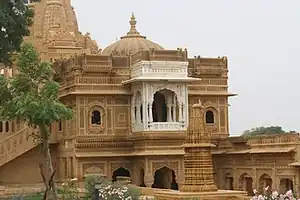 Amar Sagar Jain Temple | |
| Religion | |
| Affiliation | Jainism |
| Sect | Śvētāmbara |
| Deity | Rishabhanatha |
| Location | |
| Location | Amar Sagar, Jaisalmer |
| State | Rajasthan |
| Country | India |
| Architecture | |
| Style | Māru-Gurjara architecture |
| Creator | Himmat Rai Bafna |
| Established | 1871 |
Amar Sagar Jain Temple, also known as Adinath Jain Temple, is a Jain temple at Amar Sagar near Jaisalmer in Rajasthan, India. The temple is dedicated to Adinatha, the first Tirthankara of Jainism.[1] It stands near the historic Amar Sagar reservoir and palace complex, west of Jaisalmer.[2] The temple was constructed in 1871 CE by Himmat Rai Bafna.[3][4] Constructed principally of the characteristic yellow limestone of Jaisalmer, the two-storeyed temple is notable for its elaborate stone carving, pierced latticework and projecting jharokhas.[1][3]
History
The Amar Sagar complex predates the Jain temple. Amar Sagar developed around a reservoir and palace associated with the rulers of Jaisalmer.[2] The Jain temple was constructed during the nineteenth century as part of the continuing tradition of Jain religious patronage in the Jaisalmer region. Himmat Rai Bafna constructed the temple in 1871 CE.[3] The construction is also documented in the study Jain Inscriptions of Rajasthan, which records that a Jain temple was constructed at Amarsagar by the Bafna family in Vikrama Era 1928.[4] The construction of the temple demonstrates the continuation of the elaborate stone-working traditions associated with Jain architecture at Jaisalmer into the nineteenth century.[5]
Architecture
The temple is a two-storeyed structure constructed in yellow Jaisalmer limestone.[1][3] The temple is surmounted by a curvilinear shikhara articulated with multiple subsidiary turrets. The superstructure terminates in an amalaka, kalasha and pinnacle.[1] The exterior walls are extensively decorated with pierced stone latticework. Projecting jharokhas are supported by carved brackets, while foliated arches are used for openings in the structure.[1] The architectural treatment differs from that of the medieval Jain temples within Jaisalmer Fort. Whereas the older temples employ richly carved pillared rangamandapas and entrance structures, the Amar Sagar temples place greater emphasis on elaborate stone carving and latticework.[5]
The upper storey carries the principal curvilinear shikhara.[1] Architectural documentation of the temple notes the combination of the central tower with smaller turret-like forms, producing a vertically articulated superstructure. The extensive use of carved yellow limestone visually connects the building with the broader architectural traditions of Jaisalmer. The Amar Sagar temple is particularly notable for the treatment of Jaisalmer's yellow limestone. Its architectural decoration includes intricate floral carving, pierced screens and sculptural ornament. Jaisalmer limestone has historically been extensively used for temples, palaces, havelis and other monumental buildings in the region because of its suitability for detailed carving.[3]
At Amar Sagar, the material is used for both the structural fabric and the ornamental programme of the temple, including the jalis, brackets, balconies and architectural mouldings.[1]
Amar Sagar complex
The temple stands in the historic Amar Sagar landscape outside Jaisalmer. The wider complex includes the Amar Sagar reservoir and Amar Singh Palace. The reservoir lies adjacent to the palace and includes a series of pavilions, steps, ponds and wells. The Jain temple stands at one end of the reservoir.[2] The location of the Jain temple beside the reservoir integrates the nineteenth-century religious structure into the older architectural and water-management landscape of Amar Sagar.
Significance
Amar Sagar Jain Temple represents a relatively late phase of the Jain architectural tradition of Jaisalmer. While the major Jain temples within Jaisalmer Fort principally date from the medieval period, temple construction and Jain architectural patronage continued in the region into the nineteenth century.[5] The temple is particularly significant for its extensive use of carved Jaisalmer yellow limestone. A geological study of Jaisalmer limestone identifies the Amar Sagar Jain Temple among the notable heritage buildings constructed from the material and specifically notes its intricate carving and upper-storey shikhara.[3]
See also

References
Citations
Sources
- Indira Gandhi National Centre for the Arts; Archaeological Survey of India. "Adi Nath Jain Mandir, Amar Sagar" (PDF). Documentation Format for Archaeological / Heritage Sites / Monuments. Indira Gandhi National Centre for the Arts. RJ/JSL-059. Retrieved 20 August 2026.
- Jain, K. C. (1982). Jain Inscriptions of Rajasthan. Vaishali: Research Institute of Prakrit, Jainology & Ahimsa.
- Kaur, G.; Kaur, P.; Ahuja, A.; Singh, A.; Saini, J.; Agarwal, P.; Bhargava, O. N.; Pandit, M.; Goswami, R. G.; Acharya, K.; Garg, S. (2020). "Jaisalmer Golden Limestone: A Heritage Stone Resource from the Desert of Western India". Geoheritage. 12. Springer. doi:10.1007/s12371-020-00467-0.
- Rajasthan Tourism (2026). "Jaisalmer". Department of Tourism, Government of Rajasthan. Retrieved 20 August 2026.
{{cite web}}: CS1 maint: ref duplicates default (link)
See also : Jain temples in North America and Jain temples in Pakistan | |
| Bihar | |
| Delhi | |
| Gujarat | |
| Jharkhand | |
| Karnataka | |
| Kerala | |
| Madhya Pradesh | |
| Maharashtra | |
| Nagaland | |
| Odisha | |
| Rajasthan | |
| Tamil Nadu | |
| Telangana | |
| Uttar Pradesh | |
| West Bengal | |


| Gods | |||||
|---|---|---|---|---|---|
| Philosophy | |||||
| Branches |
| ||||
| Practices | |||||
| Literature | |||||
| Symbols | |||||
| Ascetics | |||||
| Scholars | |||||
| Community |
| ||||
| Jainism in |
| ||||
| Jainism and | |||||
| Dynasties and empires | |||||
| Related | |||||
| Lists | |||||
| Navboxes |
| ||||