744 Naval Air Squadron
| 744 Naval Air Squadron | |
|---|---|
 Squadron badge | |
| Active | 1 March 1943 - 1 June 1944 6 March 1944 - 1 December 1947 20 July 1951 - 1 March 1954 1 March 1954 - 31 October 1956 14 November 2018 - present |
| Country |  United Kingdom |
| Branch |  Royal Navy |
| Type | Fleet Air Arm Second Line Squadron |
| Role |
|
| Part of | Fleet Air Arm and Air and Space Warfare Centre |
| Home station |
|
| Mottos | Nemo solus satis sapit (Latin for 'No one or man knows enough') |
| Aircraft |
|
| Website | Official website |
| Commanders | |
| Current commander | Commander Tony Sherwin, RN |
| Insignia | |
| Squadron Badge Description | Barry wavy of ten white and blue, a sun in splendor gold charged with an eagle's head affronty proper (1956) |
| Identification Markings | letter/number combinations (Seamew/Swordfish) N7A+ (Swordfish) N6A+ (Avenger) N4A+ and N6A+ (Barracuda) 300-311 (Barracuda) 400-410 (Sea Prince/Anson) 236-239 (Firefly) 394-399 (Avenger) 401-403 (Gannet) 657-661 (Gannet from January 1956) |
| Fin Shore Codes | JR (Barracuda) GN (Sea Prince/Anson) CU (Firefly, Avenger & Gannet) |
744 Naval Air Squadron (744 NAS) is a Fleet Air Arm (FAA) naval air squadron of the United Kingdom’s Royal Navy (RN). Beginning in 2024, the squadron's role shifted to the Joint Uncrewed Air System Test and Evaluation Squadron (JUAS TES), spearheading the Ministry of Defence's initiatives in Unmanned aircraft system (UAS) testing and assessment.
It was originally established in 1943 in Nova Scotia and has undergone various re-designations and reformations throughout its history. The squadron has transitioned from early air gunner training to anti-submarine warfare and trials, and in 2018, it reformed at MoD Boscombe Down as the Mission Systems and Armament Test and Evaluation Squadron.
History
Air Gunner Training Squadron (1943–1944)

The squadron formed at RNAS Lee-on-Solent (HMS Daedalus), situated near Lee-on-the-Solent in Hampshire, on 10 February 1943.[1] However, as part of the British Commonwealth Air Training Plan, the squadron moved to RN Air Section Yarmouth, located in Yarmouth County, Nova Scotia, Canada, almost straight away. It was equipped with Curtiss SO3C Seamew aircraft.[2] Fifteen months later, in June 1944, the squadron was re-designated as 754 Naval Air Squadron.
Merchant Aircraft Carrier and Anti-Submarine training (1944–1947)
The squadron re-formed at RNAS Maydown (HMS Shrike), located 4.3 miles (6.9 km) northeast of Derry, County Londonderry, Northern Ireland, as a Merchant Aircraft Carrier training unit, on 6 March 1944, operating Fairey Swordfish torpedo bomber aircraft. A detachment, working out of RNAS Machrihanish (HMS Landrail), located near Campbeltown in Argyll and Bute, Scotland and trained crews for 836 Squadron,[3] including providing Anti-submarine warfare (ASW) training.[4]
744 Naval Air Squadron swapped its Fairey Swordfish for Fairey Barracuda torpedo and dive bomber aircraft and then briefly, Fairey Firefly aircraft. The squadron moved to RNAS Eglinton (HMS Gannet), located 1.3 miles (2.1 km) northeast of Eglinton, County Londonderry, Northern Ireland, in October 1945 and continued in the ASW training role using Avro Anson aircraft for this purpose,[3] until 1 December 1947 when it was renamed 815 Squadron.[4]
Anti-Submarine Trials and Development Unit (1951–1956)
It reformed on 20 July 1951, from 737 Squadron X Flight, as an anti-submarine trials and development unit at RNAS Eglinton (HMS Gannet)[4] and continued in this role until 31 October 1956 when it was disbanded.[5] The squadron was engaged with trials to support the development of search receivers, which were designed to detect submarine radar. A Fairey Barracuda ASV Mk.XI underwent a conversion for trial purposes, this was known as ‘Investigation Pointer’. It was also involved with Orange Harvest, which was subsequently fitted to the RAF's maritime patrol Avro Shackletons. A detachment went to RNAS Hal Far, Malta, in October 1951 following two Fairey Fireflies being fitted with a homing device that could detect sonobuoys, therefore removing the need for smoke markers, for subsequent trials with submarines and ships, from successive initial trials at Farnborough.[3]

Additionally the squadron took on Search and Rescue duties from December 1952, using Dragonfly HR.3 helicopters, although this role ended on disbandment at RNAS Eglinton.[4] By 1953, 744 Naval Air Squadron also operated as the Station Flight, but again this ended on disbandment, which took place on 1 March 1954.[3] However, on the same day, the squadron reformed at RNAS Culdrose (HMS Seahawk), located near Helston, Cornwall, as a Naval fixed wing anti-submarine warfare development unit (ASWDU), remaining there until the October where it relocated to RAF St Mawgan, near St Mawgan and Newquay, in Cornwall.[4] Here, the squadron was initially equipped with Fairey Firefly AS.6 anti-submarine warfare aircraft on reformation and these were later followed by Fairey Gannet, which arrived in May 1955. Two months later, the squadron received Grumman Avengers and the Fairey Firefly were withdrawn later in the year.[3] Two years on from arriving in RAF St Mawgan, the squadron disbanded on 31 October 1956.[4]
Mission Systems and Armament Test and Evaluation Sqn (2018–2024)

On 14 November 2018, the squadron was reformed, at MoD Boscombe Down. It was initially tasked with introducing the Crowsnest Airborne Early Warning to the Merlin Mk2 anti-submarine warfare helicopter and supporting the RAF's Chinook HC5 and HC6 transport helicopters. It operated as a joint unit under the Air Warfare Centre, evaluating and testing new helicopter and fixed-wing platforms, including their avionics and weapons.[6][7] The squadron also provided support for the Merlin HC4/4A commando transport helicopter, Wildcat HMA2 maritime helicopter and the Wildcat AH1 battlefield reconnaissance helicopter, focusing on weapons integration programmes, including the Martlet or Lightweight Multirole Missile (LMM) and Sea Venom anti-ship missile.
Joint Uncrewed Air System Test and Evaluation Squadron (2024–present)
On 26 September 2024, 744 Naval Air Squadron transitioned into the Joint Uncrewed Air System Test and Evaluation Squadron (JUAS TES). This marked a significant evolution, as the squadron became the Ministry of Defence's lead unit for testing and evaluating uncrewed air systems (UAS). This has positioned 744 Naval Air Squadron at the forefront of unmanned aircraft systems (UAS) development, supporting future UK air systems.
744 Naval Air Squadron is currently based at MoD Boscombe Down as part of the Air and Space Warfare Centre. The principal objective of this unit is to conduct testing and evaluation of both novel and established uncrewed UAS. This encompasses the assessment of platform performance, the integration of payloads and weapons, as well as the advancement of sophisticated networks. Serving as the Ministry of Defence's primary entity for UAS, JUAS TES is instrumental in influencing the future trajectory of air systems and their operational capabilities in the United Kingdom.
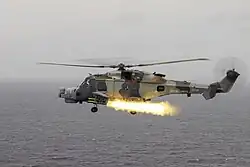
The squadron continues to support the Crowsnest Programme, the airborne early warning and control system (AEWACS) for the Merlin HM2 helicopters, which is key to enhancing the Royal Navy's ability to detect and respond to airborne and surface threats, maintaining the strategic capability of the fleet. The squadron also continues to support the integration of the Martlet missile and Sea Venom anti-ship missile for the Wildcat helicopter and other new weapons systems.
In a large change, the Parliamentary Under-Secretary of State for the Armed Forces, Luke Pollard, answered a written parliamentary question stating that 216 Squadron will transition from its current role as the swarming drone trials unit
"to become the operational delivery squadron for an Autonomous Collaborative Platforms (ACP) capability in 2025."
The role of the drone trials unit will pass to 744 Naval Air Squadron as the Joint Uncrewed Air System Test and Evaluation Squadron.[8]
During June 2026, personnel from 744 Squadron took part in a landmark maritime trial in which the Royal Navy launched a Callen‑Lenz Nyan one‑way attack drone from the experimental vessel XV Patrick Blackett while underway off the Dorset coast. Working alongside 26th Regiment Royal Artillery and the ship’s company, 744 NAS supported the setting of autonomous flight profiles, higher‑autonomy navigation tests and counter‑UAS evaluation as part of Project VANTAGE, the tri‑service effort to develop maritime one‑way effectors. The trial demonstrated that any naval vessel with adequate deck space can employ such expendable systems and provided early data on launch behaviour in ship motion, contributing to wider experimentation following the Ministry of Defence’s 2026 contract for operational and training drones.[9]
Aircraft flown

The squadron has flown and worked with a number of different aircraft types, including:[3][10]
- Curtiss Seamew I observation floatplane (March - December 1943)
- Fairey Swordfish II torpedo bomber ( March 1943 - May 1944, March 1944 - April 1945)
- Fairey Swordfish I torpedo bomber (March 1944 - April 1945)
- Stinson Reliant I liaison and training aircraft (July 1944 - August 1945)
- Grumman Avenger Mk.II torpedo bomber (October 1944 - September 1945)
- Fairey Barracuda Mk II torpedo and dive bomber (November 1944 - August 1945)
- Fairey Swordfish III torpedo bomber (February - May 1945)
- Fairey Barracuda TR III anti-submarine warfare aircraft (March 1945 - December 1947)
- Fairey Firefly I fighter aircraft (July - September 1945)
- Fairey Barracuda Mk III torpedo and dive bomber (August 1945 - October 1946)
- Supermarine Seafire F Mk.III[11] fighter aircraft (May 1946)
- Avro Anson Mk I multirole training aircraft (August 1946 - December 1947, July 1951 - November 1953)
- Airspeed Oxford[12] training aircraft (September 1947)
- Supermarine Sea Otter ASR II[13] amphibious air-sea rescue aircraft (July 1951 - January 1952)
- Fairey Barracuda TR 3 anti-submarine warfare aircraft (July 1951 - July 1953)
- de Havilland Dominie[14] short-haul airliner (July 1951 - September 1953)
- Fairey Firefly AS.Mk 6 anti-submarine warfare aircraft (July 1951 - March 1954, March 1954 - November 1955)
- Percival Sea Prince[15] T1 transport aircraft (August 1952 - February 1954, March 1954 - March 1955)
- Fairey Firefly T.Mk 1 training aircraft (August 1952 - February 1954)
- Westland Dragonfly HR.3 air-sea search and rescue helicopter (December 1952 - February 1954)
- Fairey Firefly T.Mk 2 training aircraft (October 1953 - February 1954)
- Fairey Gannet AS.1 anti-submarine warfare aircraft (May 1955 - October 1956)
- Grumman Avenger AS5 anti-submarine warfare aircraft (July 1955 - February 1956)
- Hawker Sea Fury FB.11 fighter bomber (May - October 1956)
- AgustaWestland Merlin HM2[16] anti-submarine warfare helicopter
- Chinook HC5/HC6[17] transport helicopter
Naval air stations and other airbases
744 Naval Air Squadron previously operated from a number of naval air stations of the Royal Navy, a number of Royal Navy aircraft carrier and an airbase overseas and is currently based at QinetiQ's military aircraft testing facility, MOD Boscombe Down:[18]
1943 - 1944
- Royal Naval Air Station Lee-on-Solent (HMS Daedalus), Hampshire, (10 February 1943 - 1 March 1943)
- RN Air Section Yarmouth, Nova Scotia, (1 March 1943 - 1 June 1944)
- became 754 Naval Air Squadron
1944 - 1947
- Royal Naval Air Station Maydown (HMS Shrike), County Londonderry, (6 March 1944 - 29 September 1945)
- Royal Naval Air Station Machrihanish (HMS Landrail), Argyll and Bute, (Detachment 6 March 1944 - 29 September 1945)
- Royal Naval Air Station Eglinton (HMS Gannet), County Londonderry, (29 September 1945 - 1 December 1947)
- Royal Air Force Ballykelly, County Londonderry, (Detachment six aircraft 27 November 1945 - 1 May 1946)
- Royal Naval Air Station Maydown (HMS Shrike), County Londonderry, (Detachment 1 May 1946 - 27 January 1947)
- HMS Theseus (Detachment 7 - 17 November 1946)
- became 815 Naval Air Squadron (1 December 1947)
1951 - 1954
- Royal Naval Air Station Eglinton (HMS Gannet), County Londonderry, (20 July 1951 - 1 March 1954)
- Royal Naval Air Station Hal Far (HMS Falcon), Malta, (Detachment two aircraft 3 October - 22 November 1951)
- disbanded - (1 March 1954)
1954 - 1956
- Royal Naval Air Station Culdrose (HMS Seahawk), Cornwall, (1 March 1954 - 22 October 1954)
- Royal Air Force Station St Mawgan, Cornwall, (22 October 1954 - 31 October 1956)
- disbanded - (31 October 1956)
2018 - present
- MOD Boscombe Down, Wiltshire, (14 November 2018 - present)
Commanding officers
List of commanding officers of 744 Naval Air Squadron with date of appointment:[10]
1943 - 1944
- Lieutenant(A) E.J. Trerise, RN, from 1 March 1943
- became 754 Naval Air Squadron 1 June 1944
1944 - 1947
- Lieutenant Commander(A) C.M.T. Hallewell, RN, from 6 March 1944
- Lieutenant Commander(A) D.W. Phillips DSC, RN, from 27 February 1945
- Lieutenant Commander(A) O.W. Tattersall, DSC, RN, from 18 September 1945
- Lieutenant(A) J.H.B. Bedells, RN, from 27 February 1946
- Lieutenant(A) R.H.W. Blake, RN, from 20 May 1946
- disbanded - 1 December 1947
1951 - 1954
- Lieutenant Commander F.E. Cowtan, RN, from 20 July 1951
- disbanded - 1 March 1954
1954 - 1956
- Lieutenant Commander F.G.J. Arnold, RN, from 1 March 1954
- Lieutenant Commander R. Fulton, RN, from 4 January 1956
- disbanded - 31 October 1956
Note: Abbreviation (A) signifies Air Branch of the RN or RNVR.[19]
References
Citations
- ↑ Fleet Air Arm Association (19 October 2018). "744 NAS Commissioning". Fleet Air Arm Association. Retrieved 25 March 2022.
- ↑ Thetford 1991, p. 91.
- 1 2 3 4 5 6 "744 Naval Air Squadron". www.wings-aviation.ch. Retrieved 12 January 2023.
- 1 2 3 4 5 6 "Helis 744 Naval Air Squadron". www.helis.com. Retrieved 12 January 2023.
- ↑ Ballance, Theo (2016). The Squadrons and Units of the Fleet Air Arm. Air-Britain. pp. 69–70. ISBN 978-0-85130-489-2.
- ↑ Royal Navy (14 November 2018). "Naval squadron re-forms after 60 years to test cutting-edge weaponry". Royal Navy. Retrieved 14 November 2018.
- ↑ Fleet Air Arm Association (19 October 2018). "744 NAS Commissioning". Fleet Air Arm Association. Retrieved 14 November 2018.
- ↑ Jennings, Gareth (18 October 2024). "216 Sqn to lead RAF effort to field unmanned 'loyal wingmen'". janes.com. IHS Janes. Retrieved 26 November 2024.
- ↑ "Royal Navy launches strike drone from XV Patrick Blackett in landmark trial". navylookout.com. 3 July 2026. Retrieved 2 August 2026.
- 1 2 Ballance, Howard & Sturtivant 2016, p. 50.
- ↑ Thetford 1991, p. 335.
- ↑ Thetford 1991, p. 397.
- ↑ Thetford 1991, p. 329.
- ↑ Thetford 1991, p. 421.
- ↑ Thetford 1991, p. 260.
- ↑ Royal Navy (14 November 2018). "Naval squadron re-forms after 60 years to test cutting-edge weaponry". Royal Navy. Retrieved 14 November 2018.
- ↑ Royal Navy (14 November 2018). "Naval squadron re-forms after 60 years to test cutting-edge weaponry". Royal Navy. Archived from the original on 15 November 2018. Retrieved 14 November 2018.
- ↑ Ballance, Howard & Sturtivant 2016, p. 49.
- ↑ Wragg 2019, p. 257.
Bibliography
- Ballance, Theo; Howard, Lee; Sturtivant, Ray (2016). The Squadrons and Units of the Fleet Air Arm. Air Britain Historians Limited. ISBN 978-0-85130-489-2.
- Sturtivant, R; Ballance, T (1994). The Squadrons of The Fleet Air Arm. Tonbridge, Kent, UK: Air-Britain (Historians) Ltd. ISBN 0-85130-223-8.
- Thetford, Owen (1991). British Naval Aircraft since 1912. London, UK: Putnam Aeronautical Books, an imprint of Conway Maritime Press Ltd. ISBN 0-85177-849-6.
- Wragg, David (2019). The Fleet Air Arm Handbook 1939-1945. Cheltenham, Gloucestershire, UK: The History Press. ISBN 978-0-7509-9303-6.