705 Naval Air Squadron
| 705 Naval Air Squadron | |
|---|---|
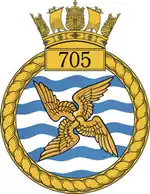 705 NAS Badge | |
| Active | Royal Air Force 1936–1939 Royal Navy
|
| Country |  United Kingdom |
| Branch |  Royal Navy |
| Type | Fleet Air Arm Second Line Squadron |
| Role | Basic helicopter flying training |
| Part of | Fleet Air Arm and No.1 Flying Training School |
| Home station | RAF Shawbury |
| Motto | Expertam docemus artem (Latin for 'We teach the art') |
| Aircraft |
|
| Decorations | Boyd Trophy 1983 |
| Website | Official website |
| Commanders | |
| Current commander | Lieutenant Commander Dave Forest, RN |
| Insignia | |
| Squadron Badge Description | Barry wavy of ten white and blue, four wings conjoined in saltire gold (1948) |
| Identification Markings |
|
| Fin Shore Codes |
|
705 Naval Air Squadron is a Fleet Air Arm (FAA) naval air squadron of the United Kingdom's Royal Navy (RN). It currently operates the Airbus H135 Juno HT1 light utility helicopter as part of No. 1 Flying Training School at RAF Shawbury in Shropshire and trains pilots and aircrew from all three services under 2 Maritime Air Wing.
It was first formed as a Flight in 1936 out of 444 Flight, Royal Air Force (RAF) and operated Fairey Swordfish torpedo bombers from battlecruisers. It achieved squadron status in 1939 before being disbanded in 1940. The squadron was next active, briefly during 1945. It re-commissioned in 1947 as a Fleet Requirements Unit to evaluate the naval use of helicopters. Since the 1950s the squadron has been involved in the basic training of helicopter aircrew.
History
Catapult Flight and Second World War
No. 705 (Catapult) Flight was formed at RAF Kalafrana, Malta, on 15 July 1936 by redesignating part of No. 444 (Fleet Reconnaissance) Flight, FAA. The flight was assigned to the battlecruisers of the Mediterranean Fleet and operated Fairey Swordfish and Blackburn Shark torpedo bomber floatplanes.[1][2] The Flight was transferred to Admiralty control on 24 May 1939 and on the same day was disbanded at RAF Kalafrana and re-formed as 705 Squadron, FAA.[1]

By the outbreak of the Second World War, its aircraft were embarked aboard the name ship of her class, the battlecruiser HMS Renown (1916) and her sister ship HMS Repulse, with Swordfish and Shark floatplanes.[3][2] The aircraft were equipped with floats so that they could be launched from the ships by catapult and then recovered from the water by crane.[2][4]
During the early part of the Second World War, 705 Squadron served on the North America and West Indies Station, where it was employed in protecting troop convoys.[5] It returned to RNAS Lee-on-Solent, Hampshire, in 1939 and was disbanded on 21 January 1940, when it was absorbed into 700 Naval Air Squadron.[2]
Swordfish replacement training
705 Naval Air Squadron re-formed at RNAS Ronaldsway (HMS Urley), Isle of Man, on 7 March 1945 as a Swordfish replacement crew-training unit. The requirement for the unit disappeared following VE Day, and the squadron was disbanded on 24 June 1945.[2]
Helicopter development and Fleet Requirements Unit
705 Naval Air Squadron was re-commissioned at RNAS Gosport, Hampshire, on 7 May 1947, taking over the Sikorsky Hoverfly element of 771 Naval Air Squadron.[2] It subsequently became the Fleet Air Arm's principal helicopter evaluation and requirements unit, undertaking helicopter trials, pilot training, air-sea rescue evaluation, equipment and technique development, torpedo-recovery work, transport duties, radar calibration and other specialist tasks.[2][6][7]
On 1 February 1947, Lieutenant Ken Reed, who was then a member of a naval flight evaluating helicopters for the Admiralty, made the first official helicopter landing on a Royal Navy warship when he landed a Sikorsky Hoverfly on the fast battleship HMS Vanguard off Portland.[6] The landing pre-dated the squadron's May 1947 re-commissioning.[6]
During the late 1940s and early 1950s, 705 undertook a wide range of experimental work. A Sikorsky S-51 helicopter was evaluated during Arctic trials in 1949, while the squadron also provided detachments for Operation Sandstone, surveying beaches and ports in Ireland and the United Kingdom.[2] The squadron subsequently evaluated the Sikorsky S-55 and also conducted experimental shipboard helicopter operations, including trials aboard the Fort ship RFA Fort Duquesne.[2]
In February 1953, 705 Squadron took part in the relief effort following the North Sea flood of 1953. Nine of its helicopters were deployed from RNAS Gosport to Gilze-Rijen in the Netherlands, where they rescued 810 people and subsequently carried out supply-dropping and other relief tasks.[8]
The squadron also took part in the Coronation Review of the Fleet at Spithead on 15 June 1953, leading the helicopter element of the flypast with its Westland Dragonflies.[2]
Helicopter training

By the mid-1950s, 705 Squadron's role had increasingly shifted towards helicopter training. In October 1955 it moved to RNAS Lee-on-Solent, Hampshire and later that year became a helicopter training squadron, continuing to use RNAS Gosport as a relief landing ground.[9]
In November 1957 the Fleet Requirements Unit and search-and-rescue tasks were transferred to the newly formed 701 Naval Air Squadron. When 701 Squadron was disbanded in September 1958, the search-and-rescue role returned to 705 Squadron.[9] The squadron subsequently moved to RNAS Culdrose, Cornwall, in the late 1950s.[9][5] From March 1959 it was organised into three Flights: 'A' Flight for operational training, 'B' Flight for basic training and 'C' Flight for special trials.[9]
During this period the squadron operated a succession of helicopters including the Westland Dragonfly, Hiller HT1, Sikorsky S55 and Westland Whirlwind.[10]

The first Westland Gazelle HT.2 helicopters were received in March 1974, and by March 1975 the squadron was equipped entirely with Gazelles.[9] From 1975, instructors from 705 also provided the Royal Navy's helicopter display capability.[9] The principal team was The Sharks, while 705 also provided the two-aircraft "Pusser's Pair" and solo display aircraft.[9][11] The Sharks were composed of volunteers who normally served as helicopter instructors with 705 Squadron.[11]
Between 1975 and 1992 the Sharks helicopter display team performed at up to 20 air displays every year both in the UK and abroad.[12]
In 1983, 705 Squadron was awarded the Boyd Trophy for its overall performance, training achievement, airmanship and contribution to the prestige of Naval Aviation.[13]
Tri-service helicopter training
In April 1997, 705 Squadron was disbanded at RNAS Culdrose and re-formed at RAF Shawbury as part of the newly established Defence Helicopter Flying School (DHFS).[5][14] It became the DHFS's Single Engine Advanced Rotary Wing training unit, operating the Eurocopter AS350 Écureuil, designated Squirrel HT.1 in British military service.[15][16]

The squadron's role continued under the UK Military Flying Training System (UKMFTS). In 2018, it began operating the Juno HT1 light utility helicopter as part of the new rotary-wing training system.[17][18] Since April 2018, 705 Squadron has trained pilots and aircrew from the Royal Navy, British Army and Royal Air Force as part of 2 Maritime Air Wing (2 MAW).[5]
On 28 February 2020, the Defence Helicopter Flying School was re-badged as No. 1 Flying Training School (1 FTS).[18] 705 Squadron remained at RAF Shawbury as part of the school, providing basic helicopter flying training to personnel from all three services.[5]
Within No. 1 Flying Training School[19] and under 2 Maritime Air Wing, 705 Squadron provides basic and advanced rotary wing flying training for all three services pilots and rear crew. As the busiest Squadron within 1 FTS, 705 Squadron teaches both pilots and crewman a vast number of different disciplines including advanced handling, instrument flying, medium and low level navigation, mountain flying and night flying including low level navigation with NVD.[20]
In addition to pure flying training, 705 Squadron also provides a naval focus for naval aircrew operating within an otherwise joint service and largely civilian-run organisation. The Squadron is commanded by a Royal Navy Lieutenant Commander, and has a Royal Navy "Senior Pilot", while the Flight Commander billets are filled in by Qualified Helicopter Instructors from any of the three services. Naval graduates of DHFS are streamed towards Merlin HM2, Merlin HC4/4A Commando or Wildcat AH1 / Wildcat HMA2 training Squadrons.[20]
Aircraft flown
The squadron has flown a number of aircraft types since its formation, including:[21]


- Blackburn Shark II/FP (July 1936 - June 1937)
- Fairey Swordfish I/FP (July 1936 - January 1940)
- Fairey Swordfish III (March - June 1945)
- Sikorsky Hoverfly I May 1947 - November 1950)
- Sikorsky Hoverfly II June 1948 - April 1951)
- Westland Dragonfly HR.1 (January 1950 - March 1953)
- Westland Dragonfly HR.3 (July 1952 - December 1957)
- Saunders-Roe Skeeter 3 (July 1952)
- Sikorsky S-55 (June 1953)
- Hiller HT.1 (May 1953 - January 1963)
- Westland Whirlwind HAS.22 (October 1953 - November 1956)
- Westland Whirlwind HAR.1 (July 1954 - May 1960)
- Westland Whirlwind HAR.3 (November 1955 - December 1966)
- Westland Dragonfly HR.5 (October 1957 - March 1962)
- Westland Whirlwind HAS.7 (JuUne 1960 - December 1974)
- Hiller HT.2 (September 1962 - March 1975)
- Westland Gazelle HT.2 (March 1974 - October 1997)
- Eurocopter Squirrel HT.1 (April 1997 – April 2018)[5][15][14]
- Airbus H135 Juno HT.1 (April 2018–present)[22]
Commanding officers
List of commanding officers of 705 Naval Air Squadron with date of appointment:[3][21]
1936 - 1940
- Lieutenant Commander D.W. MacKendrick RN (Squadron Leader, RAF), from 15 July 1936
- Lieutenant P.G.O. Sydney-Turner, RN, (Flight Lieutenant, RAF), from 25 May 1937
- Lieutenant P.E. O'Brien, RN, (Flight Lieutenant, RAF), from 14 January 1938
- disbanded - 21 January 1940
1945
1947 -
- Lieutenant(A) K.M. Reed, RN, from 7 May 1947
- Lieutenant G.N.C. Fuller, RN, from 20 August 1949
- Lieutenant(A) S.H. Suthers, DSC, RN, from 29 November 1949 (Lieutenant Commander 1 March 1950)
- Lieutenant Commander H.R. Spedding, MBE, RN, from 28 Ocotber 1952 (Commander 31 December 1953)
- Lieutenant Commander J.C. Jacob, RN, from 24 May 1954
- Lieutenant Commander G.C.J. Knight, DFC, RN, from 29 October 1955
- Lieutenant Commander G.W. Bricker, RN, from 29 November 1957
- Lieutenant Commander R.G.D. Williams, RN, from 6 January 1960
- Lieutenant Commander P.J. Craig, RN, from 21 June 1961
- Lieutenant Commander G.A. Bagnall, RN, from 22 Ocotber 1962
- Lieutenant Commander A. Casdagli, RN, from 4 April 1964
- Lieutenant Commander B.C. Sarginson, MBE, RN, from 10 Npvember 1965
- Lieutenant Commander G.W. Barras, RN, from 22 September 1967
- Lieutenant Commander D.K. Hale, RN, from 31 March 1969
- Lieutenant Commander E.C. Ashton-Johnson, RN, from 15 July 1970
- Lieutenant Commander P.B. Rover, RN, from 29 September 1971
- Lieutenant Commander C.J.S. Craig, RN, from 14 May 1973
- Lieutenant Commander T.S. Taylor, RN, from 15 May 1975
- Lieutenant Commander F.A. Rock, RN, from 18 November 1976
- Lieutenant Commander R.J.B. Riley, RN, from 17 August 1978
- Lieutenant Commander W.B. Kirby, RN, from 21 May 1980
- Lieutenant Commander I.T. Lockwood, RN, from 23 April 1982
- Lieutenant Commander S.D. Pendrich, RN, from 16 March 1984
- Lieutenant Commander M.R. Swales, RN, from 25 March 1986 (Commander 30 June 1987)
- Lieutenant Commander M.C. Nixon, RN, from 19 February 1988
- Lieutenant Commander D.G. Hale, RN, from 28 February 1990
- Lieutenant Commander A.J. Egles, AFC, RN, from 18 December 1990
- Lieutenant Commander N.K. Bennett, RN, from 26 February 1993
- Lieutenant Commander M.R. Osman, RN, from 7 November 1994
- Lieutenant Commander B. Frater, RN, from 2013[23]
- Lieutenant Commander S. Hughes, RN, from 26 July 2015[24]
- Lieutenant Commander M. Robinson, RN (July–October 2017)
- Lieutenant Commander P. Ryan (April 2018 – December 2019)
- Lieutenant Commander P. Crompton, RN, from January 2020[25]
- Lieutenant Commander D. Forrest, RN, from 10 March 2022[25]
- Lieutenant Commander R. De Maine, RN, from April 2024[26]
- Lieutenant Commander M. Pickles, RN, from June 2025 – present
Note: Abbreviation (A) signifies Air Branch of the RN or RNVR.[27]
See also
- No. 1 Flying Training School RAF - trains all military helicopter crews for the Royal Air Force, Royal Navy's Fleet Air Arm and the British Army's Army Air Corps.
- History of Royal Navy Helicopter Search and Rescue
References
- 1 2 Lake 1999, p. 83.
- 1 2 3 4 5 6 7 8 9 10 Ballance, Howard & Sturtivant 2016, p. 11.
- 1 2 Wragg 2019, p. 114.
- ↑ "Sqn Histories 712-825_P". RAFWeb. Retrieved 27 August 2026.
- 1 2 3 4 5 6 "705 Naval Air Squadron". Royal Navy. Retrieved 27 August 2026.
- 1 2 3 Ken W (February 2013). "Rotary-Wing Experiences" (PDF). Jabberwock (70). The Society of Friends of the Fleet Air Arm Museum: 31–32. Retrieved 27 August 2026.
- ↑ "705 squadron at the Helicopter History website". Retrieved 4 February 2010.
- ↑ "Helicopter Flood Rescue Work, Holland". Hansard. UK Parliament. 18 March 1953. Retrieved 27 August 2026.
- 1 2 3 4 5 6 7 Ballance, Howard & Sturtivant 2016, p. 12.
- ↑ Ballance, Howard & Sturtivant 2016, pp. 11–12.
- ↑ "Aerobatic Display Teams – 705 Squadron: The Sharks". Royal Navy Museum. Archived from the original on 9 December 2009. Retrieved 4 February 2010.
- ↑ Sturtivant, Ray (1984). The Squadrons of the Fleet Air Arm. Air-Britain (Historians) Ltd. p. 488. ISBN 978-0-85130-120-4.
- 1 2 "RAF Shawbury". Royal Air Force. Retrieved 28 August 2026.
- 1 2 "Helicopter Training". Royal Air Force Museum. Retrieved 28 August 2026.
- ↑ "UK Military Flying Training System". UK Armed Forces Commentary. Retrieved 28 August 2026.
- ↑ "Historic naval wing provides helicopter pilots of tomorrow". Royal Navy. 21 August 2020. Retrieved 27 August 2026.
- 1 2 "RAF Air & Space Power 2020". Royal Air Force. 2020. p. 117. Retrieved 27 August 2026.
- ↑ Smith, Rory (29 February 2020). "RAF chief opens state-of-the-art helicopter training facilities in Shawbury". Shropshire Star.
- 1 2 "705 NAS at the Royal Navy website". Retrieved 4 February 2010.
- 1 2 Ballance, Howard & Sturtivant 2016, p. 13.
- ↑ "Juno HT1". Royal Air Force. Retrieved 28 August 2026.
- ↑ "On 26 July 2015 ... Lt Cdr Becky Frater handed over command of 705 Naval Air Squadron to Lt Cdr Scott Hughes". RAF Shawbury. 3 September 2015. Retrieved 28 August 2026.
- ↑ "705 NAS visits the Helicopter Museum". HeliHub.com. 14 September 2015. Retrieved 28 August 2026.
- 1 2 "All change for 705 Naval Air Squadron!". Aries. Royal Air Force. 2022. Retrieved 28 August 2026.
- ↑ "There is a new Commanding Officer at the helm of 705 Naval Air Squadron". RAF Shawbury. 16 April 2024. Retrieved 28 August 2026.
- ↑ Wragg 2019, p. 257.
Bibliography
- Ballance, Theo; Howard, Lee; Sturtivant, Ray (2016). The Squadrons and Units of the Fleet Air Arm. Air Britain Historians Limited. ISBN 978-0-85130-489-2.
- Lake, Alan (1999). Flying Units of the RAF. Shrewsbury: Airlife. ISBN 1-84037-086-6.
- Wragg, David (2019). The Fleet Air Arm Handbook 1939–1945. Cheltenham: The History Press. ISBN 978-0-7509-9303-6.
External links