2026 North Indian Ocean cyclone season
| 2026 North Indian Ocean cyclone season | |
|---|---|
 Season summary map | |
| Seasonal boundaries | |
| First system formed | 7 January 2026 |
| Last system dissipated | Season ongoing |
| Strongest storm | |
| Name | BOB 03 |
| • Maximum winds | 55 km/h (35 mph) (3-minute sustained) |
| • Lowest pressure | 989 hPa (mbar) |
| Seasonal statistics | |
| Depressions | 5 |
| Deep depressions | 2 |
| Cyclonic storms | 0 |
| Severe cyclonic storms | 0 |
| Very severe cyclonic storms | 0 |
| Extremely severe cyclonic storms | 0 |
| Super cyclonic storms | 0 |
| Total fatalities | 31 |
| Total damage | Unknown |
| Related articles | |
The 2026 North Indian Ocean cyclone season is the ongoing annual cycle of tropical cyclone formation in the North Indian Ocean basin. The season has no official bounds, but most cyclones tend to form between April and December, with the peak from May to November. These dates conventionally delimit the period of each year when most tropical cyclones form in the northern Indian Ocean.
The scope of this article is limited to the Indian Ocean in the Northern Hemisphere, east of the Horn of Africa and west of the Malay Peninsula. There are two main seas in the North Indian Ocean- the Arabian Sea to the west of the Indian subcontinent, abbreviated ARB by the India Meteorological Department (IMD); and the Bay of Bengal to the east as BOB. The systems that form over land are abbreviated as LAND.
The official Regional Specialized Meteorological Centre in this basin is the IMD, while the Joint Typhoon Warning Center (JTWC) releases unofficial advisories. On average, three to four cyclonic storms form in this basin every season.[1]
Season summary

Systems
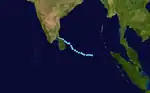
Deep Depression BOB 01
| Deep depression (IMD) | |
  | |
| Duration | 7 January – 10 January |
|---|---|
| Peak intensity | 55 km/h (35 mph) (3-min); 1004 hPa (mbar) |
On 7 January, a low-pressure area intensified into a depression over the Bay of Bengal.[2] It then further intensified into a deep depression on the morning of 8 January while moving west-northwestwards.[3] The system made landfall over Sri Lanka as a depression and crossed the country before weakening into a well marked low pressure area in the Gulf of Mannar on 10 January.
Depression BOB 02
| Depression (IMD) | |
  | |
| Duration | 5 July – 7 July |
|---|---|
| Peak intensity | 45 km/h (30 mph) (3-min); 991 hPa (mbar) |
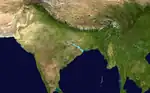
After nearly half a year of inactivity in the North Indian Ocean basin, on 5 July, the IMD classified a depression in the Bay of Bengal, labeling it as BOB 02. It was assessed with a T1.5 classification prompting maximum 3-minute sustained winds of 30 mph (45 km/h) and a minimum central pressure of 991 mbar (29.2 inHg). The depression later made landfall over northern Odisha at 09:00 UTC.[4] After making landfall, the depression remained stationary over north Chhattisghar throughout 6 July.[5] It later degenerated into a well marked low pressure area over east Madhya Pradesh the next day.[6]
Deep Depression BOB 03
| Deep depression (IMD) | |
  | |
| Duration | 26 July – 1 August |
|---|---|
| Peak intensity | 55 km/h (35 mph) (3-min); 989 hPa (mbar) |
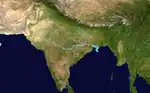
On 26 July, a depression formed over the northwest Bay of Bengal and was subsequently given the designation BOB 03 by the IMD.[7] The JTWC promptly issued tropical weather advisories on the depression, stating that the depression consisted of a broad low-level circulation producing persistent deep convection over the southern periphery of the storm.[8]
BOB 03 has caused heavy rainfall and flooding in Odisha, killing 8. Five of the deaths were from the Keonjhar district, including a fire services personnel who was electrocuted. Three of the deaths occurred in the Dhenkanal, Deogarh, and Sambalpur districts.[9] Flooding in Chhattisgarh caused at least 5 deaths.[10] Heavy rainfall and flooding triggered a building collapse in Bhiwandi, Maharashtra, killing 10. A wall collapse killed one in Buldhana, and a lightning strike killed one in Chandrapur.[11] Following heavy rainfall, a 70-year-old Hyderabad man was washed away after falling into an open manhole.[12] On 31 July, heavy rain caused four deaths in Gujarat, including three who were electrocuted in Gandeva village and an 11-year-old girl swept away in a canal in Borsad Chowkdi in Anand.[13][14] An 8-year-old girl died and four family members were injured when the roof of their house collapsed in Jodhpur.[15]
Depression BOB 04
| Depression (IMD) | |
 | |
| Duration | 13 August – 14 August |
|---|---|
| Peak intensity | 45 km/h (30 mph) (3-min); 996 hPa (mbar) |
On 13 August, the IMD classified a depression southeast of Kolkata whilst inland, labeling it as BOB 04.[16] The depression consisted of a lopsided structure with the majority of its convective organization situated to the west of the low-level circulation (LLC).[17] BOB 04 was short-lived, degenerating into a well marked low pressure area over Jharkhand on 14 August.[18]
Depression BOB 05
| Depression (IMD) | |
  | |
| Duration | 17 August – 19 August |
|---|---|
| Peak intensity | 45 km/h (30 mph) (3-min); 996 hPa (mbar) |
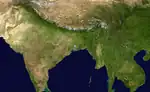
On 17 August, the IMD classified another depression, marked BOB 05 inland West Bengal. It slowly moved to the west-northwest, as the majority of its convection laid to the south and southeast of the depression’s center.[19] BOB 05 was another short-lived depression, degenerating into a Well Marked Low Pressure Area over North Jharkhand on 19 August.[20]
Storm names
Within this basin, a tropical cyclone is assigned a name when it is judged to have reached cyclonic storm intensity with winds of 65 km/h (40 mph). There is no retirement of tropical cyclone names in this basin as the list of names is only scheduled to be used once before a new list of names is drawn up. Should a named tropical cyclone move into the basin from the Western Pacific, then it will retain its original name. The next eight available names from the list of North Indian Ocean storm names are below.[21]
|
|
Season effects
This is a table of all storms in the 2026 North Indian Ocean cyclone season. It mentions all of the season's storms and their names, duration, peak intensities according to the IMD storm scale, damage, and death totals. Damage and death totals include the damage and deaths caused when that storm was a precursor wave or extratropical low. All of the damage figures are in 2026 USD.
| Name | Dates | Peak intensity | Areas affected | Damage (USD) |
Deaths | Ref(s). | ||
|---|---|---|---|---|---|---|---|---|
| Category | Wind speed | Pressure | ||||||
| BOB 01 | 7–10 January | Deep depression | 55 km/h (35 mph) | 1004 hPa (29.65 inHg) | Sri Lanka, South India | Unknown | None | |
| BOB 02 | 5–7 July | Depression | 45 km/h (30 mph) | 991 hPa (29.26 inHg) | East India, Bangladesh, Myanmar, Central India, North India | Unknown | None | |
| BOB 03 | 26 July–1 August | Deep depression | 55 km/h (35 mph) | 989 hPa (29.21 inHg) | India, Bangladesh, Myanmar, Pakistan | Unknown | 31 | [9][10][11][13] |
| BOB 04 | 13–14 August | Depression | 45 km/h (30 mph) | 996 hPa (29.41 inHg) | East India, Bangladesh, Myanmar, Central India | Unknown | None | |
| BOB 05 | 17–19 August | Depression | 45 km/h (30 mph) | 996 hPa (29.41 inHg) | East India, Bangladesh, Myanmar, Central India, North India | Unknown | None | |
| Season aggregates | ||||||||
| 5 systems | 7 January – Season ongoing | 55 km/h (35 mph) | 989 hPa (29.21 inHg) | Unknown | 31 | |||
See also
- Weather of 2026
- Tropical cyclones in 2026
- 2026 Atlantic hurricane season
- 2026 Pacific hurricane season
- 2026 Pacific typhoon season
- South-West Indian Ocean cyclone seasons: 2025–26, 2026–27
- Australian region cyclone seasons: 2025–26, 2026–27
- South Pacific cyclone seasons: 2025–26, 2026–27
Notes
References
- ↑ "Annual Frequency of Cyclonic Disturbances (Maximum Wind Speed of 17 Knots or More), Cyclones (34 Knots or More) and Severe Cyclones (48 Knots or More) Over the Bay of Bengal (BOB), Arabian Sea (AS) and Land Surface of India" (PDF). India Meteorological Department. Archived from the original (PDF) on 5 December 2019. Retrieved 22 December 2025.
- ↑ "Depression over southeast Bay of Bengal and adjoining East Equatorial Indian Ocean" (PDF). India Meteorological Department. 7 January 2026. Retrieved 8 January 2026.
- ↑ "Deep Depression over southwest & adjoining areas of southeast Bay of Bengal and East Equatorial Indian Ocean" (PDF). 8 January 2026. Retrieved 8 January 2026.
- ↑ "Depression over coastal areas of North Odisha and adjoining West Bengal". mausam.imd.gov.in. Archived from the original on 2026-07-05. Retrieved 2026-07-05.
- ↑ "Depression over north Chhattisgarh and adjoining areas of southeast Uttar Pradesh and northeast Madhya Pradesh" (PDF). mausam.imd.gov.in. Archived from the original (PDF) on 2026-07-06. Retrieved 2026-07-06.
- ↑ "Depression over north Chhattisgarh and adjoining areas of southeast Uttar Pradesh and northeast Madhya Pradesh weakened into a Well Marked Low Pressure area over east Madhya Pradesh and neighbourhood". mausam.imd.gov.in. 2026-07-07. Archived from the original on 2026-07-07. Retrieved 2026-07-07.
- ↑ Pattanaik, D. R. (2026-07-26). "Depression over northwest Bay of Bengal and adjoining areas of North Odisha- West Bengal coasts". mausam.imd.gov.in. Archived from the original on 2026-07-26. Retrieved 2026-07-26.
- ↑ "SIGNIFICANT TROPICAL WEATHER ADVISORY FOR THE INDIAN OCEAN REISSUED/260030Z-261800ZJUL2026//". Joint Typhoon Warning Center. 2026-07-26. Archived from the original on 2026-07-26.
- 1 2 "Odisha floods: Death toll rises to 8; over 4 lakh affected as rain batters state". Hindustan Times. 30 July 2026. Retrieved 30 July 2026.
- 1 2 "Five dead as rivers overflow, flood-like conditions cripple Chhattisgarh". Hindustan Times. 30 July 2026. Retrieved 31 July 2026.
- 1 2 "At least 12 dead in rain-related incidents across Maharashtra as heavy showers batter state". The Times of India. 1 August 2026. Retrieved 1 August 2026.
- ↑ "70-year-old Hyderabad man washed away after falling into open manhole". The Times of India. 29 July 2026. Retrieved 3 August 2026.
- 1 2 "3 labourers electrocuted in Gandevi". The Times of India. 1 August 2026. Retrieved 3 August 2026.
- ↑ "11-year-old girl drowns after falling into canal near Anand SP office". The Times of India. 1 August 2026. Retrieved 3 August 2026.
- ↑ "8-yr-old dead, four injured in rain-related roof collapse in Jodhpur". The Times of India. 4 August 2026. Retrieved 4 August 2026.
- ↑ "INDIA METEOROLOGICAL DEPARTMENT Ministry of Earth Sciences Government of India". mausam.imd.gov.in. 2026-08-13. Archived from the original on 2026-08-13. Retrieved 2026-08-13.
- ↑ "INDIA METEOROLOGICAL DEPARTMENT Ministry of Earth Sciences Government of India". mausam.imd.gov.in. 2026-08-13. Archived from the original on 2026-08-13. Retrieved 2026-08-13.
- ↑ "INDIA METEOROLOGICAL DEPARTMENT Ministry of Earth Sciences Government of India". mausam.imd.gov.in. 2026-08-14. Archived from the original on 2026-08-15. Retrieved 2026-08-15.
- ↑ "Depression over coastal West Bengal and adjoining areas of Bangladesh & northwest Bay of Bengal" (PDF). mausam.imd.gov.in. 2026-08-17. Archived from the original (PDF) on 2026-08-17. Retrieved 2026-08-17.
- ↑ "Depression over north Jharkhand and adjoining southwest Bihar & southeast Uttar Pradesh weakened into a Well Marked Low Pressure Area" (PDF). mausam.imd.gov.in. 2026-08-19. Archived from the original (PDF) on 2026-08-19.
- ↑ "Naming of Tropical Cyclones over the North Indian Ocean" (PDF). rsmcnewdelhi.imd.gov.in. New, Delhi: India Meteorological Department. Archived from the original (PDF) on September 3, 2021. Retrieved September 25, 2021.
External links
