1993 Russian gubernatorial elections
 | |
28 February – 26 December 1993
| |
12 Heads of Federal Subjects from 89 | |
|---|---|
|
| |
 1993 Russian regional elections:
|
Gubernatorial elections in 1993 took place in twelve regions of the Russian Federation.
Race summary
| Federal Subject[1] | Date | Leadership before election | Candidates | Result |
|---|---|---|---|---|
| Ingushetia | 28 February | Viktor Polyanichko, head of provisional administration |  Ruslan Aushev 99.9% (ran unopposed) |
New president elected. |
| Kalmykia | 11 April | Ilya Bugdayev, chairman of the Supreme Soviet Maksim Mukubenov, acting premier |
|
New president elected. |
| Krasnoyarsk Krai[2][3][4] | 11 April (first round) | Arkady Veprev (resigned) Valery Zubov (acting) |
|
Acting governor elected for a full term. |
| 25 April (runoff) |
| |||
| Amur Oblast[6] | 11 April (first round) | Albert Krivchenko |
|
Incumbent lost election. New governor elected. |
| 25 April (runoff) |
| |||
| Bryansk Oblast[7] | 11 April (first round) | Vladimir Barabanov |
|
Incumbent lost election. New governor elected. |
| 25 April (runoff) |
| |||
| Chelyabinsk Oblast[8][9][10] | 11 April (first round) | Vadim Solovyov |
|
Incumbent did not stand for election. New governor elected. Disputed government.[11] |
| 25 April (runoff) |
| |||
| Lipetsk Oblast[12][13] | 11 April | Gennady Kuptsov (removed) Vladimir Zaytsev (acting) |
|
Acting governor lost election. New governor elected. |
| Oryol Oblast[14] | 11 April | Nikolay Yudin |
|
Incumbent lost election. New governor elected. |
| Penza Oblast[12] | 11 April | Aleksandr Kondratyev |
|
Incumbent lost election. New governor elected. |
| Smolensk Oblast[15] | 25 April | Valery Fateyev |
|
Incumbent lost election. New governor elected. |
| Bashkortostan[16] | 12 December | Murtaza Rakhimov, chairman of the Supreme Soviet Anatoly Kopsov, premier |
|
New president elected.[17] |
| Chuvashia[16][18] | 12 December (first round) | Eduard Kubarev, chairman of the Supreme Soviet Valeryan Viktorov, premier |
|
New president elected. |
| 26 December (runoff) |
|
Following the escalation of 1993 Russian constitutional crisis the governors had to choose whether to support the parliament or the president. Those who chose the losing side, were later removed from office by the president. Among them were governors of Amur and Bryansk Oblasts Aleksandr Surat and Yury Lodkin,[19] both serving only six months.
Bryansk Oblast
| ||||||||||||||||
11 April 1993 (first round)
25 April 1993 (second round) | ||||||||||||||||
| ||||||||||||||||
| ||||||||||||||||


The 1993 Bryansk Oblast gubernatorial election was held on 11 April 1993. Incumbent head of administration Vladimir Barabanov ran to defend his seat against a field of 13 candidates. As none of them won the majority, a second round was held on 25 April 1993 between Barabanov and people's deputy of Russia, journalist Yury Lodkin, who won with 51.41% of the vote.
In January 1992, people's deputy of Russia Vladimir Barabanov was appointed governor by Russian president Boris Yeltsin in spite of Bryansk Oblast Council resolution proposing to appoint then-executive committee chairman Vasily Polskoy instead. As a result, Barabanov's legitimacy was dubious.[20] The election was called by the Council in December 1992, after the end of a country-wide local election moratorium. In the first round, held on 11 April 1993, Barabanov was leading with 33.82% of the vote; among opposition candidates were two of his former deputies as well as some former potential candidates for appointment, including Vasily Polskoy, general Pyotr Shirshov and people's deputy Fyodor Gosporyan. In the second round, most of the losing candidates backed the runner-up, Itar-Tass reporter and people's deputy Yury Lodkin, who then went on to win by a relatively narrow margin.[21]
Although many of newly elected governors tended to side with the anti-reformist left-wing forces, Lodkin was the only one of them to openly state his membership in the recently re-created Communist Party as well as his opposition to federal government and its policies.[7] In late September 1993, Lodkin, who criticized president Yeltsin's decision to dissolve the Congress of People's Deputies of Russia, was removed from office by an executive order which was later declared illegal by court.[22]
Results
| Candidate | First round | Second round | ||
|---|---|---|---|---|
| Votes | % | Votes | % | |
| Yury Lodkin | 178,067 | 29.30 | 382,707 | 51.41 |
| Vladimir Barabanov | 205,594 | 33.82 | 334,153 | 44.89 |
| Pyotr Shirshov | 56,855 | 9.35 | ||
| Anatoly Konovalov | 24,390 | 4.01 | ||
| Vasily Polskoy | 22,837 | 3.76 | ||
| Nikolay Rudenok | 19,506 | 3.21 | ||
| Fyodor Gosporyan | 15,596 | 2.57 | ||
| Viktor Leskov | 11,827 | 1.95 | ||
| Nikolay Osipov | 6,974 | 1.15 | ||
| Nikolay Novikov | 6,056 | 1.00 | ||
| Nikolay Filippov | 4,296 | 0.71 | ||
| Nikolay Isayev | 3,762 | 0.62 | ||
| Aleksandr Nemets | 2,941 | 0.48 | ||
| Vladimir Lavrenov | 2,646 | 0.44 | ||
| Against all | 18,507 | 3.04 | 10,588 | 1.42 |
| Invalid ballots | 27,964 | 4.60 | 16,992 | 2.28 |
| Total | 607,818 | 100 | 744,440 | 100 |
| Registered voters/turnout | 1,085,552 | 55.99 | 1,093,370 | 68.09 |
Chelyabinsk Oblast
| |||||||||||||
11 April 1993 (first round)
25 April 1993 (second round) | |||||||||||||
| Turnout | 58.4% (second round)[25] | ||||||||||||
|---|---|---|---|---|---|---|---|---|---|---|---|---|---|
| |||||||||||||
| |||||||||||||
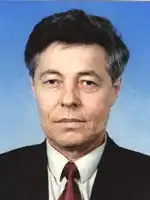

The 1993 Chelyabinsk Oblast gubernatorial election was held on 11 April 1993, after a no confidence motion in governor Vadim Solovyov was passed by the Chelyabinsk Oblast Council of People's Deputies. Solovyov was appointed by the president of Russia in October 1991, ignoring the Council's proposal to appoint its chairman Pyotr Sumin instead.[11]
To win in the election, a candidate needed to obtain more than 50% of the votes cast and more than 25% of all registered voters. As none of the candidates met the requirements (partially due to low voter turnout), a second round was held on 25 April, concurrently with the 1993 Russian government referendum. Pyotr Sumin won in the second round with 48.19% of the vote over Miass mayor Vladimir Grigoriadi (35.38%)[8] and was sworn in on 10 June 1993.[11] Solovyov did not stand for election and unsuccessfully challenged the Council's decision to hold it in courts.[26] After the election, Sumin received support and recognition from the Supreme Soviet of Russia and the Constitutional Court, while Solovyov administration was backed by president Boris Yeltsin. The dispute ended in October 1993, when Solovyov ordered to dissolve the Council of People's Deputies and Sumin lost his main source of support.[27]
Results
| Candidate | First round | Second round | ||
|---|---|---|---|---|
| Votes | % | Votes | % | |
| Pyotr Sumin | 482,130 | 58.39 | 748,826 | 48.19 |
| Vladimir Grigoriadi | 52,592 | 6.36 | 549,919 | 35.39 |
| Viktor Radionov | 39,783 | 4.82 | ||
| Vladimir Golovlyov | 39,332 | 4.76 | ||
| Valentin Buravlyov | 27,449 | 3.32 | ||
| Oleg Knyazev | 23,615 | 2.86 | ||
| Sergey Kostromin | 21,210 | 2.57 | ||
| Pavel Moderau | 17,764 | 2.15 | ||
| Vitaly Knyaginichev | 12,514 | 1.52 | ||
| Against all | 56,116 | 6.80 | 147,575 | 9.50 |
| Invali ballots | 53,270 | 6.45 | 107,581 | 6.92 |
| Total | 825,775 | 100 | 1,553,901 | 100 |
| Registered voters/turnout | 2,624,683 | 31.46 | 2,662,793 | 58.36 |
Chuvashia
 | ||||||||||||||||
12 December 1993 (first round)
26 December 1993 (second round) | ||||||||||||||||
| ||||||||||||||||
| ||||||||||||||||
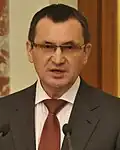

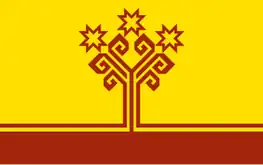
Presidential election was held in the Chuvash Republic on 12 December 1993, two years after the unsuccessful 1991 election. Since none of the seven candidates received the required majority, a second round took place on 26 December. Former justice minister of Russia Nikolay Fyodorov was elected president with 55% of the vote, defeating university chief executive Lev Kurakov. Fyodorov was sworn in on 21 January 1994.[28]
Candidates
- Nikolay Fyodorov, minister of justice of Russia (1990–93), DPR party-list candidate in the concurrent State Duma election (won seat, declined to take)
- Enver Ablyakimov, member of the Supreme Soviet of Chuvashia, construction executive
- Vladimir Fyodorov, director of Chuvash territorial branch of the State Anti-Monopoly Committee of Russia
- Yevgeny Yaransky, collective farm chairman
- Leonid Ivanov, head of department, Chuvash State University
- Nikolay Malchugin, prosecutor of Novocheboksarsk
- Atner Khuzangai, member of the Supreme Soviet of Chuvashia, leader of the Chuvash National Congress, nominal winner of the 1991 election
- Vasily Antonov, entrepreneur
- Eduard Kubarev, chairman of the Supreme Soviet of Chuvashia, 1991 candidate
- Vladimir Kirgizov, construction executive
- Lev Kurakov, rector of the Chuvash State University, member of the Supreme Soviet of Chuvashia, candidate in the concurrent Federation Council election (won seat)
- Boris Yakovlev, first deputy chairman of the Supreme Soviet of Chuvashia
- Valeryan Viktorov, chairman of the Council of Ministers of Chuvashia (1992–94), candidate in the concurrent Federation Council election (won seat)
- Leonid Prokopyev, chairman of the State Committee for Ethnic Affairs of Russia (1990–91), chairman of the Council of Ministers of the Chuvash ASSR (1975–89), 1991 election runner-up
- Withdrew
- Nadezhda Bikalova, economist (ran for State Duma, won seat)
Source:[29]
Results
| Candidate | Running mate | First round | Second round | ||
|---|---|---|---|---|---|
| Votes | % | Votes | % | ||
| Nikolay Fyodorov | Enver Ablyakimov | 147,475 | 24.90 | 269,284 | 55.06 |
| Lev Kurakov | Boris Yakovlev | 129,486 | 21.86 | 189,769 | 38.80 |
| Valeryan Viktorov | Leonid Prokopyev | 107,070 | 18.08 | ||
| Vladimir Fyodorov | Yevgeny Yaransky | 61,482 | 10.38 | ||
| Atner Khuzangai | Vasily Antonov | 37,139 | 6.27 | ||
| Eduard Kubarev | Vladimir Kirgizov | 22,002 | 3.71 | ||
| Leonid Ivanov | Nikolay Malchugin | 4,333 | 0.73 | ||
| Against all | 33,532 | 5.66 | 4.68 | ||
| Invalid ballots | 49,836 | 8.41 | 1.45 | ||
| Total | 592,355 | 100 | 489,066 | 100 | |
| Eligible voters/turnout | 62.3 | 52.03 | |||
Ingushetia
| |||||||||||||||||||
28 February 1993
| |||||||||||||||||||
| |||||||||||||||||||

On 28 February 1993, presidential elections were held in Ingushetia. Major General Ruslan Aushev, formerly head of provisional administration of Ingushetia, ran unopposed with the support of several Ingush nationalist organisations. He was sworn in as president on 7 March 1993.[33] A snap election was held a year after, along with the constitutional referendum and election of the People's Assembly.
The primary political issue of the election was the 1992 East Prigorodny conflict and the subsequent ethnic cleansing of Ingush in Prigorodny District. All of the groups supporting Aushev urged for further attention towards Ingush refugees, but disagreed on the republic's future relationship towards Russia; the National Front of Ingushetia, a party comprising supporters of Aushev's campaign, supported a takeover of Prigorodny District by the Russian federal government,[31] while Nijsxo and the Congress of the Ingush People urged for a reassessment of the relationship. The Congress of the Ingush People called for the withdrawal of all Russian troops from Ingushetia,[34] and Nijsxo would go on to oppose the signing of the Treaty of Federation after Aushev took office.[31]
Following the election, Aushev signed a decree on 7 March 1993 banning all political organisations in Ingushetia.[34]
Kalmykia
 | ||||||||||||||||
11 April 1993
| ||||||||||||||||
| ||||||||||||||||
 Winner by district: Kirsan Ilyumzhinov Valery Ochirov | ||||||||||||||||
| ||||||||||||||||


Presidential election in the Republic of Kalmykia was held on Sunday, 11 April 1993, 17 months after the previous voting of 1991, which did not reveal the winner. People's deputy of Russia Kirsan Ilyumzhinov won the presidency with 65.37% of the vote,[32] defeating deputy commander of Russia's army aviation General Valery Ochirov (29.22%)[36] and president of the Farmers Association of Kalmykia Vladimir Bambayev (1.55%).[37] Aged 31, Ilyumzhinov became the youngest holder of governor-level office in Russia.[38]
After the power struggle between Supreme Soviet speaker Vladimir Basanov and premier Batyr Mikhailov ended with their simultaneous resignation in 1992, the government of Kalmykia was effectively paralysed. During the campaign Ilyumzhinov and Ochirov quickly emerged as frontrunners, both outsiders to local politics in contrast to unpopular career politicians. Ilyumzhinov's candidacy was supported by a coalition of Kalmyk nationalists, anti-communist reformists and Cossacks.[35] Around 80% of eligible voters took part in the election,[37] although as many as 80,000 Soviet-era settlers from Chechnya and Dagestan were disenfranchised from voting.[35]
Lipetsk Oblast
| ||||||||||||||||
11 April 1993
| ||||||||||||||||
| ||||||||||||||||
| ||||||||||||||||

The 1993 Lipetsk Oblast gubernatorial election was held on 11 April 1993 to determine the Head of Administration of Lipetsk Oblast. First deputy head of administration Mikhail Narolin won the election with 49.83% of the vote.
The election was called by the Lipetsk Oblast Council of People's Deputies after then-governor Gennady Kuptsov was sacked by president Boris Yeltsin in December 1992. Kuptsov, an anti-communist Democratic Russia councilor, was little known before his appointment in late 1991. In the following year, the Kuptsov administration received criticism from the Council for incompetence during a period of a sharp decline in the economy. After losing two no confidence votes in the Council, Kuptsov was removed from office by president Yeltsin and replaced by one of his deputies, fellow Democrat Vladimir Zaytsev.[39]
On the election day, first deputy governor Mikhail Narolin emerged as the strongest candidate, leaving far behind both Zaytsev and Kuptsov. Before the election Narolin, a former high-ranking official in the Lipetsk Oblast executive committee, was seen by many as the de-facto governor, although he distanced himself from the "democratic" wing of the administration.[7] His 49.8% of the vote was enough to win in the first round, as he secured more than 1/4 of all eligible voters in the region. As was the law at that time, Narolin was sworn in immediately after the results were announced by the election commission. After the election, second place winner Vitaly Bezrukov claimed that Narolin's win was fraudulent. The court rejected Bezrukov's claim to annull the election but it was confirmed that of 263,000 votes for Narolin, at least 6,000 were falsified.[14][40]
Candidates
- Aleksandr Abramov, deputy chairman of Lipetsk Oblast state property committee
- Vladimir Betenekov, leader of Democratic Party of Russia in Lipetsk Oblast
- Vitaly Bezrukov, deputy chairman of Lipetsk Oblast state property committee
- Aleksey Burtsev, head of Khlevensky District administration
- Valentin Dmitriyevsky, leader of People's Party "Free Russia" in Lipetsk Oblast
- Aleksandr Kholin, doctor
- Aleksandr Korobeynikov, head of administration of the Oktyabrsky City District of Lipetsk
- Viktor Krysanov, deputy head of MVD directorate for Lipetsk Oblast
- Gennady Kuptsov, former head of administration of Lipetsk Oblast
- Mikhail Narolin, first deputy head of administration of Lipetsk Oblast
- Vladimir Nikonov, director of Gryazi cultivator factory
- Ivan Shatskikh, chairman of Lipetsk Oblast state property committee
- Vladimir Zaytsev, acting head of administration of Lipetsk Oblast[7]
Results
| Candidate | Votes | % |
|---|---|---|
| Mikhail Narolin | 262,833 | 49.83 |
| Vitaly Bezrukov | 41,128 | 7.80 |
| Vladimir Zaytsev | 27,904 | 5.29 |
| Gennady Kuptsov | 25,424 | 4.82 |
| Aleksey Burtsev | 24,150 | 4.58 |
| Ivan Shatskikh | 24,079 | 4.56 |
| Valentin Dmitriyevsky | 13,739 | 2.60 |
| Viktor Krysanov | 13,154 | 2.49 |
| Vladimir Nikonov | 11,891 | 2.25 |
| Aleksandr Korobeynikov | 10,630 | 2.02 |
| Aleksandr Kholin | 8,762 | 1.66 |
| Aleksandr Abramov | 7,170 | 1.36 |
| Vladimir Betenekov | 4,720 | 0.89 |
| Against all | 22,294 | 4.23 |
| Invalid ballots | 29,629 | 5.62 |
| Total | 527,507 | 100 |
| Registered voters/turnout | 915,853 | 57.60 |
Notes
References
- ↑ "Губернаторские выборы - 1993" [Gubernatorial elections - 1993]. politika.su (in Russian). Retrieved 26 March 2026.
- ↑ "Выборы главы администрации Красноярского края. 1993 год". Krasnoyarsk Krai Election Commission (in Russian). Archived from the original on 14 October 2013.
- ↑ Kynev 2020, p. 84.
- ↑ Valery Mikhailovich Zubov, "Federal Investigation Agency"
- ↑ Kynev 2020, p. 84, 87.
- ↑ Избирательная комиссия Амурской области (2013). Избирательной системе Российской Федерации 20 лет (PDF) (in Russian). p. 16.
- 1 2 3 4 Kynev 2020, p. 85.
- 1 2 Ivanov 2019, p. 260-261.
- 1 2 "Сообщение окружной избирательной комиссии по выборам главы Челябинской областной администрации". Chelyabinsky Rabochiy. No. 70 (22010). 14 April 1993. p. 1. (registration required)
- 1 2 "Сообщение об итогах выборов главы Челябинской областной администрации". Chelyabinsky Rabochiy. No. 80 (22020). 28 April 1993. p. 1. (registration required)
- 1 2 3 Зыкова, Валерия. "Челябинское противостояние. Май — июль 1993 года" [Chelyabinsk confrontation. May-July 1993]. International Institute for Humanities and Political Studies (in Russian). Retrieved 9 November 2025.
- 1 2 Ivanov 2019, p. 258-259.
- 1 2 "Сообщение окружной избирательной комиссии о результатах выборов главы администрации Липецкой области 11 апреля 1993 года". Липецкая газета (in Russian). No. 73 (387). 14 April 1993. p. 1.
- 1 2 Kynev 2020, p. 86.
- ↑ Kynev 2020, p. 88.
- 1 2 3 Ivanov 2019, p. 320-321.
- ↑ Шумилова, Марина (25 December 2003). "Инаугурация президента Башкортостана совпадает с десятилетием института президентства в республике" [Inauguration of the president of Bashkortostan coincides with the 10th anniversary of the presidency]. Bashinform (in Russian). Retrieved 29 January 2026.
- 1 2 "Чувашская Республика в декабре 1993 года" [Chuvash Republic in December 1993]. International Institute for Humanitaries and Political Studies (in Russian). Retrieved 30 January 2026.
- ↑ Decree of the President of Russia of September 25, 1993 No. 1453 "On the Head of administration of Bryansk Oblast", kremlin.ru
- ↑ Ivanov 2019, p. 167, 208.
- ↑ Kynev 2020, p. 84-85.
- ↑ Ivanov 2019, p. 292-294.
- ↑ "Сообщение окружной избирательной комиссии об итогах выборов главы администрации Брянской области 11 апреля 1993 года" (PDF). Bryansky Rabochiy (in Russian). 14 April 1993. p. 1.
- ↑ "Сообщение окружной избирательной комиссии об итогах повторного голосования по выборам главы администрации Брянской области" (PDF). Bryansky Rabochiy (in Russian). 28 April 1993. p. 1.
- ↑ Kynev 2020, p. 87.
- ↑ Ivanov 2019, p. 262.
- ↑ Ivanov 2019, p. 267.
- ↑ "История выборов и назначений главы Чувашской Республики" [History of elections and appointments of the head of the Chuvash Republic]. TASS (in Russian). 11 September 2020. Retrieved 30 January 2026.
- ↑ "Чувашская Республика в ноябре 1993 года" [Chuvash Republic in November 1993]. International Institute for Humanitaries and Political Studies (in Russian). Retrieved 30 January 2026.
- ↑ "Чувашская Республика". Регионы России. Хроника и руководители. Том 8 (PDF) (in Russian). Slavic-Eurasian Research Center. p. 140. Retrieved 4 February 2026.
- 1 2 3 Muzayev, Timur. "Этнический сепаратизм в России" [Ethnic Separatism in Russia] (PDF). SOVA Center (in Russian). p. 166-167. Retrieved 3 June 2024.
- 1 2 Ivanov 2019, p. 268.
- ↑ "20 лет назад — 28 февраля 1993 года – был избран Первый Президент Ингушетии Руслан Аушев". 06news.ru (in Russian). 28 February 2013. Archived from the original on 21 January 2015.
- 1 2 Muzayev, Timur. "Этнический сепаратизм в России" [Ethnic Separatism in Russia] (PDF). SOVA Center (in Russian). p. 163. Retrieved 3 June 2024.
- 1 2 3 4 Александр Касимов (April 1993). "Республика Калмыкия — Хальмг Тангч". International Institute for Humanities and Political Studies (in Russian). Retrieved 4 February 2026.
- ↑ Ivanov 2019, p. 269.
- 1 2 Kynev 2020, p. 83.
- ↑ "Лицом к событию: Кирсан Илюмжинов". RFE/RL (in Russian). 22 July 2001. Archived from the original on 1 May 2020.
- ↑ Ivanov 2019, p. 216, 236.
- ↑ Ivanov 2019, p. 264-265.
Sources
- Ivanov, Vitaly (2019). Глава субъекта Российской Федерации. История губернаторов [Head of the subject of the Russian Federation. History of governors] (in Russian). ISBN 978-5-907250-14-7.
- Kynev, Alexander (2020). Губернаторы в России: между выборами и назначениями [Governors in Russia: Between Elections and Appointments] (in Russian). ISBN 978-5-903135-68-4.
| Presidential elections | |
|---|---|
| Legislative elections | |
| Gubernatorial elections | |
| Regional elections | |
| Referendums | |
| |
