1,000,000,000,000
| 1000000000000 | |
|---|---|
| Cardinal | One trillion (short scale) One billion (long scale) One thousand billion One million million[1] |
| Ordinal | One trillionth (short scale) One billionth (long scale) |
| Factorization |
|
| Divisors | 169 total |
| Greek numeral | |
| Roman numeral | M̅̅̅ (M with three overlines) |
| Greek prefix | tera- |
| Binary | 11101000110101001010010100010000000000002 |
| Ternary | 101121210112011021021110013 |
| Senary | 20432210103013446 |
| Octal | 164324512100008 |
| Duodecimal | 141981B8785412 |
| Hexadecimal | E8D4A5100016 |
| Base 36 | CRE66I9S36 |
| Arabic | ١٠٠٠٠٠٠٠٠٠٠٠٠ |
| Bengali | ১০০০০০০০০০০০০ |
| Chinese | 万亿 (standard), 兆 (myriad scale) |
| Devanagari | १०००००००००००० |
| Japanese | 兆 |
| Khmer | ១០០០០០០០០០០០០ (ពាន់ពាន់លាន) |
| Korean | 조 |
| Tamil | ௲௲௲௲, க௦௦௦௦௦௦௦௦௦௦௦௦ |
| Thai | ๑๐๐๐๐๐๐๐๐๐๐๐๐ (หนึ่งล้านล้าน) |

1,000,000,000,000 (one trillion on the short scale; one billion on the long scale; one thousand billion; one million million) is the natural number following 999,999,999,999 and preceding 1,000,000,000,001. It is known as 10 kharab, 1000 arab, or 1 lakh crore in the Indian numbering system.
Etymology
The word trillion was created in the 1680s, borrowed from French trillion and Italian trilione, which is from tri- ("three") + million ("a thousand thousands"). Originally in British English, the word "trillion" referred to million million millions (while "billion" referred to million millions, which is equal to trillion in American English); however, to many people, the word refers to one thousand billion (1,000,000,000,000) in the present day.[2]
Trillion is often abbreviated as T, t, or tn. Rarer forms include tril, trill, tln, and trn.[3][4]
Properties
1,000,000,000,000 is written in scientific notation as 1 × 10¹² or 1012 (1E+12 or simply 1E12 in E notation). It is a perfect power, harshad number, square number (1,000,0002), cube number (10,0003), tesseractic number (1,0004), and a 6-hypercube number (1006). It is also even, composite, abundant, polite, practical, frugal, and regular.
1,000,000,000,000 has a total of 169 divisors (156 even, 13 odd), whose geometric mean is 1,000,000. The sum of all its divisors (including itself) is 2,499,694,822,171; therefore, its aliquot sum is 1,499,694,822,171, and its abundance is 499,694,822,171. All divisors are displayed below:
1, 2, 4, 5, 8, 10, 16, 20, 25, 32, 40, 50, 64, 80, 100, 125, 128, 160, 200, 250, 256, 320, 400, 500, 512, 625, 640, 800, 1000, 1024, 1250, 1280, 1600, 2000, 2048, 2500, 2560, 3125, 3200, 4000, 4096, 5000, 5120, 6250, 6400, 8000, 10000, 10240, 12500, 12800, 15625, 16000, 20000, 20480, 25000, 25600, 31250, 32000, 40000, 50000, 51200, 62500, 64000, 78125, 80000, 100000, 102400, 125000, 128000, 156250, 160000, 200000, 250000, 256000, 312500, 320000, 390625, 400000, 500000, 512000, 625000, 640000, 781250, 800000, 1000000, 1250000, 1280000, 1562500, 1600000, 1953125, 2000000, 2500000, 2560000, 3125000, 3200000, 3906250, 4000000, 5000000, 6250000, 6400000, 7812500, 8000000, 9765625, 10000000, 12500000, 12800000, 15625000, 16000000, 19531250, 20000000, 25000000, 31250000, 32000000, 39062500, 40000000, 48828125, 50000000, 62500000, 64000000, 78125000, 80000000, 97656250, 100000000, 125000000, 156250000, 160000000, 195312500, 200000000, 244140625, 250000000, 312500000, 320000000, 390625000, 400000000, 488281250, 500000000, 625000000, 781250000, 800000000, 976562500, 1000000000, 1250000000, 1562500000, 1600000000, 1953125000, 2000000000, 2500000000, 3125000000, 3906250000, 4000000000, 5000000000, 6250000000, 7812500000, 8000000000, 10000000000, 12500000000, 15625000000, 20000000000, 25000000000, 31250000000, 40000000000, 50000000000, 62500000000, 100000000000, 125000000000, 200000000000, 250000000000, 500000000000, 1000000000000
1,000,000,000,000 has an Euler totient of 400,000,000,000, and a cototient of 600,000,000,000. There are 37,607,912,018 positive primes less than it.[5]
Below is the list of basic calculations of 1,000,000,000,000:
| Multiplication |
Division |
Exponentiation |
nth root | |
|---|---|---|---|---|
| 2 | 2,000,000,000,000 | 500,000,000,000 | 1024 | 1,000,000 |
| 3 | 3,000,000,000,000 | 333,333,333,333.3 | 1036 | 10,000 |
| 4 | 4,000,000,000,000 | 250,000,000,000 | 1048 | 1,000 |
| 5 | 5,000,000,000,000 | 200,000,000,000 | 1060 | ≈251.188643151 |
| 6 | 6,000,000,000,000 | 166,666,666,666.6 | 1072 | 100 |
| 7 | 7,000,000,000,000 | 142,857,142,857.142857 | 1084 | ≈51.7947467923 |
| 8 | 8,000,000,000,000 | 125,000,000,000 | 1096 | ≈31.6227766017 |
| 9 | 9,000,000,000,000 | 111,111,111,111.1 | 10108 | ≈21.5443469003 |
| 10 | 10,000,000,000,000 | 100,000,000,000 | 10120 | ≈15.8489319246 |




Scientific usage
For physical quantities, the metric prefix tera- (symbol T) indicates 1,000,000,000,000 times the base unit. For example, 1012 bits of data is called a terabit, 1012 joules of energy is called a terajoule, and 1012 watts of power is called a terawatt.
The computing performance of 1012 floating point operations per second (teraFLOPS) is known as terascale computing. It is the performance of several supercomputers, such as NEC SX-4,[6] Intel's ASCI Red, and iPhone 15 Pro September 2023 A17 Pro processor.
Sense of scale
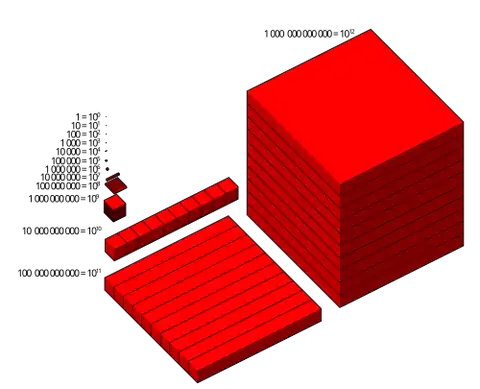
Some comparisons below give a sense of how large 1,000,000,000,000 (1012) is, according to current evidence.
Time
- 1012 seconds (a terasecond, about 31,688 years) ago, homo sapiens were living as hunter-gatherers.
- 1012 minutes (about 1.9 million years) ago, Homo erectus arose in Africa, and early expansions of hominins out of Africa started as archaic humans moved throughout Eurasia.
- 1012 hours (about 114 million years) ago, Late Cretaceous dinosaurs dominated the land, and giant squids thrived in the oceans.
- 1012 days (about 2.74 × 10⁹ years) ago, Earth was a world where only single-celled microorganisms existed. 1012 days from now, Earth's overall surface temperature will reach 420 K (296 °F; 147 °C). All life on Earth will be extinct, except single-celled microorganisms.[7][8]
- 1012 months (about 83 × 109 years) ago, the universe did not exist. 1012 months from now, the Moon may collide with the Earth or be torn apart to form an orbital ring, if both have not already been destroyed.[9]
- 1012 years—a teraannus—is 70 times the age of the universe. 1012 years from now, star formation may end in galaxies as they lack gas clouds to form new stars,[10] and evidence of Big Bang may become undetectable.[11]
Distance
- 1012 inches is about 15 million miles (24 million km), approximately 1/6th the distance from the Earth to the Sun.
- 1012 metres (a terametre) is over six times the distance from the Earth to the Sun. It is the estimated diameter of Betelgeuse, a red supergiant star.[12]
- 1012 kilometres (a petametre) is about 1/10th a light-year.
Area
- 1012 square inches is approximately the total area of Saint Lucia, an island country in the eastern Caribbean.
- 1012 square feet is larger than the total area of Portugal.
- 1012 square metres is approximately the total area of Ethiopia, the 26th largest country on Earth.
- 1012 square kilometres is almost 2,000 times the Earth's total surface area.
Volume
- If 1012 cubic metres of water were spread evenly over the Moon's surface, it would create a layer of water approximately 2.6 centimetres (1.0 in) deep.
- 1012 grains of sand would occupy a volume of about 2 cubic metres (71 ft3).[13]
Economy
Nature
- The surface of the human body houses around 1012 bacteria.[18][19]
- An average-sized mountain weighs about 1012 kilograms.[20]
- Andromeda Galaxy, Milky Way's neighbor, contains about 1012 stars.[21]
- There are around 2 × 10¹² galaxies in the observable universe.[22][23]
- There were around 3 × 10¹² trees on Earth in 2015.[24]
- There are around 3.5 × 10¹² fish in the ocean.[25]
Selected 13-digit numbers (1,000,000,000,001–9,999,999,999,999)
1,000,000,000,001 to 1,999,999,999,999
- 1,000,000,000,039 : smallest 13-digit prime number[26]
- 1,000,001,326,005 : 1,414,214th triangular number[27]
- 1,000,002,000,001 = 1,000,0012, palindromic square
- 1,004,006,004,001 = 1,002,0012 = 1,0014, palindromic fourth power
- 1,061,520,150,601 = 1,030,3012 = 10,2013 = 1016
- 1,062,991,989,013 : number of square (0,1)-matrices without zero rows and with exactly 11 entries equal to 1[28]
- 1,070,710,724,173 : 153rd Markov number[29]
- 1,099,511,627,776 = 2565 = 1610 = 420 = 240, binary approximation of metric prefix tera-
- 1,099,511,629,376 : Leyland number using 2 & 40 (240 + 402)[30]
- 1,099,511,787,776 : Leyland number using 4 & 20 (420 + 204)
- 1,111,111,111,111 : repunit
- 1,117,594,214,815 : 62nd perfect totient number[31]
- 1,124,388,064,800 : 67th superabundant number[32]
- 1,125,000,750,000 : sum of first 1,500,000 natural numbers
- 1,141,246,682,444 = 22×1111[33]
- 1,177,269,848,575 : 63rd perfect totient number
- 1,184,065,449,986 : 154th Markov number
- 1,202,590,842,879 : 35th Woodall number[34]
- 1,226,280,710,981 : 15th alternating factorial[35]
- 1,277,956,497,400 : initial number of seventh-century xx00 to xx99 containing exactly seventeen prime numbers (1,277,956,497,400+n, for n = 1, 7, 9, 13, 27, 31, 37, 39, 49, 51, 57, 63, 73, 79, 81, 87, 97)[36]
- 1,289,904,147,324 : 24th Catalan number[37]
- 1,307,674,368,000 = 15!
- 1,307,674,368,120 : 15th factoriangular number[38]
- 1,338,193,159,771 : number of posets with 14 unlabeled elements[39]
- 1,373,119,300,369 : number of series-reduced planted trees with 45 nodes[40]
- 1,419,855,914,607 : 38th Wedderburn-Etherington number[41]
- 1,427,933,269,321 : 155th Markov number
- 1,466,024,067,850 : number of 48-bead necklaces (turning over is allowed) where complements are equivalent[42]
- 1,489,877,926,680 : 5th 8-dimensional Catalan number[43]
- 1,490,542,435,045 : 156th Markov number
- 1,497,207,322,930 : number of 47-bead binary necklaces with beads of 2 colors where the colors may be swapped but turning over is not allowed[44]
- 1,499,694,822,171 : aliquot sum of 1,000,000,000,000
- 1,513,744,654,945 : 33rd Pell number,[45] 157th Markov number
- 1,523,548,331,041 = 1,234,3212 = 1,1114
- 1,548,008,755,920 : 60th Fibonacci number
- 1,563,135,350,013 : number of (unordered, unlabeled) rooted trimmed trees with 36 nodes[46]
- 1,618,362,158,587 : 19th Schröder–Hipparchus number[47]
- 1,697,385,471,211 : 30th Motzkin number[48]
- 1,706,111,387,068 : number of centered hydrocarbons with 37 carbon atoms[49]
- 1,722,099,665,665 : 158th Markov number
- 1,915,868,454,737 : 159th Markov number
- 1,927,522,396,800 : 68th superabundant number
- 1,934,197,506,555 : 48th repfigit[50]
- 1,961,990,553,600 = 24!!
2,000,000,000,000 to 2,999,999,999,999
- 2,000,001,000,000 : sum of first 2,000,000 natural numbers
- 2,076,871,684,802 : 160th Markov number
- 2,122,553,644,686 : number of secondary structures of RNA molecules with 35 nucleotides[51]
- 2,135,248,790,338 : 161st Markov number
- 2,156,735,837,173 : 162nd Markov number
- 2,222,222,222,222 : repdigit
- 2,236,994,992,300 : initial number of eighth century xx00 to xx99 containing exactly seventeen prime numbers (2,236,994,992,300+n, for n = 1, 3, 7, 13, 19, 21, 27, 39, 57, 61, 63, 67, 69, 73, 81, 91, 99)[36]
- 2,248,776,129,600 : 69th superabundant number, 100th highly composite number,[52] 18th superior highly composite number[53]
- 2,262,366,343,746 : number of trees with 35 unlabeled nodes[54]
- 2,329,089,562,800 : highly composite number; least common multiple of every number from 1 to 30.
- 2,473,901,162,495 : 36th Woodall number
- 2,499,694,822,171 : sum of all divisors of 1,000,000,000,000
- 2,504,730,781,961 : 61st Fibonacci number, 163rd Markov number
- 2,541,865,828,329 = 913 = 326, 64th perfect totient number
- 2,541,865,845,905 : Leyland number using 3 & 26 (326 + 263)
- 2,552,470,327,702 : Leyland number using 9 & 13 (913 + 139)
- 2,557,227,044,764 : number of free polyominoes with 25 cells[55]
- 2,821,109,907,456 = 1,679,6162 = 1,2964 = 368 = 616
- 2,821,126,684,672 : Leyland number using 6 & 16 (616 + 166)
- 2,872,202,028,517 : number of 49-bead necklaces (turning over is allowed) where complements are equivalent
- 2,906,166,827,065 : number of series-reduced planted trees with 46 nodes
- 2,932,031,358,484 : number of 48-bead binary necklaces with beads of 2 colors where the colors may be swapped but turning over is not allowed
- 2,959,365,073,955 ≈ 10^(3*π+3), rounded-up pi-illion[56]
3,000,000,000,000 to 3,999,999,999,999
- 3,099,893,879,221 : 164th Markov number
- 3,125,001,250,000 : sum of first 2,500,000 natural numbers
- 3,204,941,750,802 : number of positive primes less than 1014[5]
- 3,212,537,328,000 : 101st highly composite number
- 3,236,724,317,174 : 19th Schröder number[57]
- 3,257,843,882,624 : 23rd telephone number[58]
- 3,267,653,834,825 : 165th Markov number
- 3,333,333,333,333 : repdigit
- 3,373,164,194,400 : 70th superabundant number, 102nd highly composite number
- 3,389,524,479,050 : 39th Wedderburn-Etherington number
- 3,494,391,117,164 : number of signed trees with 22 nodes[59]
- 3,512,479,453,921 = 1,874,1612 = 1,3694 = 378
- 3,654,502,875,938 : 34th Pell number
- 3,809,950,977,008 : 16th logarithmic number[60]
- 3,814,697,265,625 = 1,953,1252 = 259 = 518
- 3,814,699,155,193 : Leyland number using 5 & 18 (518 + 185)
- 3,899,735,407,806 : number of (unordered, unlabeled) rooted trimmed trees with 37 nodes
4,000,000,000,000 to 4,999,999,999,999
- 4,052,739,537,881 : 62nd Fibonacci number
- 4,360,711,162,037 : 166th Markov number
- 4,444,444,444,444 : repdigit
- 4,492,268,106,137 : number of centered hydrocarbons with 38 carbon atoms
- 4,497,552,259,200 : 71st superabundant number, 103rd highly composite number
- 4,500,001,500,000 : sum of first 3,000,000 natural numbers
- 4,508,515,437,145 : 167th Markov number
- 4,643,961,467,965 : 168th Markov number
- 4,658,179,125,600 : 72nd superabundant number
- 4,747,561,509,943 = 16,8073 = 3435 = 715
- 4,747,732,369,318 : Leyland number using 7 & 15 (715 + 157)
- 4,859,761,676,391 : 31st Motzkin number
- 4,861,946,401,452 : 25th Catalan number
5,000,000,000,000 to 5,999,999,999,999
- 5,085,241,278,463 : 37th Woodall number
- 5,336,735,929,371 : number of secondary structures of RNA molecules with 36 nucleotides
- 5,528,778,008,357 : 169th Markov number
- 5,555,555,555,555 : repdigit
- 5,587,637,513,705 : 170th Markov number
- 5,629,516,646,996 : number of 50-bead necklaces (turning over is allowed) where complements are equivalent
- 5,744,387,279,818 : number of 49-bead binary necklaces with beads of 2 colors where the colors may be swapped but turning over is not allowed
- 5,832,742,205,057 : 19th Bell number[61]
- 5,878,625,373,184 : rounded-up length of a light-year in miles
6,000,000,000,000 to 6,999,999,999,999
- 6,073,061,476,032 : self-descriptive number in base 12[62]
- 6,125,001,750,000 : sum of first 3,500,000 natural numbers
- 6,155,434,522,614 : number of series-reduced planted trees with 47 nodes
- 6,226,306,037,178 : number of trees with 36 unlabeled nodes
- 6,557,470,319,842 : 63rd Fibonacci number, 171st Markov number
- 6,666,666,666,666 : repdigit
- 6,746,328,388,800 : 73rd superabundant number, 104th highly composite number
- 6,963,472,309,248 : 4th taxicab number
7,000,000,000,000 to 7,999,999,999,999
8,000,000,000,000 to 8,999,999,999,999
- 8,000,002,000,000 : sum of first 4,000,000 natural numbers
- 8,099,766,813,570 : 40th Wedderburn-Etherington number
- 8,115,549,747,397 : 173rd Markov number
- 8,649,755,859,375 = 1511
- 8,756,963,649,152 : 49th repfigit
- 8,759,309,660,445 : 20th Schröder–Hipparchus number
- 8,822,750,406,821 : 35th Pell number, 174th Markov number
- 8,888,888,888,888 : repdigit
- 8,916,100,448,256 = 29859842 = 207363 = 1446 = 1212
- 8,995,104,518,400 : 105th highly composite number
9,000,000,000,000 to 9,999,999,999,999
- 9,210,000,001,000 : 10th autobiographical number[65]
- 9,316,358,251,200 : 74th superabundant number, 106th highly composite number
- 9,460,730,472,581 : rounded-up length of a light-year in kilometres
- 9,739,810,110,758 : number of (unordered, unlabeled) rooted trimmed trees with 38 nodes[46]
- 9,787,184,545,081 : 175th Markov number
- 9,918,212,890,625 : 24th 1-automorphic number[66]
- 9,925,594,216,162 : 176th Markov number
- 9,999,088,822,075 : number of free polyominoes with 26 cells
- 9,999,999,999,971 : largest 13-digit prime number[67]
- 9,999,999,999,999 : largest 13-digit number, repdigit
See also
References
- ↑ "One million million". Vocabulary.com. (n.d.). Retrieved 15 October 2025.
- ↑ "Trillion - Etymology, Origin & Meaning". etymonline. Retrieved 2026-05-02.
- ↑ "Abbreviation for Trillion - Writing Explained". Writing Explained. Retrieved 2026-05-02.
- ↑ "Millions, Billions, and Other Large Numbers". Antidote's Blog. Retrieved 2026-05-02.
- 1 2 Sloane, N. J. A. (ed.). "Sequence A006880 (Number of primes less than 10^n)". The On-Line Encyclopedia of Integer Sequences. OEIS Foundation.
- ↑ "【NEC】SX-4". IPSJ Computer Museum. Information Processing Society of Japan. Retrieved 2025-08-25.
- ↑ O'Malley-James, Jack T.; Greaves, Jane S.; Raven, John A.; Cockell, Charles S. (2012). "Swansong Biospheres: Refuges for life and novel microbial biospheres on terrestrial planets near the end of their habitable lifetimes". International Journal of Astrobiology. 12 (2): 99–112. arXiv:1210.5721. Bibcode:2013IJAsB..12...99O. doi:10.1017/S147355041200047X. S2CID 73722450.
- ↑ Adams, Fred C. (2008). "Long term astrophysical processes". In Bostrom, Nick; Ćirković, Milan M. (eds.). Global catastrophic risks. Oxford University Press. pp. 33–47. ISBN 978-0-19-857050-9.
- ↑ Dorminey, Bruce (31 January 2017). "Earth and Moon May Be on Long-Term Collision Course". Forbes. Archived from the original on 1 February 2017. Retrieved 11 February 2017.
- ↑ Adams, Fred; Laughlin, Greg (1997). "A dying universe: the long-term fate and evolution of astrophysical objects". Reviews of Modern Physics. 69 (2): 337–372. arXiv:astro-ph/9701131. Bibcode:1997RvMP...69..337A. doi:10.1103/RevModPhys.69.337. S2CID 12173790.
- ↑ Loeb, Abraham (2011). "Cosmology with Hypervelocity Stars". Journal of Cosmology and Astroparticle Physics. 2011 (4). Harvard University: 023. arXiv:1102.0007. Bibcode:2011JCAP...04..023L. doi:10.1088/1475-7516/2011/04/023. S2CID 118750775.
- ↑ "Betelgeuse: The Eventual Supernova". Space. 2017-08-09. Retrieved 2026-07-31.
- ↑ Williard, David (July 19, 2012). "VIMS professor authors great beach read" (PDF). Virginia Institute of Marine Science, College of William & Mary. Retrieved July 31, 2026.
- ↑ Data Commons. (n.d.). Spain: Gross domestic product (2024). Retrieved from https://datacommons.org/place/country/ESP
- ↑ Siddiqui, Ovide and Faiz, Shira (11 June 2026). "Elon Musk is the world's first trillionaire (on paper) thanks to the SpaceX IPO". The Washington Post. Retrieved 12 June 2026.
- ↑ Harring, Alex (12 June 2026). "SpaceX market cap tops $2 trillion after shares of Elon Musk's rocket company gain 19% on debut". CNBC. Archived from the original on 14 June 2026. Retrieved 14 June 2026.
- ↑ "Nvidia stock gained 4% on Thursday. Here's why". Yahoo Finance. Archived from the original on 2026-06-03. Retrieved 2026-08-09.
- ↑ "Earth microbes on the moon". Science@Nasa. 1 September 1998. Archived from the original on 23 March 2010. Retrieved 27 September 2025.
- ↑ Sender, Ron; Fuchs, Shai; Milo, Ron (2016). "Revised Estimates for the Number of Human and Bacteria Cells in the Body". PLOS Biology. 14 (8) e1002533. doi:10.1371/journal.pbio.1002533. PMC 4991899. PMID 27541692.
- ↑ "Neutron Stars". Imagine the Universe!. NASA Goddard Space Flight Center. March 2017. Retrieved 31 July 2026.
- ↑ "NASA's Hubble Traces Hidden History of Andromeda Galaxy". NASA Science. National Aeronautics and Space Administration. January 16, 2025. Retrieved July 31, 2026.
- ↑ Hollis, Morgan (13 October 2016). "A universe of two × 1012 galaxies". The Royal Astronomical Society. Retrieved 27 September 2025.
- ↑ Saunders, Toby (25 July 2023). ""How many galaxies are in the Universe? A lot more than you'd think"". BBC. Retrieved September 27, 2025.
- ↑ Amos, Jonathan (3 September 2015). "Earth's trees number 'three trillion'". BBC. Archived from the original on 6 June 2017.
- ↑ Chepkemoi, Joyce (25 April 2017). "How Many Fish Live in the Ocean?". WorldAtlas. Retrieved September 27, 2025.
- ↑ Sloane, N. J. A. (ed.). "Sequence A003617 (Smallest n-digit prime)". The On-Line Encyclopedia of Integer Sequences. OEIS Foundation.
- ↑ Sloane, N. J. A. (ed.). "Sequence A068093 (Smallest n-digit triangular number)". The On-Line Encyclopedia of Integer Sequences. OEIS Foundation.
- ↑ Sloane, N. J. A. (ed.). "Sequence A122400 (Number of square (0,1)-matrices without zero rows and with exactly n entries equal to 1)". The On-Line Encyclopedia of Integer Sequences. OEIS Foundation.
- ↑ Sloane, N. J. A. (ed.). "Sequence A002559 (Markoff (or Markov) numbers)". The On-Line Encyclopedia of Integer Sequences. OEIS Foundation.
- ↑ Sloane, N. J. A. (ed.). "Sequence A076980 (Leyland numbers)". The On-Line Encyclopedia of Integer Sequences. OEIS Foundation.
- ↑ Sloane, N. J. A. (ed.). "Sequence A082897 (Perfect totient numbers)". The On-Line Encyclopedia of Integer Sequences. OEIS Foundation.
- ↑ Sloane, N. J. A. (ed.). "Sequence A004394 (Superabundant [or super-abundant] numbers)". The On-Line Encyclopedia of Integer Sequences. OEIS Foundation.
- ↑ Sloane, N. J. A. (ed.). "Sequence A048102". The On-Line Encyclopedia of Integer Sequences. OEIS Foundation.
- ↑ Sloane, N. J. A. (ed.). "Sequence A003261 (Woodall (or Riesel) numbers)". The On-Line Encyclopedia of Integer Sequences. OEIS Foundation.
- ↑ Sloane, N. J. A. (ed.). "Sequence A005165 (Alternating factorials)". The On-Line Encyclopedia of Integer Sequences. OEIS Foundation.
- 1 2 Sloane, N. J. A. (ed.). "Sequence A186509 (Centuries containing 17 primes)". The On-Line Encyclopedia of Integer Sequences. OEIS Foundation.
- ↑ Sloane, N. J. A. (ed.). "Sequence A000108 (Catalan numbers)". The On-Line Encyclopedia of Integer Sequences. OEIS Foundation.
- ↑ Sloane, N. J. A. (ed.). "Sequence A101292". The On-Line Encyclopedia of Integer Sequences. OEIS Foundation.
- ↑ Sloane, N. J. A. (ed.). "Sequence A000112 (Number of partially ordered sets ("posets") with n unlabeled elements)". The On-Line Encyclopedia of Integer Sequences. OEIS Foundation.
- ↑ Sloane, N. J. A. (ed.). "Sequence A001678 (Number of series-reduced planted trees with n nodes)". The On-Line Encyclopedia of Integer Sequences. OEIS Foundation.
- ↑ Sloane, N. J. A. (ed.). "Sequence A001190 (Wedderburn-Etherington numbers)". The On-Line Encyclopedia of Integer Sequences. OEIS Foundation.
- ↑ Sloane, N. J. A. (ed.). "Sequence A000011 (Number of n-bead necklaces (turning over is allowed) where complements are equivalent)". The On-Line Encyclopedia of Integer Sequences. OEIS Foundation.
- ↑ Sloane, N. J. A. (ed.). "Sequence A321977 (8-dimensional Catalan numbers)". The On-Line Encyclopedia of Integer Sequences. OEIS Foundation.
- ↑ Sloane, N. J. A. (ed.). "Sequence A000013 (Number of n-bead binary necklaces with beads of 2 colors where the colors may be swapped but turning over is not allowed)". The On-Line Encyclopedia of Integer Sequences. OEIS Foundation.
- ↑ Sloane, N. J. A. (ed.). "Sequence A000129 (Pell numbers)". The On-Line Encyclopedia of Integer Sequences. OEIS Foundation.
- 1 2 Sloane, N. J. A. (ed.). "Sequence A002955 (Number of (unordered, unlabeled) rooted trimmed trees with n nodes)". The On-Line Encyclopedia of Integer Sequences. OEIS Foundation.
- ↑ Sloane, N. J. A. (ed.). "Sequence A001003 (Schroeder's second problem (generalized parentheses))". The On-Line Encyclopedia of Integer Sequences. OEIS Foundation.
- ↑ Sloane, N. J. A. (ed.). "Sequence A001006 (Motzkin numbers)". The On-Line Encyclopedia of Integer Sequences. OEIS Foundation.
- ↑ Sloane, N. J. A. (ed.). "Sequence A000022 (Number of centered hydrocarbons with n atoms)". The On-Line Encyclopedia of Integer Sequences. OEIS Foundation.
- ↑ Sloane, N. J. A. (ed.). "Sequence A007629 (Repfigit (REPetitive FIbonacci-like diGIT) numbers (or Keith numbers))". The On-Line Encyclopedia of Integer Sequences. OEIS Foundation.
- ↑ Sloane, N. J. A. (ed.). "Sequence A004148 (Generalized Catalan numbers)". The On-Line Encyclopedia of Integer Sequences. OEIS Foundation.
- ↑ Sloane, N. J. A. (ed.). "Sequence A002182 (Highly composite numbers)". The On-Line Encyclopedia of Integer Sequences. OEIS Foundation.
- ↑ Sloane, N. J. A. (ed.). "Sequence A002201 (Superior highly composite numbers)". The On-Line Encyclopedia of Integer Sequences. OEIS Foundation.
- ↑ Sloane, N. J. A. (ed.). "Sequence A000055 (Number of trees with n unlabeled nodes)". The On-Line Encyclopedia of Integer Sequences. OEIS Foundation.
- ↑ Sloane, N. J. A. (ed.). "Sequence A000105 (Number of free polyominoes (or square animals) with n cells)". The On-Line Encyclopedia of Integer Sequences. OEIS Foundation.
- ↑ cookiefonster. "Pointless Gigantic List of Numbers - Part 2 (1,000,000 ~ 10^10^100)". Retrieved September 27, 2025.
- ↑ Sloane, N. J. A. (ed.). "Sequence A006318 (Large Schröder numbers (or large Schroeder numbers, or big Schroeder numbers))". The On-Line Encyclopedia of Integer Sequences. OEIS Foundation.
- ↑ Sloane, N. J. A. (ed.). "Sequence A000085 (Number of self-inverse permutations on n letters, also known as involutions)". The On-Line Encyclopedia of Integer Sequences. OEIS Foundation.
- ↑ Sloane, N. J. A. (ed.). "Sequence A000060 (Number of signed trees with n nodes)". The On-Line Encyclopedia of Integer Sequences. OEIS Foundation.
- ↑ Sloane, N. J. A. (ed.). "Sequence A002104 (Logarithmic numbers)". The On-Line Encyclopedia of Integer Sequences. OEIS Foundation.
- ↑ Sloane, N. J. A. (ed.). "Sequence A000110 (Bell or exponential numbers)". The On-Line Encyclopedia of Integer Sequences. OEIS Foundation.
- ↑ Sloane, N. J. A. (ed.). "Sequence A108551 (Self-descriptive numbers in various bases represented in base 10)". The On-Line Encyclopedia of Integer Sequences. OEIS Foundation.
- ↑ Sloane, N. J. A. (ed.). "Sequence A002110 (Primorial numbers (first definition))". The On-Line Encyclopedia of Integer Sequences. OEIS Foundation.
- ↑ Saibian, Sbiis. "3.2.2 The Fz, The Fuga & The Megafuga". sites.google.com. Retrieved September 27, 2025.
- ↑ Sloane, N. J. A. (ed.). "Sequence A138480 (Autobiographical numbers)". The On-Line Encyclopedia of Integer Sequences. OEIS Foundation.
- ↑ Sloane, N. J. A. (ed.). "Sequence A003226 (Automorphic numbers)". The On-Line Encyclopedia of Integer Sequences. OEIS Foundation.
- ↑ Sloane, N. J. A. (ed.). "Sequence A003618 (Largest n-digit prime)". The On-Line Encyclopedia of Integer Sequences. OEIS Foundation.
| |||||||||
| |||||||||
| |||||||||
| |||||||||
