Xylulokinase
| Xylulokinase | |||||||||
|---|---|---|---|---|---|---|---|---|---|
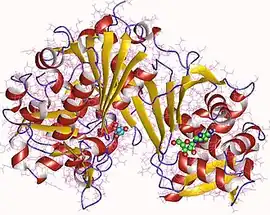 D-xylulokinase monomer, Human | |||||||||
| Identifiers | |||||||||
| EC no. | 2.7.1.17 | ||||||||
| CAS no. | 9030-58-4 | ||||||||
| Databases | |||||||||
| BRENDA | enzyme data | ||||||||
| ExPASy | NiceZyme view | ||||||||
| KEGG | enzyme entry | ||||||||
| MetaCyc | metabolic pathway | ||||||||
| Rhea | reactions | ||||||||
| PDB structures | RCSB PDB PDBe PDBsum | ||||||||
| Gene Ontology | AmiGO / QuickGO | ||||||||
| |||||||||
Xylulokinase (EC 2.7.1.17) is an enzyme that catalyzes the chemical reaction


It was first characterised from Pasteurella pestis and Lactobacillus pentosus and converts the pentose sugar, D-xylulose, to D-xylulose 5-phosphate by transferring a phosphate group from the cofactor, adenosine triphosphate (ATP), which is converted to adenosine diphosphate (ADP).[1][2] The enzyme is also found in mammalian liver, where it is an important component of carbohydrate metabolism.[3][4][5]
This enzyme is a transferase, specifically one transferring phosphorus-containing groups (phosphotransferases) with an alcohol group as acceptor. The systematic name of this enzyme class is ATP:D-xylulose 5-phosphotransferase. Other names in common use include xylulokinase (phosphorylating), and D-xylulokinase.[6]
Structural studies
As of late 2007, two structures have been solved for this class of enzymes, with PDB accession codes PDB: 2ITM and PDB: 2NLX.
Applications
Hydrogen production
In 2014 a low-temperature 50 °C (122 °F), atmospheric-pressure enzyme-driven process to convert xylose into hydrogen with nearly 100% of the theoretical yield was announced. The process employs 13 enzymes, including xylulokinase.[7][8]
References
- ↑ Slein MW (1955). "Xylose isomerase from Pasteurella pestis, strain A-1122". J. Am. Chem. Soc. 77 (6): 1663–1667. Bibcode:1955JAChS..77.1663S. doi:10.1021/ja01611a074.
- ↑ Stumpf PK, Horecker BL (February 1956). "The role of xylulose 5-phosphate in xylose metabolism of Lactobacillus pentosus". The Journal of Biological Chemistry. 218 (2): 753–68. doi:10.1016/S0021-9258(18)65840-5. PMID 13295228.
- ↑ Bunker RD, Bulloch EM, Dickson JM, Loomes KM, Baker EN (January 2013). "Structure and function of human xylulokinase, an enzyme with important roles in carbohydrate metabolism". The Journal of Biological Chemistry. 288 (3): 1643–52. doi:10.1074/jbc.m112.427997. PMC 3548474. PMID 23179721.
- ↑ Hickman J; Ashwell G (1958). "Purification and properties of D-xylulokinase in liver". J. Biol. Chem. 232 (2): 737–748. doi:10.1016/S0021-9258(19)77394-3. PMID 13549459.
- ↑ Simpson FJ (1966). "D-Xylulokinase". Carbohydrate Metabolism. Methods Enzymol. Vol. 9. pp. 454–458. doi:10.1016/0076-6879(66)09093-1. ISBN 978-0-12-181809-8.
- ↑ Enzyme 2.7.1.17 at KEGG Pathway Database.
- ↑ Martín Del Campo, J. S.; Rollin, J.; Myung, S.; Chun, Y.; Chandrayan, S.; Patiño, R.; Adams, M. W.; Zhang, Y. H. (2013-04-03). "Virginia Tech team develops process for high-yield production of hydrogen from xylose under mild conditions". Angewandte Chemie International Edition in English. 52 (17). Green Car Congress: 4587–90. doi:10.1002/anie.201300766. PMID 23512726. Retrieved 2014-01-22.
- ↑ Martín del Campo JS, Rollin J, Myung S, Chun Y, Chandrayan S, Patiño R, Adams MW, Zhang YH (April 2013). "High-yield production of dihydrogen from xylose by using a synthetic enzyme cascade in a cell-free system". Angewandte Chemie. 52 (17): 4587–90. doi:10.1002/anie.201300766. PMID 23512726.
Categories: