White Mountains Wilderness
| White Mountains Wilderness | |
|---|---|
 Montgomery Peak (right) and the White Mountains (foreground) in the White Mountains Wilderness | |
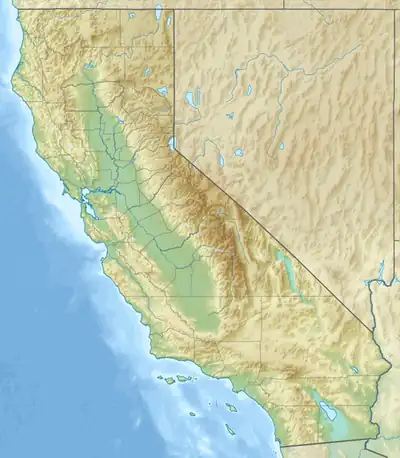  Location within California  Location within the United States | |
| Location | Inyo and Mono counties, California, United States |
| Coordinates | 37°37′03″N 118°12′13″W / 37.6175802°N 118.2036229°W[2] |
| Area | 228,454 acres (92,452 ha) |
| Established | March 30, 2009 |
| Administrator | U.S. Forest Service Bureau of Land Management |
The White Mountains Wilderness is a 228,454 acres (924.52 km2) wilderness area in the White Mountains of California, United States. It was established by the U.S. Congress under the Omnibus Public Lands Management Act of 2009.[4] Most of the wilderness (206,804 acres (83,691 ha) ) is in Inyo National Forest and managed by the U.S. Forest Service, and the remaining area is managed by the Bureau of Land Management.[4] The wilderness' northern boundary ends on the southern slopes of Boundary Peak, itself part of Boundary Wilderness in Esmeralda County, Nevada.[5][4]
Signs placed at the entrance of the wilderness near the trail to White Mountain Peak were initially misspelled "White Mountain Wilderness", the name of another wilderness area in New Mexico.[6]
Geology and hydrology
White Mountain, roughly centered in the wilderness, is the highest mountain peak in the Great Basin, rising to 14,252 feet (4,344 m).[4] Cottonwood Creek, which flows through the southeastern portion of the wilderness, was also designated a Wild and Scenic under the Omnibus Public Lands Management Act of 2009.[7][8]
Flora and fauna
The area is prime habitat for ungulates like desert bighorn sheep, pronghorn, and mule deer, and for over 1,000 plant species and varieties, including the northern terminus of the Ancient Bristlecone Pine Forest, trianglelobe moonwort, and Poison Canyon stickseed.[4][7] Paiute cutthroat trout also call Cottonwood Creek their home.[7]
References
- ↑ "Protected Planet | White Mountains". Protected Planet. Retrieved October 16, 2020.
- ↑ "White Mountains Wilderness". Geographic Names Information System. United States Geological Survey, United States Department of the Interior. Retrieved August 15, 2015.
- ↑ "White Mountains Wilderness". Geographic Names Information System. United States Geological Survey, United States Department of the Interior. Retrieved August 15, 2015.
- 1 2 3 4 5 "White Mountains Wilderness". Wilderness.net. Retrieved June 22, 2012.
- ↑ "Wilderness Areas of the United States". Wilderness.net. Retrieved June 28, 2026.
- ↑ "White Mountain Peak". Will White.
- 1 2 3 "Cottonwood Creek - Rivers.gov". Rivers.gov. Retrieved June 28, 2026.
- ↑ "White Mountains Wilderness". Bureau of Land Management. Retrieved August 15, 2015.