Bitter Creek National Wildlife Refuge
| Bitter Creek National Wildlife Refuge | |
|---|---|
IUCN category IV (habitat/species management area)[1] | |
 California condor at the refuge | |
  Location within southern California 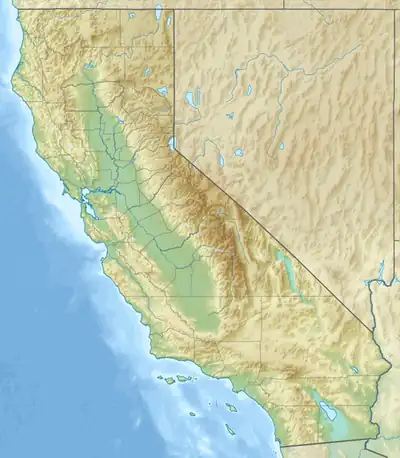 Location within California  Location within the United States | |
Interactive map of Bitter Creek National Wildlife Refuge | |
| Location | Kern County, California, United States |
| Nearest city | Maricopa, California |
| Coordinates | 34°56′18″N 119°23′11″W / 34.9383°N 119.3865°W[2] |
| Area | 14,097 acres (57.05 km2)[4] |
| Max. elevation | 4,680 feet (1,430 m)[5] |
| Min. elevation | 1,600 feet (490 m)[5] |
| Established | 1985[4] |
| Governing body | U.S. Fish and Wildlife Service |
| Website | Bitter Creek National Wildlife Refuge |
The Bitter Creek National Wildlife Refuge is located in the foothills of the southwestern San Joaquin Valley in Kern County, California. The refuge is one of four units of the Hopper Mountain National Wildlife Refuge Complex for California condors.
Geography

The San Andreas Fault Rift Zone bisects the refuge from northwest to southeast and has contributed to the formation of steep canyons within the refuge, including Bitter Creek Canyon.[5]
The South Coast Missing Linkages plan identifies the refuge within several regional connections, including the Tehachapi, Santa Monica–Sierra Madre, and Sierra Madre–Castaic linkages.[6]
Flora and fauna
The refuge is a major location used by California condors for feeding and roosting, with high use relative to nearby sites.[7][8] The refuge is an integral part of the Service's condor monitoring activities.
The refuge has been used for California condor trapping, monitoring, health examinations, and release management activities.[9]
In addition to the California condor, the Bitter Creek Refuge provides grassland, oak woodland, chaparral, pinion pine/juniper/oak woodland, and riparian and wetland habitat for federally listed endangered San Joaquin kit fox, blunt-nosed leopard lizard, giant kangaroo rat, and species of Federal concern such as the western spadefoot toad, the western horned lizard and the tri-colored blackbird.
Other terrestrial species on the refuge include coyote, bobcat, mountain lion, mule deer, pronghorn, tule elk, and western rattlesnake. A total of 119 bird species have been recorded on the refuge including 90 migratory species.
Some tule elk on the refuge dispersed from herds reintroduced at Wind Wolves Preserve in 1998 and 2005.[10]
History
This region was used as a cattle ranch prior to creation of the refuge.[4]
The refuge was established in 1985 to preserve essential foraging and roosting habitat for the California condor [4]
The last wild condor was trapped here in 1987.[11]
Recreation
Public access is limited to guided interpretive tours. No general public access is allowed since focus is protecting the sensitive California condor habitat.[12]
See also
References
- ↑ "Bitter Creek". Protected Planet. UNEP-WCMC and IUCN. Retrieved May 10, 2026.
- ↑ "Bitter Creek National Wildlife Refuge". Geographic Names Information System. United States Geological Survey, United States Department of the Interior.
- ↑ "Bitter Creek National Wildlife Refuge". Geographic Names Information System. United States Geological Survey, United States Department of the Interior.
- 1 2 3 4 "Bitter Creek National Wildlife Refuge: About Us". U.S. Fish and Wildlife Service. Retrieved May 10, 2026.
- 1 2 3 Final Comprehensive Conservation Plan: Hopper Mountain, Bitter Creek, and Blue Ridge National Wildlife Refuges (PDF) (Report). U.S. Fish and Wildlife Service. September 2013. p. 60. Retrieved May 11, 2026.
- ↑ Penrod, Kristeen; Beier, Paul; Luke, Chris; Spencer, William; Cabañas, Carolyn (2003). South Coast Missing Linkages: A Wildland Network for the South Coast Ecoregion (PDF) (Report). South Coast Wildlands Project. p. 59. Retrieved May 10, 2026.
- ↑ Johnson, Matthew; Kern, Jeffrey; Haig, Susan (2010). Analysis of California Condor (Gymnogyps californianus) Use of Six Management Units Using Location Data from Global Positioning System Transmitters, Southern California, 2004–09—Initial Report (PDF) (Report). Retrieved May 10, 2026.
- ↑ Poessel, Sharon A.; Brandt, Joseph; Mendenhall, Laura; Braham, Melissa A.; Lanzone, Michael J.; McGann, Andrew J.; Katzner, Todd E. (2018). "Flight response to spatial and temporal correlates informs risk from wind turbines to the California Condor". The Condor: Ornithological Applications. 120 (2): 330–342. doi:10.1650/CONDOR-17-100.1.
- ↑ Kettmann, Matt (January 7, 2010). "The Great California Condor Comeback". Santa Barbara Independent. Retrieved May 11, 2026.
- ↑ "Bitter Creek National Wildlife Refuge: Species". U.S. Fish and Wildlife Service. Retrieved May 10, 2026.
- ↑ Smollar, David (April 20, 1987). "California's Last Condor in Wild Captured". Los Angeles Times. Retrieved May 11, 2026.
- ↑ "Bitter Creek National Wildlife Refuge: Visit Us". U.S. Fish and Wildlife Service. Retrieved May 11, 2026.
 This article incorporates public domain material from websites or documents of the United States Fish and Wildlife Service.
External links
