Wake Up the Gypsy in Me
| Wake Up the Gypsy in Me | |
|---|---|
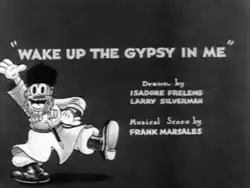 Title card | |
| Directed by | Rudolf Ising |
| Produced by | Hugh Harman Rudolf Ising Leon Schlesinger |
| Music by | Frank Marsales |
| Animation by | Isadore Freleng Larry Martin |
| Color process | Black-and-white |
Production companies | |
| Distributed by | Warner Bros. Pictures The Vitaphone Corporation |
Release date |
|
Running time | 7 min |
| Country | United States |
| Language | English |
Wake Up the Gypsy in Me is a 1933 American animated comedy short film directed by Rudolf Ising. It is the 23rd film in the Merrie Melodies series, featuring the title song written by Lew Lehr, Harry Miller and Lew Pollack.[1][2][3] The short was released on May 13, 1933.[4]
Plot
Russian Gypsies in a village dance to the titular song, while the music is performed by a band led by a caricature of jazz bandleader Paul Whiteman. A balalaika player uses a live herring to play music for him. Four men gurgle beer to the tune of "The Song of the Volga Boatmen". Another four men try to tow a puppy who refuses to walk. Another four men sing while wearing ushankas which are simply live cats. A girl dances to the tune.
A dwarf disguises himself as a taller figure with three bombs and sneaks into the village, fooling a guard by disguising as a woman. Meanwhile, the mad monk Rice-Puddin' (a caricature of Grigori Rasputin) attempts to solve a jigsaw puzzle of a donkey, but could not find the piece consisting of its tail, so he cuts up a picture of Tsar Nicholas II and uses it instead. He spots the villagers dancing and notices the girl, ordering a guard to abduct her before disposing of him so he can force himself upon her. To his horror, all the villagers immediately revolt and rush to kill him. He rides a donkey to escape; unbeknownst to him, the dwarf placed a bomb in his pants. As he manipulates the donkey to fly like a helicopter and escape, he notices the bomb which explodes and leaving him naked.
References
- ↑ Beck, Jerry; Friedwald, Will (1989). Looney Tunes and Merrie Melodies: A Complete Illustrated Guide to the Warner Bros. Cartoons. Henry Holt and Co. p. 19. ISBN 0-8050-0894-2.
- ↑ Schneider, Steve (1988). That's All, Folks! : The Art of Warner Bros. Animation. Henry Holt and Co. p. 40. ISBN 0-8050-0889-6.
- ↑ Parten, James (October 29, 2019). "Tunes From The Merrie Melodies 1932-33 Season |". Cartoon Research. Retrieved May 23, 2026.
- ↑ Lenburg, Jeff (1999). The Encyclopedia of Animated Cartoons. Checkmark Books. pp. 104–106. ISBN 0-8160-3831-7.
External links
- Big Cartoon Database article at
- Toon Zone article at
- Wake Up the Gypsy in Me at IMDb
- 1933 films
- 1933 animated short films
- Fictional representations of Romani people
- Films scored by Frank Marsales
- Films about kidnapping
- Films directed by Rudolf Ising
- Films set in Russia
- Films produced by Leon Schlesinger
- Films about Grigori Rasputin
- Merrie Melodies short films
- 1930s Warner Bros. animated short films
- 1933 English-language films
- English-language short films
- American animated black-and-white films
- Warner Bros. Cartoons animated short films