United Nations–administered Cambodia
Cambodia កម្ពុជា | |||||||||||
|---|---|---|---|---|---|---|---|---|---|---|---|
| 1992–1993 | |||||||||||
| Anthem: Song of the Paris Peace Agreement | |||||||||||
 Location of Cambodia in Southeast Asia. | |||||||||||
| Status | Independent state under United Nations administration | ||||||||||
| Capital and largest city | Phnom Penh | ||||||||||
| Common languages | Khmer | ||||||||||
| Special Representative of the Secretary General | |||||||||||
• 1992–1993 | Yasushi Akashi | ||||||||||
| Chairman of the Supreme National Council | |||||||||||
• 1992–1993 | Norodom Sihanouk | ||||||||||
| Prime Minister | |||||||||||
• 1992–1993 | Hun Sen | ||||||||||
• 1993 | Norodom Ranariddh | ||||||||||
| Historical era | Aftermaths of Third Indochina War and first phase of Cambodian conflict | ||||||||||
| 28 February 1992 | |||||||||||
| 15 March 1992 | |||||||||||
| 23 May 1993 | |||||||||||
| 24 September 1993 | |||||||||||
| Currency | Riel (៛) (KHR) | ||||||||||
| Time zone | UTC+07:00 (ICT) | ||||||||||
| Calling code | +855 | ||||||||||
| |||||||||||


| History of Cambodia |
|---|
 |
| Early history |
| Post-Angkor period |
| Colonial period |
| Independence and conflict |
| Peace process |
| Modern Cambodia |
| By topic |
 Cambodia portal |
Between 28 February 1992, or 15 March 1992, and 24 September 1993, Cambodia was administered by the United Nations Transitional Authority in Cambodia (UNTAC) under the terms of the 1991 Paris Peace Agreements which ended the Cambodian–Vietnamese War.
This was the first time the United Nations directly assumed responsibility for the administration of an independent member state.
Background
The Kingdom of Cambodia became independent from France on 9 November 1953. The monarchy was overthrown in a coup d'état on 18 March 1970 leading to the formation of the Khmer Republic. The Khmer Rouge came to power on 17 April 1975 resulting in the country becoming known as Democratic Kampuchea. Between 1975 and 1979, the Khmer Rouge's regime killed millions of its own people through mass executions, forced labour, and starvation, is what came to be known as the Cambodian genocide. The Khmer Rouge were overthrown on 7 January 1979 following the Vietnamese invasion of Cambodia. A rival government, the People's Republic of Kampuchea, was subsequently proclaimed by Vietnamese occupation forces, however the previous regime, which would become the Coalition Government of Democratic Kampuchea in 1982, continued to be recognised by the United Nations as the legitimate government of Cambodia. The Paris Peace Accords were signed in October 1991 to end the ongoing conflicts in Cambodia. The United Nations Transitional Authority in Cambodia (UNTAC) was established following the adoption of Resolution 745 by the Security Council on 28 February 1992.[1]
Administration
The Paris Peace Agreement specified the system of administration in Cambodia during the transitional period.
Supreme National Council
The Supreme National Council (SNC) as the sovereign body of Cambodia, represented the country externally and occupied its seat at the United Nations. Norodom Sihanouk was the chairman of the SNC. The SNC allowed its authority over all administrative agencies, bodies and offices acting in foreign affairs, national defence, finance, public security and information to be exercised by UNTAC on its behalf.[5][6][7][8][9][10] A council with the same name in Cambodia was established in 2005, which also got chaired by Norodom Sihanouk.[11]
Constituent Assembly
A Constituent Assembly was elected on 28 May 1992. Prince Ranariddh's FUNCINPEC Party was the top vote recipient with a 45.5% vote, followed by Hun Sen's Cambodian People's Party and the Buddhist Liberal Democratic Party, respectively. FUNCINPEC then entered into a coalition with the other parties that had participated in the election.[12] The parties proceeded to draft and approve a new constitution, which came into effect on 24 September 1993. It established a multiparty democracy in the framework of a constitutional monarchy, with Prince Sihanouk elevated to King. Prince Ranariddh and Hun Sen became First and Second Prime Ministers, respectively in the new Cambodian government.[12] Son Sann was the speaker of the assembly.
- Membership by party
| Party | MPs | Of total | |
|---|---|---|---|
| FUNCINPEC | 58 |
48.33% | |
| Cambodian People's Party | 51 |
42.50% | |
| Buddhist Liberal Democratic Party | 10 |
8.33% | |
| MOULINAKA | 1 |
0.83% | |
| Total | 120 | 100% | |
Office holders
De facto leader
During the first months Chea Sim was the de facto leader of Cambodia.[13][14]
| Portrait | Name | Term of office | ||
|---|---|---|---|---|
| Took office | Left office | Time in office | ||
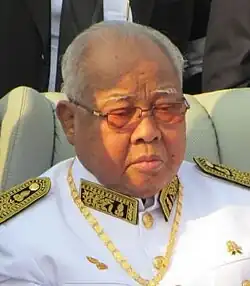 |
Chea Sim ជា ស៊ីម (1932–2015) |
22 February 1992 or 15 March 1992 | c. late June 1992 | c. 125 days |
Special Representative of the Secretary General
Yasushi Akashi of Japan served as the Special Representative of the Secretary General for Cambodia
| Portrait | Name | Term of office | ||
|---|---|---|---|---|
| Took office | Left office | Time in office | ||
 |
Yasushi Akashi 明石 康 (born 1931) |
28 February 1992 or 15 March 1992 | 24 September 1993 | 1 year, 208 days |
Chairman of the Supreme National Council
Prince Norodom Sihanouk became Chairman of the Supreme National Council on 17 July 1991 (and Head of State on 20 November 1991, six days after returning from abroad), retaining the position after the establishment of UNTAC in February 1992, and was appointed Chief of State by the Constituent Assembly on 14 June 1993. He would become King of Cambodia on 24 September 1993.
| Portrait | Name | Term of office | ||
|---|---|---|---|---|
| Took office | Left office | Time in office | ||
 |
Prince Norodom Sihanouk នរោត្តម សីហនុ (1922–2012) |
28 February 1992 or 15 March 1992 | 24 September 1993 | 1 year, 208 days |
Head of State (President of the Council of State/Chief of State)
| Portrait | Name | Term of office | ||
|---|---|---|---|---|
| Took office | Left office | Time in office | ||
 |
Heng Samrin ហេង សំរិន (born 1934) |
28 February 1992 or 15 March 1992 | 6 April 1992 | 38 days |
|
Chea Sim ជា ស៊ីម (1932–2015) |
6 April 1992 | 14 June 1993 | 1 year, 69 days |
|
Prince Norodom Sihanouk នរោត្តម សីហនុ (1922–2012) |
14 June 1993 | 24 September 1993 | 102 days |
Prime Minister
Hun Sen who had been prime minister of the People's Republic of Kampuchea since 1984 remained prime minister of Cambodia after the formation of UNTAC and was appointed as one of two co-prime ministers, together with Prince Norodom Ranariddh, by the Constituent Assembly on 2 July 1993.
| Portrait | Name | Term of office | ||
|---|---|---|---|---|
| Took office | Left office | Time in office | ||
 |
Hun Sen ហ៊ុន សែន (born 1952) |
28 February 1992 or 15 March 1992 | 24 September 1993 | 1 year, 208 days |
 |
Prince Norodom Ranariddh នរោត្តម រណឫទ្ធិ (1944–2021) |
2 July 1993 | 24 September 1993 | 84 days |
See also
References
- 1 2 3 United Nations Security Council Resolution 745. S/RES/745(1992) 28 February 1992. Retrieved 9 April 2008.
- ↑ Curtis, Grant (November 1993). "Transition to what? Cambodia, UNTAC and the peace process" (PDF). United Nations Research Institute for Social Development.
- ↑ "The Test of Transition ; The UN Administration of Cambodia (1992-1993)" (PDF). Sites.asit.columbia.edu. Retrieved 25 July 2026.
- ↑ "{title}". Archived from the original on 19 February 2009. Retrieved 29 June 2017.
- ↑ "1991 Paris Peace Agreements - Government, Constitution, National Anthem and Facts of Cambodia Cambodian Information Center". Archived from the original on 23 September 2014.
- ↑ "UNITED NATIONS TRANSITIONAL AUTHORITY IN CAMBODIA (UNTAC) - Mandate". Peacekeeping.un.org.
- ↑ "Norodom Sihanouk". Encyclopædia Britannica. Retrieved July 3, 2026.
- ↑ "Summary biography of His Majesty Preah Bat Samdech Preah NORODOM SIHANOUK, Heroic King, Father of Independence, Territorial Integrity and Unity of the Khmer Nation" (PDF). Pressocm.gov.kh.
- ↑ "Annex - Press communiqué dated 18 September 1990" (PDF). Digitallibrary.un.org.
- ↑ "Norodom Sihanouk Archival Collection (Monash University Library)". Resources.lib.monash.edu.
- ↑ "Retired King Assesses Border Council Meeting". English.cambodiadaily.com. May 16, 2005.
- 1 2 "UNTAC and UNAMIC Web site - UNTAC History". Archived from the original on 14 September 2009. Retrieved 16 July 2010.
- ↑ Renate, Strassner (26 June 1992). "Der Friedensprozeß in Kambodscha und die Neugestaltung der Beziehungen zwischen China und Indochina | APuZ 27/1992". bpb.de.
- ↑ "Report from Cambodia". New Yoker. 18 May 1992.
External links
- Nations Transitional Authority in Cambodia (UNTAC) official website
- Records of the United Nations Transitional Authority in Cambodia (UNTAC) (1992-1993) Archived 2021-11-04 at the Wayback Machine at the United Nations Archives
- Untac.com
| Current |
|
|---|---|
| UNSC-mandated |
|
| Former |
|
| Proposed |
|

- Territories administered by the United Nations
- Former countries in Cambodian history
- United Nations Security Council mandates
- 1990s in Cambodia
- States and territories established in 1992
- States and territories disestablished in 1993
- 1992 establishments in Cambodia
- 1993 disestablishments in Cambodia
- 20th century in Cambodia
- Cambodia and the United Nations