Uchimura Yushi
| Uchimura Yushi | |
|---|---|
 Uchimura in 1934 | |
| Born: November 12, 1897 Tokyo, Japan | |
| Died: September 17, 1980 (aged 82) | |
| Member of the Japanese | |
 Baseball Hall of Fame | |
| Induction | 1983 |
Uchimura Yushi (12 November 1897 – 17 September 1980)[1][2] was a Japanese medical scientist and psychiatrist. He specialised in clinical psychiatry and neuropathology.[3] He is viewed as "one of the founders of Japanese psychiatry".[4]
Early life and family

He was born in Tokyo Prefecture to Uchimura Kanzo, a Christian theologian, and Uchimura Shizuko, Uchimura's fourth wife.[5][6][2]
He was the grandson of samurai and Confucian scholar Uchimura Yoshiyuki.[7]
Education and career
Uchimura attended Tokyo Imperial University from 1918 to 1923, studying medicine and playing for the university's baseball team.[8][9] After graduating Uchimura studied psychiatry in Germany,[10] followed by research at the Kaiser Wilhelm Institute from 1925 to 1927 under Walther Spielmeyer.[11][12][2] His research focused on Ammon's horn sclerosis,[13] and led to an important paper published in 1928 authored by Uchimura detailing the vasculature of the hippocampus.[8][12]
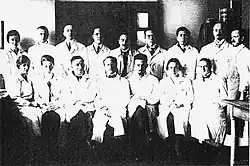
In 1928, he became a professor at Hokkaido Imperial University and established the Department of Psychiatry and Neurology.[5][12][6] Inspired by the racial hygiene policies of Germany, Uchimura conducted field research among the indigenous Ainu people of Hokkaido, providing the basis for Japan's eugenics laws.[10][14][15] After the atomic bombings of Hiroshima and Nagasaki, Uchimura was one of the psychiatrists leading work into how radiation exposure affected the neuropathology of the brain.[16]
He was a founder of the journal Psychiatry and Clinical Neurosciences in 1933, and acted as one of its chief editors.[17]
In 1936, he became a professor in the faculty of medicine at the University of Tokyo, serving as dean of the faculty and the graduate school of medicine from 1953 to 1957.[18] After retiring he held the position of professor emeritus and was elected as a member of the Japan Academy in 1965.[19]
Baseball
In May 1962, Uchimura became the third commissioner of Nippon Professional Baseball.[9][20][8] Uchimura was inducted into the Japanese Baseball Hall of Fame in 1983.[21][22][8]
References
- ↑ Shimazono, Yasuo (1980). "Obituary". Folia Psychiatrica et Neurologica Japonica. 34: i–iv.
- 1 2 3 Tayebi Meybodi et al. 2023, p. 1129.
- ↑ Tayebi Meybodi et al. 2023, p. 1128.
- ↑ Zwigenberg 2014, p. 150.
- 1 2 "Psychiatry and Neurology". Hokkaido University Hospital.
- 1 2 Fukuzawa 2024, p. 282.
- ↑ Masao 1979, p. 13.
- 1 2 3 4 5 Tayebi Meybodi et al. 2023, p. 1130.
- 1 2 "Uchimura Yūshi (uchi mura yūshi)" 内村 祐之(うちむら ゆうし) [Yushi Uchimura]. Baseball Museum of Japan (in Japanese).
- 1 2 Liu, Alex Hsu-Chun (2 September 2024). "Taiwanese Psychiatrists' Cultural Inquiries in the 1950s: Toward a Prehistory of Transcultural Psychiatry and Psychological Anthropology on the Verges of the Japanese and American Empires". Taiwan Insight. University of Nottingham.
- ↑ Boling, Ettl & Sano 2010, p. 182.
- 1 2 3 Akimoto 2004, p. 102.
- ↑ Boling, Ettl & Sano 2010, pp. 182–183.
- ↑ Fukuzawa 2024, pp. 282–284.
- ↑ Zwigenberg 2014, pp. 150–151.
- ↑ Zwigenberg 2014, pp. 151–152.
- ↑ "History of PCN". Japanese Society of Psychiatry and Neurology. 11 March 2011.
- ↑ "Chronological List of Deans". University of Tokyo.
- ↑ "Deceased Members: U-W". Japan Academy.
- ↑ Trumbull, Robert (5 February 1965). "Murakami Controversy Imperils U.S.-Japan Baseball Dealings". The New York Times.
- ↑ "Dentōiri risuto" 殿堂入りリスト [Hall of Fame List]. Baseball Museum of Japan (in Japanese).
- ↑ "Yushi Uchimura". The Baseball Hall of Fame and Museum. Retrieved January 10, 2026.
Works cited
- Akimoto, Haruo (April 2004). "What I learnt from studying epilepsy: Epileptology and myself". Psychiatry and Clinical Neuroscience. 58 (2): 101–109. doi:10.1111/j.1440-1819.2003.01223.x.
- Boling, Warren W.; Ettl, Svenja; Sano, Keiji (3 May 2010). "Professor Uchimura, Ammon's Horn Sclerosis, and the German Influence on Japanese Neuroscience". Journal of the History of the Neurosciences. 19 (2): 182–194. doi:10.1080/09647040902720735.
- Fukuzawa, Hosanna (2024). "Creating Racial Subjects: Eugenics, Psychiatry, and the Ainu". Critical Asian Studies. 56 (2): 277–296. doi:10.1080/14672715.2024.2312137.
- Masao, Sekine [in Japanese] (1979). 内村鑑三 [Kanzo Uchimura] (in Japanese).
- Tayebi Meybodi, A.; Mignucci-Jiménez, G.; Xu, Y.; Preul, M. C. (2023). "Artery of Uchimura: origin and evolution of identification of the vascular supply to the hippocampus". Journal of Neurosurgery. 139 (4): 1128–1139. doi:10.3171/2023.2.JNS221963.
- Zwigenberg, Ran (2014). Hiroshima: The Origins of Global Memory Culture. Cambridge University Press. ISBN 978-1-107-07127-8.
- 1897 births
- 1980 deaths
- 20th-century Japanese translators
- 20th-century Japanese medical doctors
- Academic staff of Hokkaido University
- Academic staff of the University of Tokyo
- Japanese neuroscientists
- Japanese psychiatrists
- Members of the Japan Academy
- Nippon Professional Baseball commissioners
- People from Tokyo Metropolis
- People of the Meiji era