Typhoon Dolphin (2026)
 Dolphin at its peak intensity on July 29 | |
| Meteorological history | |
|---|---|
| Formed | July 26, 2026 |
| Dissipated | August 13, 2026 |
| Violent typhoon | |
| 10-minute sustained (JMA) | |
| Highest winds | 205 km/h (125 mph) |
| Lowest pressure | 910 hPa (mbar); 26.87 inHg |
| Category 5-equivalent super typhoon | |
| 1-minute sustained (SSHWS/JTWC) | |
| Highest winds | 280 km/h (175 mph) |
| Lowest pressure | 909 hPa (mbar); 26.84 inHg |
| Overall effects | |
| Fatalities | 6 indirect |
| Injuries | 14 (7 direct, 7 indirect) |
| Damage | >$265 million (2026 USD) |
| Areas affected | Marshall Islands, Japan (particularly Minamitorishima, Bonin Islands, Daitō Islands, Ryukyu Islands), Taiwan, East China, Philippines |
Part of the 2026 Pacific typhoon season | |
Typhoon Dolphin[nb 1] was a powerful, large and very long-lived tropical cyclone that affected East China. The thirteenth named storm, fifth typhoon and third violent typhoon of the 2026 Pacific typhoon season, Dolphin originated from a disturbance near the International Date Line in the Central Pacific in mid-July. Initially monitored by the Central Pacific Hurricane Center (CPHC), it crossed the International Date Line a week later, with the Japan Meteorological Agency (JMA) recognizing it as a tropical depression during the late hours of July 26. The United States' Joint Typhoon Warning Center (JTWC) followed suit the following day, designating it as 12W; a few hours later, both agencies upgraded it to a tropical storm, with the former giving it the name Dolphin.
Meteorological history
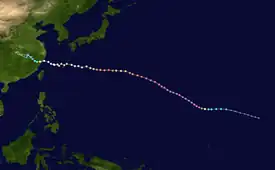
Tropical storm (39–73 mph, 63–118 km/h)
Category 1 (74–95 mph, 119–153 km/h)
Category 2 (96–110 mph, 154–177 km/h)
Category 3 (111–129 mph, 178–208 km/h)
Category 4 (130–156 mph, 209–251 km/h)
Category 5 (≥157 mph, ≥252 km/h)
Unknown


 Extratropical cyclone, remnant low, tropical disturbance, or monsoon depression

On July 19, the Central Pacific Hurricane Center began monitoring a disturbance south of the Hawaiian Islands. When the disturbance had a high 90% chance of development in the next two days, it was designated Invest 92C.[3] Later on July 26, the disturbance crossed into the Western Pacific, and the JMA classified the system as a tropical depression upon crossover. The following day at midnight, The JTWC upgraded the disturbance to a tropical depression, designating it as 12W,[4] upgraded by the JMA to a tropical storm shortly after, and received its current name Dolphin.[5] Almost immediately after its nomenclature, Dolphin began a period of rapid intensification, to an extent not seen since Typhoon Noru,[6] quickly becoming a typhoon and reaching a Category 4-equivalent initial peak intensity on the Saffir–Simpson scale on July 28, before its intensification was stunted by an eyewall replacement cycle. After finishing, Dolphin resumed intensifying once again, reaching super typhoon status the following day. Soon after reaching Category 5 strength on the Saffir–Simpson scale, Dolphin started undergoing a second eyewall replacement cycle, temporarily halting further development of the storm.[7] Dolphin continued moving westward which it started slowly weakening to a Category 2 equivalent typhoon after 3 days. Next, Dolphin regained intensity as Category 3 typhoon. On August 5, Dolphin started weakening again shortly to a Category-1 equivalent typhoon with 1-minute sustained winds of 90mph. After that, Dolphin passed the Ryukyu Islands and made a direct landfall over Kume Island. Dolphin soon made landfall over Yuhuan in China's Zhejiang province at 17:30 CST on August 9, followed by a second landfall over Wenzhou an hour later.[8]
Preparations
Japan
The Japan Meteorological Agency (JMA) warned of strong winds, heavy rainfall, landslides, and flooding due to the effects of Dolphin.[9] Heavy rainfall warnings were issued for the Daitō Islands as the typhoon closely approached.[10] Level 4 heavy rainfall warnings were also issued for Ogimi, Higashi, and Nakijin. Level 4 landslide warnings were issued for the same areas as well as Kunigami and Motobu. A Level 4 storm surge warning was posted for Kumejima, as well.[11]

More than 260,000 people in Kagoshima and Okinawa prefectures were advised to evacuate. The typhoon was expected to affect parts of Kumamoto Prefecture impacted by a magnitude 7.1 earthquake the previous week. More than 6,700 residents remained in shelters at the time of Dolphin's arrival.[12] Residents in Kumamoto Prefecture covered roofs damaged by the earthquake in plastic sheets. More than 500 flights were cancelled due to the storm, with Naha Airport cancelling all its flights on August 7.[13] Toyota ceased operations at nine factories across Japan over concerns about shipping disruptions.[14] All bus companies on the island of Okinawa suspended operations as the typhoon approached.[15] The Okinawa Urban Monorail also suspended operations for the duration of the typhoon.[16] The city government of Naha opened seven temporary storm shelters.[17] About 240 people evacuated to storm shelters prior to the storm across Okinawa Prefecture.[11]
China
China Meteorological Administration (CMA) issued a yellow typhoon warning for part of the country's east coast as Dolphin approached, and updated it to red on the noon of August 9.[18][19] Gale-force winds were expected to impact the waters of the East China Sea and the Bashi Channel, as well as coastal areas of Zhejiang and Fujian.[20] More than 1 million people were evacuated across eastern China in preparation for the storm.[8]
The provincial government of Zhejiang prepared 15 tow boats for emergencies. A total of 162 ferry routes and 193 water construction projects were halted for the duration of the typhoon. A total of 474 ships were also docked for the storm. Seaside tourists and sports activities in Ningbo were cancelled. The government of Fujian Province declared a Level 4 emergency response which advised all communities to dock fishing vessels and ferries and to secure offshore wind power platforms. Safety inspections, evacuations of high-risk zones, and the gathering of emergency resources were also required through the order.[21] Major delays occurred as ports in China closed in preparation for Dolphin. Container operations were suspended at the Port of Shanghai. Temporary port suspensions were also expected to take place in Ningbo.[22] China's insurance industry had received nearly 130,000 claims related to Typhoon Dolphin as of August 12, with estimated losses of 1.75 billion yuan ($259.5 million).[23]
The government of China used the arrival of Dolphin to test new technology for typhoons. This included the use of artificial intelligence in forecasting systems at the National Marine Environmental Forecasting Centre which were used to give long-range forecasts for the storm. Drones were also deployed to aid in preparations in coastal provinces.[21]
Philippines
Despite the system remaining outside the Philippine Area of Responsibility (PAR), rainfall warnings were put in place as the system enhanced the southwest monsoon.[24][25] Heavy rainfall warnings were put in place over Bataan, Occidental Mindoro, and Zambales, while multiple provinces plus Metro Manila were put under an orange warning.[26]
Impact
Japan
In Japan, Dolphin reached maximum wind speeds of 162 km/h (101 mph), with Okinawa and Amami Islands among the most affected regions; Naha Airport of Okinawa suspended all flights on August 7.[13] Dolphin created havoc in parts of southern Japan, paralyzing traffic and sending hundreds to take shelter.[27] Preliminary damage caused by the storm was assessed at JP¥800 million (US$5.02 million).[28]
Taiwan
Taiwan was hit with heavy rainstorms on August 7-8, with citizens of Taipei reporting "toppled trees, downed scaffolding and collapsed construction fencing", and Tamsui District reporting blown-off roofs.[29] One the morning of August 9, Taiwan suspended all ferry routes and issued about 200 flight cancellations; its Central Weather Administration reported a maximum sustained wind speed of 119 km/h (74 mph) on 11 a.m., stating it to be about 350 kilometers north-northeast of Taipei and moving west.[30]
China
In Shanghai, the Shanghai Ferry suspended all services on August 8[31], and all coastal tourist destinations in Fengxian District[32] and a number of parks[33] were temporarily closed. More than 1,300 flights were cancelled on August 9, and around 300,000 people in surrounding regions were evacuated in preparation.[34] Shanghai Disney and Disneytown also closed beginning that night.[35] Numerous metro lines either completely or partially stopped operation, with more closing down on August 10.[31][36] Flooding occurred in the French Concession.[8]
In Beijing, intense rain from the storm flooded key roads and stranded vehicles.[37]
In Zhejiang, Ningbo Lishe International Airport suspended all flights.[13] A nine-year-old boy in Wenling was reported missing after he was swept into the sea. Two people were detained on suspicion of spreading misinformation related to the storm.[8]
Philippines
More than 500 passengers were stranded across 28 ports due to rough conditions brought on by the southwest monsoon that was intensified by Dolphin.[38] Torrential rains caused waist-deep flooding in low-lying communities and areas near creeks in Quezon City. Several other neighborhoods in Manila and western Philippines also experienced flooding.[39] Malacañang Palace announced sweeping suspensions on classes and work in government offices in Metro Manila and 15 other provinces due to continuing heavy rains by the typhoon's enhancement of the southwest monsoon.[40]
Hong Kong
Hong Kong recorded its hottest ever temperature of 36.9 °C because of subsiding hot air from outside the typhoon, breaking the previous record set on 22 August 2017, before Typhoon Hato hit. A weather station in Sheung Shui recorded 39.8 °C, the highest ever temperature recorded in Hong Kong since automatic weather stations were introduced in 1984.[41]
See also
- Weather of 2026
- Tropical cyclones in 2026
- List of super typhoons
- List of violent typhoons
- Typhoon Bavi (2026) – another very large Category 5 super typhoon that made landfall in nearly the exact same spot in China almost a month earlier
Notes
- ↑ The name Dolphin (Cantonese: 白海豚, [pak hɔi tʰyn]) was contributed by Hong Kong and refers to the Chinese white dolphin.[1]
References
- ↑ "List of names for tropical cyclones adopted by the Typhoon Committee for the western North Pacific and the South China Sea". Japan Meteorological Agency. Archived from the original on February 26, 2020. Retrieved August 10, 2026.
- ↑ Prognostic Reasoning for Typhoon 12W (Dolphin) Warning No. 48 (Report). United States Joint Typhoon Warning Center. August 8, 2026. Archived from the original on August 8, 2026. Retrieved August 8, 2026.
- ↑ Tropical Weather Outlook for 200 AM HST Sun Jul 26 2026. NHC Graphical Outlook Archive (Report). Honolulu, Hawaii: Central Pacific Hurricane Center. July 26, 2026. Retrieved July 27, 2026.
- ↑ Prognostic Reasoning for Tropical Depression 12W (12W) Warning No. 1 (Report). United States Joint Typhoon Warning Center. July 27, 2026. Archived from the original on July 27, 2026. Retrieved July 27, 2026.
- ↑ Tropical Weather Advisory for Typhoon T2613 (Dolphin) at 27 July, 0950 UTC (Report). Japan Meteorological Agency. July 27, 2026. Archived from the original on July 27, 2026.
- ↑ Janakiraman, Mamatha (July 31, 2026). "Where Is Super Typhoon Dolphin Headed? Latest Forecast Tracks Possible Approach Toward Japan". International Business Times. Retrieved August 1, 2026.
- ↑ Prognostic Reasoning for Category 5-Equivalent Tropical Cyclone 12W (Dolphin) Warning No. 13 (Report). United States Joint Typhoon Warning Center. July 30, 2026. Archived from the original on July 30, 2026. Retrieved July 30, 2026.
- 1 2 3 4 "China evacuates one million from homes as massive storm arrives". BBC. August 10, 2026. Retrieved August 10, 2026.
- ↑ "Typhoon Dolphin batters Japan's southwestern islands". NHK World Japan. August 7, 2026. Retrieved August 7, 2026.
- ↑ "台風13号 大東島地方が暴風域に 暴風や高潮など厳重警戒". NHK One. August 6, 2026. Retrieved August 7, 2026.
- 1 2 Rishav Kothari (August 7, 2026). "Typhoon Dolphin strengthens near Okinawa, 5 injured as China braces for landfall". The Watchers. Retrieved August 7, 2026.
- ↑ "Japan orders evacuations as Typhoon Dolphin approaches, cancels 500 flights". Reuters. August 6, 2026. Retrieved August 7, 2026.
- 1 2 3 "Typhoon Dolphin batters Japan's Okinawa before bearing down on China". BBC News. August 8, 2026. Retrieved August 9, 2026.
Typhoon Dolphin has cut power to at least 44,000 buildings and injured at least five people after hitting Japan's Okinawa island on Saturday [...] maximum wind speeds of 162km/h [... with JMA warning of] high waves, storm surges and lightning strikes. [The most affected areas are] the islands of Okinawa and Amami in the far south-west of the country [...] reports numerous accounts of trees being toppled [and] a car was found overturned and leaking oil in a parking lot. [...] In China, Zhejiang's Ningbo Lishe International Airport said it would stop its operations from 23:30 and suspend all flights on Sunday.
- ↑ Stuti Mishra (August 7, 2026). "Typhoon Dolphin mapped: 500 flights cancelled as powerful storm impacts Japan region still reeling from earthquake". The Independent. Retrieved August 7, 2026 – via AOL.
- ↑ "【台風13号】沖縄本島のバス4社、8日は始発から運休" (in Japanese). Okinawa Times. August 7, 2026. Retrieved August 7, 2026.
- ↑ "【台風13号】ゆいレール 8日も始発から運休" (in Japanese). Okinawa Times. August 7, 2026. Retrieved August 7, 2026.
- ↑ "【台風13号】那覇市役所に避難所開設 市民が避難「家は風雨でガタガタ鳴る」 千葉の観光客家族も欠航で" (in Japanese). Okinawa Times. August 7, 2026. Retrieved August 7, 2026.
- ↑ "中央氣象台升級發布颱風紅色預警" [China's National Meterological Center issues red alert against Dolphin.]. 香港文匯報 (in Chinese (China)). Retrieved August 9, 2026.
- ↑ 宋艺. "China issues red alert as Typhoon Dolphin approaches eastern coast". China Daily. Retrieved August 9, 2026.
- ↑ Zhao Yimeng (August 7, 2026). "Warning remains in place as Typhoon Dolphin approaches China's coast". China Daily. Retrieved August 7, 2026.
- 1 2 Phoebe Zang (August 7, 2026). "1,230 times the size of Hong Kong: China deploys drones, AI as Typhoon Dolphin nears coast". Shenzhen, China: South China Morning Post. Retrieved August 7, 2026.
- ↑ "Typhoon Dolphin Causes Widespread Port Delays Across China". Beckchoice. August 7, 2026. Retrieved August 7, 2026.
- ↑ Lei, Li. "Special teams drive post-disaster relief". China Daily.
- ↑ Santos, Jel (August 8, 2026). "Typhoon Dolphin enhances 'habagat,' brings heavy rains over parts of PH—PAGASA". Philippines: Manila Bulletin. Retrieved August 8, 2026.
- ↑ Jamito, Dennis. "Typhoon Dolphin at isa pang bagyo, patuloy na binabantayan sa labas ng PAR" (in Tagalog). Bombo Radyo.
Patuloy na binabantayan ng mga awtoridad ang Bagyong Dolphin, na kasalukuyang nasa labas ng Philippine Area of Responsibility (PAR) ngunit malapit sa hilagang bahagi ng bansa. [...] Bagama't nasa labas ng PAR, inaasahang magpapatuloy ang epekto ng bagyo sa pamamagitan ng pagpalakas sa Habagat, na nagdadala ng malakas na ulan sa malaking bahagi ng Luzon at Visayas. [Authorities continue to monitor Typhoon Dolphin, which is currently outside the Philippine Area of Responsibility (PAR) but near the northern portion of the country. [...] Despite being located outside PAR, it is expected that the typhoon's effects will continue as it enhances the southwest monsoon, which is bringing heavy rains to large portion of Luzon and Visayas.]
- ↑ Bacay, Holly (August 7, 2026). "Habagat to bring rains in PH; Maymay weakens into LPA — Pagasa". Manila: Philippine Daily Inquirer. Retrieved August 8, 2026.
- ↑ Yamaguchi, Mari (August 12, 2026). "Tropical Storm Chan-hom weakens and departs Japan after causing power outages and injuries". apnews. Retrieved August 12, 2026.
- ↑ "台風13号で被害8億円 沖縄の農林水産業 サトウキビが6億円で最大 JA「出荷量はさらに落ち込む可能性" [Typhoon No. 13 caused 800 million yen in damage to Okinawa's agriculture, forestry, and fisheries sectors. Sugarcane was the biggest damage, with 600 million yen in losses. JA (Japan Agricultural Cooperatives) says "shipments may fall further."]. Okinawa Times. August 12, 2026 [Originally posted 11 August 2026].
- ↑ "Taiwan: Typhoon Dolphin Brings Damaging Winds". Reuters. August 9, 2026.
Typhoon Dolphin's outer bands battered northern Taiwan on Saturday, August 8, bringing damaging winds. Toppled trees, downed scaffolding and collapsed construction fencing were reported in Taipei, while New Taipei's Tamsui District reported blown-off roofing and leaning utility poles.
- ↑ "Typhoon Dolphin causes damage across northern Taiwan - Focus Taiwan". Focus Taiwan. August 9, 2026. Retrieved August 9, 2026.
[...Nine] ferry routes were suspended Sunday [Aug. 9], while [...] 79 domestic and 115 international and cross-strait flight cancellations as of 10 a.m. [...] Dolphin was about 350 kilometers north-northeast of Taipei as of 11 a.m. [...] with maximum sustained winds of 119 kph. A sea warning remained in effect for waters off northern Taiwan.
- 1 2 "受台风"白海豚"影响,上海轮渡全线停航,铁路民航部分线路航班调整". 上观新闻-站上海,观天下 (in Chinese). Retrieved August 10, 2026.
- ↑ "上海奉贤沿海景区全数临时闭园,安全防范先行" (in Chinese). 新浪文旅指南. August 8, 2026. Retrieved August 9, 2026.
- ↑ "受台风"白海豚"影响,上海多家景点临时闭园、调整运营时间". “上海发布”微信公众号. August 9, 2026. Retrieved August 9, 2026.
- ↑ "Shanghai cancels 1,300 flights as China prepares for Typhoon Dolphin". AP News. August 9, 2026. Retrieved August 9, 2026.
- ↑ 邹佳雯 (August 7, 2026). "受台风"白海豚"影响,上海迪士尼度假区将调整运营时间". 澎湃新闻. Retrieved August 7, 2026.
- ↑ "明日上海轨交3、5、16号线和浦江线全线停运,1、2、6、10号线缩线运行_浦江头条_澎湃新闻-The Paper". thepaper.cn (in Chinese). August 9, 2026. Retrieved August 9, 2026.
- ↑ "Rain pounds Beijing as Typhoon Dolphin sweeps through China". Beijing, China: Channel News Asia. August 12, 2026. Retrieved August 12, 2026.
- ↑ Villa, Hazel (August 9, 2026). "Habagat, Typhoon Dolphin strand 543 passengers, disrupt sea travel". Iloilo City: Philippine Daily Inquirer. Retrieved August 9, 2026.
- ↑ Blaza, Peter (August 9, 2026). "Enhanced monsoon rains due to typhoon Dolphin trigger flooding in PH". Philippines: ABS-CBN. Retrieved August 9, 2026.
- ↑ Cabalza, Dexter (August 9, 2026). "Palace orders class, work suspensions in NCR, 15 provinces on Aug. 10". Philippine Daily Inquirer. Retrieved August 9, 2026.
- ↑ "Hong Kong records hottest day ever as Typhoon Dolphin fuels heatwave". The Guardian. AFP. August 10, 2026. ISSN 0261-3077. Retrieved August 11, 2026.
External links

- JMA General Information on Typhoon Dolphin from Digital Typhoon
Tropical cyclones of the 2026 Pacific typhoon season | ||
|---|---|---|
 | ||
