Turin–Orbassano–Giaveno Tramway
| Turin–Orbassano–Giaveno tramway | |||
|---|---|---|---|
 The tramway station in Giaveno | |||
| Overview | |||
| Operation | |||
| Operator(s) | SATTI | ||
| Number of vehicles | steam tram locomotives and trailers (1882-1937) electric railcars (1928-1958) | ||
| |||
The Turin–Orbassano–Giaveno tramway, with branches to the San Luigi Hospital, Cumiana and Pinerolo, was an interurban tramway line active between 1881 and 1958 in Italy.[1]
History
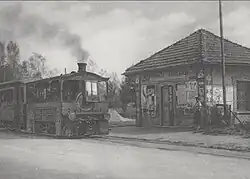
As early as 1877, the construction of an economical railway to Giaveno was proposed; despite the approval of subsidies by the interested municipalities, nothing came of it.[2] In February 1880, the municipalities of Orbassano and Giaveno approved the preliminary concession to engineer Giovanni Corti for the construction and operation of a steam tramway line between Turin, Orbassano and Piossasco with a branch to Giaveno; this proposal was countered by another, pushed by banker Ulrich Geisser but rejected by the interested municipalities, for the construction of a narrow-gauge railway on the same route.[2]
The concession was obtained by engineer Corti;[2] on 3 July 1881, the Turin-Orbassano section was inaugurated, in the presence of the mayor of Turin Luigi Ferraris, the writer Edmondo De Amicis and other authorities;[2] the following 11 September was the turn of the section between Orbassano and Piossasco. The line from Orbassano was extended to Trana on 12 March 1882. The extension to Giaveno, for which the municipality of Giaveno had allocated 300,000 lire, was tested on Sunday 4 February 1883.[2] From Piossasco, the line was extended to Cumiana on 1 December 1889[2] and to Pinerolo on 6 August 1899.[2]
The following year the line passed into the hands of the Società Torinese di Tramways e Ferrovie Economiche (STTFE), which had been the concessionaire since 1890 also of the Turin-Piobesi tramway.[3] The line connected Turin to the Val Sangone, passing through the agricultural centres of Orbassano and Piossasco, reaching Giaveno, an industrial centre (in the textile, paper and tanning sectors) and capital of a district which, although part of the Susa district, was served neither by the Fréjus railway nor by the Cenisio state road; it also served Cumiana, a location with important stone quarries.[3]

In 1926, to solve the communication problems between Turin, the Mirafiori hippodrome, Stupinigi and the San Luigi sanatorium, the municipal administration (through commissioner Donato Etna) established with the STTFE the Esercizio Tranvie Orbassano Stupinigi (ETOS) consortium,[4][5] which proceeded to electrify the Turin-Stupinigi (of the Turin-Piobesi tramway) and Turin-Orbassano sections: the electrified line to Stupinigi was inaugurated on 5 July 1928, while the electrification of the Turin-Orbassano section was inaugurated on the following 28 October; in the same year the branch to the sanatorium was also inaugurated.[4]
On 1 January 1936, the tramway came under the management of the Società Anonima Tranvie Torino Ovest (SATTO), and under the new management work began on the transformation and electrification of the Orbassano-Giaveno section, including the reconstruction on its own right-of-way of the Orbassano-Bruino and Bruino-Trana sections, the construction of the new Orbassano station, the Turin freight yard and the Trana power plant.[6]

On 28 October 1936, steam service to Cumiana and Pinerolo was suppressed and replaced with buses,[7] while on 1 August the following year the SATTI (the new name of SATTO) inaugurated the reconstructed line:[8] both on the Turin-Orbassano-Giaveno line and on the sections for Cumiana and Pinerolo there was an increase in passengers carried.[9]
During the Second World War, the tramway suffered only slight damage to rolling stock until 1944,[10] contributing to the evacuation of Turin's population.[11]
The convoys, carrying commuting workers and evacuees travelling to Giaveno, were bombed and strafed by Allied aircraft on two occasions: on 9 January 1945 in Orbassano[12][13] and on 27 January 1945 between Bruino and Sangano.[14] In the first attack, 31 people died and 34 were injured; in the second case, thanks to the promptness of the driver who realised the imminent attack and stopped the convoy, there was only one victim and a few injured; however, there was serious damage to the tracks.[15] In Orbassano, in the garden between Via Di Nanni and Via De Gasperi, a commemorative stone by sculptor Giuliano Romano was erected,[12] and a ceremony is held every year to commemorate the event.
In December 1957, SATTI supplemented the tramway with a bus service: in February 1958 the timetable provided for twelve pairs of trams between Turin and Giaveno (with an average speed of 28 km/h) and nineteen pairs of buses between Turin, Giaveno and Cumiana.[7] The line closed on 31 October 1958, the last Turin interurban tramway.[16]
Characteristics
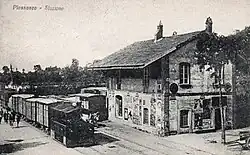
The tramway line was standard gauge, and developed over a total of 57.341 km (36.671 km for the Turin-Orbassano-Pinerolo section; 3.590 km for the Bivio Cumiana-Cumiana section; 16.380 km for the Orbassano-Giaveno section; 700 m for the Bivio Sanatorio-Sanatorio section); the minimum curve radius was 50 metres, and the maximum gradient was 43.5 per thousand. The maximum permitted speed was 30 km/h.[17]
The Turin-Orbassano-Giaveno section was electrified between 1928 and 1937 at 600 V DC in urban sections and 1200 V DC in extra-urban sections; partially rebuilt on its own right-of-way, it was 31.769 km long (of which 700 m was the branch to the San Luigi sanatorium), had a minimum curve radius of 60 metres (50 on the branch to the Sanatorium) and a maximum gradient of 43.5 per thousand.[17]
Route

The line's terminus was on Via Sacchi at the corner with Corso Vittorio Emanuele II,[18] then passed near the tram rolling stock depot; leaving the new parade ground on its right, the tramway crossed the Crocetta district, then, after crossing the Orbassano barrier, it took the provincial road for Beinasco and Orbassano, keeping to the right side of the same.[2]
With the electrification of the Turin-Orbassano section (1928), the tramway changed its route, starting from Via Sacchi at number 15[19] and running (in common with the Turin-Piobesi tramway) along Corso Stupinigi to Via Settembrini, then turning left onto Corso Orbassano; a branch was simultaneously created to serve the San Luigi hospital, which from Via Settembrini turned right onto Corso Orbassano.[20]
Leaving Orbassano, the line forked: on one side it entered the Val Sangone, passing through Bruino, Sangano and the sanctuary of Trana, then following the road to Giaveno against the backdrop of the peat bogs of the Lakes of Avigliana;[2] on the other side it headed towards Piossasco, Cumiana, Frossasco and Pinerolo, a city where the terminus was located on Corso Bosio, near those of the tramways for Pinerolo–Perosa Argentina Tramway and Saluzzo–Pinerolo tramway.[21]
Shortly before closure (1 July 1958), the Turin terminus was moved: instead of from Via Sacchi, the tramway departed from the Mauriziano Hospital (Corso Unione Sovietica corner Via Arquata).[22]
The SATTI depot in Turin was located on Via Giordano Bruno.[23]
Rolling stock

Initially, Krauss steam locomotives and carriages built by Locati served the line;[2] over time other locomotives were added. The following steam tram-type locomotives served the line:[24]
- 1÷4: built by Krauss in 1882, B wheel arrangement, 20 km/h;
- 5÷7: built by Krauss in 1882, B wheel arrangement, 30 km/h;
- 8: built by Krauss in 1882, C wheel arrangement, 25 km/h;
- 9: built by Krauss in 1887, B wheel arrangement, 30 km/h;
- 10: built by Krauss in 1882, B wheel arrangement, 20 km/h;
- 11÷14: built by Henschel & Sohn between 1888 and 1901, B wheel arrangement, 30 km/h, purchased used from the Société Anonyme des Tramways Napolitains (SATN), for which they served on the Naples–Bagnoli–Pozzuoli Tramway;[25]
- 15÷16: built by Krauss between 1906 and 1908, C wheel arrangement, 25 km/h;
- 17÷18: built by Krauss in 1908, B wheel arrangement, 25 km/h;
- 19÷25: built by Krauss in 1913, B wheel arrangement, 30 km/h.
The electrified line saw the use of locomotives built by the Officine di Savigliano.[26] In the 1950s, electric railcars also served from the tramways Turin–Pianezza/Druento Tramway and Turin–Venaria Reale Tramway operated by the Società Trazione Elettrica Piemontese (STEP)[16] and trailers obtained from the de-motoring of railcars from the Turin–Settimo Torinese tramway.[27]
In 1927, the STTFE rolling stock consisted of twelve steam locomotives, 64 two-axle trailers and 206 freight wagons; in 1955, instead, seven steam locomotives, eight electric railcars, three two-axle trailers, 27 bogie trailers and five freight wagons served the line.[28]
See also
References
- ↑ Valter & Comello 2022, p. 11.
- 1 2 3 4 5 6 7 8 9 10 "La tranvia Torino-Orbassano-Giaveno, attiva dal 1881 al 1958 collegava la Valsangone" [The Turin-Orbassano-Giaveno tramway, active from 1881 to 1958, connected the Val Sangone]. L'Agenda News. 7 January 2021. Retrieved 17 August 2026.
- 1 2 Brogiato 1977, p. 62.
- 1 2 "La necessità dell'intervento del Comune di Torino" [The need for the intervention of the Municipality of Turin]. La Stampa. 4 December 1932. p. 6.
- ↑ Sereno 2009, p. 292.
- ↑ Ogliari & Sapi 1968, vol. 9, pp. 630–632.
- 1 2 "Tra sbuffi di vapore la tranvia arriva a Giaveno" [Amid puffs of steam, the tramway arrives in Giaveno]. Laboratorio Alte Valli. 10 November 2020. Retrieved 17 August 2026.
- ↑ "Con l'inaugurazione di domani scompare l'ultima tranvia a vapore nella provincia di Torino" [With tomorrow's inauguration, the last steam tramway in the province of Turin disappears]. La Stampa. 31 July 1937. p. 5.
- ↑ Sartirana 1937, p. 5.
- ↑ Ogliari & Sapi 1968, vol. 9, p. 623.
- ↑ Ogliari & Sapi 1968, vol. 9, p. 611.
- 1 2 9 gennaio 1945-1995. Per non dimenticare [9 January 1945–1995. Lest we forget]. Comune di Orbassano. 1996.
- ↑ "Ottantanni fa il raid dei "liberatori": Orbassano ricorda la strage del trenino" [Eighty years ago the raid of the "liberators": Orbassano remembers the massacre of the train]. La Stampa. 7 January 2025. Retrieved 17 August 2026.
- ↑ "Non tramonta il ricordo delle vittime del mitragliamento del trenino Torino-Giaveno di 70 anni fa" [The memory of the victims of the strafing of the Turin-Giaveno train 70 years ago does not fade]. Luna Nuova. 16 January 2015.
- ↑ At the initiative of the municipalities of Orbassano, Bruino, Giaveno and Sangano, a video with some testimonies was produced: https://www.youtube.com/watch?v=_g1Zn4k82P4
- 1 2 Ogliari & Sapi 1968, vol. 9, p. 636.
- 1 2 Ogliari & Sapi 1968, vol. 9, p. 762.
- ↑ Governato 2016, p. 25.
- ↑ Governato 2016, p. 34.
- ↑ Governato 2016, p. 26.
- ↑ Il Pinerolese, l’Unità d’Italia, gli Alpini. Atti del convegno, castello di Macello, 18 giugno 2011 [The Pinerolo area, the Unification of Italy, the Alpini. Proceedings of the conference, Macello castle, 18 June 2011] (PDF). p. 56. Archived from the original (PDF) on 8 December 2015.
- ↑ "Rivoluzione in via Sacchi" [Revolution in Via Sacchi]. Stampa Sera. 1 July 1958. p. 2.
- ↑ "Il trenino di Giaveno sparisce da via Sacchi" [The Giaveno train disappears from Via Sacchi]. Stampa Sera. 8 March 1958. p. 2.
- ↑ Hefti 1984, pp. 217–218.
- ↑ Bevere, Chiaro & Cozzolino 1999, p. 30.
- ↑ Ogliari & Sapi 1968, vol. 9, p. 444.
- ↑ Molino 1988, p. 86.
- ↑ Ogliari & Sapi 1968, vol. 9, p. 763.
Bibliography
- Valter, Bruno; Comello, Marco (2022). Binari in Val Sangone. Storia per immagini della tranvia Torino-Orbassano-Piossasco-Giaveno-Cumiana-Pinerolo (1881-1958) [Rails in the Val Sangone. A pictorial history of the Turin-Orbassano-Piossasco-Giaveno-Cumiana-Pinerolo tramway (1881-1958)]. LAReditore. ISBN 978-88-31236-80-5.
- Ogliari, Francesco; Sapi, Franco (1968). Scintille tra i monti. Storia dei trasporti italiani [Sparks among the mountains. History of Italian transport]. Vol. 8 and 9. Piemonte-Valle d'Aosta. Milan.
{{cite book}}: CS1 maint: location missing publisher (link) - Brogiato, Giovanni (1977). "Le tramvie extraurbane in Piemonte 1875-1914" [The interurban tramways in Piedmont 1875-1914]. Cronache Economiche - Rivista della Camera di Commercio Industria Artigianato e Agricoltura di Torino (1–2): 55–63.
- Sereno, Paola, ed. (2009). Torino reti e trasporti: strade, veicoli e uomini dall'Antico Regime all'età contemporanea [Turin networks and transport: roads, vehicles and people from the Ancien Régime to the contemporary age] (PDF). Turin: Archivio storico della Città di Torino.
- Governato, Mario (2016). C'era una volta il tram. Tranvie intercomunali di Torino nelle immagini d'epoca 1880-1950 [Once upon a time there was the tram. Inter-communal tramways of Turin in period images 1880-1950]. Turin: Edizioni del Capricorno. ISBN 978-88-7707-274-0.
- Hefti, Walter (1984). Dampf-Strassenbahnen [Steam Tramways]. Basel: Birkhäuser Verlag. ISBN 978-3-7643-1536-8.
- Bevere, Eduardo; Chiaro, Gerardo; Cozzolino, Andrea (1999). Storia dei trasporti urbani di Napoli e delle linee interurbane gestite dalla SATN, dalle Tramvie di Capodimonte e dalle aziende municipalizzate. Volume secondo - il materiale rotabile [History of urban transport in Naples and the interurban lines operated by SATN, the Capodimonte Tramways and the municipal companies. Volume two - rolling stock]. Cortona (AR): Calosci. ISBN 88-7785-153-8.
- Sartirana, Ugo (September 1937). "I servizi tranviari intercomunali e la loro municipalizzazione" [The inter-municipal tramway services and their municipalisation]. Torino - Rassegna mensile della città: 5.
- Molino, Nico (July–September 1988). "La tramvia interurbana Torino-Settimo" [The Turin-Settimo interurban tramway]. Strade Ferrate (36). Colleferro (RM): Editrice di Storia dei Trasporti: 86.
External links

- "Museo virtuale dei tram di Torino - Torino-Orbassano-Giaveno" [Virtual tram museum of Turin - Turin-Orbassano-Giaveno]. Archived from the original on 8 December 2015. Retrieved 29 November 2015.
- "Il trenino Torino-Orbassano-Giaveno-Piossasco" [The Turin–Orbassano–Giaveno–Piossasco Commuter Train]. 3confini.it.