Naples–Bagnoli–Pozzuoli Tramway
| Naples–Bagnoli–Pozzuoli tramway | |||
|---|---|---|---|
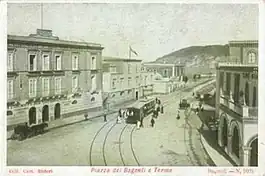 Tram at Bagnoli | |||
| Overview | |||
| Termini | |||
| Service | |||
| Type | Tram | ||
| History | |||
| Opened | 1883 | ||
| Technical | |||
| Track gauge | 1,445 mm | ||
| Electrification | 600 V DC | ||
| |||
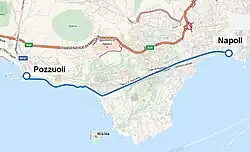
The Naples–Bagnoli–Pozzuoli tramway was an interurban tram line connecting Naples with Pozzuoli. Integrated into the Neapolitan tram network, this connection was one of its busiest routes.
Opened with steam traction in 1883, the line was later electrified and remained in service until the Second World War.[1]
History
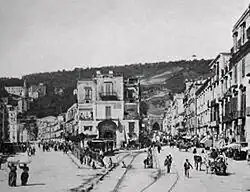
In 1876 the Société Anonyme des Tramways Napolitain (SATN) designed an urban horse-drawn tram line connecting Piazza San Ferdinando to Fuorigrotta, which required the excavation of a tunnel inaugurated in 1884.[1]
From this original connection was born the first interurban steam tram line in the Neapolitan area, the Fuorigrotta–Pozzuoli line, inaugurated on 5 July 1883.[1] It was extended to the new terminus at largo Torretta on 25 March 1885 after the construction of the tunnel under Posillipo,[2][1] giving rise to the Torretta–Pozzuoli service.[1] The tunnel, built by SATN, was completed in August 1884, measured about 750 metres in length, and was designed for steam tram operation.[1]
To serve the line, the Fuorigrotta depot was built in 1894, abandoned in 1980 following damage from the 1980 Irpinia earthquake.[3]
In 1902 the line was electrified,[1] and in 1910 the interurban services operating on it were assigned numbers 22 (Torretta–Pozzuoli) and 23 (Torretta–Bagnoli).[4] Later the numbering of the interurban lines changed and the two connections became lines 52 and 53, later merged into just 52 (Piazza della Vittoria–Pozzuoli).[5][4]
In 1912, the branch to Agnano Terme was inaugurated, granted by the Municipality of Naples directly to the Società Terme di Agnano; it branched off from the main Pozzuoli route at the junction of via Agnano with via Diocleziano.[6] It was finally suppressed on 19 April 1961.[6]
In 1919, urban operations were taken over by the Municipality of Naples and separated from the interurban ones, which remained under concession to SATN until June 1927, when they too were entrusted to the municipal company.[1][4]
The entire tram network, with the exception of that operated by the Société Anonyme des Tramways Provinciaux (SATP), came under the management of the Ente Autonomo Volturno on 1 January 1931.[7]
On 24 September 1947 the entire tram network was transferred to the newly established Azienda Tranvie Autofilovie Napoli (ATAN), which launched a plan to eliminate trams from the city centre and gradually reduce the network, suppressing all interurban services.[8] In the meantime, as a result of the war, line 52, which had been converted into the Bagnoli–Pozzuoli shuttle as line 50, had already been replaced by bus line 152.[1]
Technical characteristics
Like the rest of the Neapolitan network, the Pozzuoli line was laid with tramway gauge of 1,445 mm and built mainly with Phoenix rails; the electrification system was that adopted by SATN, at 600 V DC.[9]
From the terminus at Piazza della Vittoria, the cars travelled along the Riviera di Chiaia to the Torretta, where at the end of via Piedigrotta, to the right of the church of Santa Maria, they entered the tram tunnel built in 1884, which was later widened and adapted for vehicular traffic and renamed "4 giornate".[1]
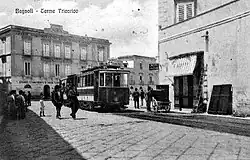
The cars of lines "22" and "23" then encountered the important stop of Piazza Pilastri, indicated in the timetables of the time as the main locality, located on the square in front of Piazza Leopardi station along via Giulio Cesare, as Viale Augusto had not yet been built at the time.[1]
After entering via Diocleziano and passing under the Rome–Naples railway the branch to the Diocleziano baths was encountered, before continuing along via Bagnoli which led to the terminus in that locality. The line then continued with more distinctly interurban characteristics along the coastal route formed by via di Pozzuoli, via Napoli and corso Umberto I, up to the Pozzuoli terminus.[1]
Rolling stock
For the steam operation of the line, S.A.T.N. used, over time, 11 locomotives, of which nine were built by Henschel and two by Saint-Léonard; all were transferred to other Italian lines (Turin–Orbassano–Giaveno tramway, the interprovincial steam tramways of Milan, Bergamo and Cremona, and the Cremonese provincial tramways) upon the electrification of the tramway in 1902.[10] To these was added a Rowan-type steam railcar, built by Borsig in 1896.[11] The electric motor cars used on the Naples–Pozzuoli line were the same ones in service on the urban network: all two-axle bidirectional cars, they were chosen among those with the highest power, as they sometimes had to be able to tow two trailers as well. On line 23 alone, bogie trams from the company's overall fleet were later used.[12]
Peter Witt cars were used on line 23.[1]
See also
References
- 1 2 3 4 5 6 7 8 9 10 11 12 13 Cozzolino, Andrea. "I tram dell'area vesuviana" [The trams of the Vesuvian area]. Clamfer (in Italian). Retrieved 2014-12-01.
Il 5 luglio 1883 viene inaugurata la prima linea interurbana a vapore Fuorigrotta-Pozzuoli ... Nel 1902 la linea viene elettrificata ... Il prolungamento alla Torretta avvenne il 25 marzo 1885 ... La galleria sotto Posillipo, completata nell'agosto 1884, era lunga 750 metri.
- ↑ Bevere, Chiaro & Cozzolino 1996a, p. 45.
- ↑ "Deposito Tram Fuorigrotta, Museo dei Trasporti di Napoli". Fondo Ambiente Italiano (in Italian). Retrieved 2026-08-18.
L'ex deposito tranviario di Fuorigrotta, costruito nel 1894, ospitò le vetture del tram a vapore per Pozzuoli e poi i tram a trazione elettrica fino al 1980.
- 1 2 3 "Scissione esercizi SATN – Comune di Napoli" (PDF). Clamfer (in Italian). Retrieved 2026-08-18.
N° fino al 1919: 22 – Piazza Vittoria – Pozzuoli; 23 – Piazza Vittoria – Bagnoli.
- ↑ Bevere, Chiaro & Cozzolino 1996a, p. 78.
- 1 2 Cozzolino, Andrea. "Il tram di Agnano" [The Agnano tram]. Clamfer (in Italian). Retrieved 2015-01-01.
Risale esattamente a cento anni fa, al 1912, l'inaugurazione della tramvia per Agnano Terme. Soppressa il 19 aprile 1961.
- ↑ Bevere, Chiaro & Cozzolino 1996a, p. 102.
- ↑ Bevere, Chiaro & Cozzolino 1996a, p. 124.
- ↑ Bevere, Chiaro & Cozzolino 1996a, p. 56.
- ↑ Bevere, Chiaro & Cozzolino 1996b, p. 30.
- ↑ Bevere, Chiaro & Cozzolino 1996b, p. 33.
- ↑ Bevere, Chiaro & Cozzolino 1996b, p. 40.
Bibliography
- Bevere, Eduardo; Chiaro, Gerardo; Cozzolino, Andrea (1996a). Storia dei trasporti urbani di Napoli – volume I (in Italian). Cortona: Edizioni Calosci. ISBN 88-77-85145-7.
{{cite book}}: CS1 maint: ref duplicates default (link) - Bevere, Eduardo; Chiaro, Gerardo; Cozzolino, Andrea (1996b). Storia dei trasporti urbani di Napoli – volume II (in Italian). Cortona: Edizioni Calosci. ISBN 88-77-85145-7.
{{cite book}}: CS1 maint: ref duplicates default (link)
External links
