Troides amphrysus
| Malay birdwing | |
|---|---|
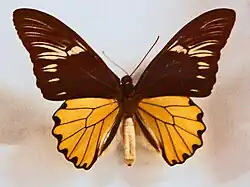 | |
| Male, upperside | |
 | |
| Female | |
Scientific classification  | |
| Kingdom: | Animalia |
| Phylum: | Arthropoda |
| Clade: | Pancrustacea |
| Class: | Insecta |
| Order: | Lepidoptera |
| Family: | Papilionidae |
| Genus: | Troides |
| Species: | T. amphrysus |
| Binomial name | |
| Troides amphrysus (Cramer, 1779) | |
| Synonyms | |
| |

Troides amphrysus, the Malay birdwing, is a birdwing butterfly in the genus Troides in the family Papilionidae.
Taxonomy
Subspecies
Many subspecies have been proposed:[3]
- T. a. actinotia Jordan, 1909 Indonesia (South Borneo)
- T. a. amphrysus (Cramer, 1779) Indonesia (Java, Bali)
- T. a. arkumene Hayami, 1994 Malaysia (Tioman Island)
- T. a. astrea Hayami, 1992 Indonesia (Banyak Island)
- T. a. chrysomelas Parrott & Schmid, 1984 Indonesia (Natuna Regency)
- T. a. euthydemus (Fruhstorfer, 1913 Indonesia (Sumatra)
- T. a. flavicollis (Druce, 1873) Malaysia (North Borneo)
- T. a. hilbert Hayami, 1992 Indonesia[n] Borneo: Karimata Islands
- T. a. kecilensis (Schäffler, 1999) Indonesia (South Borneo: Laut Kecil Islands)
- T. a. kuris Kobayashi & Hayami, 1987 Indonesia (Anambas Islands Regency)
- T. a. merah Kobayashi & Hayami, 1992 Indonesia (Simuk, Batu Islands)
- T. a. naokoae (Morita, 1996) Malaysia (Langkawi)
- T. a. niasicus (Fruhstorfer, 1898) Indonesia (Nias)
- T. a. perintis Kobayashi, 1986 Indonesia (Tambelan Islands)
- T. a. ruficollis (Butler, 1879 Malaysia (Peninsular Malaya, Thailand, Myanmar)
- T. a. simeuluensis Ohya, 1985 Indonesia (Simeuluë, Babi Island)
- T. a. vistara Fruhstorfer, 1906 Indonesia (Batu Island)
- T. a. zeus Kobayashi & Hayami, 1992 Indonesia (Sipora, Siberut, Mentawai)
Closely allied species
Several species together may form a wider "Troides amphrysus-species group", these include:
- Troides amphrysus (Cramer, [1779])
- Troides andromache (Staudinger, 1892)
- Troides cuneifera (Oberthür, 1879)
- Troides miranda (Butler, 1869)
Description
Male. The uppersides of the forewings are black or dark brown, with veins bordered by pale yellow. The uppersides of the hindwings are golden yellow, with black veins and black spots at the edges.
Female. The basic colour of the females is black or dark brown, with veins bordered by white. The uppersides of the hindwings have a smaller golden-yellow area at the base and several yellow spots at the edges.
In both sexes the undersides are similar to the uppersides. The abdomen is yellow, while the head and thorax are black.[4]
Life history

The egg is large and round and a pearly colour. Eggs are deposited on the food plant and the incubation period is two weeks. The first instar larva is black and bears numerous orange tubercles with short, black, branched spines. The intermediate instars 2, 3 and 4 are black. The thoracic segments have eight tubercles and the abdominal segments have six each. These are fleshy and lack spines. The dorsal tubercles of the 2nd, 3rd, 6th, and the 7th abdominal segments, are black. All the other tubercles are bright orange. In the penultimate and final instars the head is black and the thorax and abdomen is dark coffee brown. There is no saddle mark in this species. The tubercles are largely uniform in size, shape and of the ground colour. They are incline posteriorly and the apices are bent forwards to form small hooks. This species is not monophagous. The larvae feed on Aristolochia - A. acuminata and A. foveolata and on various Thottea species.[5]
The pupa is yellowish green and is marked with greyish veins as in a leaf. It has a broad dorsal saddle mark, this is lemon yellow transversely marked with brown streaks. The abdomen has three pairs of sharp dorsal processes, directed laterally. The pupal stage lasts from 27 to 30 days.[5]
Distribution and habitat

This species can be found in the Australasian realm and in the Indomalayan realm, from Myanmar to Indonesia.[3] The habitat is primary and secondary rainforest.
Behaviour
In the morning the butterflies fly at 20 to 30 m high in the canopy. Females rest on the foliage, while males glide in broad circles above them. The males perform an elaborate quivering courtship display several metres above the females, before copulation. Later in the day both sexes descend to feed on flowering trees and bushes including Lantana.[5]
References
- ↑ Böhm, M. (2018). "Troides amphrysus". IUCN Red List of Threatened Species. 2018 e.T160996A867473. doi:10.2305/IUCN.UK.2018-1.RLTS.T160996A867473.en. Retrieved 25 July 2026.
- ↑ "Troides amphrysus (Cramer, 1779)". Species+. UN Environment Programme World Conservation Monitoring Centre. Retrieved 25 July 2026.
- 1 2 3 Funet
- ↑ Seitz, A., 1912-1927. Die Indo-Australien Tagfalter Grossschmetterlinge Erde 9
- 1 2 3 =" Straatman, Raymond & Nieuwenhuis, Engbert Jan, 1961 Biology of certain Sumatran Species of Atrophaneura, Trogonoptera, and Troides (Lepidoptera, Papilionidae). Tijdschr. Ent. 104(3): 31-41
Further reading
- Morita, S. 1996: A new subspecies of Troides amphrysus from Langkawi Is., Malaysia. Wallace 2: 5.
- Collins, N. Mark; Morris, Michael G. (1985). Threatened Swallowtail Butterflies of the World: The IUCN Red Data Book. Gland & Cambridge: IUCN. ISBN 978-2-88032-603-6 – via Biodiversity Heritage Library.
- Kurt Rumbucher, Béla von Knötgen and Oliver Schäffler, Knötgen 1999 Part 7, Papilionidae IV. Troides II., amphrysus-group in Erich Bauer and Thomas Frankenbach Eds. Butterflies of the World. Keltern: Goecke & Evers ISBN 978-3-931374-74-7.
External links

