Tris(trifluoropropyl)trimethylcyclotrisiloxane
 | |
| Identifiers | |
|---|---|
3D model (JSmol) |
|
| ChemSpider | |
| ECHA InfoCard | 100.017.414 |
| EC Number |
|
PubChem CID |
|
| UNII | |
CompTox Dashboard (EPA) |
|
| |
| |
| Properties | |
| C12H21F9O3Si3 | |
| Molar mass | 468.538 g·mol−1 |
| Hazards | |
| GHS labelling:[1] | |
  | |
| Danger | |
| H315, H319, H361, H372, H373 | |
| P203, P260, P264, P264+P265, P270, P280, P302+P352, P305+P351+P338, P318, P319, P321, P332+P317, P337+P317, P362+P364, P405, P501 | |
Except where otherwise noted, data are given for materials in their standard state (at 25 °C [77 °F], 100 kPa).
Infobox references | |
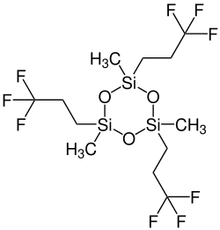
Tris(trifluoropropyl)trimethylcyclotrisiloxane (D3F) is a chemical substance. It is a derivative of hexamethylcyclotrisiloxane (D3), but also belongs to the class of per- and polyfluoroalkyl substances (PFASs).
It occurs in two diastereomeric forms:[2]
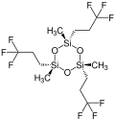 cis-D3F
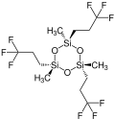 trans-D3F
D3F is used to produce polymethyltrifluoropropylsiloxane (PMTFPS). The starting material is dichloromethyl(3,3,3-trifluoropropyl)silane. Tetrakis(trifluoropropyl)tetramethylcyclotetrasiloxane (D4F) is produced as a reaction by-product.[3]

It has been detected in wastewater,[4] sewage sludge[5] as well as in biosolid-amended soils.[6]
References
- ↑ "Cyclotrisiloxane, 2,4,6-trimethyl-2,4,6-tris(3,3,3-trifluoropropyl)-". pubchem.ncbi.nlm.nih.gov.
- ↑ Zhi, Liqin; Sun, Hongyu; Xu, Lin; Cai, Yaqi (2021-01-19). "Distribution and Elimination of Trifluoropropylmethylsiloxane Oligomers in Both Biosolid-Amended Soils and Earthworms". Environmental Science & Technology. 55 (2): 985–993. Bibcode:2021EnST...55..985Z. doi:10.1021/acs.est.0c05443. ISSN 0013-936X. PMID 33356203. S2CID 229687934.
- ↑ OECD: Synthesis Report on Understanding Side-Chain Fluorinated Polymers and Their Life Cycle, Figure 5.1
- ↑ Huang, Zichun; Xiang, Xiaoling; Xu, Lin; Cai, Yaqi (2020-10-15). "Phenylmethylsiloxanes and trifluoropropylmethylsiloxanes in municipal sludges from wastewater treatment plants in China: Their distribution, degradation and risk assessment". Water Research. 185 116224. Bibcode:2020WatRe.18516224H. doi:10.1016/j.watres.2020.116224. ISSN 0043-1354. PMID 32758790. S2CID 221037569.
- ↑ Xiang, Xiaoling; Liu, Nannan; Xu, Lin; Cai, Yaqi (2021-11-01). "Review of recent findings on occurrence and fates of siloxanes in environmental compartments". Ecotoxicology and Environmental Safety. 224 112631. Bibcode:2021EcoES.22412631X. doi:10.1016/j.ecoenv.2021.112631. ISSN 0147-6513. PMID 34416634.
- ↑ Zhi, Liqin; Sun, Hongyu; Xu, Lin; Cai, Yaqi (2021-01-19). "Distribution and Elimination of Trifluoropropylmethylsiloxane Oligomers in Both Biosolid-Amended Soils and Earthworms". Environmental Science & Technology. 55 (2): 985–993. Bibcode:2021EnST...55..985Z. doi:10.1021/acs.est.0c05443. ISSN 0013-936X. PMID 33356203. S2CID 229687934.