Tetrakis(trifluoropropyl)tetramethylcyclotetrasiloxane
 | |
| Identifiers | |
|---|---|
3D model (JSmol) |
|
| ChemSpider | |
| ECHA InfoCard | 100.006.420 |
| EC Number |
|
PubChem CID |
|
| UNII | |
CompTox Dashboard (EPA) |
|
| |
| |
| Properties | |
| C₁₆H₂₈F₁₂O₄Si₄ | |
| Molar mass | 624.71 |
| Hazards | |
| GHS labelling:[1] | |
  | |
| Warning | |
| H302, H312, H315, H319, H332, H335, H410, H413 | |
| P261, P264, P264+P265, P270, P271, P273, P280, P301+P317, P302+P352, P304+P340, P305+P351+P338, P317, P319, P321, P330, P332+P317, P337+P317, P362+P364, P391, P403+P233, P405, P501 | |
Except where otherwise noted, data are given for materials in their standard state (at 25 °C [77 °F], 100 kPa).
Infobox references | |
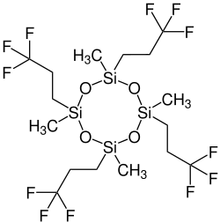
Tetrakis(trifluoropropyl)tetramethylcyclotetrasiloxane (D4F) is a chemical substance. It is a derivative of octamethylcyclotetrasiloxane (D4), but also belongs to the class of per- and polyfluoroalkyl substances (PFASs).
It occurs in four diastereomeric forms:[2]
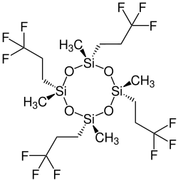 cis-D4F
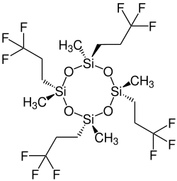 trans-D4F (2R,4r,6S,8s)
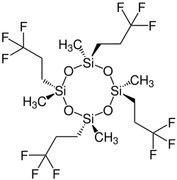 trans-D4F (2R,4R,6S,8S)
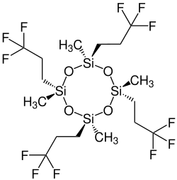 trans-D4F (2r,4r,6r,8r)
D4F is formed as a reaction by-product in the synthesis of polymethyltrifluoropropylsiloxane (PMTFPS). The starting material is dichloromethyl(3,3,3-trifluoropropyl)silane and tris(trifluoropropyl)trimethylcyclotrisiloxane (D3F) is an intermediate.[3]
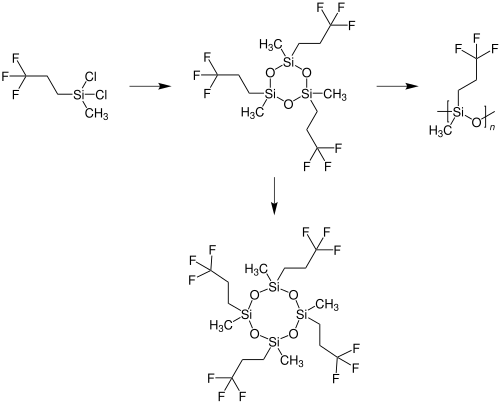 Reaction of dichloromethyl(3,3,3-trifluoropropyl)silane via D3F to form PMTFPS, with D4F as a reaction by-product
It has been detected in wastewater,[4] sewage sludge[5] as well as in biosolid-amended soils.[2]
References
- ↑ "Cyclotetrasiloxane, 2,4,6,8-tetramethyl-2,4,6,8-tetrakis(3,3,3-trifluoropropyl)-". pubchem.ncbi.nlm.nih.gov.
- 1 2 Zhi, Liqin; Sun, Hongyu; Xu, Lin; Cai, Yaqi (2021-01-19). "Distribution and Elimination of Trifluoropropylmethylsiloxane Oligomers in Both Biosolid-Amended Soils and Earthworms". Environmental Science & Technology. 55 (2): 985–993. Bibcode:2021EnST...55..985Z. doi:10.1021/acs.est.0c05443. PMID 33356203. S2CID 229687934.
- ↑ OECD: Synthesis Report on Understanding Side-Chain Fluorinated Polymers and Their Life Cycle, Figure 5.1
- ↑ Huang, Zichun; Xiang, Xiaoling; Xu, Lin; Cai, Yaqi (2020-10-15). "Phenylmethylsiloxanes and trifluoropropylmethylsiloxanes in municipal sludges from wastewater treatment plants in China: Their distribution, degradation and risk assessment". Water Research. 185 116224. Bibcode:2020WatRe.18516224H. doi:10.1016/j.watres.2020.116224. PMID 32758790. S2CID 221037569.
- ↑ Xiang, Xiaoling; Liu, Nannan; Xu, Lin; Cai, Yaqi (2021-11-01). "Review of recent findings on occurrence and fates of siloxanes in environmental compartments". Ecotoxicology and Environmental Safety. 224 112631. Bibcode:2021EcoES.22412631X. doi:10.1016/j.ecoenv.2021.112631. PMID 34416634.