Trimethylbismuth
 | |
| Names | |
|---|---|
| IUPAC name
Trimethylbismuthane | |
Other names
| |
| Identifiers | |
3D model (JSmol) |
|
| ChemSpider | |
| ECHA InfoCard | 100.008.927 |
| EC Number |
|
PubChem CID |
|
| UNII | |
CompTox Dashboard (EPA) |
|
| |
| |
| Properties | |
| Bi(CH3)3 | |
| Molar mass | 254.085 g·mol−1 |
| Appearance | Colorless liquid[1] |
| Density | 2.3 g/cm3[2] |
| Melting point | −85.9 °C (−122.6 °F; 187.2 K)[1] |
| Boiling point | 110 °C (230 °F; 383 K)[1] |
| Structure | |
| Trigonal pyramidal at Bi | |
| Hazards | |
| Occupational safety and health (OHS/OSH): | |
Main hazards |
Flammable, toxic, serious eye damage |
| GHS labelling:[3] | |
    | |
| Danger | |
| H225, H250, H302, H311, H314 | |
| P210, P222, P231, P233, P240, P241, P242, P243, P260, P262, P264, P270, P280, P301+P317, P301+P330+P331, P302+P335+P334, P302+P352, P302+P361+P354, P303+P361+P353, P304+P340, P305+P354+P338, P316, P321, P330, P361+P364, P363, P370+P378, P403+P235, P405, P501 | |
| Lethal dose or concentration (LD, LC): | |
LD50 (median dose) |
|
| Related compounds | |
Related compounds |
|
Except where otherwise noted, data are given for materials in their standard state (at 25 °C [77 °F], 100 kPa).
Infobox references | |
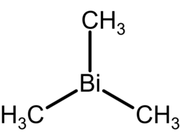
Trimethylbismuth is an organobismuth compound with the chemical formula Bi(CH3)3. It is a colorless, flammable, organometallic liquid.[1]
Synthesis
Trimethylbismuth is produced by reaction of bismuth(III) chloride with methylmagnesium iodide in diethyl ether under atmosphere of nitrogen, hydrogen or carbon dioxide.[4]
- BiCl3 + 3 CH3MgI → Bi(CH3)3 + 3 MgClI
It can also be sinthesized by reaction between bismuth(III) bromide and methyllithium in tetrahydrofuran or diethyl ether under inert atmosphere.[4]
- BiBr3 + 3 CH3Li → Bi(CH3)3 + 3 LiBr
Reactions
Trimethylbismuth is reactive, especially in the presence of moisture, where it can hydrolyze to form bismuth(III) oxide and methanol.[5]
Uses
Trimethylbismuth is used in material science, semiconductor technology, and chemical synthesis, where it enables the controlled addition of bismuth in various systems. Its properties make it important in producing high-performance materials for electronics and specialized chemical research.[6]
Trimethylbismuth is commonly used in metalorganic chemical vapor deposition (MOCVD) processes, especially for creating thin bismuth-containing films. A mixture of trimethylbismuth and oxygen is used for growth of Bi2O3 rods on a silicon substrate without using any catalyst.[7] Trimethylbismuth is also used to grow the GaAs1−yBiy semiconductor.[8]
A Cherenkov scintillator, trimethylbismuth has been proposed for particle detection in positron emission tomography.[2][9]
Safety
Trimethylbismuth is toxic. It can cause serious skin and eye damage. It catches fire spontaneously upon contact with air.[3] It must be kept under inert atmosphere.[6]
References
- 1 2 3 4 "593-91-9 CAS MSDS (BISMUTH TRIMETHYL) Melting Point Boiling Point Density CAS Chemical Properties". www.chemicalbook.com. Retrieved 2026-03-01.
- 1 2 Chyzh, R.; Tauzin, G.; Yvon, D.; Sung, C.-H.; Breton, D.; Maalmi, J.; Schäfers, K.; Weinheimer, C.; Sharyy, V. (2024). "Characterization of the BOLDPET optical prototype, an innovative Cherenkov detector for 511 keV γ radiation". Journal of Instrumentation. arXiv:2401.17003. doi:10.1088/1748-0221/19/07/P07018.
- 1 2 3 PubChem. "Trimethylbismuth". pubchem.ncbi.nlm.nih.gov. Retrieved 2026-03-01.
- 1 2 "BISMUTH TRIMETHYL synthesis - chemicalbook". www.chemicalbook.com. Retrieved 2026-03-01.
- ↑ "CAS 593-91-9: Trimethylbismuth | CymitQuimica". cymitquimica.com. Retrieved 2026-03-01.
- 1 2 "Trimethylbismuth | TMBi | Bi(CH3)3". Ereztech. Retrieved 2026-03-01.
- ↑ Kim, H.W.; Myung, J.H.; Shim, S.H.; Lee, C. (2006-07-01). "Growth of Bi2O3 rods using a trimethylbismuth and oxygen mixture". Applied Physics A. 84 (1): 187–189. doi:10.1007/s00339-006-3596-y. ISSN 1432-0630.
- ↑ Forghani, Kamran; Guan, Yingxin; Wood, Adam W.; Anand, Amita; Babcock, Susan E.; Mawst, Luke J.; Kuech, Thomas F. (2014-06-01). "Self-limiting growth when using trimethyl bismuth (TMBi) in the metal-organic vapor phase epitaxy (MOVPE) of GaAs1−yBiy". Journal of Crystal Growth. 395: 38–45. doi:10.1016/j.jcrysgro.2014.03.014. ISSN 0022-0248.
- ↑ Ramos, E.; Yvon, D.; Verrecchia, P.; Tauzin, G.; Desforge, D.; Reithinger, V.; Dubreuil, D.; Hamel, M.; Flouzat, C.; Sharyy, V.; Bard, J.-P.; Bulbul, Y.; Mols, J.-P.; Starzynski, P.; Marcel, A.; Granelli, R. (2015). "Trimethyl Bismuth Optical Properties for Particle Detection and the CaLIPSO Detector". IEEE Transactions on Nuclear Science. 62 (3): 1326–1335. doi:10.1109/TNS.2015.2424080.