Toy Story (video game)
| Toy Story | |
|---|---|
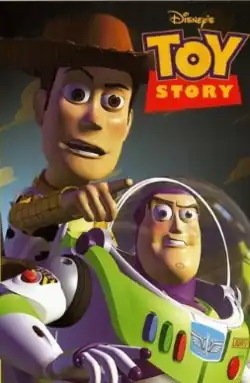 Cover art | |
| Developer | Traveller's Tales[a] |
| Publishers | |
| Producers | Craig Annis[1] Steve Riding[1] |
| Designers | Jon Burton[1] Andy Ingram |
| Programmers | Chris Stanforth[1] Jon Burton[1] Mike Follin[1] Paul Hunter[1] David Dootson[1] |
| Artists | Andy Ingram[1] Bev Bush[1] James Cunliffe[1] Dave Burton[1] Oliver Wade[1] Tamara Holcomb[1] |
| Composers |
|
| Series | Toy Story |
| Platforms | |
| Release | Sega Genesis Super NES Game Boy Microsoft Windows |
| Genre | Platform |
| Mode | Single-player |
Toy Story is a 1995 platform game developed by Traveller's Tales and published by Disney Interactive for the Sega Genesis, Super Nintendo Entertainment System, Game Boy, and Microsoft Windows. It is based on the 1995 computer-animated Pixar film of the same name.
Gameplay
Players control Woody through several stages that encompass the entire plot of the film. Several obstacles lie between the player and the goal of each level, including an assortment of enemies. Woody is equipped with a pullstring whip, which will temporarily tie up opponents, letting Woody pass by unharmed. It cannot, however, kill enemies (with the lone exception of Nightmare Buzz, the only boss in the game to be permanently defeated through the whip). This whip can also latch onto certain hooks, letting Woody swing above perilous terrain.
The game occasionally changes genres for a stage. Players control R.C. in two stages: one in which Woody knocks Buzz out a window, the other in which they both race back to the moving truck. Both play largely the same; the game takes an overhead view of the level, giving the players basic acceleration, braking and steering, and tasking players with reaching the end of the stage while not running out of batteries (which drain constantly, but can be replenished by bumping them out of Buzz in the former stage, and merely finding them on the ground in the latter). Another stage is played from a first-person perspective as Woody searches through a maze to find alien squeaky toys lost inside the claw machine and return them to the play area, where the rest of the alien toys reside, all within a time limit.
The Sega Genesis version has 18 levels,[5][6] while the Super NES and Microsoft Windows versions have 17.[13] The Game Boy version features only 10 levels, mostly featuring platforming levels.[14][15] The Genesis and Windows versions have an additional racing level named "Day-toy-na", absent from the other versions, in which Woody rides R.C. from the moving van to Buzz.[13][5][2][6] The Windows version lacks "Really Inside the Claw Machine".
Development and release
The Game Boy version was developed by Tiertex Design Studios and the Windows version was developed by the same Disney Interactive in-house team that created Maui Mallard in Cold Shadow, while the other versions were developed by Traveller's Tales. The Sega Genesis version of Toy Story was the lead version.[16] The game features 3D-rendered graphics,[5] and Pixar provided Traveller's Tales with the film's animations of Woody and Scud. The development team and Pixar initially had issues rendering the animations with correct lighting that would allow the development team to convert them for the game. Pixar provided final animations to the team only two weeks before the game was to be submitted to Sega for final approval. If the game did not receive approval the first time, its release would have been delayed, failing to coincide with the theatrical release of the film. As a precaution, Traveller's Tales rendered their own animations of Woody in case Pixar could not provide them on time.[16]
Jon Burton, the founder of Traveller's Tales, served as both the designer and programmer for the game.[16] To pass Sega's strict approval process, Burton disguised game glitches as part of the game; instead of receiving an error message, game testers would be sent to a bonus minigame, which Burton said was part of the game.[17][18] While the film had vibrant, vivid colors, the Genesis had only a limited array of colors. As a partial solution, Traveller's Tales utilized a special mode that provided access to additional shades of red, green, and blue.[19] The Windows game features instrumental versions of two Randy Newman songs from the film.[12]
The game was published by Disney Interactive.[2][20] In the United States, the Genesis version was released in November 1995,[2] coinciding with the film's release.[3] The Super NES version followed shortly thereafter.[20] The Game Boy version was released in May 1996[11] and the Windows version was released on 31 October 1996.[12] In Europe, the Genesis version was released around Easter 1996,[b] while the Super NES version was released in June 1996.[9]
In Taiwan, an unlicensed and pirated port was developed for the NES in 1997, which circulated in Europe and Russia.[21] The port was made by Ei-How Yang, an ex-Sachen developer.
The Genesis, SNES, and Game Boy versions of the game will be re-released in 2026 as part of the Toy Story: Retro Roundup! compilation.[22]
Reception
Reviews
| Publication | Score |
|---|---|
| AllGame | PC: 3.5/5[13] SMD: 3.5/5[23] SNES: 3.5/5[24] |
| Computer and Video Games | SMD: 92/100[5] SNES: 4/5[25] |
| Electronic Gaming Monthly | SMD: 6.875/10[26] SNES: 6.75/10[27] |
| EP Daily | PC: 8/10[28] SMD: 9/10[29] |
| Famitsu | 6/10, 6/10, 7/10, 7/10 (SNES)[10] |
| Game Informer | SMD: 8.75/10[30] SNES: 8.75/10[31] |
| GameFan | SMD: 87%[2] SNES: 80%[20] |
| GamePro | GB: 13.5/20[15] SMD: 15/20[32] SNES: 14/20[33] |
| GameSpot | PC: 6.4/10[12] |
| Jeuxvideo.com | SMD: 17/20[34] SNES: 17/20[35] |
| M! Games | SMD: 62%[36] SNES: 63%[36] |
| Mean Machines Sega | SMD: 92/100[6] |
| Next Generation | SMD: 4/5[37] |
| Nintendo Power | SNES: 14.3/20[38] |
| Official Nintendo Magazine | GB: 77/100[39] SNES: 92/100[40] |
| PC Gamer (UK) | PC: 69%[41] |
| PC Gamer (US) | PC: 27%[42] |
| Superjuegos | GB: 79/100[43] SNES: 90/100[44] |
| Super Play | SNES: 79%[45] |
| Total! | GB: 72/100[46] SNES: 90/100[47] |
Toy Story was received positively on the Genesis and SNES, while reception to the PC version was mixed. The game was praised for its impressive visuals,[26][27][32][30][31][12][37] varied gameplay,[26][27][32][30][12][37] and the PC version's enhanced soundtrack,[12] but criticized for its poor controls[26][27][32][12] and uneven difficulty, with some levels which reviewers found to be too frustratingly difficult, particularly for the young target audience.[26][27][32][33][12] The visuals were best received on the Genesis version due to the game's 3D-rendered graphics, which had several precedents on the SNES and PC but were completely new to the Genesis.[30][31][12][37] Critics were varied in their overall impressions; GamePro concluded that "despite the stunning graphics, Toy Story's uninspiring gameplay makes for merely fleeting fun",[32] while Game Informer decreed the game "a humorous and fun adventure that will certainly entertain everyone in the whole family".[30] Roger Burchill of Super Play wrote that while the Genesis version "marked a new high point" in graphics and gameplay, the Super NES version "can't help but be compared to Donkey Kong Country 2 and that's a comparison where it will lose every time".[45]
Mark East of GameSpot praised the soundtrack of the Windows version but had several minor criticisms of the game, including keyboard control issues, delayed sound effects, and brief pauses that occur when the soundtrack restarts.[12] Adam Douglas of PC Gamer considered it to be rushed, unoriginal, difficult, and frustrating, and concluded that the game failed to recapture "the magic of the film".[42]
The Game Boy version received little coverage. A brief review in GamePro opined that it did not live up to the legacy of the film and previous versions of the game, citing "plodding and repetitive" gameplay, rudimentary graphics, and the inaccuracy of Woody's drawstring.[15]
Sales
Eurogamer reported in 2018 of Toy Story garnering "millions of sales" upon release; according to Jon Burton, this changed other companies' business models to have games launch at the same time the film was released.[48] According to Disney Interactive, the Super NES and Genesis versions were both "tremendous successes", though a Super NES chip shortage prevented them from producing as many copies of the Super NES version as they believed they could have sold.[49]
Awards
Toy Story was nominated for the Video Software Dealers Association's "Video Game of the Year" for 1995,[50] losing to Donkey Kong Country 2.[51] In 1996, GamesMaster ranked the Mega Drive version 3rd on their "The GamesMaster Mega Drive Top 10."[52]
See also
Notes
References
- 1 2 3 4 5 6 7 8 9 10 11 12 13 14 Traveller's Tales (December 1995). Toy Story (SNES). Disney Interactive Studios. Level/area: Credits.
- 1 2 3 4 5 "Toy Story (Genesis)". GameFan: 20, 134–135. December 1995.
- 1 2 Wallis, Alistair (9 November 2006). "Playing Catch Up: Traveller's Tales' Jon Burton". Gamasutra. Archived from the original on 12 May 2012. Retrieved 7 June 2019.
- ↑ "Computer & Video Games #174 pg. 64". Sega Retro. May 1996. Retrieved 6 October 2015.
- 1 2 3 4 5 Hearn, Marcus (March 1996). "Toy Story". Computer and Video Games. pp. 48–51.
- 1 2 3 4 "Megadrive Review: Toy Story". Mean Machines (41). March 1996. pp. 60–63.
- ↑ "releases". Tec Toy S.A., Web Archive. Archived from the original on July 24, 1997. Retrieved May 6, 2016.
- ↑ Nintendo staff. "Super NES Games" (PDF). Nintendo. Archived from the original (PDF) on 14 June 2011. Retrieved 24 September 2011.
- 1 2 "CTW Games Guide". Computer Trade Weekly. No. 592. United Kingdom. 17 June 1996. p. 29.
- 1 2 Tsūshin, Hamamura; Sakai, Kta; Kosugi, Game; Hada, Takayuki (3 May 1996). "New Game Cross Review Part 1". Weekly Famitsu (in Japanese). No. 385. ASCII Corporation. p. 31.
- 1 2 Nintendo staff. "Game Boy (original) Games" (PDF). Nintendo. Archived from the original (PDF) on 15 June 2011. Retrieved 24 September 2011.
- 1 2 3 4 5 6 7 8 9 10 11 East, Mark (17 December 1996). "Toy Story Review (PC)". GameSpot. Archived from the original on 5 February 2004. Retrieved 19 March 2014.
- 1 2 3 Smith, Nick. "Disney's Toy Story: Power Play - Review". AllGame. Archived from the original on 12 December 2014. Retrieved 19 March 2014.
- ↑ Scullion, Chris (30 November 2024). The Game Boy Encyclopedia: Every Game Released for the Nintendo Game Boy and Game Boy Color. White Owl. p. 150. ISBN 978-1-3990-9680-5.
- 1 2 3 "ProReview: Toy Story". GamePro. No. 95. IDG. August 1996. p. 70.
- 1 2 3 "Telling Tales". Super Play. May 1996. pp. 38–39.
- ↑ Alexandra, Heather (3 October 2017). "Developer Used Fake Secrets To Sneak Games Through Sega's Certification Process". Kotaku. Retrieved 7 June 2019.
- ↑ Wales, Matt (3 October 2017). "How one Mega Drive dev cheekily slipped through Sega's certification process". Eurogamer. Retrieved 7 June 2019.
- ↑ Walker, Alex (9 October 2017). "How Toy Story Squeezed More Colour Out Of The Sega Genesis". Kotaku Australia. Archived from the original on 20 April 2018. Retrieved 7 June 2019.
- 1 2 3 "Toy Story (SNES)". GameFan: 18, 94–95. February 1996.
- ↑ "ВД#35, стр 74-75, Toy Story, 8bit NES, GDragon". Velikiy Drakon (in Russian).
- ↑ Zwiezen, Zack (2 June 2026). "Toy Story 2: Buzz Lightyear And More Classics Are Getting Remastered". Kotaku. Retrieved 2 June 2026.
- ↑ Weiss, Brett Alan. "Disney's Toy Story (Genesis) - Review". AllGame. Archived from the original on 13 November 2014. Retrieved 19 March 2014.
- ↑ Weiss, Brett Alan. "Disney's Toy Story (SNES) - Review". AllGame. Archived from the original on 16 November 2014. Retrieved 19 March 2014.
- ↑ Davies, Paul (June 1996). "Toy Story". Computer and Video Games. No. 175. p. 89. Retrieved 11 August 2021.
- 1 2 3 4 5 "Review Crew: Toy Story". Electronic Gaming Monthly. No. 78. Sendai Publishing. January 1996. p. 39.
- 1 2 3 4 5 "Review Crew: Toy Story". Electronic Gaming Monthly. No. 79. Sendai Publishing. February 1996. p. 30.
- ↑ James, Bonnie. "Toy Story". The Electric Playground. Archived from the original on 4 August 1997. Retrieved 11 August 2021.
- ↑ Lucas, Victor. "Toy Story". The Electric Playground. Archived from the original on 1 June 2004. Retrieved 11 August 2021.
- 1 2 3 4 5 "Toy Story (Genesis)". Game Informer. No. 32. December 1995. pp. 10–11. Archived from the original on 20 November 1997. Retrieved 19 March 2014.
- 1 2 3 "Disney's Toy Story (SNES)". Game Informer. No. 33. January 1996. Archived from the original on 20 November 1997. Retrieved 19 March 2014.
- 1 2 3 4 5 6 Air Hendrix (January 1996). "ProReview Genesis: Toy Story" (PDF). GamePro. No. 88. IDG. p. 92.
- 1 2 Grease Monkey (March 1996). "ProReview SNES: Toy Story" (PDF). GamePro. No. 90. IDG. p. 62.
- ↑ lilico08 (16 November 2010). "Test de Toy Story sur MD". Jeuxvideo.com (in French). Archived from the original on 2 May 2021. Retrieved 11 August 2021.
{{cite web}}: CS1 maint: numeric names: authors list (link) - ↑ lilico08 (16 November 2010). "Test de Toy Story sur SNES". Jeuxvideo.com (in French). Archived from the original on 11 August 2021. Retrieved 11 August 2021.
{{cite web}}: CS1 maint: numeric names: authors list (link) - 1 2 "Toy Story". MANIAC (in German). No. 31. May 1996. p. 54. Retrieved 11 August 2021.
- 1 2 3 4 "Rendered". Next Generation. No. 13. Imagine Media. January 1996. p. 169.
- ↑ "Toy Story". Nintendo Power. Vol. 81. February 1996. pp. 96–97.
- ↑ Simon; Dave (May 1996). "Toy Story". Nintendo Magazine System. No. 44. pp. 50–51. Retrieved 11 August 2021.
- ↑ Dave; Shaun (May 1996). "Toy Story". Nintendo Magazine System. No. 44. pp. 26–32. Retrieved 11 August 2021.
- ↑ "Toy Story". PC Gamer UK. 1996.
- 1 2 Douglas, Adam (April 1997). "Toy Story". PC Gamer. Archived from the original on 8 March 2000. Retrieved 19 March 2014.
- ↑ "Game Toy Story". Superjuegos (in Spanish). No. 50. pp. 102–103. Retrieved 11 August 2021.
- ↑ "Toy Story (Juguetes)". Superjuegos (in Spanish). No. 49. pp. 48–51. Retrieved 11 August 2021.
- 1 2 Burchill, Roger (May 1996). "Toy Story (SNES)". Super Play. pp. 40–42.
- ↑ Tim (July 1996). "Toy Story GB". Total!. No. 55. pp. 56–58. Retrieved 11 August 2021.
- ↑ Tim (April 1996). "Toy Story". Total!. No. 52. pp. 56–59. Retrieved 11 August 2021.
- ↑ Wright, Steven (5 February 2018). "Why the founder of Traveller's Tales released a director's cut of an old Sonic game 25 years later". Eurogamer. Retrieved 5 October 2020.
- ↑ "First Look at the Games of CES" (PDF). Electronic Gaming Monthly. No. 80. Sendai Publishing. March 1996. pp. 50–51.
- ↑ "News Bits". GamePro. No. 96. IDG. September 1996. p. 21.
- ↑ "Home Entertainment Awards – Video Games". Entertainment Merchants Association. Archived from the original on 28 January 2017. Retrieved 5 February 2012.
- ↑ "The GamesMaster Mega Drive Top 10" (PDF). GamesMaster (44): 74. July 1996.
External links
| Films |
| ||||
|---|---|---|---|---|---|
| Short films |
| ||||
| Television |
| ||||
| Characters | |||||
| Video games |
| ||||
| Attractions |
| ||||
| Music |
| ||||
| Related | |||||


- 1995 video games
- Black Pearl Software games
- Disney Interactive Studios games
- Game Boy games
- Psygnosis games
- Sega Genesis games
- Side-scrolling platformers
- Single-player video games
- Super Nintendo Entertainment System games
- Tiertex Design Studios games
- Toy Story video games
- Traveller's Tales games
- Video games about sentient toys
- Video games developed in the United Kingdom
- Video games scored by Allister Brimble
- Video games scored by Andy Blythe and Marten Joustra
- Windows games