Tomodachi Life: Living the Dream
| Tomodachi Life: Living the Dream | |
|---|---|
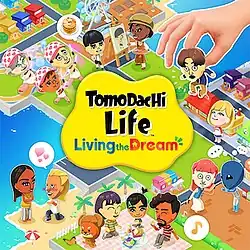 Promotional artwork | |
| Developer | Nintendo EPD[a] |
| Publisher | Nintendo |
| Director | Ryutaro Takahashi |
| Producer | Yoshio Sakamoto |
| Programmers |
|
| Artist | Daisuke Kageyama |
| Writer | Noriyuki Sato |
| Composers |
|
| Series | Tomodachi Life |
| Platform | Nintendo Switch |
| Release | April 16, 2026 |
| Genre | Social simulation |
| Mode | Single-player |
Tomodachi Life: Living the Dream, known in Japan as Tomodachi Collection: Exciting Life,[b] is a 2026 social simulation game developed and published by Nintendo for the Nintendo Switch. It is the third entry in the Tomodachi Life series, succeeding the Nintendo 3DS title Tomodachi Life (2013). The game centers on the everyday lives of Miis, customizable avatars, residing on an island as they autonomously develop relationships and solve problems, all overseen by the player.
Production on Living the Dream began in 2017, shortly after development concluded on the mobile app Miitomo (2016). Director Ryutaro Takahashi and producer Yoshio Sakamoto became inspired to formulate a sequel to Tomodachi Life as they felt the 3DS' technical limitations held back the game's scale. Creating avenues for user-generated content was done in an effort heighten its replay value. The Miis' character designs were adjusted through trial-and-error; they were ultimately made more cartoonish, while their robotic voices from previous installments were retained to maintain their distinct personality.
Leading up to its release, fans and critics praised Living the Dream's elevated inclusivity for LGBTQ people, particularly its addition of same-sex relationships, compared to previous installments. It was released worldwide on April 16, 2026. Living the Dream received generally favorable reviews; its customization options and humor were praised, while its gameplay elicited mixed responses for perceived repetitiveness. The game's lack of online functionality, particularly screenshot and Mii sharing, was met with criticism. Living the Dream has sold 8 million copies as of August 2026, making it the best-selling Tomodachi Life installment to date.
Gameplay

Tomodachi Life: Living the Dream is a social simulation game[1] that revolves around the everyday lives of Miis, user-customizable avatars, who reside on a remote tropical island.[2] Upon starting gameplay, the player is tasked with naming their island before creating Miis through a number of outlets. These include making Miis from scratch using the in-game Mii Maker or a set of prompts.[3][4] The Mii Maker includes additional choices for hair, facial features, and ears.[5] Optionally, "face paint" can be applied, allowing the player to manually draw atop the Miis' features.[6] The player adjusts the Miis' gender—male, female, or non-binary—as well as their personal pronouns, and romantic preferences. A personality is assigned by selecting various temperament attributes. Miis talk through robotic speech synthesis, which is modified by using sliders that manipulate its pitch, speed, and other attributes.[5]

Upon creation, the Miis settle in individual houses; a maximum of 70 Miis can live on the island at once.[7] The player can manually grab and relocate Miis, prompting them to interact with other Miis or the environment.[8][9] The player can optionally enter nicknames for Miis to call each other, as well as eavesdrop on Miis' dreams while they are asleep.[10][5] At a Mii's request, the player inputs topics of choice into custom text fields, generating an island-specific "lingo" database. Miis will then randomly utilize certain lingo in their conversations, or when prompted by surroundings.[11] Miis can be given "little quirks" that augment their everyday behaviors, such as their gait when walking.[5][6] Outside the player's direct supervision, Miis autonomously wander about the island and interact with each other, forming relationships and sporadic conflict.[5][7] If a Mii harbors romantic feelings for another Mii, they can confess their love; if the confession is successful, the two are united as a couple. Marriage can occur after further interactions. Married couples can have children.[12] The player may help remedy an argument between two Miis. This can lead to them either making up, staying enemies, or confessing their love.[7]
Living the Dream has no end condition; the player's main objective is to sustain their Mii's happiness.[13] Occasionally, Miis will signal the player that they have a problem. These issues range from requesting food or clothes (yellow), soliciting advice on friendships (orange) or romantic relationships (pink), and aiding them during physical accidents (purple).[9] Miis will periodically ask the player to participate in short minigames.[14] Fulfilling their needs boosts their happiness level, awarding the player with in-game currency that can be exchanged for interior decor, furniture, and infrastructure items.[5] The player also receives "warm fuzzies" that can be deposited at the island's wishing fountain to increase its level and grant "wishes". Wishes can be exchanged to unlock additional customization options, such as new items and island facilities.[6] A new addition is the Palette House, an island facility which allows players to design clothing, food, pets, interiors, and other miscellaneous items through an in-game drawing interface that can be used with the Switch's controller or touchscreen.[5]
Living the Dream introduces the ability to manually customize the layout of the island.[15] By continuously adding Miis, the island expands, allowing players to place more land.[14] In-universe news broadcasts, held at Mii News, inform the player of recent events on the island,[5] and time in the game passes parallel to that of the real-world clock.[1]
Development and release

Tomodachi Life: Living the Dream was principally developed by Nintendo EPD, with assistance from Intelligent Systems, Bandai Namco Studios Singapore, and Bandai Namco Studios Malaysia. Ryutaro Takahashi and Yoshio Sakamoto returned as director and producer, respectively, while Takaomi Ueno and Naonori Ohnishi collaborated as programming directors. Noriyuki Sato served as lead writer, Ryota Akutsu as lead character designer, Daisuke Kageyama as art director, and Wataru Tanimura as voice programmer. Sound director Toru Minegishi composed the soundtrack, alongside with Shinobu Nagata, Reika Nakai, and Kairi Hamada.[16][17]
Development on Living the Dream began in 2017 and lasted nine years.[18] After production concluded on the mobile app Miitomo, Takahashi and Sakamoto, both of whom had been attached to Tomodachi Life (2013), felt that the Nintendo 3DS's technical limitations hindered the game's scale. They subsequently began discussing about creating a new installment in the series. Believing that using the current production style would inevitably turn it into a "quest for quantity" and making the game repetitive, a focus on user-generated content (UGC) was decided on. The Switch's processing power augmented the Mii's social environment, which prompted the use of UGC tools to duplicate inside jokes.[17] They intended on completing work on UGC tools within one and a half years, but a constant stream of ideas resulted in them being finished in six-to-seven years instead. Takahashi hoped that leveraging built-in features with UGC would give the game significant replayability and wanted the game to remain enjoyable for those that were uninterested in using the UGC tools.[19] The team wanted the in-game world to be more personalized to players. To do so, they made the food items and currency differ, depending on their regional settings. For instance, those in Japan can purchase rice balls or matcha with virtual yen, while in the United States, s'mores can be purchased with virtual dollars. Ueno felt that a fictional currency would have "instantly make the world seem unfamiliar."[18]
The team organized an idea board to share proposed concepts.[18] The developers sought to make the Miis look more visually appealing and initially added new elements to their characters. After Kageyama discussed with Takahashi, Sakamoto, and the preceding production team regarding how Miis are viewed, they opted against altering elements that had long defined them, including their facial features and limbs. They nonetheless re-evaluated each aspect of their design to avoid them feeling outdated; the Miis' appearances were revamped to a "simple, anime-inspired toon-style." Living the Dream's expanded customization options for physical appearances, dating preferences, and gender, as well as the "little quirk" feature, were implemented to better allow players to create any character they desired. Minegishi deliberately processed the Miis' text-to-speech voices to sound robotic, akin to how the characters sounded in previous Tomodachi Life entries. Kageyama discussed with animators on the Mii's movements, arranging them through trial-and-error. They intentionally eliminated "wind-up motions" that resulted in smoother movements and inserted "more bold, memorable movements."[17] During development, the programmers faced difficulties in adjusting the Miis's behaviors. They ultimately set rules for unwanted behaviors, keeping those that were "odd but amusing."[19] The ability to pick up Miis originated as a debug function, but was kept in the final product. The developers endured difficulty in figuring out how Miis would interact with one another, such as creating prototypes of string telephones to let Miis communicate with each other and allowing players to give advice from four choices.[17]
The composition of Living the Dream's soundtrack was approached in a similar manner to previous installments. Minegishi found that capturing the unique musical feel of Tomodachi Life was difficult; he characterized the series' musical style as laid-back and simple on the surface, but ultimately nuanced and intricate.[17] Due to time constraints, the development team was inclined to discard ideas from previous entries, including Mii News. One, younger staffer who was attached to the DS and 3DS games opposed the removal of Mii News specifically and negotiated for its inclusion.[18] According to the USK, the game was mostly complete and evaluated on May 20, 2025.[20]
Promotion
Tomodachi Life: Living the Dream was announced at the end of a Nintendo Direct presentation on March 27, 2025.[21] The announcement trailer posted to X by Nintendo in Japan became one of their most liked posts, surpassing that of the Nintendo Switch 2 reveal.[22]
Upon Living the Dream's reveal, fans speculated whether same-gender relationships would be included.[23] Neither of its predecessors contained the ability to form relationships with Miis of the same gender, which sparked controversy ahead of the international release of the latter. Despite vocal resentment toward this decision, Nintendo did not add the feature post-launch.[24] They later apologized and stated that if they were to create a third game in the series, they would "strive to design a gameplay experience from the ground up that is more inclusive, and better represents all players."[25][26] The game's reveal trailer featured a scene with two female Miis interacting during a dream sequence, which fans theorized hinted at additional romance options.[27]
A second Nintendo Direct presentation on September 12, 2025, introduced the creation of Miis and their interactions. It revealed the initial release window for the second quarter of 2026.[28] A 22-minute Direct presentation focused on the game premiered on January 29, 2026.[29] The presentation included demonstrations for Mii creation tools, locations, island customization, and romantic relationships and confirmed that the options for gay, bisexual, aromantic, and non-binary Miis would be present in the game.[30] Different videos were also broadcast in North America, Europe, and Japan featuring a different cast of Mii characters.[31][32]
Hugh Morris, a jester-themed Mii exclusive to the American trailer whose name resembles the word humorous, was met with acclaim by critics.[33][34][35] In other regions, different Mii characters gained popularity, such as Bubbles and Kirishima, who appeared in the European and Japanese Nintendo Directs respectively.[36][37][38] A week after this Direct aired, the soundtrack for Tomodachi Life on the 3DS was added to the Nintendo Music streaming service.[39]
Release
A demo was released on March 25, 2026, giving access to a limited feature set of the retail version. Progress established in the demo can be carried over to the retail version.[40] Completing the demo unlocks one of six color variants of a hamster costume.[41]
The game was released for the Nintendo Switch on April 16, 2026.[21] It was the last video game offered for the Switch Game Vouchers program the day prior to its discontinuation, with the vouchers being unavailable to purchase after January 30, 2026.[42][43] Pre-orders in the United Kingdom included a themed magnetic photo frame.[44] In Japan, pre-orders included bonus accessories depending on the retailer purchased, including stickers of Miis, keychains, and a microfiber cloth.[45] On the same day as the game's release, ten music tracks were added to Nintendo Music as a "special release".[46]
Reception
Pre-release
Fans and gaming journalists praised the inclusion of same-sex relationships and non-binary Miis in Tomodachi Life: Living the Dream. Publications such as Checkpoint Gaming and The Daily Dot commented that the additions were well-received by a majority of fans.[47][48] Amelia Zollner writing for Kotaku described the settings as "surprisingly inclusive", being particularly impressed by the explicit use of the term non-binary, calling it "a massive step forward for the developer". They also noted the majority of positive comments from fans during the live stream on YouTube, with Zollner feeling relieved that it was confirmed prior to its release.[49] Alana Hagues writing for Nintendo Life called the addition "a huge win", crediting the developers for sticking to their promise from 2014.[50] Jade King writing for TheGamer expressed her excitement being able to accurately represent her friends and family without needing to do any extra steps like in Tomodachi Life. King was also delighted that Nintendo was inclusive of the LGBTQ+ community, as she felt much of the video game industry was regressing from representing those topics. In her summary, she wrote that "Tomodachi Life is woke now, and [she] couldn't be more delighted".[51]
Upon learning that sharing images directly onto smartphones or social media platforms would be restricted so that "out-of-context scenes" would not be misinterpreted, the decision was met with criticism,[52][53][54] and fan response was mostly negative.[55] Dustin Bailey writing for GamesRadar+ called the decision "downright absurd", as they believed sharing character interactions with others was one of the main appeals of the previous installment.[56] Deven McClure writing for Polygon believed that restrictions on image sharing contrasted with the game's emphasis on creativity.[57] Alana Hagues writing for Nintendo Life thought the decision was strange when compared to the additional inclusivity options. She speculated that the company was attempting to avoid replicating a past incident regarding the 3DS messaging application Swapnote, which was disabled due to offensive imagery being distributed.[58] Stephanie Liu of Siliconera thought the decision was made to reduce posts on social media platforms involving controversial people being recreated as Miis.[59] Additionally, the lack of any online functionality was criticized. McClure thought the inability to share Miis online would potentially impact the live streaming community, as well as the game's success overall.[57] Anna Koselke of GamesRadar+ thought it was disappointing compared to other games such as StreetPass Mii Plaza (2011) and Miitopia (2016).[60]
Post-release
| Aggregator | Score |
|---|---|
| Metacritic | 77/100[61][c] |
| OpenCritic | 74% recommend[62][d] |
| Publication | Score |
|---|---|
| Eurogamer | 3/5[63] |
| Game Informer | 7/10[11] |
| GamesRadar+ | 4/5[6] |
| IGN | 7/10[5] |
| Nintendo Life | 7/10[7] |
| Shacknews | 9/10[15] |
| TechRadar | 4/5[64] |
| Video Games Chronicle | 4/5[65] |
Tomodachi Life: Living the Dream received "generally favorable" reviews according to review aggregator website Metacritic.[61] Review aggregator OpenCritic assessed that 74% of critics recommended the game.[62]
Critics complimented the game's customization features. Brian Shea of Game Informer described the addition of custom text fields to respond to Miis' questions as creating a "fun Mad Lib-style experience,"[11] a sentiment shared by Eurogamer's Alexander Bohn-Elias, who cited what he felt were the Miis' charming personality in animation and voice.[63] Shea said the ability to create custom clothing designs "came in handy when [he] was creating a specific character with an iconic look, like Link or Donkey Kong."[11] Emma-Jane Betts of GamesRadar+ considered the Mii maker to be the most intuitive in the series, lauding the face paint tool and stating that the "only thing stopping you is how patient you are drawing with a controller or your finger."[6] The game's relationship simulation mechanics also drew praise;[6][5][63] Chris Scullion of Video Games Chronicle felt that the relationship system was comprehensive, citing features such as assigning real-life relationships to Miis and customizing how they address one another upon becoming best friends or romantic partners.[65] The game was conversely lamented for lacking the concert hall, previously included in Tomodachi Life, that allowed the player to create custom songs that would be sung by the island's residents.[66][67]
Living the Dream's humor and writing received praise. Multiple critics characterized the gameplay experience overall as comedically surreal,[e] some having likened its tone to reality television.[6][15][64] Bohn-Elias applauded its slapstick comedy and enjoyed the interactable dream sequences and in-universe news broadcasts.[63] Scullion, reviewing the UK English version of the game, found the inclusion of regional slang in Mii dialogue amusing.[65]
To critics, the game became repetitive over time. Writing for Nintendo Life, Alana Hagues wrote that playing the game sometimes felt directionless, even if mitigated somewhat by shorter play sessions.[7] TJ Denzer of Shacknews judged that Living the Dream managed to keep things relatively fresh, but observed that certain Mii interactions recurred more frequently than he desired.[15] Betts argued that fully engaging with the game's customization options was necessary to sustain long-term interest, warning that players who did not would "be left without much of anything to keep hold of [them] long-term".[6] Scullion similarly opined that once the novelty of Living the Dream's offbeat comedy faded, the game became little more than an ordinary life simulator.[65] Denzer described Living the Dream's entertainment value as correlational to the time and effort one would be willing to engage with it.[15] Betts additionally criticized the minigames as trite, desiring a greater variety in both minigames and subjects for her Miis to interact with.[6]
The decision to restrict image sharing and online Mii sharing was also criticized by many reviewers. Bohn-Elias believed that this restriction hampered the game's overall charm. He also felt Living the Dream's potential for online virality, akin to that experienced by its predecessor, would be reduced as users could no longer exchange their "wildest creations".[63] Brian Shea of Game Informer called the decision shortsighted, and noted that removing the online Mii sharing features also removed the "safety net" for players who didn't want to manually create many Miis.[11] Logan Plant of IGN said that, while he had been impressed with the Miis that people had created with the pre-release demo, he felt disappointment knowing that the restriction meant there would be "no way for [him] to get that exact character on [his] island".[5]
Other technical oddities were critiqued. Hagues criticized the functionality of the touchscreen as "weirdly limited" and found the lack of higher frame rates on the Nintendo Switch 2 "a little jarring" considering the Switch 2 received a resolution boost.[7] Bohn-Elias and Wood were similarly critical of the inability to use the Joy-Con 2's mouse features in the in-game editor,[63] with Wood calling it "a huge missed opportunity given the number of mechanics that involve drawing".[64]
Sales
During the month of March 2026, it was at the top of the Amazon pre-order charts in Japan.[69][70] At launch, Tomodachi Life: Living the Dream topped the sales charts in Japan, selling 565,405 physical copies during its first week according to Famitsu.[71][72] It similarly topped the UK sales charts in its first week, beating out Capcom's recent release of Pragmata (2026).[73] In France, the game had the best-selling physical launch of 2026 thus far, selling more than 70,000 copies, the amount sold by Resident Evil Requiem (2026).[74] By August 2026, Living the Dream sold over 8 million copies worldwide, surpassing the sales figure of its predecessor and making it the best-selling Tomodachi Life game to date.[75][76]
Notes
References
- 1 2 Lambertsen, Carrie (April 15, 2026). "Tomodachi Life: Living The Dream Review - Worth The Wait". Screen Rant. Archived from the original on April 15, 2026. Retrieved April 19, 2026.
- ↑ Fanelli, Jason (March 27, 2026). "Tomodachi Life: Living The Dream Coming To Nintendo Switch In 2026". GameSpot. Archived from the original on March 27, 2025. Retrieved March 27, 2025.
- ↑ Leith, Alaisdair (April 15, 2026). "Tomodachi Life: Living the Dream delivers one of the best social sims in quite some time". The AU Review. Archived from the original on April 16, 2026. Retrieved April 19, 2026.
- ↑ Wright, Steve (April 15, 2026). "Tomodachi Life: Living the Dream Review: Slow and cozy". Stevivor. Archived from the original on April 16, 2026. Retrieved April 19, 2026.
- 1 2 3 4 5 6 7 8 9 10 11 Plant, Logan (April 15, 2026). "Tomodachi Life: Living the Dream Review". IGN. Archived from the original on April 15, 2026. Retrieved April 19, 2026.
- 1 2 3 4 5 6 7 8 9 10 Betts, Emma-Jane (April 15, 2026). "Tomodachi Life: Living the Dream is like Real Nintendo Housewives meets the OC in my own personal Mii fever dream". GamesRadar+. Archived from the original on April 22, 2026. Retrieved April 15, 2026.
- 1 2 3 4 5 6 Hagues, Alana (April 15, 2026). "Review: Tomodachi Life: Living The Dream (Switch) - BREAKING NEWS: Mii Life Is Still Bizarre, Hilarious, And A Bit Samey". Nintendo Life. Archived from the original on May 23, 2026. Retrieved April 15, 2026.
- ↑ Ignacchitti, Ivanir (April 22, 2026). "Tomodachi Life: Living the Dream Review". Hardcore Gamer. Archived from the original on April 22, 2026. Retrieved April 25, 2026.
- 1 2 Esra, Clave (April 20, 2026). "『トモダチコレクション わくわく生活』レビュー RPGのようなレベル上げは面倒だが、個性あふれるコミュニティを作れる体験は秀逸" [Tomodachi Collection: Exciting Life - Review]. IGN Japan (in Japanese). Archived from the original on April 21, 2026. Retrieved April 25, 2026.
- ↑ Ledezma, Cecilia (April 16, 2026). "After the demo, I cannot wait to play Tomodachi Life: Living the Dream". The Michigan Daily. Archived from the original on April 27, 2026. Retrieved April 26, 2026.
- 1 2 3 4 5 Shea, Brian (April 16, 2026). "Tomodachi Life: Living the Dream Review - You Get What You Give". Game Informer. Archived from the original on April 16, 2026. Retrieved April 15, 2026.
- ↑ Colantonio, Giovanni (April 17, 2026). "Todd Howard is my archnemesis in Tomodachi Life after trying to steal my girlfriend". Polygon. Archived from the original on May 23, 2026. Retrieved April 25, 2026.
- ↑ Hagues, Alana (March 24, 2026). "First Impressions: The Diary Of A First-Time Tomodachi Life Player - Am I Living The Dream?". Nintendo Life. Archived from the original on March 24, 2026. Retrieved April 25, 2026.
- 1 2 Berthelson, Brandy (April 22, 2026). "Tomodachi Life: Living the Dream Review: Limitless and Limited". Restart.run. Retrieved April 24, 2026.
{{cite web}}: CS1 maint: url-status (link) - 1 2 3 4 5 Denzer, TJ (April 15, 2026). "Tomodachi Life: Living the Dream review: Soap opera simulator". Shacknews. Archived from the original on April 16, 2026. Retrieved April 19, 2026.
- ↑ Nintendo EPD (April 16, 2026). Tomodachi Life: Living the Dream (Nintendo Switch). Nintendo. Scene: Staff Credits.
- 1 2 3 4 5 "Ask the Developer Vol. 21: Tomodachi Life: Living the Dream — Part 1". Nintendo. April 14, 2026. Archived from the original on April 14, 2026. Retrieved April 14, 2026.
- 1 2 3 4 "Ask the Developer Vol. 21: Tomodachi Life: Living the Dream — Part 3". Nintendo. April 14, 2026. Archived from the original on April 14, 2026. Retrieved April 29, 2026.
- 1 2 "Ask the Developer Vol. 21: Tomodachi Life: Living the Dream — Part 2". Nintendo. April 14, 2026. Archived from the original on April 14, 2026. Retrieved April 29, 2026.
- ↑ Hagues, Alana (April 20, 2026). "Tomodachi Life: Living The Dream Was Reportedly Feature-Complete A Year Ago". Nintendo Life. Archived from the original on April 21, 2026. Retrieved April 23, 2026.
- 1 2 Valentine, Rebekah (March 27, 2025). "Tomodachi Life: Living the Dream Announced for Nintendo Switch". IGN. Archived from the original on March 27, 2025. Retrieved March 27, 2025.
- ↑ Robinson, Andy (March 29, 2025). "Tomodachi Life's Switch debut shatters even Nintendo Switch 2 hype in Japan". Video Games Chronicle. Archived from the original on March 29, 2025. Retrieved February 1, 2026.
- ↑ Hansford, Amelia (March 28, 2025). "Fans think new Tomodachi Life game will feature same-sex marriage – this is why". PinkNews. Archived from the original on March 28, 2025. Retrieved November 22, 2025.
- ↑ Lang, Derrik (May 7, 2014). "Nintendo Says No to Virtual Equality in Life Game". ABC News United States. Archived from the original on May 12, 2014. Retrieved November 22, 2025.
- ↑ "We are committed to fun and entertainment for everyone". Nintendo. May 9, 2014. Archived from the original on March 4, 2016. Retrieved November 22, 2025.
- ↑ "Nintendo apologizes for response to same-sex controversy over Tomodachi Life game". CBS News. May 12, 2014. Archived from the original on June 25, 2014. Retrieved November 22, 2025.
- ↑ Compendio, Chris (January 29, 2026). "Tomodachi Life: Living The Dream Adds Same-Sex Relationships And Non-Binary Miis". GameSpot. Archived from the original on January 30, 2026. Retrieved January 31, 2026.
- ↑ O'Reilly, PJ (September 12, 2025). "Tomodachi Life: Living The Dream Showcases Island Life, Coming To Switch Spring 2026". Nintendo Life. Archived from the original on May 1, 2026. Retrieved November 20, 2025.
- ↑ Norman, Jim (January 26, 2026). "Tomodachi Life: Living The Dream Nintendo Direct Announced For Thursday, 29 January". Nintendo Life. Archived from the original on January 29, 2026. Retrieved January 26, 2026.
- ↑ Suresh, Advaita (January 29, 2026). "Nintendo expands Mii options with non-binary choice in Tomodachi Life: Living the Dream". The Economic Times. ISSN 0013-0389. Archived from the original on January 29, 2026. Retrieved January 31, 2026.
- ↑ Norman, Jim (January 29, 2026). "Tomodachi Life: Living The Dream Nintendo Direct: Every Announcement - How Would You Rate It?". Nintendo Life. Archived from the original on January 29, 2026. Retrieved January 30, 2026.
- ↑ Hagues, Alana (January 30, 2026). "Random: Bubbles Or Hugh? The Tomodachi Life Nintendo Direct May Have Been Different In Your Region". Nintendo Life. Archived from the original on January 30, 2026. Retrieved January 30, 2026.
- ↑ Koselke, Anna (January 30, 2026). "Tomodachi Life: Living the Dream has given the web a colorful new Nintendo hunk to shamelessly swoon over – Hugh Morris, a literal clown". GamesRadar+. Archived from the original on January 30, 2026. Retrieved January 31, 2026.
- ↑ Woods, Sam (January 30, 2026). "Japanese Tomodachi Life Fans Were Deprived Of Hugh Morris, Bubbles, And Monster Trucks". TheGamer. Archived from the original on January 30, 2026. Retrieved January 31, 2026.
- ↑ Winslow, Levi (January 29, 2026). "Tomodachi Life: Living The Dream Lets You Have A Love Square With A Clown Because Why Not?". GameSpot. Archived from the original on January 30, 2026. Retrieved January 31, 2026.
- ↑ Taro, Nenne (January 30, 2026). "『トモコレ』新作の"きりしま先輩"、なぜトレンド入り?イケメン枠かと思いきや、「スプリンクラーでシャワー」「水飲み場で挟まる」など全てを持っていく" [Why is the new "Kirishima Senpai" of Tomokore trending? I thought it was a handsome frame, but I took everything with me, such as "shower with a sprinkler" and "stwiched in the drinking fountain"]. Inside Games (in Japanese). Archived from the original on February 20, 2026. Retrieved March 24, 2026.
- ↑ Hatanaka, Kenta (January 30, 2026). "「トモコレわくわく生活」英語版の紹介映像は登場人物が違う! カルロ先生はカフェの店員で、ピエロがモテモテ枠に" [The introduction video of the English version of Tomodachi Collection: Exciting Life has different characters! Mr. Carlo is a clerk at a cafe, and the clown is in the popular frame]. GAME Watch (in Japanese). Archived from the original on April 12, 2026. Retrieved March 24, 2026.
- ↑ Zunko. (January 30, 2026). "海外でも"きりしま先輩"枠のキャラが登場!?北米・欧州版の「トモダチコレクション わくわく生活 Direct」と比較する" [Characters in the "Kirishima Senpai" frame appear overseas!? Compare with the North American and European version of Tomodachi Collection Exciting Life Direct]. Game*Spark (in Japanese). Archived from the original on February 1, 2026. Retrieved March 24, 2026.
- ↑ Doolan, Liam (February 3, 2026). "Surprise! Tomodachi Life's 3DS Soundtrack Has Been Added To Nintendo Music". Nintendo Life. Archived from the original on February 3, 2026. Retrieved April 15, 2026.
- ↑ Faulkner, Cheri (March 25, 2026). "You Can Play The New Tomodachi Life Game Right Now, And It's Already Chaos". GameSpot. Archived from the original on March 25, 2026. Retrieved March 25, 2026.
- ↑ Lada, Jenni (March 25, 2026). "Tomodachi Life: Living the Dream Demo Launches". Siliconera. Archived from the original on March 25, 2026. Retrieved April 2, 2026.
- ↑ Yawaragi (January 30, 2026). "「2本でお得 ニンテンドーカタログチケット」,本日23:59に販売終了。「トモダチコレクション わくわく生活」も引換可能" [The "Nintendo Catalog Ticket - Buy 2 for a Discount" sale ends today at 23:59. Tomodachi Collection: Exciting Life is also redeemable.]. 4Gamer.net (in Japanese). Archived from the original on April 22, 2026. Retrieved March 24, 2026.
- ↑ Norman, Jim (January 30, 2026). "Reminder: Today's Your Last Day To Buy Switch Game Vouchers". Nintendo Life. Archived from the original on January 30, 2026. Retrieved March 24, 2026.
- ↑ Newcombe, Rosalie (January 30, 2026). "Tomodachi Life Living the Dream Switch pre-orders are here, and UK fans get a picture-perfect free bonus". GamesRadar+. Archived from the original on January 30, 2026. Retrieved February 1, 2026.
- ↑ "『トモダチコレクション わくわく生活』購入特典まとめ。Amazonはぷっくりシール、楽天はシール&アクキー、ヤマダデンキはコースター!" [Summary of purchase bonuses for Tomodachi Collection: Exciting Life. Amazon offers puffy stickers, Rakuten offers stickers and acrylic keychains, and Yamada Denki offers coasters!]. Famitsu (in Japanese). March 25, 2026. Archived from the original on May 5, 2026. Retrieved April 19, 2026.
- ↑ Doolan, Liam (April 16, 2026). "Nintendo Music Celebrates Tomodachi Life Switch Launch With Special Update". Nintendo Life. Archived from the original on April 16, 2026. Retrieved April 16, 2026.
- ↑ Stergiou, James (January 30, 2026). "Tomodachi Life: Living the Dream Direct brings an in-depth look at Mii chaos and goodness". Checkpoint Gaming. Archived from the original on February 22, 2026. Retrieved January 31, 2026.
- ↑ LaMarca, Susan (January 30, 2026). "'Homodachi Life confirmed!!': Nintendo Miis are now allowed to be gay and nonbinary in latest Tomodachi Life release". The Daily Dot. Archived from the original on January 30, 2026. Retrieved January 31, 2026.
- ↑ Zollner, Amelia (January 29, 2026). "Nintendo Reveals Gay And Nonbinary Miis In New Tomodachi Life". Kotaku. Archived from the original on January 29, 2026. Retrieved January 31, 2026.
- ↑ Hagues, Alana (January 29, 2026). "Tomodachi Life: Living The Dream Will Allow Same-Sex Relationships & Non-Binary Miis". Nintendo Life. Archived from the original on January 29, 2026. Retrieved January 31, 2026.
- ↑ King, Jade (January 30, 2026). "Tomodachi Life: Living The Dream Was Always Going To Be Woke". TheGamer. Archived from the original on February 8, 2026. Retrieved January 31, 2026.
- ↑ Makar, Connor (January 29, 2026). "Fans excited for Nintendo's upcoming Tomodachi Life: Living the Dream left completely baffled by "wacky" image sharing restrictions". Eurogamer. Archived from the original on January 29, 2026. Retrieved March 24, 2026.
- ↑ Zwiezen, Zack (January 29, 2026). "Nintendo Is Going To Make It Really Hard To Share Screenshots In Tomodachi Life: Living the Dream". Kotaku. Archived from the original on January 29, 2026. Retrieved March 24, 2026.
- ↑ Bevan, Rhiannon (January 29, 2026). "Nintendo Won't Let You Share Your Tomodachi Life: Living The Dream Screenshots Because You're All Too Filthy". TheGamer. Archived from the original on January 31, 2026. Retrieved March 24, 2026.
- ↑ Phillips, Tom (January 29, 2026). "Fans Decry Heavy Image-Sharing Restrictions for Tomodachi Life: Living the Dream That Nintendo Says Are Necessary to Ensure 'Fun and Safe' Gameplay". IGN. Archived from the original on January 29, 2026. Retrieved March 24, 2026.
- ↑ Bailey, Dustin (January 29, 2026). "Nintendo fulfills a 12-year-old promise by bringing non-binary characters and queer relationships to Tomodachi Life, and immediately breaks hearts by killing the game's screenshot-sharing features". GamesRadar+. Archived from the original on January 29, 2026. Retrieved March 24, 2026.
- 1 2 McClure, Deven (January 29, 2026). "Nintendo will restrict Tomodachi Life image sharing to help the game 'remain fun and safe'". Polygon. Archived from the original on January 29, 2026. Retrieved March 24, 2026.
- ↑ Hagues, Alana (January 29, 2026). "Nintendo Restricting Some Image Sharing Features For Tomodachi Life: Living The Dream". Nintendo Life. Archived from the original on January 29, 2026. Retrieved March 24, 2026.
- ↑ Liu, Stephanie (January 30, 2026). "Nintendo Detailed Image Restrictions for Tomodachi Life: Living the Dream". Siliconera. Archived from the original on January 30, 2026. Retrieved March 24, 2026.
- ↑ Koselke, Anna (January 30, 2026). "Tomodachi Life: Living the Dream won't allow Mii and item sharing or any real online functionality at all, and I think I need Hugh Morris to cheer me up". GamesRadar+. Archived from the original on January 30, 2026. Retrieved March 24, 2026.
- 1 2 "Tomodachi Life: Living the Dream Critic Reviews". Metacritic. Retrieved April 19, 2026.
- 1 2 "Tomodachi Life: Living the Dream". OpenCritic. Retrieved May 17, 2026.
- 1 2 3 4 5 6 7 Bohn-Elias, Alexander (April 16, 2026). "Tomodachi Life Test: Warum Nintendos Regeln sogar Spaghettisaurier ausbremsen". Eurogamer (in German). Archived from the original on April 20, 2026. Retrieved April 16, 2026.
- 1 2 3 4 Wood, Dashiell (April 15, 2026). "Tomodachi Life: Living the Dream is all about making your own fun — which is both a blessing and a curse". TechRadar. Archived from the original on April 20, 2026. Retrieved April 15, 2026.
- 1 2 3 4 5 Scullion, Chris (April 15, 2026). "Tomodachi Life Living the Dream review: Nintendo delivers a hilarious helping of nonsense". Video Games Chronicle. Archived from the original on May 25, 2026. Retrieved April 15, 2026.
- ↑ Colantonio, Giovanni (April 15, 2026). "Nintendo's next big sequel gives you permission to get intricately stupid". Polygon. Archived from the original on April 16, 2026. Retrieved April 16, 2026.
- ↑ Hagues, Alana (April 16, 2026). "Tomodachi Life: Living The Dream: How To Unlock All Buildings & Shops". Nintendo Life. Archived from the original on April 17, 2026. Retrieved April 16, 2026.
- ↑ "『トモダチコレクション わくわく生活』で微生物のMiiが爆誕。より自由になったMii作成と手軽な島作り、お世話と発展のサイクルがプレイする手を止めさせない『トモコレ』最新作【先行レビュー】 | ゲーム・エンタメ最新情報のファミ通.com" [The microorganial Mii is born in "Tomodachi Collection Exciting Life". The latest work of "Tomocore" that makes more free Mii creation and easy island creation, care and development cycle does not stop playing [Advance review]]. Famitsu (in Japanese). April 15, 2026. Archived from the original on April 15, 2026. Retrieved April 15, 2026.
- ↑ "【Amazon予約数ランキング】『トモダチコレクション わくわく生活』が首位に浮上。『モンスターハンターストーリーズ3 ~運命の双竜~』は2位に【3/1~3/7】" [[Amazon Pre-order Ranking] 'Tomodachi Collection: Wakuwaku Seikatsu' rises to the top spot. 'Monster Hunter Stories 3: Fate of the Twin Dragons' is in second place. [March 1st - March 7th]]. Famitsu (in Japanese). March 14, 2026. Retrieved March 24, 2026.
- ↑ "【Amazon予約数ランキング】『トモダチコレクション わくわく生活』が首位を維持。『ヨッシーとフカシギの図鑑』が8位に初登場【3/8~3/14】" [[Amazon Pre-order Ranking] Tomodachi Collection: Exciting Life maintains its top position. Yoshi and the Mysterious Encyclopedia debuts at number 8. [March 8th - March 14th]]. Famitsu (in Japanese). March 19, 2026. Archived from the original on April 29, 2026. Retrieved March 24, 2026.
- ↑ Scullion, Chris (April 23, 2026). "Tomodachi Life: Living the Dream tops the Japanese charts, outselling the rest of the top 10 seven times over". Video Games Chronicle. Archived from the original on May 2, 2026. Retrieved April 23, 2026.
- ↑ "【ソフト&ハード週間販売数】『トモコレ わくわく生活』が首位スタート! 世界100万本突破の『プラグマタ』『ドラえもんのどら焼き屋さん物語』もランクイン【4/13~4/19】" [[Weekly Software & Hardware Sales] Tomodachi Collection: Exciting Life takes the top spot! Pragmata and Doraemon's Dorayaki Shop Story, both exceeding 1 million copies sold worldwide, also rank high [April 13th - April 19th]]. Famitsu (in Japanese). April 23, 2026. Archived from the original on May 8, 2026. Retrieved April 23, 2026.
- ↑ Norman, Jim (April 20, 2026). "UK Charts: Tomodachi Life Is Living The Dream In Its Debut Week". Nintendo Life. Archived from the original on April 28, 2026. Retrieved April 23, 2026.
- ↑ Hagues, Alana (April 22, 2026). "Tomodachi Life: Living The Dream Is Reportedly The Best Physical Launch Of 2026 In France". Nintendo Life. Archived from the original on May 2, 2026. Retrieved April 23, 2026.
- ↑ Reynolds, Ollie (August 6, 2026). "Tomodachi Life: Living The Dream Has Already Sold Over 8 Million Units". Nintendo Life. Retrieved August 6, 2026.
{{cite web}}: CS1 maint: url-status (link) - ↑ Scullion, Chris (August 6, 2026). "Tomodachi Life: Living the Dream has already outsold its 3DS predecessor, Nintendo says". VGC. Archived from the original on August 6, 2026. Retrieved August 7, 2026.
External links
| Games |
| ||||||
|---|---|---|---|---|---|---|---|
| Developers | |||||||

- 2026 video games
- LGBTQ-related video games
- Nintendo games
- Nintendo Switch games
- Nintendo Switch-only games
- Sequel video games
- Single-player video games
- Social simulation video games
- Tomodachi Life (series)
- Video games developed in Japan
- Video games developed in Malaysia
- Video games developed in Singapore
- Video games set on fictional islands
- Video games with customizable avatars
- Video games with gender-selectable protagonists