Time After Time (Chris Montez album)
| Time After Time | ||||
|---|---|---|---|---|
 | ||||
| Studio album by | ||||
| Released | December 1966 | |||
| Genres | ||||
| Label | A&M | |||
| Producers |
| |||
| Chris Montez chronology | ||||
| ||||
| Singles from Time After Time | ||||
| ||||
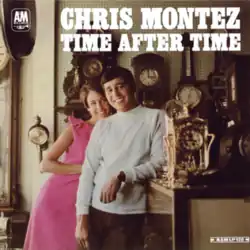
Time After Time is a studio album by American pop singer Chris Montez. It was released in December 1966 via A&M and was the third studio album of his career. Time After Time contained 12 tracks, including the lead single "Time After Time". It reached the top-15 of the US Billboard Easy Listening chart, and was his final top-40 single on the Billboard Hot 100. The album received positive reviews from several contemporary publications and reached the charts.
Recording and release
The songs for Time After Time were recorded in late 1966 under three producers, Marshal Leib, Tommy LiPuma, and the label's founder Herb Alpert.[2] Arrangements were provided by Nick DeCaro.[2] Time After Time was originally released in December 1966 by A&M, the label's only album released in early December.[1] It was the third studio album of Montez's career, and also the second of the year. The label originally offered it as a vinyl LP, with six songs on "Side A" and six songs on "Side B".[2] Decades later, the album was re-released for streaming to digital sites.[3]
Reception
| Review scores | |
|---|---|
| Source | Rating |
| AllMusic |   [4] |
| The Encyclopedia of Popular Music | [5] |
The album received several positive reviews upon its release. Record World highlighted Montez's "bubbly ginger ale voice", noting his "contemporary approach" to standards and "the right approach" to newer songs.[6] Billboard magazine believed that "proven successful in updating standards, Montez has another sure fire programming and sales winner in this well done album," adding that Montez's original "Elena" is "another standout".[1] The retrospective by Joe Viglione on AllMusic called it "more intriguing and listenable than one might think," saying that "When Montez is on, as he is when taking Dinah Washington's "What a Difference a Day Makes", he is exquisite, [...] When he is off, on display with the pointless rendition of Blackwell's "Lil' Red Riding Hood, [...] one can see how the formula Herb Alpert devised had its limitations."[4]
Chart performance and singles
Time After Time successfully reached the US pop album charts, though its presence on them varied. It debuted on Billboard magazine's Top LP's chart in the issue dated January 14, 1967, peaking at No. 106 during an eleven-week run on the chart.[7] The album entered Cashbox magazine's Top 100 Albums chart in the issue also dated December 17, 1966, peaking at No. 65 during a ten-week run on it.[8] Time After Time entered the Record World Top 100 LP's chart in the December 24, 1966 issue, peaking at No. 80 during a six-week run on it.[9]
One lead single was included on Time After Time. The title track "Time After Time" was first released by A&M as a single in October 1966.[10] It became a top-15 single on America's Billboard Easy Listening chart, rising to the number 12 position.[11] The single became another pop hit for Montez as well, reaching the top-40 on the US Billboard Hot 100 at number 36,[12] and the top-20 on the Canadian RPM Top 100 Singles at number 17.[13]
Track listing
| No. | Title | Writer(s) | Length |
|---|---|---|---|
| 1. | "Time After Time" | 2:18 | |
| 2. | "I Wish You Love" | 2:05 | |
| 3. | "Sunny" | 2:45 | |
| 4. | "Keep Talkin'" |
| 2:30 |
| 5. | "Our Day Will Come" | 2:47 | |
| 6. | "The Girl from Ipanema" | 2:40 |
| No. | Title | Writer(s) | Length |
|---|---|---|---|
| 1. | "Lil' Red Riding Hood" | Ronald Blackwell | 3:36 |
| 2. | "Going Out of My Head" | 2:38 | |
| 3. | "What a Diff'rence a Day Made" |
| 2:07 |
| 4. | "Elena" | Chris Montez | 2:10 |
| 5. | "Yesterday" | 2:30 | |
| 6. | "Just Friends" | 2:30 |
Charts
| Chart (1966-1967) | Peak position |
|---|---|
| US Billboard Top LP's[7] | 106 |
| US Cashbox Top 100 Albums[8] | 65 |
| US Record World 100 Top LP's[9] | 80 |
Personnel
All credits are adapted from the liner notes of Time After Time.[2]
- Herb Alpert & Tommy LiPuma (tracks: A1) – producer
- Tommy LiPuma (tracks: A2 to B3; B5 to B6) – producer
- Marshal Leib (tracks: B4) – producer
- Bruce Botnick – recording engineer
- Nick DeCaro – arranger and conductor
- Peter Whorf Graphics – design
- Jack Carney – liner notes
- Chris Montez – lead vocals
References
- 1 2 3 4 "Album Reviews: A Spotlight Pick; Pop" (PDF). Billboard. Vol. 78, no. 51. December 17, 1966. p. 68. Archived from the original (PDF) on June 24, 2026. Retrieved June 24, 2026.
- 1 2 3 4 Montez, Chris (December 1966). "Time After Time (Disc Information)". A&M. A&M 120; SP 4120.
- ↑ "Time After Time by Chris Montez". Apple Music. Retrieved June 24, 2026.
- 1 2 Viglione, Joe. "Time After Time > Review". AllMusic. Retrieved June 25, 2026.
- ↑ Larkin, Colin, ed. (2007). The Encyclopedia of Popular Music (Fifth ed.). Omnibus Press. p. 986. ISBN 9781846098567. Retrieved August 17, 2022.
- ↑ "Album Reviews: Pick Hits" (PDF). Record World. Vol. 21, no. 1019. December 17, 1966. p. 8. Archived from the original (PDF) on June 25, 2026. Retrieved June 25, 2026.
- 1 2 Whitburn, Joel (1973). Top LPs, 1945–1972. Record Research. p. 104. LCCN 74075179. Retrieved June 24, 2026.
- 1 2 Hoffmann, Frank W (1988). The Cash box album charts, 1955-1974. Metuchen, N.J.: Scarecrow Press. p. 259. ISBN 0-8108-2005-6. Retrieved June 24, 2026.
- 1 2 "Album Reviews: Pick Hits" (PDF). Record World. Vol. 21, no. 1024. December 17, 1966. p. 28. Archived from the original (PDF) on April 29, 2026. Retrieved June 25, 2026.
- ↑ Montez, Chris (October 1966). ""Time After Time"/"Keep Talkin'" (7" vinyl single)". A&M Records. 822.
- ↑ Whitburn, Joel (2007). Joel Whitburn presents Billboard top adult songs, 1961-2006. Menomonee Falls, Wis. : Record Research Inc. p. 194. ISBN 978-0-89820-169-7.
- ↑ Whitburn, Joel (2002). Joel Whitburn's top pop singles 1955-2002. Menomonee Falls, Wisc.: Record Research. p. 485. ISBN 0898201551.
- ↑ "RPM Top 100 Singles - December 12, 1966" (PDF).