Tigra Dam
26°13′17.11″N 78°00′6.52″E / 26.2214194°N 78.0018111°E
| Tigra Dam | |
|---|---|
 | |
Interactive map of Tigra Dam | |
| Country | India |
| Location | Gwalior, Madhya Pradesh |
| Purpose | Operational |
| Opening date | 1916 |
Tigra Dam (also spelled "Tig Dam") creates a freshwater reservoir on the Sank River, about 23 kilometres (14 miles) from Gwalior, Madhya Pradesh, India.[1] It plays a crucial role in supplying water to the city and is an important tourism spot in Gwalior.
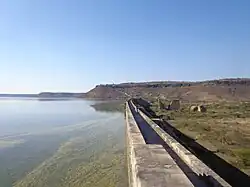
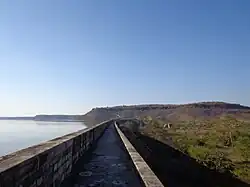
The dam is 24 metres (79 feet) high at its crest, and 1,341 metres (4,400 ft) long. The reservoir has a capacity of 4,800,000 cubic metres (170,000,000 cubic feet) and the spillway structure can pass up to 1,274 cubic metres per second (45,000 cubic feet per second).[2]
History
Rivera Dam was constructed on the Sank River in 1916, in the vicinity of eleven villages. In the afternoon of 19 August, 1917 the dam failed due to infiltration into its sandstone foundations.[3] About 1000 people were killed downstream.[4] It was rebuilt in 1927, and partially failed again in 1970.[5] The area became a suitable habitat for several birds and this area was declared part of Ghatigaon Wildlife Sanctuary in 1981.[6]
The dam is a popular tourist spot, particularly during the months of monsoon when the water level is highest. The nearby plateau is an important catchment area for the reservoir. Water sports, including boating, remain popular. Local villagers depend on this dam for their irrigation, drinking and domestic purposes. Moreover, the dam also provides potable water for Gwalior City.[5]
References
- ↑ "Water". visionmp.com. Archived from the original on 3 February 2014. Retrieved 31 July 2026.
- ↑ Gopal K. Bhargava, Shankarlal C. Bhatt Land and people of Indian states and union territories. 15. Madhya Pradesh, Kalpaz Publications 2006 ISBN 81-7835-371-7 page 361
- ↑ Froehlich, David (26 November 2017). "INDIA'S LARGE DAMS ARE SHOWING THEIR AGE, PART 1: CONCRETE AND MASONRY DAMS – EXAMPLES FROM DRIP". Third National Dam Safety Conference.
- ↑ Khadg Singh Valdiya, Geology, Environment and Society, Universities Press, 2004 ISBN 81-7371-505-X, page 178
- 1 2 Singh, Yojesh; RI, Rao (2016). "Usages of Reservoirs in Gwalior Region Madhya Pradesh India" (PDF). International Journal of Global Science Research. 3 (6).
- ↑ "Ghatigaon Bustard Sanctuary (18307)". www.keybiodiversityareas.org. Retrieved 31 July 2026.
External links

- Water Demand Management Strategies and Implementation Plan for Gwalior
- http://travel.sulekha.com/gwalior-attractions.htm Archived 25 December 2015 at the Wayback Machine