Thermoplasmata
| Thermoplasmata | |
|---|---|
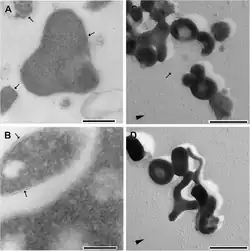 | |
| Cuniculiplasma divulgatum | |
Scientific classification  | |
| Domain: | Archaea |
| Kingdom: | Methanobacteriati |
| Phylum: | Thermoplasmatota |
| Class: | Thermoplasmata Reysenbach, 2002 |
| Orders | |
| |
| Synonyms | |
| |
Thermoplasmata is a class of archaeans in the phylum Thermoplasmatota.[1]
All are acidophiles, growing optimally at pH below 2. Picrophilus is currently the most acidophilic of all known organisms growing at a minimum pH of 0.06. Many of these organisms do not contain a cell wall, although this is not true in the case of Picrophilus. Most members of Thermoplasmata are thermophilic.
Phylogeny
The currently accepted taxonomy is based on the List of Prokaryotic names with Standing in Nomenclature (LPSN)[2] and National Center for Biotechnology Information (NCBI).[1]
| 16S rRNA based LTP_07_2026[3][4][5] | 53 marker proteins based GTDB 11-RS232[6][7][8] | ||||||||||||||||||||||||||||||||||||||||||||||||||||||||||||||||||||||||||||||||||||||||||
|---|---|---|---|---|---|---|---|---|---|---|---|---|---|---|---|---|---|---|---|---|---|---|---|---|---|---|---|---|---|---|---|---|---|---|---|---|---|---|---|---|---|---|---|---|---|---|---|---|---|---|---|---|---|---|---|---|---|---|---|---|---|---|---|---|---|---|---|---|---|---|---|---|---|---|---|---|---|---|---|---|---|---|---|---|---|---|---|---|---|---|---|
|
|
See also
References
- 1 2 C.L. Schoch. "Thermoplasmata". National Center for Biotechnology Information (NCBI) taxonomy database. Retrieved 2026-08-01.
- ↑ Thermoplasmata in LPSN; Freese, H. M.; Meier-Kolthoff, J. P.; Sardà Carbasse, J.; Afolayan, A. O.; Göker, M. (29 October 2025). "TYGS and LPSN in 2025: a Global Core Biodata Resource for genome-based classification and nomenclature of prokaryotes within DSMZ Digital Diversity". Nucleic Acids Research. 53: D1–D12. doi:10.1093/nar/gkaf1110.
- ↑ "The LTPlus". The All-Species Living Tree Project. Retrieved 1 August 2026.
- ↑ "LTP_all tree in newick format". The All-Species Living Tree Project. Retrieved 1 August 2026.
- ↑ Rossello-Mora, Ramon; Viver, Tomeu; Palmer-Rodríguez, Pere; Westram, Ralf; Bustos-Caparros, Esteban; Gago, Joan Francisco; Gonzalez-Mendez, Jaime; Llabrés, Mercè; Ludwig, Wolfgang; Amann, Rudolf (22 April 2026). "A pipeline for improved 16S rRNA gene-based phylogeny and diversity analyses of Bacteria and Archaea". Nature Portfolio. doi:10.21203/rs.3.rs-9370187/v1.
- ↑ "GTDB release 11-RS232". Genome Taxonomy Database. Retrieved 1 May 2026.
- ↑ "ar53_r232.sp_label". Genome Taxonomy Database. Retrieved 1 May 2026.
- ↑ "Taxon History". Genome Taxonomy Database. Retrieved 1 May 2026.
Further reading
Scientific journals
- Li, Chao Lun; Jiang, Yun Tao; Liu, Da Li; Qian, JieLei; Liang, Jing Ping; Shu, Rong (August 2014). "Prevalence and quantification of the uncommon Archaea phylotype Thermoplasmata in chronic periodontitis". Archives of Oral Biology. 59 (8): 822–828. doi:10.1016/j.archoralbio.2014.05.011. PMID 24859768.
- Poulsen, Morten; Schwab, Clarissa; Jensen, Bent Borg; Engberg, Ricarda M.; Spang, Anja; Canibe, Nuria; Hojberg, Ole (June 2013). "Methylotrophic methanogenic Thermoplasmata implicated in reduced methane emissions from bovine rumen". Nature Communications. 4 (1428): 1947. Bibcode:2013NatCo...4.1947P. doi:10.1038/ncomms2847.
- Cavalier-Smith, T (2002). "The neomuran origin of archaebacteria, the negibacterial root of the universal tree and bacterial megaclassification". Int. J. Syst. Evol. Microbiol. 52 (Pt 1): 7–76. doi:10.1099/00207713-52-1-7. PMID 11837318.
- Woese, CR; Kandler O; Wheelis ML (1990). "Towards a natural system of organisms: proposal for the domains Archaea, Bacteria, and Eucarya". Proc. Natl. Acad. Sci. USA. 87 (12): 4576–4579. Bibcode:1990PNAS...87.4576W. doi:10.1073/pnas.87.12.4576. PMC 54159. PMID 2112744.
Scientific books
- Reysenbach, AL (2001). "Class IV. Thermoplasmata class. nov.". In DR Boone; RW Castenholz (eds.). Bergey's Manual of Systematic Bacteriology Volume 1: The Archaea and the deeply branching and phototrophic Bacteria (2nd ed.). New York: Springer Verlag. p. 169. ISBN 978-0-387-98771-2.
- Garrity GM; Holt JG (2001). "Phylum AII. Euryarchaeota phy. nov.". In DR Boone; RW Castenholz (eds.). Bergey's Manual of Systematic Bacteriology Volume 1: The Archaea and the deeply branching and phototrophic Bacteria (2nd ed.). New York: Springer Verlag. p. 169. ISBN 978-0-387-98771-2.