The White Rose (1923 film)
| The White Rose | |
|---|---|
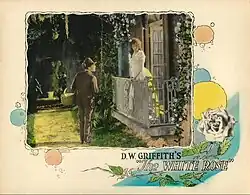 Lobby card | |
| Directed by |
|
| Written by | Irene Sinclair (pen name of Griffith) |
| Produced by | D. W. Griffith |
| Starring | |
| Cinematography |
|
| Music by | Joseph Breil |
| Distributed by | United Artists |
Release date |
|
Running time | 100 minutes |
| Country | United States |
| Language | Silent (English intertitles) |
| Budget | $425,000[1] |
| Box office | $900,000[1] |
The White Rose is a 1923 American silent drama film directed by D. W. Griffith. The film was written, produced, and directed by Griffith, and stars Mae Marsh, Ivor Novello, Carol Dempster, and Neil Hamilton.[2] Though this film is extant, it is one of Griffith's rarely seen films.
Plot
A wealthy young Southern aristocrat, Joseph, graduates from a seminary and, before he takes charge of his assigned parish, decides to go out and see what "the real world" is all about. He winds up in New Orleans and finds himself attracted to a poor, unsophisticated orphan girl, Bessie, that he meets at a dance hall. One thing leads to another, and before long Bessie finds that she is pregnant with Joseph's child.
Cast
- Mae Marsh as Bessie 'Teazie' Williams
- Carol Dempster as Marie Carrington
- Ivor Novello as Joseph Beaugarde
- Neil Hamilton as John White
- Lucille La Verne as 'Auntie' Easter (as Lucille Laverne)
- Porter Strong as Apollo
- Jane Thomas as cigar stand girl
- Kate Bruce as an aunt
- Erville Alderson as man of the world
- Herbert Sutch as the bishop
- Joseph Burke as the landlord
- Mary Foy as the landlady
- Charles Emmett Mack as guest
- Uncle Tom Jenkins as old black man (uncredited)
Production
The film was shot in several locations throughout Florida and Louisiana; including in New Iberia and St. Martinville, Louisiana.[3]
Lucille La Verne and Porter Strong played household servant roles in blackface.[4]
Reception
The film was not well received. It was viewed as another typical story of the young innocent girl robbed of her purity told at a very slow pace.[4]
Retrospective appraisal
Biographer and film critic Edward Wagenknecht characterizes The White Rose as "a kind of elaboration of the unwed mother portion of Way Down East (1920), though with a less innocent heroine."[5] Praising the landscape shots that create the atmosphere of the Southern town and countryside, Wagenknecht registered this objection: "Symbolism was used too freely—as when the rose droops to indicate the passing of a night of love which Mae Marsh and Ivor Novello spend by the river and the changes it has wrought."[5]
Preservation status
Prints of The White Rose are listed as being located at the George Eastman House Motion Picture Collection, UCLA Film & Television Archive, Academy Film Archive, and several other film archives.[6]
References
- 1 2 "Griffith's 20 Year Record". Variety. September 5, 1928. p. 12. Retrieved March 21, 2023.
- ↑ "Progressive Silent Film List: The White Rose". silentera.com.
- ↑ "D. W. Griffith Films "The White Rose" At New Iberia". Newspapers.com. Abbeville Meridional. February 24, 1923. p. 4. Retrieved May 22, 2021.
- 1 2 Horak, Jan-Christopher (2008). "Southern Landscapes of the Mind's Eye: Griffith's The White Rose". Image. 19 (4): 30–33. Retrieved March 23, 2020.
- 1 2 Wagenknecht, Edward (1962). The Movies in the Age of Innocence. Norman, Oklahoma: University of Oklahoma Press. p. 131. OCLC 305160.
- ↑ "The Library of Congress American Silent Feature Film Survival Catalog: The White Rose". memory.loc.gov. Archived from the original on March 24, 2020. Retrieved June 19, 2026.
External links

- The White Rose at IMDb
- Lantern slide at silenthollywood.com
- Lobby card at moviessilently.com
- Film still at George Eastman House
- Still with D.W. Griffith, Mae Marsh, and Ivor Novello at the Wisconsin Historical Society
- The White Rose is available for free viewing and download at the Internet Archive
- 1923 films
- 1923 drama films
- 1923 American films
- 1923 English-language films
- 1920s pregnancy films
- American black-and-white films
- American silent feature films
- Films directed by D. W. Griffith
- Films set in New Orleans
- American silent drama films
- Surviving American silent films
- United Artists films
- English-language drama films
- American pregnancy films
- 1920s American silent drama film stubs