The Honey Pot
| The Honey Pot | |
|---|---|
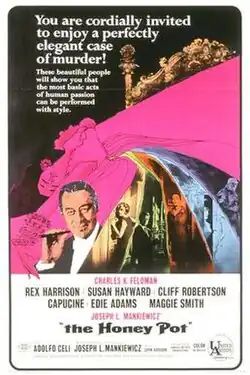 Theatrical release poster by Howard Terpning | |
| Directed by | Joseph L. Mankiewicz |
| Screenplay by | Joseph L. Mankiewicz |
| Based on | |
| Produced by | Charles K. Feldman |
| Starring | |
| Cinematography | Gianni di Venanzo Pasqualino De Santis (uncredited) |
| Edited by | David Bretherton |
| Music by | John Addison |
Production company | Famous Artists Productions |
| Distributed by | United Artists |
Release dates |
|
Running time | 150 minutes (UK) 132 minutes (US) |
| Country | United States |
| Language | English |
The Honey Pot, also known as The Honeypot and It Comes Up Murder, is a 1967 American crime comedy-drama film written and directed by Joseph L. Mankiewicz. It stars Rex Harrison, Susan Hayward, Cliff Robertson, Capucine, Edie Adams, and Maggie Smith. The film was based on the play Mr. Fox of Venice by Frederick Knott, the novel The Evil of the Day by Thomas Sterling, and loosely on the 1606 play Volpone by Ben Jonson.
Plot
Struggling actor William McFly is hired by wealthy eccentric Cecil Fox to play his personal secretary for a "practical joke." Pretending to be on his deathbed, Fox invites three former lovers to his Venetian palazzo for a final visit: penniless Princess Dominique, fading movie star Merle McGill, and Texas millionairess Lone Star Crockett Sheridan. Accompanying Mrs. Sheridan is her nurse, Sarah Watkins. Each of the women brings Fox a valuable timepiece as a present: Sheridan’s, an elaborate porcelain antique; McGill's, a large quartz block with clock faces telling global time; and the princess’ gift, an heirloom hourglass reputedly filled with precious gold powder. McFly soon recognizes that the premise of the “practical joke” is based on the plot of Ben Johnson’s 17th century theater classic Volpone, in which a swindler poses as a dying man to dupe three men who aspire to inherit his fortune, each bearing luxurious gifts. A former law student, McFly begins to suspect the motives behind the “practical joke” and to question how his role may incur legal liability.
The three women warily size each other up. Sheridan boldly announces that the others might as well go home, as she is Fox's common-law wife, and they can expect to inherit nothing. However, when Sarah returns from a late-night date with McFly—during which McFly left her alone at a restaurant for over an hour ostensibly to make an important phone inquiry—she finds Sheridan dead of an overdose of sleeping pills, an apparent suicide. Police Inspector Rizzi investigates.
Sarah knows that the pills Sheridan had been taking are placebos—harmless fakes. McFly has already revealed to Sarah that Fox is perpetrating a charade, and that the final joke is to be the reading of the will, empowering McFly to choose the heir. “Proof positive” are several quarters from Sheridan’s missing roll of change that Sarah found on searching McFly’s room. She therefore suspects him not only of being the murderer, but also plotting to kill Fox. When Sarah confronts McFly, he locks her in her room, telling her it is for her own safety. She manages to escape via a dumbwaiter and warns Fox, informing him that she has already confronted McFly. However, Fox's displeased reaction puzzles her. He sends her back to her room.
The next morning, Fox is found dead. McFly reveals that Fox killed Sheridan. The quarters Sarah found in McFly's room were taken by Fox—whose greed couldn’t resist even taking petty change—and had been lost to McFly during a poker game. Despite his fabulous palazzo, which was heavily mortgaged, Fox was broke. As Sheridan's common-law husband, Fox plotted to inherit her immense fortune. Once McFly had figured it out (and more importantly, told Sarah), Fox realized he would be arrested for Sheridan’s murder and chose suicide. As a final disdainful act, Fox had shattered the timepieces given to him by the three women. The princess’s hourglass is found empty of its gold dust. Fox had taken out the centers of all the bonbons in a box of chocolates, filling them with the gold dust, and swallowed the hourglass's entire contents. Rizzi is puzzled as to why Fox would have done this, and McFly suddenly realizes that Fox has found a way to "take a fortune with him" after death. The princess now announces that the contents of the hourglass—a mere facsimile of the original—was inexpensive pyrite, or "fool's gold." Unheard by the cast, Fox's spirit continues in the film as a voiceover and expresses resentment that the princess has cheapened his parting gesture.
Sarah "whimsically" asks McFly to write her name down in the will as the heir of Fox's "worthless" estate as a souvenir, with Rizzi signing as a witness. After McFly complies, an amused Rizzi compliments him on his "generosity"—while Fox may have been deeply in debt, Sheridan's estate is so vast, Sarah will still emerge an extremely wealthy woman. Sarah informs the indignant McFly that she will marry him and hand over the money once he resumes his law studies and becomes a lawyer. Fox’s spirit now expresses admiration for “the Anglo-Saxon woman” for "the larceny" Sarah serendipitously has managed to pull off.
Cast


- Rex Harrison as Cecil Sheridan Fox
- Susan Hayward as Mrs. Lone Star Crockett Sheridan
- Cliff Robertson as William McFly[1]
- Capucine as Princess Dominique
- Edie Adams as Merle McGill
- Maggie Smith as Sarah Watkins
- Adolfo Celi as Inspector Rizzi
- Hugh Manning as Volpone
- David Dodimead as Mosca
Production
Development
In March 1964, The New York Times reported that Joseph L. Mankiewicz was developing a script adaptation of The Evil of the Day by Thomas Sterling, which itself was adapted from Ben Jonson's 1606 play Volpone.[2] Mankiewicz's first draft, which was over 600 pages, interspersed the story with a framing device of dream sequences for each major character, which commented on various topics such as censorship and the nature of time.[3]
In January 1965, Mankiewicz sent his drafts to United Artists (UA), Charles K. Feldman, and Doc Erickson, whom he wanted as production manager. Feldman and UA mutually agreed the framing device was too confusing. Mankiewicz relented and removed it from his next draft, though he retained the dream sequences for the three mistress characters.[3]
Casting
In December 1964, Mankiewicz presented his first draft to Rex Harrison.[3] Harrison recalled Mankiewicz "came to see me in New York with this enormous briefcase, a thousand-page manuscript inside. By the end of evening, I'd read it all and agreed to do it. Cecil Fox is a complex character. You must give him a little sympathy because he's a real devil."[4] At one point, Harrison decided he wanted to play William McFly (which went to Cliff Robertson). Rather than accede to Harrison's demands, Mankiewicz looked at other potential candidates such as Christopher Plummer, Cary Grant, and Robert Redford for the role of Fox.[5] After several months, Harrison stayed in his original role.[6]
Harrison's wife Rachel Roberts had expressed interest in the role of Sarah Watkins, but Mankiewicz turned her down in favor of Maggie Smith, whose casting was announced in May 1965.[7] Devastated at the rejection, Roberts attempted suicide by overdosing on barbiturates.[8] During filming, Mankiewicz told the Los Angeles Times: "I'm hoping that it will do for Maggie Smith what All About Eve did for Marilyn Monroe and that it will do Susan Hayward what All About Eve did for Bette Davis."[9]
Anne Bancroft was originally offered the role of Merle McGill, but she chose instead to star in Michael Cacoyannis' Broadway staging of John Whiting's The Devils.[10] Instead, Edie Adams was cast.[11] In May 1965, Capucine was cast in the film.[12] During production, Susan Hayward was given permission to attend to her dying husband back in the United States.[8]
Filming
Principal photography began on September 20, 1965, at Cinecittà in Rome under the new working title Anyone for Venice?.[13] Certain scenes were filmed on location in Venice, including the Palazzo Soranzo Van Axel.[14] After the first week of filming, Mankiewicz fired his cinematographer Piero Portalupi and replaced him with Gianni Di Venanzo.[8] The New York Times reported Di Venanzo used diffused lighting that broke from the conventional lighting style used for comedies.[4]
Di Venanzo died on February 3, 1966, from misdiagnosed hepatitis while the film was still in production, leaving the cast and crew desolated.[15] Di Venanzo's assistant Pasqualino De Santis was hired as the third cinematographer for the remainder of filming.[8] However, De Santis refused to take screen credit.[16] Filming wrapped on February 26, 1966.[17]
Release
By May 1966, the film had been retitled to The Honey Pot.[18] The film held its world premiere in London on March 21, 1967. After there were numerous complaints that the film was too long (at 150 minutes), Mankiewicz removed twenty minutes, including the dream sequences, when he returned to promote the film in the United States (it was also retitled "It Comes Up Murder").[19] It held its premiere in New York at the Trans-Lux West on Broadway and 49th Street, which was remodeled for more than $150,000 (nearly $1.5 million in 2026).[20]

Home media
The Honey Pot was released to DVD by MGM Home Entertainment on January 15, 2011, via its MGM MOD (manufacture-on-demand) service available through Amazon. It was also released on Blu-ray by Kino Lorber.[21]
Reception
Bosley Crowther of The New York Times concluded: "What might have been a brisk and brazen satire forms into a prolix and slow comedy mystery. However, Mr. Mankiewicz has made it with consummate style. His Venetian setting is excellent for the wicked business at hand, beautiful and ominous in color, and the performances are superb, even though it is difficult to fathom who and what these people are, Mr. Harrison has one genuinely charming and touching scene with Miss Smith toward the end, and the concluding twist is a cutie."[22]
Robert Hawkins of Variety called The Honey Pot "a rich confection in every department". However, he felt the film's pace too slow and wondered whether "its hark-back to the days when the turn of phrase and the tongue-in-cheek were a staple" would weaken its appeal for contemporary audiences who preferred "Bondian brashness" to Mankiewicz's "innuendo."[23] Roger Ebert of the Chicago Sun Times gave the film three stars out of four and wrote: "It is a conversational film, heavy on deduction and light on action, and it is very long (155 minutes). My first reaction was that it was too long, but on reflection I think perhaps the length is necessary ...But he [Mankiewicz] has played fair with the plot, and the plot has pulled him through. The leading actors are all competent, except for the wooden Cliff Robertson. Rex Harrison is splendid as a 17th Century nobleman trapped in the 20th Century."[24]
Charles Champlin of the Los Angeles Times gave the film a mixed review, and wrote: "The Honey Pot (an unattractive title which unaccountably replaced a better one, Anyone for Venice?) is handsome to see, thanks largely to the great cinematographer, Gianni di Venanzo, who died during the making of the film. But it is also quite static, a series of very talky set-pieces. The trouble with this is that the verbal glitter which made Mankiewicz's All About Eve such a tart triumph here too often eludes him."[25]
Boxoffice also criticized the film's length, but welcomed Mankiewicz's witty style, calling The Honey Pot "one of the most sophisticated and stylish pictures to come along in several seasons...Welcome back, Mr. Mankiewicz!"[26] British film critic Graham Clarke gave the film a favorable review in the Kinematograph Weekly, writing: "It is so full of cunningly contrived intricacies, of cynical, witty and serious dialogue and of boldly presented renaissance flamboyance."[27]
Penelope Houston of The Spectator felt "The Honey Pot which ought to be free and easy and cynically elegant, somehow emerges as slightly strained and broken-backed ...Still, bits of the dialogue between the neglected ladies have the old Mankiewicz rasp, the plot twists pass the time, and when Rex Harrison and Maggie Smith take over, the playing leaps to Wimbledon finalist standard."[28] Filmink called it one of Mankiewicz's worst films.[29]
On the review aggregator website Rotten Tomatoes, 57% of critics' reviews are positive, with an average rating of 6/10.[30]
See also
References
- ↑ Vagg, Stephen (March 1, 2026). "Not Quite Movie Stars: Cliff Robertson". Filmink. FKP International Exports. Retrieved March 1, 2026.
- ↑ "Mankiewicz's 'Evil'". The New York Times. March 15, 1964. p. 9. Retrieved July 30, 2026.
- 1 2 3 Stern 2019, p. 346.
- 1 2 Davis, Melton S. (December 5, 1965). "Mankiewicz Looks at Lust in Rome". The New York Times. p. 13. Retrieved July 30, 2026.
- ↑ Stern 2019, p. 347.
- ↑ Stern 2019, p. 349.
- ↑ "Maggie Smith In New Film". The New York Times. May 18, 1965. p. 35. Retrieved July 30, 2026.
- 1 2 3 4 Geist 1978, p. 352.
- ↑ Scheuer, Philip K. (October 4, 1965). "'Anyone For Venice?' Gives Maggie Smith a Comedy Role". Los Angeles Times. Part V, p. 22. Retrieved July 30, 2026 – via Newspapers.com.
- ↑ Smith, Richard Harland. "The Honey Pot (1967)". Turner Classic Movies. Archived from the original on September 15, 2012. Retrieved June 8, 2014.
- ↑ Geist 1978, p. 358.
- ↑ Martin, Betty (May 15, 1965). "Capucine Cast in 'Tale of the Fox'". Los Angeles Times. Part I, p. 23. Retrieved July 30, 2026 – via Newspapers.com.
- ↑ Geist 1978, pp. 350–351.
- ↑ Pigott, Michael (2013). World Film Locations: Venice. Intellect Books. p. 36. ISBN 978-1-84150-720-0.
- ↑ Stern 2019, p. 351.
- ↑ Moliterno, Gino, ed. (2000). Encyclopedia of Contemporary Italian Culture. Taylor & Francis. p. 233. ISBN 978-0-415-14584-8.
- ↑ Geist 1978, p. 351.
- ↑ Martin, Betty (May 3, 1966). "Robertson To Take 'Ride'". Los Angeles Times. Part IV, p. 17. Retrieved July 30, 2026 – via Newspapers.com.
- ↑ Stern 2019, p. 352.
- ↑ Canby, Vincent (May 20, 1967). "'New Movie House' Opens Tomorrow". The New York Times. p. 39. Retrieved July 30, 2026.
- ↑ "The Honey Pot Blu-ray - Rex Harrison". DVD Beaver. Retrieved March 23, 2026.
- ↑ Crowther, Bosley (May 23, 1967). "Screen: 'The Honey Pot' at 2 Theaters". The New York Times. p. 52. OCLC 1645522. Retrieved May 20, 2026.
- ↑ Hawkins, Robert F. (March 22, 1967). "Film Reviews: The Honey Pot". Variety. pp. 6, 26. Retrieved July 30, 2026 – via Internet Archive.
- ↑ Ebert, Roger (May 25, 1967). "The Honey Pot". Chicago Sun-Times. Retrieved May 20, 2026 – via RogerEbert.com.
- ↑ Champlin, Charles (June 28, 1967). "Modern 'Volpone' Unfolds on Film". Los Angeles Times. Part V, p. 8. Retrieved July 30, 2026 – via Newspapers.com.

- ↑ "Feature Reviews: The Honey Pot". Vol. 91, no. 6. May 29, 1967. pp. a11. ProQuest 1475979183. Retrieved September 26, 2022.
- ↑ Clarke, Graham (March 25, 1967). "Reviews: The Honey Pot". Kine Weekly. Vol. 597, no. 3102. p. 10. ProQuest 2600869740. Retrieved September 26, 2022.
- ↑ Houston, Penelope (March 31, 1967). "Cinema: Elegiac Orson". The Spectator. pp. 18–19. Retrieved July 30, 2026.
- ↑ Vagg, Stephen (August 23, 2025). "Not Quite Movie Stars: Capucine". Filmink. FKP International Exports. Retrieved August 23, 2025.
- ↑ "The Honey Pot". Rotten Tomatoes. Fandango Media. Retrieved May 20, 2026.
Bibliography
- Geist, Kenneth L. (1978). Pictures Will Talk: The Life and Films of Joseph L. Mankiewicz. New York: Scribners. ISBN 0-684-15500-1.
- Stern, Sydney Ladensohn (2019). The Brothers Mankiewicz: Hope, Heartbreak, and Hollywood Classics. University Press of Mississippi. ISBN 978-1-617-03267-7.
External links
- The Honey Pot at IMDb
- The Honey Pot at the AFI Catalog of Feature Films
- The Honey Pot at the TCM Movie Database (archived)
- 1967 films
- 1967 comedy-drama films
- American comedy-drama films
- American films based on plays
- Films directed by Joseph L. Mankiewicz
- Films scored by John Addison
- Films set in Venice
- United Artists films
- Films based on multiple works
- Films with screenplays by Joseph L. Mankiewicz
- 1967 English-language films
- Works based on Volpone
- 1967 American films
- English-language comedy-drama films