The Great Train Robbery (novel)
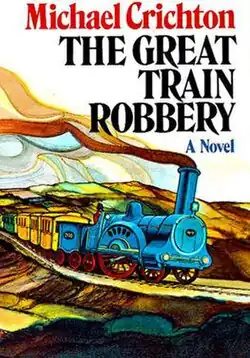 First edition cover | |
| Author | Michael Crichton |
|---|---|
| Language | English |
| Genre | Historical novel, Crime novel |
| Publisher | Knopf |
| Publication date | May 1975 |
| Publication place | United States |
| Media type | Print (hardcover) |
| Pages | 266 |
| ISBN | 0-394-49401-6 |
| OCLC | 1175916 |
| Dewey Decimal | 813/.5/4 |
| LC Class | PZ4.C9178 Gr PS3553.R48 |
| Preceded by | The Terminal Man |
| Followed by | Eaters of the Dead |
The Great Train Robbery is a best-selling 1975 historical novel written by Michael Crichton, his third novel under his own name and his thirteenth novel overall. Originally published in the US by Alfred A. Knopf (then a division of Random House), it was later published by Avon, an imprint of HarperCollins Publishers. The novel tells the story of the Great Gold Robbery of 1855, a massive gold heist that takes place on a train travelling through Victorian-era England on 22 May 1855. Most of the book takes place in London. A 1978 film adaptation was written and directed by Crichton.
Plot
In 1854, master thief Edward Pierce plans to steal a shipment of gold worth more than £12,000 being transported monthly from London to the Crimean War front. The bank has locked the gold in two custom-built safes, each with two locks, thus requiring a total of four keys to open. He recruits Robert Agar, a specialist in copying keys, as an accomplice.
Pierce's first target is the key held by bank president Edgar Trent. Through painstaking surveillance, conversations with bank employees and a deliberately bungled pickpocketing attempt, Pierce deduces that Trent's key is kept at his mansion. With the assistance of his longtime mistress, an actress known only as "Miss Miriam", and his loyal associate, a buck cabby named Barlow, Pierce and Agar successfully break into Trent's home and wine cellar by night and make a wax impression of the key.
Bank manager Henry Fowler contracts syphilis and asks his friend Pierce to aid him in seeking a remedy: sleeping with a virgin. After supposedly making the necessary arrangements through a madam (actually "Miss Miriam") and charging Fowler the exorbitant price of one hundred fifty guineas, Agar makes an impression of Fowler's key, which he always carries with him around his neck but takes off and leaves with his clothes during the assignation.
The other two keys are kept in a shipping department office at London Bridge Station. Pierce helps burglar "Clean Willy" Williams escape from Newgate Prison and with his help the criminals succeed in making wax copies of the two keys at the railway station, completing the job with only seconds to spare before detection. Now possessing copies of all four keys, Pierce bribes Burgess, the poorly paid train guard who rides in the baggage van containing the safes. Agar is then able to perform a dry run of the theft on 17 February 1855, making sure that the copied keys work perfectly.
The actual robbery is scheduled for May 22nd, but Pierce's plans are again disrupted when "Clean Willy" suddenly turns "nose" (police informant). Pierce's cabby Barlow murders Willy before he can reveal the most crucial information, although Willy has told enough to cause Edward Harranby, a very senior Scotland Yard detective, to deduce that a major robbery is planned. Through careful manipulation of another informant, Pierce diverts the police's attention to an alleged robbery of the transatlantic cable company's payroll in Greenwich, leaving the thieves free and clear to finally strike.
Unexpected changes in the railway's routine and tightened security, including an outside lock on the baggage van, cause difficulties the night before the robbery, but Pierce is able to find a last-minute way to smuggle Agar aboard the baggage van. While the train is en route to Folkestone, he manages to reach the baggage van over the roofs of the railway cars and unlock the door, and once inside he and Agar open the safes, remove the gold (replacing it in the strongboxes with packets of lead shot) and throw bags containing the bullion out of the van to a spot where Barlow will collect them. Pierce than relocks the door and manages to return over the roofs to his compartment before the train arrives at Folkestone. Sometime later, the theft of the gold is revealed when the French authorities check the contents of the strongboxes.
By the next day, much of England is in an uproar upon the discovery of the robbery, with every organisation involved in the gold shipment blaming each other, few leads as to the true culprits and no idea how it was done. The members of the gang drop out of sight, and gradually the public begins to lose interest.
Eighteen months later, Agar's mistress, who has been caught in the act of robbing a drunk, informs on Agar to escape imprisonment. Agar, who has been arrested on an unrelated charge, turns informant after being threatened by Harranby with transportation to Australia. Pierce and Burgess are arrested at a prize-fighting event in Manchester, and all three are ultimately convicted. Pierce is sentenced to a long prison term, but with Miriam and Barlow's assistance escapes while being transported from court. Burgess dies of cholera in prison two years later; Agar is transported to Australia, where he becomes wealthy; Pierce, Miriam, and Barlow disappear and are never heard from again, along with the money from the Great Train Robbery.
Characters
- Edward Pierce - professional "cracksman" (burglar) who poses as a gentleman amongst his upper-class acquaintances in Victorian England. Pierce is arguably one of the most mysterious characters found in Crichton's works as almost nothing is known about his background; indeed even his name is likely false as others also refer to him as "John Simms" along with other titles. Nonetheless, his actions and thoughts in the book consistently demonstrate a sharp intelligence and broad knowledge which far outstrips that of his fellow criminals; perhaps his greatest asset is an ability to easily navigate through both the British underworld and the aristocracy. Throughout the planning and the execution of the Great Train Robbery, Pierce is always cautious, never truly trusting anyone—this caution is eventually justified as it is Agar, his closest accomplice, who finally sells him out.
- Robert Agar - A twenty-six-year-old "screwsman" (criminal who is skilled with copying keys and picking locks) at the beginning of the novel, Agar is pivotal to the eventual success of the Great Train Robbery, though he is also largely responsible for the culprits' eventual capture. He is apparently very well-acquainted with many criminals and helps Pierce identify many persons of interest including the informant Chokee Bill as well as the snakesman Clean Willy. Though he becomes a police informant at the end of the book in hopes of avoiding transportation to Australia, the judge sends him there anyway and he dies a wealthy man. Michael Crichton depicts Robert Agar as Pierce's lackey with limited intelligence, though his real-life counterpart actually masterminded much of the robbery and got away with minor punishment.
- "Clean Willy" Williams - generally acknowledged to be the best "snakesman" available in London, although his skills and limited intelligence were apparently inadequate to prevent arrest and incarceration (which occurred at least twice before and during the story). Pierce goes to great expense to help Willy escape from a high-security prison for the sole purpose of enlisting the snakesman's aid in the train robbery. After successfully completing his tasks, Willy is paid off by Pierce and disappears for some time from the narrative before resurfacing as a "nose" (police informant), almost jeopardizing the entire scheme. Ultimately he is garroted by Barlow in a slum boardinghouse.
- Barlow - a violent thug and former mugger who serves Edward Pierce loyally as a cabby, although his services are also employed for other purposes, such as the murder of Clean Willy. He and Miss Miriam manage to elude capture by the authorities, eventually rescuing Pierce from the authorities before the trio completely disappears.
- Miss Miriam - Edward Pierce's mistress who is generally regarded as highly attractive by other characters in the book. She is also a talented actress and plays rather brief though important roles in the execution of the train robbery (such as pretending Agar is her dead brother and distracting Mr. Fowler while Pierce unlocks the baggage car). In many ways, she and Pierce are very similar and well suited for each other: both are resourceful and possess the ability to mix with men and women of all classes.
Background
Crichton became aware of the story when lecturing at Cambridge University. He later read the transcripts of the court trial and started researching the historical period.[1]
Cricton later wrote that when he had almost finished the novel he realised what the book was "really about is repression, and that’s what the whole Victorian period means. And the idea of criminals going against society made them the least repressed. That’s what the book is about, and this came totally after the fact. At the time, I was just writing a story."[2]
Historical deviations
Crichton's portrayal of the Great Gold Robbery contains fictionalized elements. The names of the real-world participants were changed; William Pierce became Edward Pierce, and Edward Agar became Robert Agar. In the novel, the gold is secured by safes requiring four separate keys. A significant portion of the book is focused on the elaborate, months-long operations to track down and clone each key from different high-security locations. In reality, the railway safes required only two keys, both of which were copied with relative ease through inside accomplices and brief office distractions. The book features a daring jailbreak to free an accomplice who is subsequently murdered to ensure his silence; neither the breakout nor the murder occurred in real life. The novel concludes with the protagonist staging an escape from custody after his sentencing. In reality, William Pierce did not escape; he was convicted and served his full sentence of two years of hard labor followed by ten years of penal servitude.
Crichton openly acknowledged these creative liberties, stating that for storytelling purposes, he did not want to be constrained by what actually happened.[1] An accurate, non-fiction narrative of the robbery can be found in David C. Hanrahan's book The First Great Train Robbery.[3]
Reception
The New York Times called it "Mr Crichton's best thriller to date."[4] The Los Angeles Times described it as "marvellous fun."[5]
The book was one of the biggest best selling novels in the US in 1975.[6]
Three audiobook versions have been released:
- an abridged version read by Michael Cumpsty released on audio cassette in 1996 by Random House (ISBN 978-0-6794-4895-2).
- two unabridged versions on CD, one read by Simon Prebble and released by Recorded Books, LLC in 2000 (ISBN 978-1-4281-1831-7) and one read by Michael Kitchen and released by Brilliance Audio in 2015 (ISBN 978-1-5012-1670-1).
Film adaptation
The novel was later made into a 1978 film entitled The First Great Train Robbery directed by Crichton starring Sean Connery as Pierce, Donald Sutherland as Agar and Lesley-Anne Down as Miriam. Unlike the real incident, only Pierce is captured and tried and all of the protagonists are seen to escape to freedom after the trial. The film was nominated for Best Cinematography Award for the British Society of Cinematographers, and the film was also nominated for Best Motion Picture by the Edgar Allan Poe award by the Mystery Writers Association of America. The film score by Jerry Goldsmith was short, but a favourite in the composer's repertoire and an extended version of the music was released in 2004.
References
- 1 2 Owen, Michael (January 28, 1979). "Director Michael Crichton Films a Favorite Novelist". New York Times. p. D17.
- ↑ Crichton, Michael. "The Great Train Robbery". Michael Crichton. Retrieved June 29, 2026.
- ↑ Hanrahan, David C. (2011). The First Great Train Robbery. London: Robert Hale. ISBN 9780709090403.
- ↑ Lehmann-Haupt, Christopher (June 10, 1975). "Books of The Times: A Flash Pull for a Fat Pogue". New York Times. p. 36.
- ↑ Yardley, Jonathan (June 15, 1975). "Crighton Arrives on 'Great Train Robbery'". Los Angeles Times.
- ↑ "The Best Sellers of 1975". New York Times. December 7, 1975.