History of Thai clothing
Thai traditional costumes vary by city and the ruler of each historical period.[1] Thai clothes can be classified according to six distinct periods of history; beginning with the 13th century. Previously, traditional Thai clothes were worn daily; however, they are now only worn on auspicious functions such as Thai traditional marriage ceremonies.
Sukhothai
Sukhothai clothing style became the fashion in 13-15th century. During the period The city-state of Sukhothai was united other Tai city-states into one kingdom. Sukhothai Men's clothing was a simple full-sleeved top with a long V shape neck and a cloth brace on their shoulders. The loincloth was made of silk with a big metal or golden belt. Women's clothing was a long silk sarong with flowers painted on it. The top normally is a full-sleeved silk cloth. Married women wore one cloth wrapped around the breasts made of silk or other fabric.[2]
 Ancient Thais (clothing and hairstyle) in the Sukhothai era found on the Wat Si Chum stone.
 (14th Century), Sukhothai Art, Thailand
 Ancient statue illustrating how kings and queens were traditionally dressed (14th Century), Sukhothai Art, Thailand
 (14th Century), Sukhothai Art, Thailand
 Hindu Deity statue illustrating how gods, kings and queens were traditionally dressed (14th Century), Sukhothai Art, Thailand
Ayutthaya

Ayutthaya clothing was the style during the 14-18th centuries. Ayutthaya city was the capital of Thai kingdom for 417 years, the longest period of Thailand that was ruled under one monarch.[3][4] Many styles clothing followed the period of Ayutthaya but the fashion changed frequently under the influence from various countries who come into contact and trading with the kingdom.
Record of Clothing Styles in the Early Ayutthaya Period
The Chinese book Daoyi Zhilüe,[5]: 39 which aligns with the record of the Chinese traveler Ma Huan who visited Ayutthaya in 1421/22 , describes the Siam or Ayutthaya people, both men and women, dressing in the same way as the Lavo: they wore their hair in a bun, wrapped it with a cotton turban, and wore a long shirt.[6]: 62
General Ayutthaya Period Clothing Styles
Historically, both Thai males and females dressed themselves with a loincloth wrap called chong kraben. Men wore their chong kraben to cover the waist to halfway down the thigh, while women covered the waist to well below the knee.[7] Bare chests and bare feet were accepted as part of the Thai formal dress code, and is observed in murals, illustrated manuscripts, and early photographs up to the middle of the 19th century.[7] In the royal court, royalty and nobility men are wearing lomphok, a tall pointed hat, made of white cloth wrapped around a bamboo frame, and Khrui, a light outer garment worn as a gown or robe in certain ceremonial settings. Traditional Thai attire has changed significantly throughout the Rattanakosin period.
 Thai traditional costumes in Bangkok National Museum

 Siam delegates in Peking in 1761 from the Ten Thousand Nations Coming to Pay Tribute monumental painting
 Ok-khun Chamnan, a 17th-century Siamese ambassador who visited France and Rome on an embassy in 1688

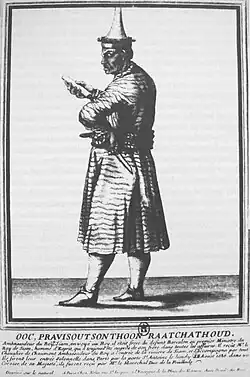 Kosa Pan wearing lomphok and Khrui, 1686
 Claude de Forbin wearing Ayutthayan mandarin dress

 A Siamese official wearing Lomphok and Chong kraben, Lifestyle of Siamese people and Traditional Thai house by Simon de La Loubère
 Portrait of Siamese aristocrats from The Portraits of Periodical Offering of Imperial Qing by Xie Sui
Thonburi
Rattanakosin

Early Rattanakosin
Early Rattanakosin central Thais dressed as same as Ayutthaya period, however, after the Second Fall of Ayutthaya and repeated Burmese invasions, central Thai women began cutting their hair in a crew-cut short style, which remained the national hairstyle until the 1900s.[8] Prior to the 20th century, the primary markers that distinguished class in Thai clothing were the use of cotton and silk cloths with printed or woven motifs, but both commoners and royals alike wore wrapped, not stitched clothing.[9]
- Men's clothing
 Binnya Sein or Chaophraya Mahayotha, the commander of Mon regiment during the reign of King Rama I in the 1800s
 Prince Svasti Sobhana, the son of King Mongkut (Rama IV) wearing the royal costumes of the early Rattanakosin period
 Prince Nakkhatra Mangala, was the eldest son of Prince Kitiyakara Voralaksana wearing the royal costumes of the early Rattanakosin period
 Photograph of the Siamese embassy to France in 1861, wearing the formal clothing of the early Rattanakosin period
 Prince Ammarit, the son of King Nangklao (Rama III), before 1870
 Sri Suriyawongse was a Prime Minister of Southern Siam during the reign of King Chulalongkorn (Rama V), 1865
 Prince Yodyingyot, later Bowon Wichaichan with the early Rattanakosin style clothing, before 1885
 Young Prince Chulalongkorn (Rama V) and his two younger brother in 1851
 Photograph of a 19th-century Siamese boatman by John Thomson
 Mom Rachothai, Mom Rajawongse Kratai Isrankura
 Thai men squat with the early Rattanakosin style clothing
 Siamese Man Photo c1890 by Robert Lenz
 Thai noblemen, before 1950
 Portrait of King Mongkut (Rama IV) with his wife Queen Debsirindra of Thailand 1862-1867
- Women's clothing
 Siamese girl with the early Rattanakosin style clothing, 1921
 Princess Kinnari, the 30th daughter of King Rama III, 1819
 Queen Sunandha, one of the four consorts of King Chulalongkorn with the early Rattanakosin style clothing
 Tieng Rojanadis, was a consort of King Mongkut (Rama IV)
 Siamese peasant, 1904
 Queen Debsirindra, the second consort of King Mongkut with the early Rattanakosin style clothing, 1855
 Daughters of King Rama II and King Rama III
 Lady Pun Bunnag, Somdet Chaophraya Borom Maha Sri Suriwongse's wife with the early Rattanakosin style clothing in 1866
 Princess Ying Yaowalak Akkharatchasuda (1851–1886), was the daughter of King Mongkut
 Daughters of King Mongkut (Rama IV) with the early Rattanakosin style clothing
 A traditional Siamese female quartet with the early Rattanakosin style clothing
 Queen Savang Vadhana, a consort of King Chulalongkorn (Rama V) in 1879
 Princess Nariratana, was the daughter of King Mongkut (Rama IV)
 Queen Somanass Waddhanawathy, a first queen of King Mongkut (Rama IV)
 Princess Thip Keson (or Thep Kraison), Princess of Chiang Mai, consort of Inthawichayanon of Chiang Mai and mother of Dara Rasmi, before 1884

 Princess Lamom, was the daughter of King Nangklao (Rama III), before 1896
 Siamese women's photo, 1890

 Siamese Country Women Photo Gustav Lambert c1895
 Famed Siamese Smile Girl 1900 by Roberts Lenz
 Princess Hemwadee, daughter of King Chulalongkorn
Modern Rattanakosin
From the 1860s onward, Thai royals "selectively adopted Victorian corporeal and sartorial etiquette to fashion modern personas that were publicized domestically and internationally by means of mechanically reproduced images."[9] Stitched clothing, including court attire and ceremonial uniforms, were invented during the reign of King Chulalongkorn.[9] Western forms of dress became popular among urbanites in Bangkok during this time period.[9]
During the early 1900s, King Vajiravudh launched a campaign to encourage Thai women to wear long hair instead of traditional short hair, and to wear pha sinh (ผ้าซิ่น), a tubular skirt, instead of the chong kraben (โจงกระเบน), a cloth wrap.[10]
- Noblemen's clothing
 King Chulalongkorn wearing the raj pattern costume, consisting of a white Nehru-style jacket with five buttons and a chong kraben
 Prince Damrong Rajanubhab wearing the raj pattern costume, 1900
 King Vajiravudh wearing the raj pattern covered with the khrui
 Prince Vividhavannapreecha, the 51st son of King Chulalongkorn in 1893
 Portrait of Mom Luang Pin Malakul as a student at Suankularb Wittayalai School, 1910s
 Thai barristers, 1897
- Noblewomen's clothing
 Queen consort Sukhumala Marasri of King Chulalongkorn (Rama V). with her mother and daughters in 1880
 Queen consort Sukhumala Marasri and the princesses of King Chulalongkorn (Rama V), 1887
 Queen Saovabha Phongsri, an agnatic half-sister and queen of King Chulalongkorn (Rama V), 1897
 Chum Krairoek Royal Highness Consort of King Chulalongkorn (Rama V) and her daughters in 1900s
 Princess Puangsoi Sa-ang, was the daughter of King Mongkut (Rama IV), 1880
 Princess Suddha Dibyaratana or the Princess of Rattanakosin, was the daughter of King Chulalongkorn (Rama V), before 1910
 Princess Saisavali Bhiromya, was a princess consort of King Chulalongkorn (Rama V), 1887
 Chao Chom Mom Rajawongse Sadap (1890–1983), was the noble consort of King Chulalongkorn (Rama V)
 Princes Mankhian, was the daughter of King Rama II
 Thai princess of the Inner Court of the Grand Palace, Bangkok in 1890
 Daughters of King Rama V, 1904
 Prince Dilok Noppharat and his mother, Princess Thip Keson of Chiang Mai in 1896
 Prince Yugala Dighambara and his mother, Princess Saisavali Bhiromya a consort of King Chulalongkorn (Rama V), before 1905
 Bualai, was a Princess Consort of Phiriya Thepphawong of Phrae, before 1902
 Princess Wiangchuen of Phrae, before 1902
 Prince Mahidol Adulyadej with his sister Princess Valaya Alongkorn and his mother, Queen Sri Savarindira (Savang Vadhana), 1925
Strict Public Mandate
On 15 January 1941, Plaek Pibulsonggram issued a Thai cultural mandate to modernize and westernize Thai dress, by deeming long-practiced customs of wearing underpants, wearing no shirt, or wearing a wraparound cloth, as forms of inappropriate public attire.[11]
 Galyani Vadhana, Princess of Naradiwas in 1941
 Thai costumes in 1941
 Plaek Pibulsonggram and La-iat Pibulsonggram in 1943
 Thai costumes in 1943
 Thai costumes in 1943
Contemporary Thai clothing
The formal Thai costume, known in Thai as ชุดไทยพระราชนิยม (RTGS: chut thai phra ratcha niyom, literally Thai dress of royal endorsement), includes several sets of dress, designed as the Thai national costume in formal occasions.[12] Although described and intended for use as national costume, they are of relatively modern origins, having been conceived in the second half of the 20th century.
- Women's clothing


- Men's clothing
 Prem Tinsulanonda, former Thai Prime Minister wearing the "chut thai phra ratcha niyom" (Thai: ชุดไทยพระราชนิยม)
 Former Thai Prime Minister Abhisit Vejjajiva wearing the "chut thai phra ratcha niyom" (Thai: ชุดไทยพระราชนิยม)
 Surayud Chulanont, former Thai Prime Minister wearing the "chut thai phra ratcha niyom" (Thai: ชุดไทยพระราชนิยม)
See also
References
- ↑ Silahorm, kanokporn, kanhittha et al (2007),Thai Costume(In thai).
- ↑ Chayada (2009), thaigoodview.com (in Thai)
- ↑ Thailand Knowledge Center (March 2012),The costume of Ayutthaya(In thai)
- ↑ "History of Thai Traditional Dress" (in Thai). 2023-04-10. Retrieved 2024-06-26.
- ↑ Yoneo Ishii (2004). "Exploring a New Approach to Early Thai History" (PDF). Journal of the Siam Society. 92: 37–42. Archived from the original (PDF) on 2020-07-15.
- ↑ Siripaisarn, Supakarn; Bussabok, Phiphu (2018), การแปลและศึกษาเอกสารจีนโบราณเกี่ยวกับไทยในบริบทของเส้นทางสายไหม [The Translation into Thai and Study of Ancient Chinese Records Relating to Thailand in Connection with the Maritime Silk Road] (PDF) (in Thai), Bangkok: Princess Maha Chakri Sirindhorn Anthropology Centre, archived from the original (PDF) on 2024-06-18, retrieved 11 November 2024
- 1 2 Terwiel, Barend Jan (2007). "The Body and Sexuality in Siam: A First Exploration in Early Sources" (PDF). Manusya: Journal of Humanities. 10 (14): 42–55. doi:10.1163/26659077-01004003.
- ↑ Jotisalikorn, Chami (2013). Thailand's Luxury Spas: Pampering Yourself in Paradise. Tuttle Publishing. p. 183.
- 1 2 3 4 Peleggi, Maurizio (2010). Mina Roces (ed.). The Politics of Dress in Asia and the Americas. Sussex Academic Press. ISBN 9781845193997.
- ↑ Sarutta (10 September 2002). "Women's Status in Thai Society". Thaiways Magazine. Archived from the original on 31 October 2016. Retrieved 7 November 2016.
- ↑ The Royal Gazette, Vol. 58, Page 113. January 21, B.E. 2484 (C.E. 1941). Retrieved on June 4, 2010.
- ↑ "Types of Thai Clothing - dreamrentaldress.com" (in Thai). 2023-03-13. Retrieved 2024-06-26.
External links
- "การแต่งกายของไทย". Postjung.com. Archived from the original on 2014-04-27. Retrieved 2012-07-21.
- "ถ่ายภาพชุดไทย ภาพโบราณ แต่งชุดไทย ถ่ายภาพ ล้านนา ทวารวดี อยุธยา รัตนโกสินทร์". Bangkokstudiothai.com. Archived from the original on 2012-08-05. Retrieved 2012-07-21.
- teenee.com. "การแต่งกายของสตรีไทยตามประวัติศาสตร์โบราณคดีจนถึงปัจจุบัน : อาหารสมอง". Variety.teenee.com. Retrieved 2012-07-21.
- "การแต่งกายสมัยอยุธยา (พ.ศ. 1893 ถึง พ.ศ. 2310)". Baanjomyut.com. Retrieved 2012-07-21.
- การแต่งกายสมัยอยุธยา
Timeline of clothing and fashion | ||
|---|---|---|
| Ancient |  | |
| Middle Ages |
| |
| 1500s–1820s Western fashion | ||
| 1830s–1910s Western fashion | ||
| 1920s–1950s Western fashion | ||
| 1960s–1990s fashion | ||
| 2000–2026 fashion | ||
| By country and region | ||
| By clothing | ||

