Texas Facilities Commission
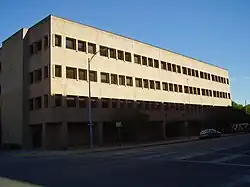
The Texas Facilities Commission is a Texas state agency.
TFC's main duty is to manage state government buildings (excluding those operated by universities, the Texas State Capitol, and the Governor's Mansion). TFC also handles the sale of surplus property and manages the Federal Surplus Program on behalf of the State and qualified local and non-profit agencies.[1]
The TFC was originally established in 1919 as the State Board of Control, which mandated consolidation of the State's purchasing, printing, and property management functions. The State Purchasing and General Services Commission replaced the State Board of Control in September 1979. The agency's name was changed again in 1991 to the General Services Commission. In 2001, the 77th Legislature replaced the General Services Commission (GSC) with the Building and Procurement Commission (TBPC), while transferring responsibilities for telecommunications services to the Department of Information Services.[2]
The final name change happened during the 80th Legislature when the TBPC was renamed the Facilities Commission and took over all responsibilities of the Building and Procurement Commission. At the time of the name change, additional responsibilities were assigned to the Facilities Commission, including control, maintenance, and repair of state properties; construction of a state building; purchase or lease of state properties; salvage and surplus property; and child care services for state employees. [3]
TFC has its headquarters in the Central Services Building in Austin.[4][5]
References
- ↑ "Federal Surplus Property". TFC. State of Texas. Retrieved 27 October 2014.
The Texas Facilities Commission manages the disposition of surplus property donated to the state by federal programs. The TFC's Federal Surplus Property Program certifies organizations as eligible under federal agency regulations to receive and use the property. Private citizens and the general public may not participate in this program. The program is not funded by the legislature, but is totally supported by the revenues generated from handling fees. This means that the cost of maintaining the staff and facilities are passed on to the program participants in the form of the handling fee. Handling fees will vary according to condition of the item and demand, but are usually significantly lower than the cost of comparable items on the open market. The difference in value is considered a "donation" from the federal government; hence, participants in the program are referred to as "donees."
- ↑ Texas. Legislature. Legislative Council. (October 2001). Summary of Enactments: 77th Legislature. Regular Session, 2001 (Report). Austin, Texas: Texas. Legislature. Legislative Council. p. 249. Retrieved July 1, 2026.
- ↑ Texas. Legislature. Legislative Council. Research Division. (December 2007). New, Renamed, and Abolished State Governmental Entities: 80th Legislature (Report). Austin, Texas: Texas. Legislature. Legislative Council. p. 56. Retrieved July 1, 2026.
- ↑ "Facilities List." Texas Facilities Commission. Retrieved on November 5, 2010. "CSB Central Services Building 1711 San Jacinto Austin." Archived August 20, 2010, at the Wayback Machine
- ↑ "Map and Directions to Agency." Texas Facilities Commission. Retrieved on November 5, 2010. Map image.
External links
| Executive | |
|---|---|
| Legislative | |
| Judicial |
|

