Tenshō Kōtai Jingūkyō
| Tenshō Kōtai Jingūkyō | |
|---|---|
| 天照皇大神宮教 | |
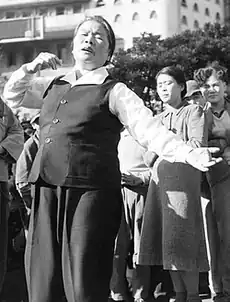 Sayo Kitamura, the religion's founder, preaching to a crowd in 1948 | |
| Scripture | Seisho (生書) (4 volumes) |
| Founder | Sayo Kitamura |
| Origin | 1945 Tabuse, Japan |
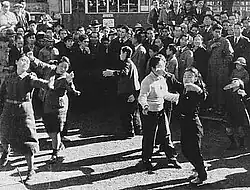


Tenshō Kōtai Jingūkyō (Japanese: 天照皇大神宮教) is a Japanese new religious movement. The movement began activities in 1945, and reportedly includes 450,000 members.[1] It was established by Sayo Kitamura (北村 サヨ) (1900–1967), who was possessed by the deity Tenshō Kōtaijin (天照皇大神) on May 4, 1944. She is referred to as Ogamisama (大神様) by the religion's followers.[2]
Its headquarters are in Tabuse (田布施町, Tabuse-chō), a town in Kumage District, Yamaguchi, Japan.[3]
History
Following the burning of her family barn by an arsonist in 1942, Kitamura was told by a healer to begin intense prayer and ascetic practices, taking cold baths and going to worship at a nearby shrine in the early morning, which continued for a few years.[4][5][6] In 1944, she became possessed by a spirit that later claimed to be Tenshō Kōtai Jingū. The deity gave her orders, and if she failed to obey, it caused her immense pain.[5] Later that year the deity claimed that it would use her to save the world.[5][7] Today, a tall concrete pillar marks the summit of Mount Ongaku (恩額山, Ongaku-zan) (33°57′10″N 132°00′48″E / 33.952640°N 132.013410°E),[8] the mountain where Kitamura received this divine revelation.
Kitamura started to speak more harshly and dressed in masculine clothes, claiming that it was more suitable for the way she now spoke.[5][4] She also became openly critical of other established religions and the Japanese government and even the emperor, predicting that the war would end badly for Japan. During the first few years after her possession, Kitamura held daily sermons at her own home, and her reputation began to spread in Tabuse.[9] After the war ended, she proved her predictions to be correct, and people began devoting themselves to her teachings.[4] Followers claimed to be cured of their illnesses from hearing her sermons and practising her teachings.[9]
Tenshō Kōtai Jingūkyō began garnering attention from the press in April 1946. When Kitamura was imprisoned and tried for refusing to comply with compulsory rice quotas in the area, a local newspaper began publishing articles about her trial. Throughout the course of her trial, Kitamura also drew the interest of the prosecutor, Watanabe Tomekichi, who visited her during her probation to listen to her sermons, and converted soon after the trial ended.[9] Watanabe later became an important figure for the religion.[6][9]
Tenshō Kōtai Jingūkyō registered under the Religious Corporations Ordinance on January 11, 1947.[9]
When Kitamura died in 1967, she was succeeded as head of Tenshō Kōtai Jingūkyō by her granddaughter Kiyokazu.[4]
Beliefs and practices
Kitamura, or Ogamisama, preached abandoning one's attachments to the "maggot world," especially to traditional, established religions, which she believed to be idol worship.[9] Kitamura and her followers claimed that she was a messiah equal to Jesus Christ and Buddha.[5][7]
Followers practice a dance called muga no mai (無我の舞, "Dance of the non-self" or "Dance of the non-ego"), which is why the religion is often referred to as the "dancing religion" (踊る宗教, Odoru shūkyō).[1] They also chant Na Myōhō Renge Kyō (名妙法連結経) (with the kanji differing that of the typical Buddhist version) as part of their daily practice.
The religion's scripture is the Seisho (生書), which is published in four volumes.[2] The religion's teachings are known as mioshie (御教え), while followers are referred to as dōshi (同志) (lit. 'comrades').[10]
Tenshō Kōtai Jingūkyō's international headquarters in Tabuse consists of a large concrete dōjō built in 1962. The third floor is the main worship hall consisting of 550 tatami mats, with one statue of Ogamisama and natural light coming in from the rooftop. There is are also dōjōs in Tokyo and Honolulu.[11] During dōjō sessions, Ogamisama's recordings are played. About 3,000 hours of recordings have been archived. At the headquarters, there is also a house where Ogamisama used to live, as well as a memorial hall that enshrines the spirit of Ogamisama. Dormitories are available for visitors.[12]
Tensho Kotai Jingukyo's Kigen (紀元) calendar year starts from 1946, when Sayo Kitamura proclaimed that God's new era would start. For example Kigen (紀元) year 1 would be 1946, and Kigen (紀元) year 22 would be 1967.[13]
Six basic emotions
In Tenshō Kōtai Jingūkyō, the "six basic emotions" to be controlled are:[14][15]: 23
- to begrudge (惜しい, oshii)
- to desire (欲しい, hoshii)
- hatred (憎い, nikui)
- fondness (かわい, kawai)
- to love inordinately (好いた, suita)
- wishing to be loved (好かれた, sukareta)
The first four basic emotions are identical to the first four "eight dusts" in Tenrikyo.
Prayer
The main prayer of the religion is as follows.[16]: 78 [15]: 21–2
| Japanese text | Japanese transliteration | English translation |
|---|---|---|
|
|
|
See also
- Anatta / Anātman (Japanese: muga)
References
- 1 2 "Glossary of Shinto Names and Terms: T". www2.kokugakuin.ac.jp (in Japanese). Retrieved 2018-10-16.
- 1 2 "Tenshō Kōtai Jingūkyō (Encyclopedia of Shinto)". 國學院大學デジタルミュージアム (in Japanese). Retrieved 2025-04-27.
- ↑ "天照皇大神宮教 本部道場". ロングライフビル推進協会 (in Japanese). Retrieved 2025-04-27.
- 1 2 3 4 Ambros, Barbara (2015). Women in Japanese religions. Women in religions. New York: New York university press. ISBN 978-1-4798-2762-6.
- 1 2 3 4 5 Blacker, Carmen (1992). The Catalpa bow: a study of shamanistic practices in Japan (Mandala ed. repr ed.). London: Mandala. ISBN 978-0-04-398008-8.
- 1 2 Kerner, Karen. 1979. “Building God’s Kingdom: Society and Order in a Japanese Utopian Community.” Dissertation.
- 1 2 May, L. Carlyle (1954). "The Dancing Religion: A Japanese Messianic Sect". Southwestern Journal of Anthropology. 10 (1): 119–137. ISSN 0038-4801.
- ↑ "生き証人". Newshirogarasuのブログ (in Japanese). 2014-06-16. Retrieved 2026-03-01.
- 1 2 3 4 5 6 Dorman, Benjamin (2012). Celebrity gods: new religions, media, and authority in occupied Japan. Nanzan library of Asian religion and culture. Honolulu: University of Hawaiʻi Press. ISBN 978-0-8248-3621-4.
- ↑ Dorman, Benjamin (2012). "Kitamura Sayo: Celebrity in the Maggot World". Celebrity Gods: New Religions, Media, and Authority in Occupied Japan. University of Hawai'i Press. ISBN 978-0-8248-3621-4. JSTOR j.ctt6wqd4v.10.
- ↑ Tensho-kotai-jingu-kyo (n.d.). Everspreading Kingdom of God (開けゆく神の国). Tabuse: Tensho-kotai-jingu-kyo.
- ↑ Yanabu, Leanne (2011-08-17). "Personal Photographs 2009: Tabuse, Japan". Olopua Consulting. Retrieved 2026-04-06.
- ↑ "天照皇大神宮教". 新・宗教図鑑 (in Japanese). 2020-01-19. Retrieved 2026-05-22.
- ↑ "北村サヨと天照皇大神宮教シリーズ03". 「洗脳」「マインド・コントロール」の虚構を暴く (in Japanese). 2019-04-10. Retrieved 2026-05-04.
- 1 2 Tensho Kotai Jingu-Kyo (c. 1960). Prescription for Happiness. Tabuse: Tensho Kotai Jingu-Kyo.
- ↑ Kitamura, Sayo (1963). Ogamisama says... (1st ed.). Tabuse: Tensho Kotai Jingu-Kyo.
Further reading
- Tensho Kotai Jingu-Kyo (1954). The Prophet of Tabuse. Tabuse: Tensho Kotai Jingu-Kyo.
- Kitamura, Sayo (1963). Ogamisama says... (1st ed.). Tabuse: Tensho Kotai Jingu-Kyo. (3rd edition published in 2001)
- Tensho Kotai Jingu-Kyo (c. 1960). Prescription for Happiness. Tabuse: Tensho Kotai Jingu-Kyo.
- Tina Hamrin: Dansreligionen i japansk immigrantmiljö på Hawai'i. Via helbrägdagörare och Jodu shinshu-präster till nationalistisk millennarism. (English summary: The Dancing Religion in a Japanese-Hawaiian Immigrant Environment). Stockholm: Almqvist & Wiksell International, 1996. (Acta Universitatis Stockholmiensis. Stockholm Studies in Comparative Religion) - Review
- NISHIYAMA Shigeru & FUJII Takeshi: The Propagation and Spread of Tenshô Kôtai Jingûkyô within Japanese-American Society on Hawaii Island at the Wayback Machine (archived 2014-04-21). 1991, 1997 Institute for Japanese Culture and Classics, Kokugakuin University.
- Clark B. Offner: The Work of the Holy Spirit in the Japanese Cultural Setting (PDF; 2,3 MB), S. 57ff.
- May, L. Carlyle (1954). "The Dancing Religion: A Japanese Messianic Sect". Southwestern Journal of Anthropology. 10 (1). University of New Mexico: 119–137. doi:10.1086/soutjanth.10.1.3629079. ISSN 0038-4801. JSTOR 3629079.
- Kitamura, Sayo (1961). "Tensho Kotai Jingu-Kyo (1): The Dancing Religion". Contemporary Religions in Japan. 2 (3). Nanzan University: 26–42. ISSN 0010-7557. JSTOR 30233862.
- "Tensho Kotai Jingu-Kyo (2): The Testimony of Believers". Contemporary Religions in Japan. 2 (3). Nanzan University: 43–47. 1961. ISSN 0010-7557. JSTOR 30233863.
- Dorman, Benjamin (2012). "Kitamura Sayo: Celebrity in the Maggot World". Celebrity Gods: New Religions, Media, and Authority in Occupied Japan. University of Hawai'i Press. ISBN 978-0-8248-3621-4. JSTOR j.ctt6wqd4v.10.
External links
