Supreme Council of Louisiana
The Supreme Council of Louisiana is a Scottish Rite branch of Freemasonry founded in 1839. The Supreme Council of Louisiana has chartered lodges in 11 US states.[1]
History
Beginnings
The Supreme Council of Louisiana was founded in New Orleans in 1839 in the aftermath of the Morgan Affair.[2][3][4] During this time, the Northern Masonic Jurisdiction consisted of John James Joseph Gourgas and Giles Fonda Yates who were "effectively a Supreme Council of two people" and were completely inactive from 1832 to 1843.[5][6] Likewise, the Grand Commander of the Southern Jurisdiction, Moses Holbrook longed to "relinquish his responsibilities as Sovereign Grand Commander" moving to the rural frontier of Florida to serve as a doctor.[7]
It was during this period that the Supreme Council of Louisiana emerged, which claimed its authority via "Cerneauism" – a type of Scottish Rite Masonry without ties to the either the Northern or Southern Jurisdictions.[8][9][10][11]
Concordant of 1855
Foulhouze resigned “both as Grand Commander and member of this Supreme Council” on July 30, 1853.[12] In 1855, a concordat was sent to Charleston on January 31, 1855, and signed on February 6, 1855, by Grand Commander John H. Honour, Lieutenant Grand Commander Charles M. Furman, and Grand Secretary General Albert G. Mackey. It was then taken back to New Orleans, likely by Mackey, and signed there on February 17, 1855, by Grand Commander Charles Claiborne, as well as Samory and Laffon de Ladébat.[13][14] On the same day the Supreme Council at Charleston issued a warrant to “our well-beloved, Princes and Knights” Claiborne, Samory, Laffon de Ladébat, John H. Holland, and others, creating a Grand Consistory of Louisiana, and installing them as officers with all the powers relative thereto.[15]
Continued existence
However, on October 7, 1856, a year after the Supreme Council of Louisiana had formed its concordat with Charleston, Foulhouze, Thomas Wharton Collens, and J.J.E. Massicott, who all resigned in 1853, “declared the Supreme Council to be still in existence and continued its works.”[16][2]
Foulhouze would be expelled by the Grand Orient of France in 1859, then under the leadership of Lucien, 3rd Prince Murat.[17] Murat had been appointed the head of Freemasonry by his cousin Napoleon III, who had seized power by force in 1851. Foulhouze and the Supreme Council of Louisiana, in turn, rejected the leadership of Murat.[18]
In 1867, the Supreme Council of the Louisiana was the first predominantly white Masonic organization to allow ex-slaves and people of color to become members.[19][20][21] In response to the decision, Giuseppe Garibaldi, also a Freemason, complimented the Supreme Council on their decision for racial integration.[22]
In 1868, the Grand Orient of France, under the leadership of Émile Mellinet, re-recognized the Supreme Council of Louisiana.[23] In response, in 1870, the Northern Masonic Jurisdiction and Southern Jurisdiction suspended relations with the Grand Orient of France.[23]
20th century
In 1883, Albert Pike wrote a treatise decrying the actions of Foulhouze with respect to the Supreme Council of Louisiana specifically and Cerneauism more generally.[4]
During the 19th and 20th century, the council had fraternal relations with Masonic organizations in Mexico, Italy, Haiti, Egypt, Belgium, Cuba, Scotland, and France.[24]
In 1907, Homer Plessy earlier the plaintiff in the United States Supreme Court case Plessy v. Ferguson served as secretary of the organization.[25]
Under the leadership of George Longe from 1938 to 1985, the Supreme Council of Louisiana tripled in size and expanded to other states, including Maryland and New York.[26] His papers related to the history of the organization and its work during this period are held at the Amistad Research Center of Tulane University.[26]

During the 1940s, its headquarters was located at 315 South Rampart Street in New Orleans, Louisiana.[27]
Since 1973, its headquarters has been located at 3200 Saint Bernard Avenue.[28][29]
21st century
In 2005, its headquarters was damaged by Hurricane Katrina and it was abandoned. It was subsequently torn down in 2014.[30] Challenges with the city's zoning regulations delayed construction of a new headquarters until 2022.[30]
In recent years, Masonic scholars Alain Blenheim and S. Brent Morris, along with Arthuro de Hoyos and Michael Poll have conducted research into the history of the organization.[31]
Leadership
The list of Sovereign Grand Commanders, who have led the organization, are as follows:[32][33]
| Number | SGC | Years in office | Number | SGC | Years in office |
|---|---|---|---|---|---|
| 1 | Orazio de Attellis | 1839–1842[33][18] | 12 | Arthur J. Guiranovich | 1889–1891; 1894–1915 |
| 2 | Jean Jacques Conte | 1842–1845 | 13 | Joseph N. Cheri | 1891–1893 |
| 3 | Jean François Canonge | 1845–1848[34] | 14 | Rene Achille Chiapella[35] | 1893; 1893–1894 |
| 4 | James Foulhouze[36] | 1848–1854; 1857–1867 | 15 | O.A. Giovanni | 1893 |
| 5 | Charles Clairborne | 1854–1856 | 16 | George Ulysses Maury | 1915–1923; 1925–1926[37][38] |
| 6 | Jean Jacques Edouard Massicot[39] | 1856–1857 | 17 | Rene C. Metoyer | 1923–1925; 1926–1937 |
| 7 | Eugene Chassaignac | 1867–1872[40] | 18 | Charles W. Vance | 1937–1938 |
| 8 | Edouard Marc | 1872–1875 | 19 | George Longe | 1938–1985[26][41][42] |
| 9 | Armand Bertel | 1875–1876; 1877–1887 | 20 | Joseph Williams | 1987–1993 |
| 10 | Jean Gentil | 1876–1877 | 21 | Philip Washington, Sr. | 1993–2017[43] |
| 11 | M.J. Piron | 1887–1889 | 22 | Eddie L. Gabriel, Sr. | 2017–present |
Gallery
 Orazio de Attellis, Founder and Sovereign Grand Commander, 1839–1842
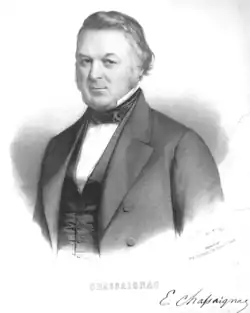 Eugène Chassaignac, Sovereign Grand Commander, 1867–1872
 George Ulysses Maury, Sovereign Grand Commander, 1915–1923
See also
References
- ↑ "Gallery". scol. Retrieved 2023-10-23.
- 1 2 Folger, The Ancient and Accepted Scottish Rite, 2d ed., p 322.
- ↑ "Home". scol. Retrieved 2023-10-08.
- 1 2 Pike, Albert (1884). Foulhouzeism and Cerneauism scourged : dissection of a manifesto (PDF). J.J. Little and Company. p. 49.
{{cite book}}: CS1 maint: date and year (link) - ↑ "Digital Collections Highlight: Killian H. Van Rensselaer's 1845 Petition". Scottish Rite Masonic Museum & Library Blog. Retrieved 2023-08-08.
- ↑ "Proceedings ... 1781-1862". HathiTrust. hdl:2027/mdp.39015070515542. Retrieved 2023-11-10.
- ↑ "Scottish Rite Masonic Museum & Library Blog". Scottish Rite Masonic Museum & Library Blog. Retrieved 2023-08-08.
- ↑ "Cerneauism and American Freemasonry". www.scottishritestore.org. Archived from the original on 2022-12-29. Retrieved 2022-12-29.
- ↑ "What is Cerneauism?". Scottish Rite of Freemasonry, S.J., U.S.A. Retrieved 2023-10-08.
- ↑ A recent work on this topic is by Arturo de Hoyos and S. Brent Morris, Cerneaiusm and American Masonry (Washington, D.C.: Scottish Rite Research Society, 2019)
- ↑ "Home". scol. Retrieved 2023-10-08.
- ↑ Folger, Robert B. (1881). The ancient and accepted Scottish rite, in thirty-three degrees. The Library of Congress. New York : The author. p. 312.
{{cite book}}: CS1 maint: publisher location (link) - ↑ Folger, Robert B. (1881). Ancient and Accepted Scottish Rite in Thirty-Three Degrees. New York: By the Author. pp. 318–319.
{{cite book}}: CS1 maint: date and year (link) - ↑ See photograph of the original Concordat in Carter and Harris, History of the Supreme Council, 33° [. . .] 1801–1861 (1964), pp. 353–56
- ↑ See photograph of the original Concordat in Carter and Harris, History of the Supreme Council, 33° [. . .] 1801–1861 (1964), p. 359
- ↑ Folger, Robert B. (1881). The Ancient and Accepted Scottish Rite in Thirty-Three Degrees: A Full and Complete History. New York: By the Author. pp. 312–313.
- ↑ On February 4, 1859 Foulhouze’s name was "erased from its [i.e., the Grand Orient’s] book of gold," and his patent was declared “void and of no effect.” See “Action Taken by the Grand Orient of France and the Supreme Council of France in the Matter of the Foulhouze Supreme Council, 1858–9," in Official Bulletin of the Supreme Council of the 33d Degree, for the Southern Jurisdiction of the United States, Vol. VIII ([Washington, DC]: Grand Orient of Charleston, September, 1887), No. 1, pp. 553–73. In particular, see the "Extrait du Ballustre des trav. 4 Février, 1859, (E.V.)" which document is reprinted and translated.
- 1 2 Cossé Bell, Caryn (1997). Revolution, Romanticism, and the Afro-Creole Protest Tradition in Louisiana, 1718–1868. Baton Rouge and London: Louisiana State University Press. pp. 159, 182. ISBN 9780807141526.
- ↑ Wright, Dudley. Gould's History of Freemasonry Throughout the World: Volume 3 (PDF).
- ↑ DeCuir, Sharlene (2009-01-01). "Attacking Jim Crow: black activism in New Orleans 1925-1941". LSU Doctoral Dissertations: 28. doi:10.31390/gradschool_dissertations.1869.
- ↑ Barthé, Darryl. "Becoming American in Creole New Orleans, 1896–1949". LSU Press. Retrieved 2026-05-29.
- ↑ "Colored Masons--Letter from Garibaldt". The New York Times. ISSN 0362-4331. Retrieved 2026-05-29.
- 1 2 Poll, Michael (2020). James Foulhouze: S.G.C. of the Supreme Council of Louisiana. Scottish Rite Research Society. p. 216.
- ↑ "Supreme Council of the Ancient and Accepted Scottish Rite of Freemasonry of Louisiana (AASRFML), 1858-1971, undated | ArchivesSpace Public Interface". amistad-finding-aids.tulane.edu. Retrieved 2026-06-01.
- ↑ "Collection: George Longe papers | ArchivesSpace Public Interface". amistad-finding-aids.tulane.edu. Retrieved 2026-05-28.
- 1 2 3 "George Longe papers, 1849–1971 | Amistad Research Center". amistadresearchcenter.tulane.edu. Archived from the original on 2022-12-29. Retrieved 2022-12-29.
- ↑ CreoleGen (2012-09-17). "Masonic Ceremony". CreoleGen. Retrieved 2026-05-29.
- ↑ Messenger, Gentilly (2022-08-02). "Masonic Temple planned for St. Bernard Avenue". Gentilly Messenger. Retrieved 2025-07-09.
- ↑ "3200 St. Bernard Avenue". The New Orleans Blight Blog. Retrieved 2025-07-09.
- 1 2 Messenger, Gentilly (2022-08-02). "Masonic Temple planned for St. Bernard Avenue". Gentilly Messenger. Retrieved 2025-07-09.
- ↑ "Outline of the Rise and Progress of Freemasonry in Louisiana". Cornerstone Book Publishers. Retrieved 2026-05-29.
- ↑ Ballard, E.C. (3 July 2015). "Michael Poll and The Supreme Council of Louisiana". The Hedge Mason. Retrieved 3 February 2021.
- 1 2 Poll, Michael (2020). The Scottish Rite Papers. New Orleans, Louisiana: Cornerstone Book Publishers. p. 222.
- ↑ "The Louisiana Freemason • Fall 2022". Issuu. 2022-10-06. p. 5. Retrieved 2026-05-28.
- ↑ "FamilySearch.org". ancestors.familysearch.org. Retrieved 2026-06-08.
- ↑ "Heredom | Albert Pike's Address". www.freemasons-freemasonry.com. Archived from the original on 2011-02-27. Retrieved 2026-06-08.
- ↑ "Portrait of George Ulysses Maury in Scottish Rite Masonic Garb". xula.contentdm.oclc.org. Retrieved 2026-05-28.
- ↑ creolegen@yahoo.com (2025-03-31). "A Glamorous Life: Juanita Fidélise Maury Logan (1900-1947)". CreoleGen. Retrieved 2026-05-29.
- ↑ "Jean Jacques Edouard "Edward" Massicot b. Feb 1814 New York, USA d. 14 Jun 1884 New Orleans, Orleans County, Louisiana, USA: Boyums of America". www.boyum.info. Retrieved 2026-06-08.
- ↑ "The Joseph A. Walkes Site". thephylaxis.org. Retrieved 2026-05-29.
- ↑ "National Archives" (PDF).
- ↑ creolegen@yahoo.com (2018-07-03). ""Barefoot, Cravat, & Cane": Paul Dominguez, Edward LaMothe, and 'Naval Intelligence' in Haiti". CreoleGen. Retrieved 2026-05-29.
- ↑ "Philip Washington Obituary (2017) - New Orleans, LA - The Times-Picayune". Legacy.com. Retrieved 2026-06-08.


