Styx (album)
| Styx | ||||
|---|---|---|---|---|
 | ||||
| Studio album by | ||||
| Released | August 31, 1972[1] | |||
| Recorded | 1972 | |||
| Studios | Paragon, Chicago | |||
| Genres | ||||
| Length | 32:36 | |||
| Label | Wooden Nickel | |||
| Producers | John Ryan, Bill Traut | |||
| Styx chronology | ||||
| ||||
| Singles from Styx | ||||
| ||||
| Review scores | |
|---|---|
| Source | Rating |
| AllMusic |   [3] |
| The Rolling Stone Album Guide | [4] |
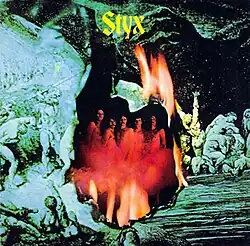
Styx is the debut studio album by the American rock band Styx. It was released in 1972.
Background
The band started as a cover band that played weddings and birthday parties. They called themselves The Tradewinds in 1961, when the band was composed of 12-year-old fraternal twins Chuck and John Panozzo, who played bass guitar and drums, respectively, and their neighbor, 14-year-old Dennis DeYoung on keyboards, accordion, and vocals. They later named themselves TW4, after adding their college friend John Curulewski in 1968, and the South Side hard rocker James "J.Y." Young in 1970, as guitarists, songwriters, and singers.
Their debut album showcases them as a progressive-art rock/'60s garage rock act. The album's centerpiece is the 13-minute opus "Movement for the Common Man," a four-part suite. It opens with "Children of the Land," a J.Y.-led rocker featuring a potent percussion solo by John Panozzo, which flows seamlessly into "Street Collage"— a section built from ambient urban soundscapes of Chicago. From there, the band delivers a symphonic rock interpretation of Aaron Copland's composition "Fanfare for the Common Man," before concluding with "Mother Nature's Matinee," a prog-folk track co-written by James Young and Dennis DeYoung. The upbeat pop rocker "Best Thing" also co-written by Young and DeYoung, was released as a single in late '72, and peaked at No. 82 on the Billboard Hot 100 charts for that year.
The remaining songs on the album were cover versions that the record label suggested. The band members, including DeYoung, said that they had never heard of them before, but their version of George S. Clinton's "After You Leave Me" is described as a "suitably open-throttled ending to Styx' commendable introductory affair".[5]
The album was reissued in 1979 under the title Styx I with new artwork. In late 2012, it was re-released for CD and digital download, along with Styx II (1973), The Serpent Is Rising (1973), and Man of Miracles (1974).
Track listing
| No. | Title | Writer(s) | Lead vocals/Lead guitar | Length |
|---|---|---|---|---|
| 1. | "Movement for the Common Man"
| 13:11 | ||
| 2. | "Right Away" | Paul Frank | Young | 3:40 |
| No. | Title | Writer(s) | Lead vocals/Lead guitar | Length |
|---|---|---|---|---|
| 3. | "What Has Come Between Us" | Mark Gaddis | DeYoung | 4:53 |
| 4. | "Best Thing" | Young, DeYoung | DeYoung, Young | 3:13 |
| 5. | "Quick Is the Beat of My Heart" | Lewis Mark | Young | 3:49 |
| 6. | "After You Leave Me" | George S. Clinton | Young | 4:00 |
Personnel
Styx
- Dennis DeYoung – vocals, keyboards
- James "J.Y." Young – vocals, electric guitars
- John Curulewski – vocals, electric and acoustic guitars
- Chuck Panozzo – bass guitar
- John Panozzo – drums, percussion
Production
Charts
Singles - Billboard (United States)
| Year | Single | Chart | Position |
|---|---|---|---|
| 1972 | "Best Thing" | Pop Singles | 82 |
References
- ↑ Music - StyxWorld
- ↑ "Styx singles".
- ↑ Planer, Lindsay. Styx: Styx at AllMusic. Retrieved April 29, 2020.
- ↑ Brackett, Nathan; Christian Hoard (2004). The Rolling Stone Album Guide. New York City, New York: Simon and Schuster. p. 789. ISBN 0-7432-0169-8.
rolling stone styx album guide.
- ↑ Styx - Styx (1972) album review by Lindsay Planer, credits & releases at AllMusic.com
External links
- Styx - Styx (1972) album review by Lindsay Planer, credits & releases at AllMusic.com
- Styx - Styx (1972) album releases & credits at Discogs.com
- Styx - Styx (1972) album credits & user reviews at ProgArchives.com
- Styx - Styx (1972) album to be listened as stream at Spotify.com
| Studio albums | |
|---|---|
| Extended plays | |
| Live albums | |
| Compilations | |
| Songs |
|
| Related articles | |
